
Explain in detail ergonomic evaluation in cbr explain about rula and reba
RULA REBA ergonomic assessment CBR community based rehabilitation detail
https://www.xsens.com/resources/blog/occupational-health-and…
RULA rapid upper limb assessment worksheet scoring diagram
Ergonomic Evaluation in CBR (Community-Based Rehabilitation)
What is Ergonomic Evaluation in CBR?
- Identify harmful postures, repetitive movements, forceful exertions, and awkward positions during daily tasks or occupational activities
- Guide adaptive equipment prescription and workstation modification
- Enable persons with disabilities to participate safely in vocational activities
- Prevent secondary musculoskeletal complications in people who are already physically compromised
- Assess caregivers, community health workers, and rehabilitation workers who are at risk from patient handling and repetitive tasks
Purpose of Ergonomic Evaluation in CBR
- Vocational rehabilitation - Assessing individuals returning to or entering employment, identifying job demands vs. their functional capacities
- Home and workplace modification - Using assessment data to redesign workstations, tools, and environments
- Caregiver safety - Evaluating postures of caregivers who assist disabled individuals
- Prevention of secondary disability - Identifying ergonomic risks in persons already managing a primary condition
- Advocacy and policy - Generating data to support workplace accommodations
Common Ergonomic Assessment Methods Used in CBR
- RULA - Rapid Upper Limb Assessment
- REBA - Rapid Entire Body Assessment
- OWAS - Ovako Working Posture Analysis System
- NIOSH Lifting Equation - for manual material handling
- Ergonomic checklists - site-specific screening tools
RULA - Rapid Upper Limb Assessment
Background and Development
- Repetitive movements of the upper limbs
- Static or awkward postures of the neck and trunk
- Force and load handling with the arms and hands
Body Segments Assessed
Group A - Upper Limbs
- Upper arm - Angle of flexion/extension, abduction, elevation of shoulder
- Lower arm (forearm) - Angle of flexion, crossing midline
- Wrist - Flexion/extension, radial/ulnar deviation
- Wrist twist - pronation/supination
Group B - Neck, Trunk, Legs
- Neck - Flexion, extension, lateral bend, rotation
- Trunk - Erect vs. flexed, twisted, laterally bent
- Legs - Supported/unsupported, walking
RULA Scoring Procedure
- Each body segment in Group A is scored based on joint angle ranges
- Scores are modified by muscle use (+1 if posture is static >1 min or repeated >4x/min) and force/load (+1 for 2-10 kg intermittent; +2 for 2-10 kg static/repeated; +3 for >10 kg)
- Scores are entered into Table A to generate Score A
- Similarly scored for angle ranges and modified for muscle use and force
- Scores entered into Table B to generate Score B
- Score A and Score B are cross-referenced in Table C to generate the Grand Score (1-7)
RULA Action Levels
| Grand Score | Action Level | Interpretation |
|---|---|---|
| 1-2 | Level 1 | Acceptable posture - no intervention required |
| 3-4 | Level 2 | Low risk - further investigation warranted; changes may be needed |
| 5-6 | Level 3 | High risk - investigate and implement changes soon |
| 7 | Level 4 | Very high risk - immediate investigation and change required |
RULA Scoring Details for Body Segments
Upper Arm
- Score 1: 20° flexion to 20° extension (near neutral)
- Score 2: >20° extension or 20-45° flexion
- Score 3: 45-90° flexion
- Score 4: >90° flexion
- Modifiers: +1 if shoulder raised, +1 if arm abducted, -1 if arm supported/gravity-assisted
Lower Arm (Forearm)
- Score 1: 60-100° flexion (mid-range)
- Score 2: <60° or >100° flexion
- Modifier: +1 if crossing midline or working out to side
Wrist
- Score 1: Neutral position
- Score 2: 0-15° flexion/extension
- Score 3: >15° flexion/extension
- Modifier: +1 if deviated radially or ulnarly
Neck
- Score 1: 0-10° flexion
- Score 2: 10-20° flexion
- Score 3: >20° flexion
- Score 4: Extension
- Modifiers: +1 for rotation or lateral bending
Trunk
- Score 1: Erect/sitting upright
- Score 2: 0-20° flexion
- Score 3: 20-60° flexion
- Score 4: >60° flexion
- Modifiers: +1 for rotation or lateral bending
REBA - Rapid Entire Body Assessment
Background and Development
Key Differences from RULA
| Feature | RULA | REBA |
|---|---|---|
| Body coverage | Upper body focus | Whole body |
| Leg assessment | Minimal | Detailed |
| Dynamic postures | Limited | Included |
| Coupling (grip quality) | Not included | Included |
| Score range | 1-7 | 1-15 |
| Primary application | Repetitive upper limb tasks | Whole-body tasks, patient handling |
| Origin | 1993 | 2000 |
Body Segments Assessed in REBA
Group A - Trunk, Neck, Legs
- Trunk - Flexion/extension, lateral bending, rotation
- Neck - Flexion/extension, lateral bending, rotation
- Legs - Bilateral support, unilateral, walking; knee angle
Group B - Upper Arm, Lower Arm, Wrist
- Upper arm - Flexion/extension, abduction, shoulder raised
- Lower arm - Flexion angle
- Wrist - Flexion/extension, deviation/twist
REBA Scoring Procedure
- Trunk, neck, and leg scores combined in Table A → Score A
- Add Load/Force score: +0 (< 5 kg), +1 (5-10 kg), +2 (>10 kg), +1 extra for shock or rapid build-up of force
- Gives Score A (modified)
- Upper arm, lower arm, wrist scores combined in Table B → Score B
- Add Coupling score (quality of grip): 0 (good grip), +1 (fair), +2 (poor), +3 (unacceptable)
- Gives Score B (modified)
- Score A (modified) and Score B (modified) cross-referenced in Table C → Score C
- Add Activity score (+1 for static posture >1 min; +1 for repeated small range actions >4x/min; +1 for rapid large range changes)
- Final REBA Score = Score C + Activity score
REBA Action Levels
| REBA Score | Risk Level | Action Required |
|---|---|---|
| 1 | Negligible | None necessary |
| 2-3 | Low | Change may be needed |
| 4-7 | Medium | Further investigation; change soon |
| 8-10 | High | Investigate and implement change |
| 11-15 | Very High | Implement change immediately |
REBA Scoring Details for Body Segments
Trunk
- Score 1: Erect (0°)
- Score 2: 0-20° flexion or extension
- Score 3: 20-60° flexion or >20° extension
- Score 4: >60° flexion
- Modifiers: +1 for rotation or lateral bending
Neck
- Score 1: 0-20° flexion
- Score 2: >20° flexion or extension
- Modifier: +1 for rotation or lateral bending
Legs
- Score 1: Bilateral weight, walking, or seated
- Score 2: Unilateral, unsupported, or in an unstable posture
- Modifier: +1 for 30-60° knee flexion; +2 for >60° knee flexion
Upper Arm
- Score 1: 20° extension to 20° flexion
- Score 2: 20-45° or >20° extension
- Score 3: 45-90° flexion
- Score 4: >90° flexion
- Modifiers: +1 for shoulder raised or arm abducted; -1 if leaning/supported/gravity assists
Lower Arm
- Score 1: 60-100° flexion
- Score 2: <60° or >100° flexion
Wrist
- Score 1: 0-15° flexion/extension
- Score 2: >15° flexion/extension
- Modifier: +1 for deviation/twist
Application of RULA and REBA in CBR Settings
Who is Being Assessed?
- Persons with disabilities in vocational settings - Assessing postures during supported employment (e.g., weaving, tailoring, assembly work, farming tasks)
- Caregivers - Evaluating postures during patient transfers, bathing, positioning activities
- Community rehabilitation workers (CRWs) - Screening home-visiting workers for ergonomic risk during assistive device fitting, training, and community activities
- Self-care tasks - Evaluating postures adopted by persons with physical disabilities during activities of daily living
Practical Steps in CBR Ergonomic Evaluation
- Observation and task analysis - Observe the individual performing the task; identify the most common or extreme postures
- Posture recording - Photograph or video-record the task at its most demanding posture; identify the "worst case" posture for assessment
- Select the appropriate tool - Use RULA for upper limb-dominant or seated tasks; use REBA for tasks involving the whole body, patient handling, or dynamic activity
- Score each body segment - Using the worksheets or apps
- Calculate the total score - Follow the scoring tables
- Interpret the action level - Determine urgency of intervention
- Implement and reassess - Modify equipment, posture, or task design; re-evaluate after changes
Specific CBR Applications
RULA is preferred for:
- Office and computer work with disability adaptations
- Upper limb prosthetics/orthotics use assessment
- Wheelchair propulsion analysis (upper limb loads)
- Repetitive assembly or craft tasks in supported employment
- Sitting posture assessment during CBR training sessions
REBA is preferred for:
- Manual handling and patient lifting/transfer tasks
- Agricultural tasks (bending, lifting, squatting) in rural CBR programs
- Construction and labor-intensive vocational activities
- Tasks involving unpredictable or variable postures
- Assessment of persons with mobility impairments working in community settings
Comparison: RULA vs. REBA Summary
| Parameter | RULA | REBA |
|---|---|---|
| Developer | McAtamney & Corlett, 1993 | Hignett & McAtamney, 2000 |
| Focus | Upper limbs, neck, trunk | Entire body |
| Score Range | 1-7 | 1-15 |
| Coupling | No | Yes |
| Leg Assessment | Basic | Detailed |
| Load scoring | Yes | Yes (more detailed) |
| Activity score | No | Yes |
| Best for CBR | Upper limb/sedentary tasks | Whole body/dynamic tasks |
| Reliability | Moderate-good (ICC 0.50-0.86) | Moderate (ICC ~0.50-0.77) |
| Validated in | Manufacturing, office, education | Healthcare, service industries |
Limitations of RULA and REBA in CBR
- Both tools capture a snapshot posture and may miss posture variability across a task
- They rely on observer judgment - inter-rater reliability is moderate
- Neither captures cumulative exposure over time or across multiple tasks
- REBA and RULA do not account for individual capacities - especially relevant for persons with disabilities in CBR
- Both tools require training to apply reliably
- In low-resource CBR settings, access to trained ergonomists may be limited
Summary
Can u give like mind map for this stepwise evaluation
A detailed, colorful mind map diagram for ergonomic evaluation in CBR (Community-Based Rehabilitation) showing stepwise evaluation process with RULA and REBA. Central node: "Ergonomic Evaluation in CBR" in bold dark blue. Branch 1 (green): "Step 1: Task Observation & Selection" with sub-nodes: Identify the task, Record posture (photo/video), Select worst-case posture, Analyze task demands Branch 2 (orange): "Step 2: Choose Assessment Tool" with sub-nodes: RULA (upper limb tasks, repetitive, sedentary) and REBA (whole body, dynamic, patient handling) Branch 3 (blue): "Step 3: RULA Scoring" with two sub-branches: - Group A: Upper arm → Forearm → Wrist → Wrist twist → Table A → Score A → Add muscle use & force - Group B: Neck → Trunk → Legs → Table B → Score B → Add muscle use & force - Table C: Score A + Score B = Grand Score (1-7) - Action Levels: 1-2 (No action), 3-4 (Investigate), 5-6 (Change soon), 7 (Immediate) Branch 4 (red): "Step 4: REBA Scoring" with two sub-branches: - Group A: Trunk → Neck → Legs → Table A → + Load/Force score = Score A - Group B: Upper arm → Lower arm → Wrist → Table B → + Coupling score = Score B - Table C: Score A + Score B + Activity score = REBA Score (1-15) - Action Levels: 1 (Negligible), 2-3 (Low), 4-7 (Medium), 8-10 (High), 11-15 (Very High/Immediate) Branch 5 (purple): "Step 5: Interpret & Intervene" with sub-nodes: Workstation modification, Adaptive equipment, Posture training, Task redesign, Re-evaluate after changes Clean white background, professional medical education style, clear readable font, well-spaced nodes with connecting lines
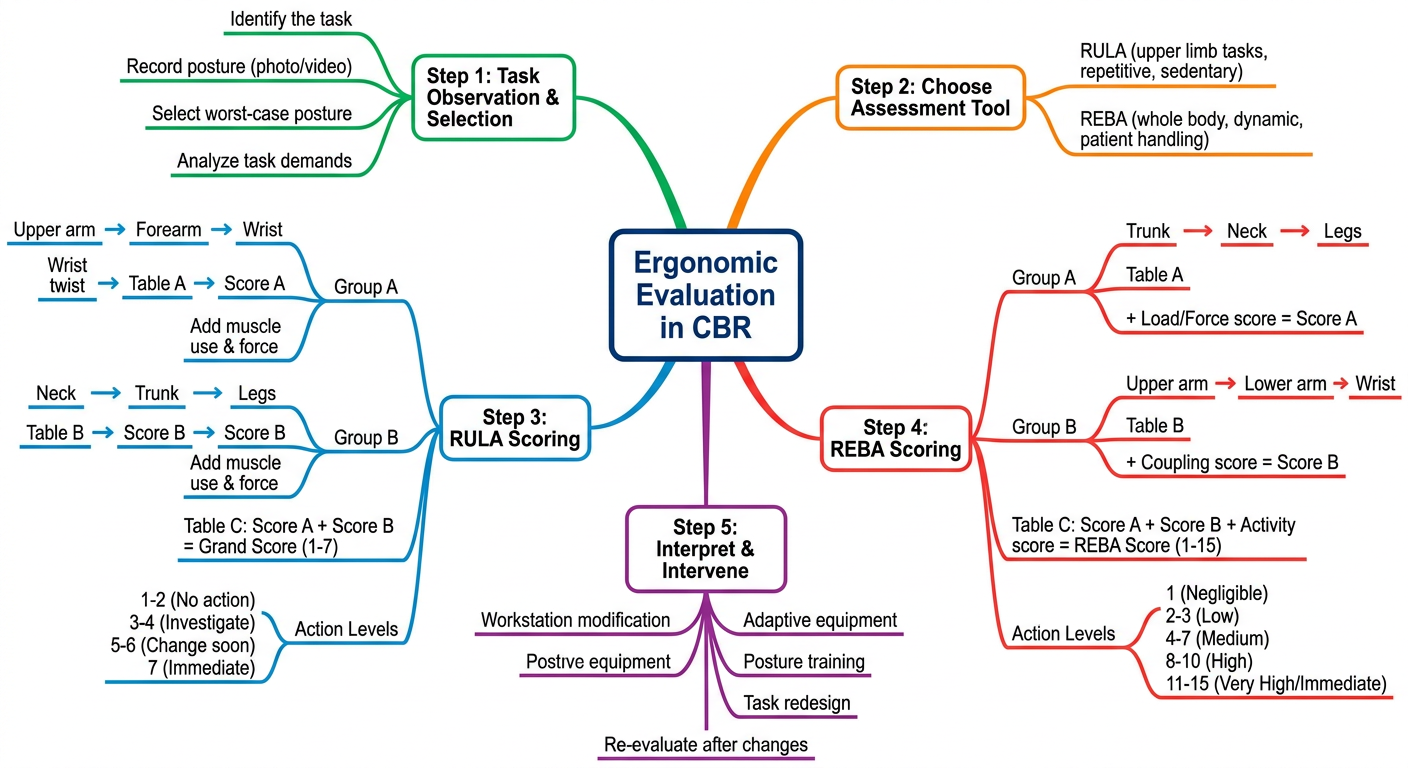
- Pick RULA if the task is upper limb dominant, repetitive, or sedentary (e.g., wheelchair propulsion, craft work, computer use)
- Pick REBA if the task involves the whole body, dynamic movements, or patient handling (e.g., transfers, lifting, farming)
- Score Group A (Upper arm → Forearm → Wrist) → Table A → add muscle use & force modifier → Score A
- Score Group B (Neck → Trunk → Legs) → Table B → add muscle use & force modifier → Score B
- Cross-reference in Table C → Grand Score (1-7) → assign Action Level
- Score Group A (Trunk → Neck → Legs) → Table A → add Load/Force score → Score A
- Score Group B (Upper arm → Forearm → Wrist) → Table B → add Coupling score → Score B
- Cross-reference in Table C → add Activity score → REBA Score (1-15) → assign Action Level