
Essay on post burn contracture and recent advances
"burn contracture" AND reconstruction
PMID: 38250207
PMID: 39423713
PMID: 40817644
"burn scar" AND ("tissue expander" OR "dermal substitute" OR "laser" OR "fat grafting")
post burn contracture neck scar release reconstruction
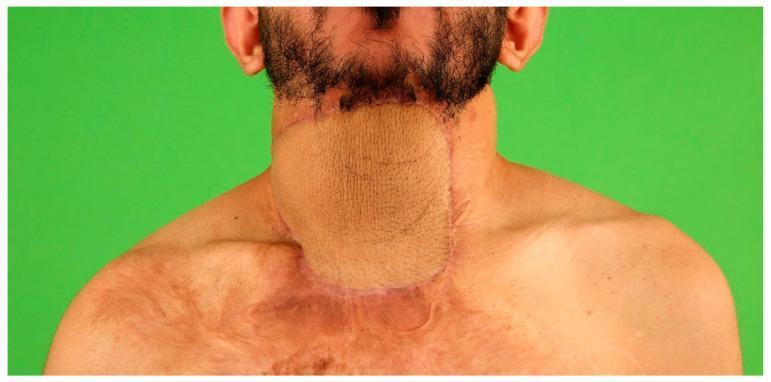
This clinical photograph shows a front-view of a patient's neck and upper torso one year after a secondary burn scar reconstruction. Centered on the anterior neck is a large, well-integrated pre-expanded Anterolateral Thigh (ALT) free flap used to release a sternomental contracture. The flap displays a uniform, slightly meshed texture and is paler than the surrounding skin, with clearly defined surgical margins and healed suture lines at its perimeter. Below and adjacent to the flap, the upper chest and right shoulder area exhibit significant post-burn sequelae, characterized by extensive mottled scarring, hypertrophic changes, and irregular patches of hyperpigmentation and hypopigmentation. The image illustrates the successful surgical management of complex burn-related neck contractures through microsurgical flap transfer, demonstrating improved range of motion and aesthetic outcome in reconstructive plastic surgery.
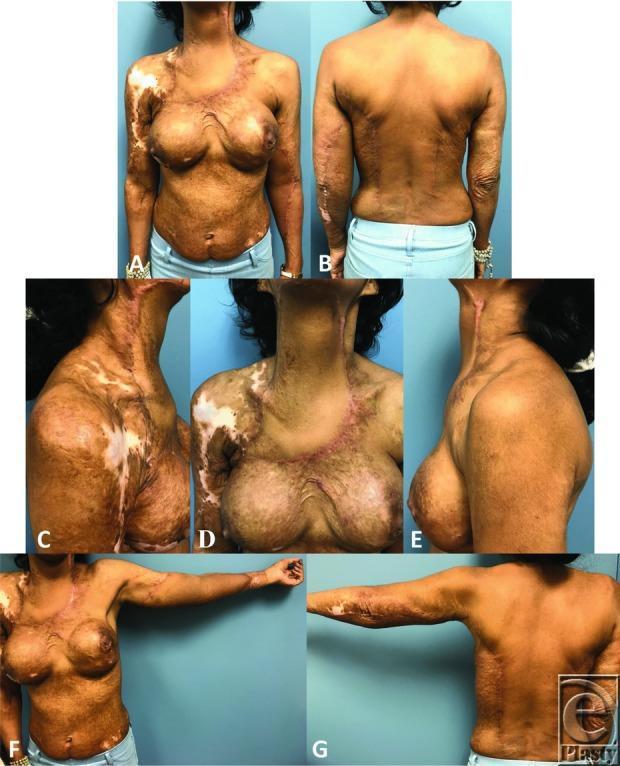
A series of clinical photographs (labeled a–g) documenting a 41-year-old female patient following surgical reconstruction for extensive burn scar contractures. The images show multiple views (anterior, posterior, and lateral) of the neck, chest, upper extremities, and back. Primary visual findings include extensive mottle-patterned burn scars with mixed hyperpigmentation and hypopigmentation, particularly on the right shoulder and chest. Postoperative evidence of latissimus dorsi (LD) flap reconstruction is visible, including surgical incisions and integrated flap tissue on the neck and left upper extremity. Linear surgical scars on the back (posterior view) indicate the donor site where the LD flaps were harvested. The neck views (c, d, e) demonstrate improved range of motion in extension post-reconstruction. The abdomen and breasts show textural changes consistent with prior high-surface-area burn injury. This photographic series serves as an educational resource for plastic and reconstructive surgery, specifically illustrating the use of pre-expanded regional flaps for burn contracture release and secondary reconstruction in adult patients.
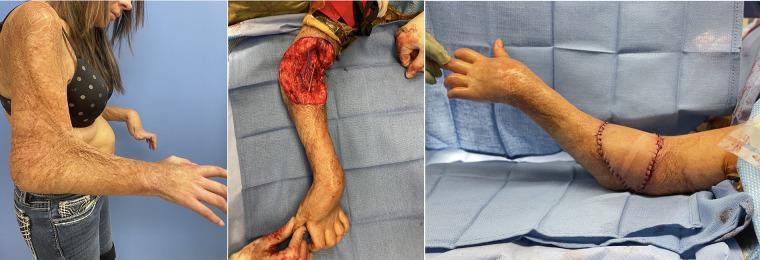
Clinical photographs depicting the pre-operative and intra-operative stages of burn scar contracture release and reconstruction. Left: A 32-year-old female presents with severe post-burn sequelae on the bilateral upper extremities. The skin demonstrates diffuse, mottled dyspigmentation and textural irregularities consistent with extensive scarring and previous split-thickness skin grafting (STSG). A rigid 90-degree flexion contracture of the elbow is evident. Middle: Intra-operative view showing a large soft tissue defect at the elbow following release of the burn scar and lacertus fascia, and lengthening of the biceps tendon. The surgical field reveals exposed deeper tissues prepared for reconstruction. Right: Post-reconstruction view showcasing a successful free Anterolateral Thigh (ALT) flap used to cover the 12x12 cm defect. The flap is secured with visible circumferential sutures at the elbow joint, and the limb is shown in improved extension. The case illustrates advanced plastic surgery techniques including contracture release and microsurgical free flap reconstruction for complex burn injuries.
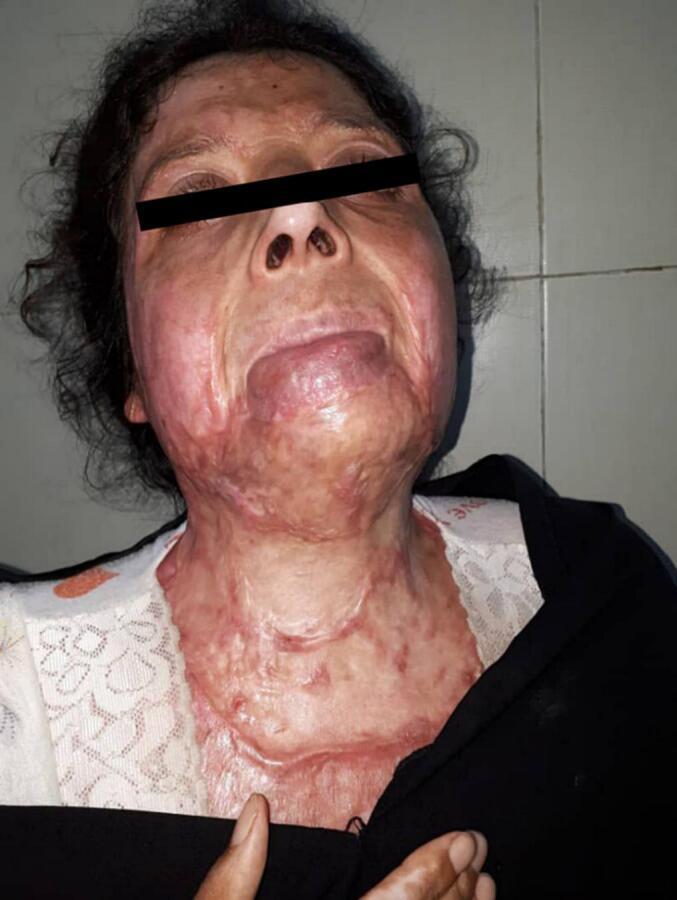
This clinical photograph shows a female patient's face, neck, and upper chest following treatment for extensive burn injuries and subsequent surgical reconstruction. The image illustrates post-operative healing and scarring. Widespread hypertrophic and atrophic scar tissue is visible, characterized by uneven texture, tautness, and a mixture of erythematous (pink-red) and hypopigmented (pale) patches. There is evidence of significant tissue remodeling across the mentum (chin), submental region, and the entire anterior neck. Structural distortions are present, including a downward pull of the lower lip and oral commissures, suggesting residual tension from scar contractures. The neck appears shortened with visible horizontal ridge-like formations, likely representing graft junctions or mature incision lines from a previous contracture release. The educational focus of this image is the long-term sequelae of severe thermal injuries, the outcomes of split-thickness skin grafting, and the role of physiotherapy in managing post-burn cervical contractures and improving functional range of motion.
PMID: 39435560
PMID: 37206342
post burn contracture recent advances 2024 2025 treatment innovations
Post-Burn Contracture: A Comprehensive Essay with Recent Advances
1. Introduction
2. Pathophysiology of Post-Burn Contracture
2.1 Phases of Scar Formation
- Inflammatory phase (0-3 days): Cytokine release (TGF-β1, PDGF, IL-1, IL-6) recruits fibroblasts and myofibroblasts to the wound site.
- Proliferative phase (3 days - 3 weeks): Fibroblasts lay down disorganized Type III collagen. Myofibroblasts - smooth muscle actin-expressing cells - generate the contractile force that progressively shortens the scar. This is the principal cellular driver of contracture.
- Remodeling phase (3 weeks - 2 years): Type III collagen is replaced by Type I collagen with cross-linking. In hypertrophic scars the remodeling is dysregulated, resulting in persistent scar thickening and contracture.
2.2 Key Molecular Mediators
- TGF-β1/β2: The dominant pro-fibrotic cytokines. They promote myofibroblast differentiation, collagen synthesis, and inhibit matrix metalloproteinases (MMPs) responsible for collagen degradation.
- TGF-β3: Counter-regulatory; promotes scar-free healing and is a target for pharmacological intervention.
- CTGF (connective tissue growth factor): Downstream mediator of TGF-β-driven fibrosis.
- MicroRNA regulation: Emerging evidence highlights miR-21, miR-29, and miR-200 as key post-transcriptional regulators of the fibrotic cascade. miR-29 suppresses collagen genes and its downregulation in burns promotes fibrosis. Gene-miRNA crosstalk is an active frontier of research.
2.3 Biomechanical Factors
3. Classification of Post-Burn Contracture
3.1 By Location
- Cervical contracture (anterior neck - chin to sternum, most common site in developing countries)
- Axillary contracture
- Antecubital (elbow) contracture
- Wrist and hand contracture (most common in industrialized nations)
- Popliteal (knee) contracture
- Perioral contracture
- Eyelid contracture (ectropion)
3.2 By Depth/Type
| Type | Description |
|---|---|
| Linear/cord-like | Band of scar tissue across a joint |
| Sheet-like (planar) | Diffuse scar involving a large area |
| Web contracture | Typically seen in axilla and first web space of hand |
| Severe/complex | Involvement of deep structures (tendon, joint capsule, bone) |
3.3 Severity Grading (Neck - Aydın's classification)
- Grade I: Neck mobility partially restricted; platysma visible
- Grade II: Neck mobility severely restricted; chin-sternum distance decreased
- Grade III: Neck mobility completely absent; chin fused to chest
3.4 Functional Grading (Hand - Kurtzman classification)
- Grade 0: Normal
- Grade I: Mild functional deficit
- Grade II: Moderate functional deficit (occupational therapy alone insufficient)
- Grade III: Severe functional deficit requiring reconstruction
4. Prevention
4.1 Acute Phase Measures
- Splinting and positioning: Joints should be splinted in the anti-contracture position from day one. For the hand: MCPs at 70-90° flexion, IPs in full extension, wrist 15-30° extension, thumb in abduction. For the neck: extension with a cervical collar or pillow positioning.
- Early excision and grafting: Excising full-thickness wounds within 48-72 hours and covering with skin grafts reduces contracture risk by shortening the inflammatory phase and preventing prolonged wound contraction.
- Judicious fluid resuscitation: Avoiding over-resuscitation reduces edema, which contributes to tissue stiffness and poor joint range of motion.
4.2 Rehabilitation Phase Measures
- Compression garments: Custom-fitted pressure garments (>25 mmHg) worn 23 hours/day for 6-24 months remain the standard of care for hypertrophic scar prophylaxis. They act via local ischemia, reduced collagen synthesis, and altered cytokine milieu.
- Silicone gel sheeting: Used alone or under pressure garments; reduces scar vascularity and thickness, likely via local hydration and temperature effects.
- Physiotherapy and occupational therapy: Active and passive range-of-motion exercises, splinting during sleep, and task-specific activities are cornerstones of preventing joint stiffness.
- Massage therapy: Improves scar pliability and reduces pruritus. A 2024 systematic review confirmed massage, laser, and shockwave therapy all improve pain and pruritus after burns (Santuzzi et al., J Physiother 2024).
5. Timing of Surgical Reconstruction
- Emergency reconstruction: Ectropion causing corneal exposure, severe microstomia, severe neck contracture threatening airway, or tourniquet-like constriction require urgent or semi-urgent intervention regardless of scar maturity.
- Early reconstruction (within 6 months): Growing children at risk of developmental deformity (e.g., hand contractures limiting prehension), or cases with rapidly developing joint contracture not responding to therapy.
- Elective reconstruction (12+ months): Once scar is pale, flat, and soft (mature), predictable surgical outcomes are achievable.
6. Surgical Management
6.1 Local Tissue Rearrangement
6.2 Skin Grafting
- Split-thickness skin grafts (STSG): Harvested from donor sites (thigh, back) at 0.012-0.018 inches thick. Sheet grafts (unmeshed) are preferred on the face, hands, and neck for superior aesthetic and functional outcomes. Sheet grafts contract less than meshed grafts. STSGs are the most commonly used technique for burn reconstruction (n=89 in the Raborn & Janis 2024 scoping review of 327 publications; PMID 38250207).
- Full-thickness skin grafts (FTSG): Harvested from groin, post-auricular, supraclavicular, or antecubital areas. Undergo minimal secondary contraction and are preferred for the hand (palmar surface, fingers), eyelids, and face. Donor site must be primarily closed.
- Composite grafts: Include dermis + epidermis + occasionally fat; used in smaller areas such as the alar base, eyelids, and fingertip.
6.3 Tissue Expansion
6.4 Flap-Based Reconstruction
- Rotational, advancement, and transposition flaps using adjacent unburned skin
- Perforator-based flaps: e.g., thoracodorsal artery perforator (TDAP) flap for axillary contracture; medial sural artery perforator (MSAP) flap for popliteal contracture
- Reverse radial forearm flap: For dorsal hand contractures
- Latissimus dorsi flap: For large shoulder/axillary/elbow contractures (as illustrated in clinical images above)
- Indicated when local tissue is unavailable, contractures are severe/recurrent, or joints are involved
- Anterolateral thigh (ALT) free flap: The most versatile workhorse - thin, pliable, and can be harvested as fascio-cutaneous, muscle, or chimeric flap. Widely used for neck and elbow contractures
- Radial forearm free flap: Thin and pliable for hand and face
- Gracilis muscle flap: With skin paddle for complex defects
- Contracture resolution: 98.9% for pedicled flaps and 90.1% for free flaps
- Recurrence rate: 1.8% (pedicled) and 0.6% (free flap)
- Total flap loss was low: 1.5% (pedicled) and 2.9% (free flap)
- No significant difference in outcomes between pedicled and free flap types (p=0.50)
6.5 Hand Contracture Reconstruction
- Dorsal skin contracture with MCP hyperextension and IP flexion ("claw hand")
- First web space contracture (thumb adduction contracture)
- Palmar contracture with finger flexion
- Boutonnière and swan-neck deformities
- FTSG for dorsal hand (superior to STSG)
- Perforator flaps and pedicled groin flap for larger defects
- Fasciocutaneous free flaps (ALT, radial forearm) for complex joint contractures
- Tenolysis, capsulotomy, and arthrolysis for underlying joint stiffness
7. Non-Surgical Adjunct Treatments
7.1 Intralesional Injections
- Triamcinolone acetonide (10-40 mg/mL): Suppresses fibroblast activity, reduces collagen synthesis, and softens hypertrophic scars. Often used in series (every 4-6 weeks). Risk of skin atrophy and telangiectasia.
- 5-Fluorouracil (5-FU): Anti-proliferative; used alone or in combination with steroids for resistant scars.
- Bleomycin: Anti-fibrotic; intralesional injection disrupts collagen cross-linking.
- Botulinum toxin A: Inhibits myofibroblast activity via reduction of mechanical tension; emerging role in preventing and treating hypertrophic scars.
7.2 Laser Therapy
- Fractional CO₂ laser (ablative, 10,600 nm): Creates microscopic ablation columns surrounded by coagulation zones. Stimulates collagen remodeling, elastin neogenesis, and soft-tissue relaxation. Improves scar thickness, pliability, range of motion, and symptoms (pain, pruritus). The fractional approach allows rapid re-epithelialization within 48 hours from adjacent untreated tissue (Current Surgical Therapy 14e). This is now considered the "workhorse" for mature thick contracted burn scars.
- Pulsed-dye laser (PDL, 585/595 nm): Targets oxyhemoglobin in scar vasculature; reduces erythema and thickness of early hypertrophic scars. Less effective for contracture than ablative lasers.
- Non-ablative fractional lasers (1540/1550 nm Erbium): Produce columns of dermal coagulation without surface ablation; useful in pigmented skin or areas requiring minimal downtime.
8. Recent Advances (2022-2026)
8.1 Dermal Substitutes
- Collagen-elastin matrix caused a delay in re-epithelialization (-7.3%) compared to STSG in acute burns
- Acellular dermal matrix (ADM) significantly improved subjective scar quality at 6 months compared to STSG alone (-1.95 on standardized scales; p<0.01)
- Dermal substitutes hold promise for enhancing scar quality, though their use requires staged procedures
- Integra (bovine collagen + glycosaminoglycan matrix): Two-stage - first layer provides dermal regeneration, then STSG placed at 3-4 weeks
- Matriderm (collagen-elastin matrix): Single-stage with STSG
- AlloDerm (acellular human dermis): Available for immediate single-stage reconstruction
8.2 Fat Grafting
- Paracrine effects of ADSCs reducing local fibrosis (downregulation of TGF-β1)
- Improved scar pliability and reduction of contracture tightness
- Improved skin quality (texture, color, elasticity)
- Pain relief in post-burn neuropathic areas
8.3 Tissue Engineering and Bioengineered Skin
- Cultured autologous keratinocyte sheets (CEA - Epicel): Used for massive burns; however, fragile and susceptible to contracture
- 3D bioprinted skin constructs: Using bio-inks containing fibroblasts, keratinocytes, and endothelial cells to fabricate skin-like structures with dermal architecture. Currently transitioning from experimental to early clinical use (2024-2025)
- Composite skin substitutes (StrataGraft, etc.): Bi-layered constructs combining allogenic cells on a scaffold; approved for clinical use in some centers for deep partial-thickness burns to reduce scarring
- 3D-printed splints: Custom-manufactured for axillary and other complex contractures - an innovation presented at the 2025 ISBI Regional Conference, offering improved compliance and fit over traditional thermoplastic splints
8.4 Gene Therapy and Molecular Targets
- TGF-β pathway inhibition: Anti-sense oligonucleotides and siRNA targeting TGF-β1 have shown efficacy in animal models; clinical trials pending
- MicroRNA therapeutics: miR-29 mimics and anti-miR-21 agents reduce collagen deposition in preclinical burn models (MDPI Int J Mol Sci, 2025)
- Gene editing (CRISPR-Cas9): Targeting fibrosis genes in myofibroblasts; still experimental
- Stem cell therapy: Bone marrow-derived MSCs and ADSCs reduce scar formation via paracrine anti-inflammatory and anti-fibrotic mechanisms
8.5 Neuromodulation
8.6 Perforator Flap Innovations
- Super-thin and supra-fascial flaps reduce donor-site morbidity
- Pre-expanded free perforator flaps (combined tissue expansion + free flap) allow coverage of very large burn contracture areas (neck, chest) with minimal donor scarring
- Chimeric flaps (combining two or more distinct flap territories on a single pedicle) allow reconstruction of three-dimensional defects in a single stage
8.7 Microsurgical Outcomes - Level 1 Evidence
9. Special Situations
9.1 Pediatric Burn Contracture
9.2 Neck Contracture
9.3 Axillary Contracture
10. Post-Operative Care
- Immobilization: Splinting in the position of maximum correction for 5-7 days, followed by early mobilization
- Rehabilitation: Active and passive ROM exercises initiated within 5-7 days of surgery
- Pressure garments: Recommended for 6-18 months post-grafting to prevent recurrence
- Silicone gel sheeting: Applied once wounds are healed
- Scar monitoring: Monthly assessments with validated tools (Vancouver Scar Scale, POSAS)
- Laser therapy: Fractional CO₂ laser sessions commenced from 3-6 months post-op to improve scar quality and prevent recurrence
11. Prognosis and Outcomes
- Contracture recurrence remains the most common complication, especially with skin grafting alone (higher rates with STSG than FTSG)
- Flap-based reconstruction offers the lowest recurrence rates (0.6-1.8% with microsurgical flaps per Elemosho 2025 meta-analysis)
- Hand contractures have the most complex rehabilitation trajectory and functional recovery depends on adherence to therapy
- Psychosocial impact is significant; body image disturbance, depression, and occupational disability are common; multidisciplinary care incorporating psychology is essential
12. Summary Table
| Treatment | Best Indication | Key Advantage | Limitation |
|---|---|---|---|
| Z-plasty/local flap | Linear/band contractures | No donor site scar | Limited by local tissue availability |
| STSG | Large surface area contractures | Simple, large coverage | Secondary contraction (20-40%); poor elasticity |
| FTSG | Hand, face, eyelid | Minimal contraction | Limited donor site; must be closed primarily |
| Tissue expansion | Face, scalp, neck | Excellent color/texture match | Two-stage; risk of extrusion |
| Pedicled flap | Moderate-large contractures | Reliable vascular supply | Limited reach |
| Free microvascular flap | Severe/recurrent/joint contractures | Best outcomes for joints | Technically demanding; requires microsurgery |
| Fractional CO₂ laser | Hypertrophic scar/mild-mod contracture | Non-surgical, outpatient | Multiple sessions needed |
| Dermal substitutes | Acute deep burns + scar reconstruction | Improved scar quality | Delayed re-epithelialization; costly |
| Fat grafting | Scar pliability, post-grafting stiffness | Regenerative effects (ADSCs) | Multiple sessions; unpredictable retention |
References (Key Sources)
- Raborn LN, Janis JE. Prevention and Treatment of Burn Scar Contracture: A Practical Review. Plast Reconstr Surg Glob Open. 2024. PMID 38250207
- Elemosho A, et al. Outcomes of Microsurgical Reconstruction of Post-Burn Joint Contracture - Systematic Review and Meta-Analysis. Microsurgery. 2025. PMID 40817644
- Vosinakis C, et al. Effectiveness of hand reconstruction techniques for post-burn hand contractures: A systematic review. Burns. 2024. PMID 39423713
- van den Bosch AS, et al. Outcomes of dermal substitutes in burns and burn scar reconstruction: A systematic review and meta-analysis. Wound Repair Regen. 2024. PMID 39435560
- Donelan MB, Buta MR. The Art of Local Tissue Rearrangements in Burn Reconstruction: Z-Plasty and More. Clin Plast Surg. 2024. PMID 38789143
- McNamara CT, et al. Concepts in soft-tissue reconstruction of the contracted hand and upper extremity after burn injury. Front Surg. 2023. PMID 37206342
- Current Surgical Therapy, 14th Edition - Reconstruction Philosophy & Burn Management
- Schwartz's Principles of Surgery, 11th Edition - Burn Surgical Management & Reconstruction

Can u make it a word document
ls -la /tmp/workspace/ 2>/dev/null || mkdir -p /tmp/workspace && ls -la /tmp/workspace/
mkdir -p /tmp/workspace/burn-contracture && cat > /tmp/workspace/burn-contracture/create_doc.py << 'PYEOF' from docx import Document from docx.shared import Pt, Inches, RGBColor from docx.enum.text import WD_ALIGN_PARAGRAPH from docx.oxml.ns import qn from docx.oxml import OxmlElement doc = Document() # ── Page margins ────────────────────────────────────────────────────────────── section = doc.sections[0] section.top_margin = Inches(1) section.bottom_margin = Inches(1) section.left_margin = Inches(1.2) section.right_margin = Inches(1.2) # ── Default Normal style ────────────────────────────────────────────────────── normal = doc.styles["Normal"] normal.font.name = "Arial" normal.font.size = Pt(11) # ── Heading styles ──────────────────────────────────────────────────────────── def set_heading_style(doc, level, size, color_hex, bold=True): style_name = f"Heading {level}" s = doc.styles[style_name] s.font.name = "Arial" s.font.size = Pt(size) s.font.bold = bold s.font.color.rgb = RGBColor.from_string(color_hex) set_heading_style(doc, 1, 18, "1F3864") # dark navy set_heading_style(doc, 2, 14, "2E74B5") # medium blue set_heading_style(doc, 3, 12, "2E74B5") # same blue, smaller # ── Helper functions ────────────────────────────────────────────────────────── def add_body(doc, text, bold=False, italic=False, space_after=6): p = doc.add_paragraph(style="Normal") run = p.add_run(text) run.bold = bold run.italic = italic p.paragraph_format.space_after = Pt(space_after) return p def add_bullet(doc, text, level=0): p = doc.add_paragraph(style="List Bullet") p.paragraph_format.left_indent = Inches(0.3 + 0.2 * level) p.paragraph_format.space_after = Pt(3) run = p.add_run(text) run.font.name = "Arial" run.font.size = Pt(11) return p def add_table(doc, headers, rows, col_widths=None): table = doc.add_table(rows=1+len(rows), cols=len(headers)) table.style = "Table Grid" # Header row hdr = table.rows[0] for i, h in enumerate(headers): cell = hdr.cells[i] cell.text = h run = cell.paragraphs[0].runs[0] run.bold = True run.font.name = "Arial" run.font.size = Pt(10) # blue background tc = cell._tc tcPr = tc.get_or_add_tcPr() shd = OxmlElement("w:shd") shd.set(qn("w:val"), "clear") shd.set(qn("w:color"), "auto") shd.set(qn("w:fill"), "2E74B5") tcPr.append(shd) run.font.color.rgb = RGBColor(0xFF, 0xFF, 0xFF) # Data rows for ri, row_data in enumerate(rows): row = table.rows[ri+1] for ci, val in enumerate(row_data): cell = row.cells[ci] cell.text = val run = cell.paragraphs[0].runs[0] run.font.name = "Arial" run.font.size = Pt(10) if ri % 2 == 1: tc = cell._tc tcPr = tc.get_or_add_tcPr() shd = OxmlElement("w:shd") shd.set(qn("w:val"), "clear") shd.set(qn("w:color"), "auto") shd.set(qn("w:fill"), "EBF3FB") tcPr.append(shd) if col_widths: for ci, w in enumerate(col_widths): for row in table.rows: row.cells[ci].width = Inches(w) return table def page_break(doc): doc.add_page_break() # ══════════════════════════════════════════════════════════════════════════════ # TITLE PAGE # ══════════════════════════════════════════════════════════════════════════════ tp = doc.add_paragraph() tp.alignment = WD_ALIGN_PARAGRAPH.CENTER tp.paragraph_format.space_before = Pt(60) run = tp.add_run("Post-Burn Contracture") run.font.name = "Arial" run.font.size = Pt(28) run.bold = True run.font.color.rgb = RGBColor.from_string("1F3864") tp2 = doc.add_paragraph() tp2.alignment = WD_ALIGN_PARAGRAPH.CENTER run2 = tp2.add_run("Pathophysiology, Management and Recent Advances") run2.font.name = "Arial" run2.font.size = Pt(16) run2.italic = True run2.font.color.rgb = RGBColor.from_string("2E74B5") doc.add_paragraph() tp3 = doc.add_paragraph() tp3.alignment = WD_ALIGN_PARAGRAPH.CENTER run3 = tp3.add_run("A Comprehensive Clinical Essay") run3.font.name = "Arial" run3.font.size = Pt(12) run3.font.color.rgb = RGBColor.from_string("555555") tp4 = doc.add_paragraph() tp4.alignment = WD_ALIGN_PARAGRAPH.CENTER run4 = tp4.add_run("July 2026") run4.font.name = "Arial" run4.font.size = Pt(11) run4.font.color.rgb = RGBColor.from_string("555555") page_break(doc) # ══════════════════════════════════════════════════════════════════════════════ # 1. INTRODUCTION # ══════════════════════════════════════════════════════════════════════════════ doc.add_heading("1. Introduction", level=1) add_body(doc, ( "Burn injuries remain a major global health burden, with an estimated 11 million people " "seeking medical care for burns annually. Among the most debilitating long-term sequelae is " "the post-burn contracture (PBC) - a pathological shortening of scar tissue across a joint " "or mobile surface that limits function and causes aesthetic deformity. Nearly one-third of " "all burn patients develop contractures at some point in their recovery, and the economic and " "psychosocial burden is immense. The upper extremity (particularly the hand) and the neck are " "the two most commonly affected regions. Managing PBC demands a thorough understanding of its " "pathophysiology, a systematic classification approach, and access to a wide reconstructive " "armamentarium - from simple Z-plasties to free microvascular tissue transfer." )) # ══════════════════════════════════════════════════════════════════════════════ # 2. PATHOPHYSIOLOGY # ══════════════════════════════════════════════════════════════════════════════ doc.add_heading("2. Pathophysiology of Post-Burn Contracture", level=1) doc.add_heading("2.1 Phases of Scar Formation", level=2) bullets_phases = [ ("Inflammatory phase (0-3 days): ", "Cytokine release (TGF-\u03b21, PDGF, IL-1, IL-6) recruits fibroblasts and myofibroblasts to the wound site."), ("Proliferative phase (3 days - 3 weeks): ", "Fibroblasts lay down disorganized Type III collagen. Myofibroblasts - smooth muscle actin-expressing cells - generate the contractile force that progressively shortens the scar. This is the principal cellular driver of contracture."), ("Remodeling phase (3 weeks - 2 years): ", "Type III collagen is replaced by Type I collagen with cross-linking. In hypertrophic scars the remodeling is dysregulated, resulting in persistent scar thickening and contracture."), ] for bold_part, rest in bullets_phases: p = doc.add_paragraph(style="List Bullet") p.paragraph_format.space_after = Pt(4) r1 = p.add_run(bold_part) r1.bold = True; r1.font.name = "Arial"; r1.font.size = Pt(11) r2 = p.add_run(rest) r2.font.name = "Arial"; r2.font.size = Pt(11) doc.add_heading("2.2 Key Molecular Mediators", level=2) mediators = [ ("TGF-\u03b21/\u03b22: ", "The dominant pro-fibrotic cytokines. They promote myofibroblast differentiation, collagen synthesis, and inhibit matrix metalloproteinases (MMPs) responsible for collagen degradation."), ("TGF-\u03b23: ", "Counter-regulatory; promotes scar-free healing and is a target for pharmacological intervention."), ("CTGF (connective tissue growth factor): ", "Downstream mediator of TGF-\u03b2-driven fibrosis."), ("MicroRNA regulation: ", "Emerging evidence highlights miR-21, miR-29, and miR-200 as key post-transcriptional regulators of the fibrotic cascade. miR-29 suppresses collagen genes and its downregulation in burns promotes fibrosis. Gene-miRNA crosstalk is an active frontier of research."), ] for bold_part, rest in mediators: p = doc.add_paragraph(style="List Bullet") p.paragraph_format.space_after = Pt(4) r1 = p.add_run(bold_part); r1.bold = True; r1.font.name = "Arial"; r1.font.size = Pt(11) r2 = p.add_run(rest); r2.font.name = "Arial"; r2.font.size = Pt(11) doc.add_heading("2.3 Biomechanical Factors", level=2) add_body(doc, ( "Full-thickness burns destroy the dermis, eliminating the mechanical resistance it provides " "to myofibroblast contraction. Even with early excision and grafting, split-thickness skin grafts " "(STSGs) undergo secondary contraction of 20-40%, while full-thickness skin grafts (FTSGs) " "contract considerably less (~5%). Skin grafts also lack elastin, contributing to long-term " "stiffness. Immobility, edema, and joint positioning in the acute phase further accelerate " "contracture development." )) # ══════════════════════════════════════════════════════════════════════════════ # 3. CLASSIFICATION # ══════════════════════════════════════════════════════════════════════════════ doc.add_heading("3. Classification of Post-Burn Contracture", level=1) doc.add_heading("3.1 By Location", level=2) locations = [ "Cervical contracture (anterior neck - chin to sternum; most common in developing countries)", "Axillary contracture", "Antecubital (elbow) contracture", "Wrist and hand contracture (most common in industrialized nations)", "Popliteal (knee) contracture", "Perioral contracture", "Eyelid contracture (ectropion)", ] for loc in locations: add_bullet(doc, loc) doc.add_heading("3.2 By Type", level=2) add_table(doc, ["Type", "Description"], [ ["Linear / cord-like", "Band of scar tissue across a joint"], ["Sheet-like (planar)", "Diffuse scar involving a large area"], ["Web contracture", "Typically seen in axilla and first web space of hand"], ["Severe / complex", "Involvement of deep structures (tendon, joint capsule, bone)"], ], col_widths=[2.0, 3.5] ) doc.add_paragraph() doc.add_heading("3.3 Severity Grading - Neck (Aydin's Classification)", level=2) add_table(doc, ["Grade", "Description"], [ ["Grade I", "Neck mobility partially restricted; platysma visible"], ["Grade II", "Neck mobility severely restricted; chin-sternum distance decreased"], ["Grade III", "Neck mobility completely absent; chin fused to chest"], ], col_widths=[1.5, 4.0] ) doc.add_paragraph() doc.add_heading("3.4 Functional Grading - Hand (Kurtzman Classification)", level=2) add_table(doc, ["Grade", "Description"], [ ["Grade 0", "Normal"], ["Grade I", "Mild functional deficit"], ["Grade II", "Moderate functional deficit (OT alone insufficient)"], ["Grade III", "Severe functional deficit requiring reconstruction"], ], col_widths=[1.5, 4.0] ) doc.add_paragraph() # ══════════════════════════════════════════════════════════════════════════════ # 4. PREVENTION # ══════════════════════════════════════════════════════════════════════════════ doc.add_heading("4. Prevention", level=1) add_body(doc, ( "Prevention begins at the moment of injury and continues through the entire rehabilitation phase. " "As stated in Current Surgical Therapy (14th Ed): \"Prediction, prevention, and treatment of " "potential functional and aesthetic morbidity now starts at the time of initial resuscitation.\"" )) doc.add_heading("4.1 Acute Phase Measures", level=2) acute = [ ("Splinting and positioning: ", "Joints should be splinted in the anti-contracture position from day one. For the hand: MCPs at 70-90\u00b0 flexion, IPs in full extension, wrist 15-30\u00b0 extension, thumb in abduction. For the neck: extension with a cervical collar."), ("Early excision and grafting: ", "Excising full-thickness wounds within 48-72 hours and covering with skin grafts reduces contracture risk by shortening the inflammatory phase."), ("Judicious fluid resuscitation: ", "Avoiding over-resuscitation reduces edema, which contributes to tissue stiffness and poor joint range of motion."), ] for bold_part, rest in acute: p = doc.add_paragraph(style="List Bullet") p.paragraph_format.space_after = Pt(4) r1 = p.add_run(bold_part); r1.bold = True; r1.font.name = "Arial"; r1.font.size = Pt(11) r2 = p.add_run(rest); r2.font.name = "Arial"; r2.font.size = Pt(11) doc.add_heading("4.2 Rehabilitation Phase Measures", level=2) rehab = [ ("Compression garments: ", "Custom-fitted pressure garments (>25 mmHg) worn 23 hours/day for 6-24 months; standard of care for hypertrophic scar prophylaxis."), ("Silicone gel sheeting: ", "Used alone or under pressure garments; reduces scar vascularity and thickness via local hydration and temperature effects."), ("Physiotherapy and occupational therapy: ", "Active and passive range-of-motion exercises, splinting during sleep, and task-specific activities are cornerstones of preventing joint stiffness."), ("Massage therapy: ", "Improves scar pliability and reduces pruritus. A 2024 systematic review (Santuzzi et al., J Physiother 2024, PMID 38072714) confirmed massage, laser, and shockwave therapy all improve pain and pruritus."), ] for bold_part, rest in rehab: p = doc.add_paragraph(style="List Bullet") p.paragraph_format.space_after = Pt(4) r1 = p.add_run(bold_part); r1.bold = True; r1.font.name = "Arial"; r1.font.size = Pt(11) r2 = p.add_run(rest); r2.font.name = "Arial"; r2.font.size = Pt(11) # ══════════════════════════════════════════════════════════════════════════════ # 5. TIMING # ══════════════════════════════════════════════════════════════════════════════ doc.add_heading("5. Timing of Surgical Reconstruction", level=1) add_body(doc, ( "The classical teaching is to wait for scar maturation (12-18 months) before reconstruction. " "However, this principle has been modified based on clinical urgency:" )) timing = [ ("Emergency reconstruction: ", "Ectropion causing corneal exposure, severe microstomia, neck contracture threatening the airway, or tourniquet-like constriction require urgent intervention regardless of scar maturity."), ("Early reconstruction (within 6 months): ", "Growing children at risk of developmental deformity, or cases with rapidly developing joint contracture not responding to therapy."), ("Elective reconstruction (12+ months): ", "Once scar is pale, flat, and soft (mature), predictable surgical outcomes are achievable."), ] for bold_part, rest in timing: p = doc.add_paragraph(style="List Bullet") p.paragraph_format.space_after = Pt(4) r1 = p.add_run(bold_part); r1.bold = True; r1.font.name = "Arial"; r1.font.size = Pt(11) r2 = p.add_run(rest); r2.font.name = "Arial"; r2.font.size = Pt(11) # ══════════════════════════════════════════════════════════════════════════════ # 6. SURGICAL MANAGEMENT # ══════════════════════════════════════════════════════════════════════════════ doc.add_heading("6. Surgical Management", level=1) add_body(doc, "The reconstructive ladder - from simple to complex - guides surgical decision-making.") doc.add_heading("6.1 Local Tissue Rearrangement", level=2) add_body(doc, ( "Z-Plasty is the workhorse of local scar release. It involves transposing two triangularly based " "flaps to lengthen a linear scar. Classic Z-plasty with 60\u00b0 limb angles yields a theoretical " "75% lengthening and 25% increase in overall scar length. Multiple Z-plasties (\"running\" or " "\"jumping man\") distribute tension across longer scars. A 2024 review by Donelan and Buta " "(Clin Plast Surg, PMID 38789143) highlights Z-plasty and its variants - W-plasty, compound " "Z-plasties, and the \"jumping man\" - as highly effective for band-like contractures across " "concave surfaces. Y-V and V-Y plasties are used for smaller scar bands, particularly in web spaces. " "Four-flap and five-flap Z-plasties provide greater lengthening for first web space contractures." )) doc.add_heading("6.2 Skin Grafting", level=2) grafting = [ ("Split-thickness skin grafts (STSG): ", "Harvested at 0.012-0.018 inches. Sheet grafts preferred on face, hands, and neck for superior outcomes. STSG is the most commonly used technique in burn reconstruction (Raborn & Janis 2024, PMID 38250207)."), ("Full-thickness skin grafts (FTSG): ", "Harvested from groin, post-auricular, supraclavicular, or antecubital areas. Minimal secondary contraction (~5%); preferred for the hand (palmar surface, fingers), eyelids, and face."), ("Composite grafts: ", "Include dermis + epidermis + occasionally fat; used in smaller areas such as the alar base, eyelids, and fingertip."), ] for bold_part, rest in grafting: p = doc.add_paragraph(style="List Bullet") p.paragraph_format.space_after = Pt(4) r1 = p.add_run(bold_part); r1.bold = True; r1.font.name = "Arial"; r1.font.size = Pt(11) r2 = p.add_run(rest); r2.font.name = "Arial"; r2.font.size = Pt(11) doc.add_heading("6.3 Tissue Expansion", level=2) add_body(doc, ( "Tissue expanders inserted subcutaneously adjacent to the scar allow generation of large amounts " "of local tissue with similar color, texture, and thickness. The expanded skin is then used to " "resurface the contracture release defect. Particularly useful for scalp, neck, and facial " "reconstruction. Complications include expander extrusion, infection, and implant failure." )) doc.add_heading("6.4 Flap-Based Reconstruction", level=2) add_body(doc, ( "Flaps are the most commonly reported technique in burn contracture management and are favored " "for large contractures, exposed deep structures, joint contractures, and recurrent contractures " "after prior grafting." )) add_body(doc, "Pedicled flaps include:", bold=True) pedicled = [ "Rotational, advancement, and transposition flaps using adjacent unburned skin", "Perforator-based flaps (e.g., TDAP flap for axillary contracture; MSAP flap for popliteal contracture)", "Reverse radial forearm flap for dorsal hand contractures", "Latissimus dorsi flap for large shoulder/axillary/elbow contractures", ] for item in pedicled: add_bullet(doc, item) add_body(doc, "Free flaps (microsurgical reconstruction):", bold=True) free_flaps = [ "Indicated when local tissue is unavailable, contractures are severe/recurrent, or joints are involved", "Anterolateral thigh (ALT) free flap: The most versatile workhorse - thin, pliable, used for neck and elbow contractures", "Radial forearm free flap: Thin and pliable for hand and face", "Gracilis muscle flap: With skin paddle for complex defects", ] for item in free_flaps: add_bullet(doc, item) # Highlighted evidence box p_box = doc.add_paragraph() p_box.paragraph_format.left_indent = Inches(0.4) p_box.paragraph_format.right_indent = Inches(0.4) p_box.paragraph_format.space_before = Pt(6) p_box.paragraph_format.space_after = Pt(6) pPr = p_box._p.get_or_add_pPr() pBdr = OxmlElement("w:pBdr") for side in ["top", "left", "bottom", "right"]: bdr = OxmlElement(f"w:{side}") bdr.set(qn("w:val"), "single") bdr.set(qn("w:sz"), "12") bdr.set(qn("w:space"), "4") bdr.set(qn("w:color"), "2E74B5") pBdr.append(bdr) pPr.append(pBdr) shd = OxmlElement("w:shd") shd.set(qn("w:val"), "clear"); shd.set(qn("w:color"), "auto"); shd.set(qn("w:fill"), "EBF3FB") pPr.append(shd) r_box = p_box.add_run( "\u2605 Evidence: Elemosho et al. (Microsurgery 2025, PMID 40817644) - Meta-analysis of 830 joint " "contractures: contracture resolution 98.9% (pedicled) and 90.1% (free flap); recurrence 1.8% and 0.6% " "respectively. No significant difference between pedicled and free flap outcomes (p=0.50)." ) r_box.font.name = "Arial"; r_box.font.size = Pt(10); r_box.bold = True r_box.font.color.rgb = RGBColor.from_string("1F3864") doc.add_paragraph() doc.add_heading("6.5 Hand Contracture Reconstruction", level=2) add_body(doc, ( "The hand deserves special mention due to the complexity of its functional anatomy. Post-burn " "hand deformities include dorsal skin contracture with MCP hyperextension and IP flexion (\"claw hand\"), " "first web space contracture, palmar contracture, and Boutonniere/swan-neck deformities. " "A 2024 systematic review (Vosinakis et al., Burns 2024, PMID 39423713; 1,310 patients) found " "no single reconstruction technique is superior - a stepwise, individualized approach is essential." )) hand = [ "FTSG for dorsal hand (superior to STSG for function and cosmesis)", "Perforator flaps and pedicled groin flap for larger defects", "Fasciocutaneous free flaps (ALT, radial forearm) for complex joint contractures", "Tenolysis, capsulotomy, and arthrolysis for underlying joint stiffness", ] for item in hand: add_bullet(doc, item) # ══════════════════════════════════════════════════════════════════════════════ # 7. NON-SURGICAL ADJUNCTS # ══════════════════════════════════════════════════════════════════════════════ doc.add_heading("7. Non-Surgical Adjunct Treatments", level=1) doc.add_heading("7.1 Intralesional Injections", level=2) injections = [ ("Triamcinolone acetonide (10-40 mg/mL): ", "Suppresses fibroblast activity, reduces collagen synthesis, softens hypertrophic scars. Given every 4-6 weeks."), ("5-Fluorouracil (5-FU): ", "Anti-proliferative; used alone or in combination with steroids for resistant scars."), ("Bleomycin: ", "Disrupts collagen cross-linking; anti-fibrotic."), ("Botulinum toxin A: ", "Inhibits myofibroblast activity via reduction of mechanical tension; emerging role in hypertrophic scar prevention and treatment."), ] for bold_part, rest in injections: p = doc.add_paragraph(style="List Bullet") p.paragraph_format.space_after = Pt(4) r1 = p.add_run(bold_part); r1.bold = True; r1.font.name = "Arial"; r1.font.size = Pt(11) r2 = p.add_run(rest); r2.font.name = "Arial"; r2.font.size = Pt(11) doc.add_heading("7.2 Laser Therapy", level=2) lasers = [ ("Fractional CO\u2082 laser (ablative, 10,600 nm): ", "Creates microscopic ablation columns surrounded by coagulation zones. Stimulates collagen remodeling, elastin neogenesis, and soft-tissue relaxation. Improves scar thickness, pliability, range of motion, pain, and pruritus. Now considered the workhorse for mature contracted burn scars."), ("Pulsed-dye laser (PDL, 585/595 nm): ", "Targets oxyhemoglobin in scar vasculature; reduces erythema and thickness of early hypertrophic scars."), ("Non-ablative fractional lasers (1540/1550 nm): ", "Produce dermal coagulation without surface ablation; useful in pigmented skin or areas requiring minimal downtime."), ] for bold_part, rest in lasers: p = doc.add_paragraph(style="List Bullet") p.paragraph_format.space_after = Pt(4) r1 = p.add_run(bold_part); r1.bold = True; r1.font.name = "Arial"; r1.font.size = Pt(11) r2 = p.add_run(rest); r2.font.name = "Arial"; r2.font.size = Pt(11) add_body(doc, ( "A 2023 systematic review (PMID 36749436) confirmed fractional CO\u2082 and Er:YAG lasers outperform " "microneedling for hypertrophic scar improvement." ), italic=True) # ══════════════════════════════════════════════════════════════════════════════ # 8. RECENT ADVANCES # ══════════════════════════════════════════════════════════════════════════════ page_break(doc) doc.add_heading("8. Recent Advances (2022-2026)", level=1) doc.add_heading("8.1 Dermal Substitutes", level=2) add_body(doc, ( "Dermal substitutes aim to replace lost dermis, improving scar quality by providing a scaffold " "for dermal regeneration. A 2024 systematic review and meta-analysis (van den Bosch et al., " "Wound Repair Regen, PMID 39435560; 31 trials) found:" )) ds = [ "Collagen-elastin matrix caused delayed re-epithelialization (-7.3%) compared to STSG in acute burns", "Acellular dermal matrix (ADM) significantly improved subjective scar quality at 6 months vs STSG alone (-1.95; p<0.01)", "Dermal substitutes hold promise for scar quality, though staged procedures are often required", ] for item in ds: add_bullet(doc, item) add_body(doc, "Key products in use: Integra (bovine collagen + GAG matrix), Matriderm (collagen-elastin), AlloDerm (acellular human dermis).") doc.add_heading("8.2 Fat Grafting (Lipofilling)", level=2) add_body(doc, ( "Autologous fat grafting has emerged as a powerful adjunct for burn scar reconstruction. " "Harvested fat (rich in adipose-derived stem cells, ADSCs) is injected into and around " "hypertrophic scars and contractures. Mechanisms include:" )) fg = [ "Paracrine effects of ADSCs reducing local fibrosis (downregulation of TGF-\u03b21)", "Improved scar pliability and reduction of contracture tightness", "Improved skin quality (texture, color, elasticity)", "Pain relief in post-burn neuropathic areas", ] for item in fg: add_bullet(doc, item) add_body(doc, "Fat grafting is now used both as a standalone treatment and as an enhancer prior to laser or surgical intervention.") doc.add_heading("8.3 Tissue Engineering and Bioengineered Skin", level=2) te = [ ("Cultured autologous keratinocyte sheets (CEA - Epicel): ", "Used for massive burns; however, fragile and susceptible to contracture."), ("3D bioprinted skin constructs: ", "Using bio-inks containing fibroblasts, keratinocytes, and endothelial cells to fabricate skin-like structures with dermal architecture. Transitioning from experimental to early clinical use (2024-2025)."), ("Composite skin substitutes (StrataGraft): ", "Bi-layered constructs combining allogenic cells on a scaffold; approved for clinical use in some centers for deep partial-thickness burns to reduce scarring."), ("3D-printed splints: ", "Custom-manufactured for axillary and complex contractures - presented at the 2025 ISBI Regional Conference - offering improved compliance and fit over traditional thermoplastic splints."), ] for bold_part, rest in te: p = doc.add_paragraph(style="List Bullet") p.paragraph_format.space_after = Pt(4) r1 = p.add_run(bold_part); r1.bold = True; r1.font.name = "Arial"; r1.font.size = Pt(11) r2 = p.add_run(rest); r2.font.name = "Arial"; r2.font.size = Pt(11) doc.add_heading("8.4 Gene Therapy and Molecular Targets", level=2) gene = [ ("TGF-\u03b2 pathway inhibition: ", "Anti-sense oligonucleotides and siRNA targeting TGF-\u03b21 have shown efficacy in animal models; clinical trials pending."), ("MicroRNA therapeutics: ", "miR-29 mimics and anti-miR-21 agents reduce collagen deposition in preclinical burn models."), ("Gene editing (CRISPR-Cas9): ", "Targeting fibrosis genes in myofibroblasts; still experimental."), ("Stem cell therapy: ", "Bone marrow-derived MSCs and ADSCs reduce scar formation via paracrine anti-inflammatory and anti-fibrotic mechanisms."), ] for bold_part, rest in gene: p = doc.add_paragraph(style="List Bullet") p.paragraph_format.space_after = Pt(4) r1 = p.add_run(bold_part); r1.bold = True; r1.font.name = "Arial"; r1.font.size = Pt(11) r2 = p.add_run(rest); r2.font.name = "Arial"; r2.font.size = Pt(11) doc.add_heading("8.5 Neuromodulation", level=2) add_body(doc, ( "A 2026 Nature Communications Medicine paper highlights neuromodulation strategies in post-burn " "rehabilitation including transcutaneous electrical nerve stimulation (TENS), transcranial magnetic " "stimulation, and wireless microcurrent stimulation - targeting both scar remodeling and neuropathic " "pain, which commonly co-exist with contracture." )) doc.add_heading("8.6 Perforator Flap Innovations", level=2) add_body(doc, ( "Refinements in perforator flap anatomy and the advent of color duplex ultrasonography and CT " "angiography for preoperative perforator mapping have greatly expanded the reconstructive toolkit:" )) perf = [ "Super-thin and supra-fascial flaps reduce donor-site morbidity", "Pre-expanded free perforator flaps (combined tissue expansion + free flap) allow coverage of very large burn contracture areas (neck, chest) with minimal donor scarring", "Chimeric flaps (combining two or more distinct flap territories on a single pedicle) allow reconstruction of three-dimensional defects in a single stage", ] for item in perf: add_bullet(doc, item) # ══════════════════════════════════════════════════════════════════════════════ # 9. SPECIAL SITUATIONS # ══════════════════════════════════════════════════════════════════════════════ doc.add_heading("9. Special Situations", level=1) doc.add_heading("9.1 Pediatric Burn Contracture", level=2) add_body(doc, ( "Children present unique challenges because scar tissue does not grow with the child, leading " "to progressive deformity as skeletal growth occurs. Earlier intervention thresholds are warranted. " "Facial and hand contractures in children may cause secondary skeletal changes (mandibular dystrophy, " "short metacarpals). A 2022 systematic review (PMID 35137105) found that video laryngoscopy and " "awake fiberoptic intubation are the safest techniques for airway management in patients with " "facial/neck contractures." )) doc.add_heading("9.2 Cervical Contracture", level=2) add_body(doc, ( "Cervical contracture may compromise the airway, cause chin-to-chest fusion, restrict shoulder " "motion, and produce lower lip ectropion. Management follows a spectrum: Z-plasty (mild linear " "bands) to FTSG (moderate) to free ALT flap (severe/recurrent/large area). The pre-expanded ALT " "free flap is the optimal solution for large anterior neck contractures, providing large, pliable, " "skin-matched tissue." )) doc.add_heading("9.3 Axillary Contracture", level=2) add_body(doc, ( "Often presents as web-type scar restricting shoulder abduction. The five-flap Z-plasty " "(jumping man) is ideal for mild-to-moderate axillary bands. For severe contractures, the " "TDAP or LD flap provides reliable coverage. 3D-printed airplane splints have been reported " "for postoperative positioning (ISBI 2025)." )) # ══════════════════════════════════════════════════════════════════════════════ # 10. POST-OPERATIVE CARE # ══════════════════════════════════════════════════════════════════════════════ doc.add_heading("10. Post-Operative Care", level=1) postop = [ "Immobilization: Splinting in the position of maximum correction for 5-7 days, then early mobilization", "Rehabilitation: Active and passive ROM exercises initiated within 5-7 days of surgery", "Pressure garments: Recommended for 6-18 months post-grafting to prevent recurrence", "Silicone gel sheeting: Applied once wounds are healed", "Scar monitoring: Monthly assessments with validated tools (Vancouver Scar Scale, POSAS)", "Laser therapy: Fractional CO\u2082 laser sessions from 3-6 months post-op to improve scar quality and prevent recurrence", ] for item in postop: add_bullet(doc, item) # ══════════════════════════════════════════════════════════════════════════════ # 11. SUMMARY TABLE # ══════════════════════════════════════════════════════════════════════════════ doc.add_heading("11. Summary of Reconstruction Options", level=1) add_table(doc, ["Treatment", "Best Indication", "Key Advantage", "Limitation"], [ ["Z-plasty / local flap", "Linear/band contractures", "No donor site scar", "Limited by local tissue availability"], ["STSG", "Large surface area contractures", "Simple, large coverage", "Secondary contraction 20-40%; poor elasticity"], ["FTSG", "Hand, face, eyelid", "Minimal contraction (~5%)", "Limited donor site; must be closed primarily"], ["Tissue expansion", "Face, scalp, neck", "Excellent color/texture match", "Two-stage; risk of extrusion"], ["Pedicled flap", "Moderate-large contractures", "Reliable vascular supply", "Limited reach"], ["Free microvascular flap", "Severe/recurrent/joint contractures", "Best outcomes for joints (>98% resolution)", "Technically demanding; requires microsurgery"], ["Fractional CO\u2082 laser", "Hypertrophic scar/mild-mod contracture", "Non-surgical, outpatient", "Multiple sessions needed"], ["Dermal substitutes", "Acute deep burns + scar reconstruction", "Improved scar quality", "Delayed re-epithelialization; costly"], ["Fat grafting", "Scar pliability, post-grafting stiffness", "Regenerative effects (ADSCs)", "Multiple sessions; unpredictable retention"], ], col_widths=[1.5, 1.6, 1.8, 1.8] ) doc.add_paragraph() # ══════════════════════════════════════════════════════════════════════════════ # 12. REFERENCES # ══════════════════════════════════════════════════════════════════════════════ doc.add_heading("12. References", level=1) refs = [ "Raborn LN, Janis JE. Prevention and Treatment of Burn Scar Contracture: A Practical Review. Plast Reconstr Surg Glob Open. 2024. PMID 38250207", "Elemosho A, et al. Outcomes of Microsurgical Reconstruction of Post-Burn Joint Contracture - Systematic Review and Meta-Analysis. Microsurgery. 2025. PMID 40817644", "Vosinakis C, et al. Effectiveness of hand reconstruction techniques for post-burn hand contractures: A systematic review. Burns. 2024. PMID 39423713", "van den Bosch AS, et al. Outcomes of dermal substitutes in burns and burn scar reconstruction: A systematic review and meta-analysis. Wound Repair Regen. 2024. PMID 39435560", "Donelan MB, Buta MR. The Art of Local Tissue Rearrangements in Burn Reconstruction: Z-Plasty and More. Clin Plast Surg. 2024. PMID 38789143", "McNamara CT, et al. Concepts in soft-tissue reconstruction of the contracted hand and upper extremity after burn injury. Front Surg. 2023. PMID 37206342", "Unal D, Sumak Hazir M. Airway Management in Pediatric Patients With Burn Contractures of the Face and Neck. J Burn Care Res. 2022. PMID 35137105", "Nobari NN, et al. Comparison between needling and ablative fractional lasers in treatment of hypertrophic scars. Lasers Med Sci. 2023. PMID 36749436", "Current Surgical Therapy, 14th Edition - Burn Reconstruction Philosophy", "Schwartz's Principles of Surgery, 11th Edition - Burn Surgical Management", ] for i, ref in enumerate(refs, 1): p = doc.add_paragraph(style="Normal") p.paragraph_format.left_indent = Inches(0.3) p.paragraph_format.first_line_indent = Inches(-0.3) p.paragraph_format.space_after = Pt(4) r = p.add_run(f"{i}. {ref}") r.font.name = "Arial" r.font.size = Pt(10) # Save out_path = "/tmp/workspace/burn-contracture/Post_Burn_Contracture_Essay.docx" doc.save(out_path) print(f"Saved: {out_path}") PYEOF python3 /tmp/workspace/burn-contracture/create_doc.py
ls -lh /tmp/workspace/burn-contracture/
Post Burn Contracture Essay
Word Document · DOCX
- Professional formatting with navy/blue heading hierarchy
- Title page with subtitle
- 12 fully structured sections:
- Introduction
- Pathophysiology (phases, molecular mediators, biomechanics)
- Classification (location, type, Aydin's neck grading, Kurtzman hand grading)
- Prevention (acute + rehabilitation phase)
- Timing of reconstruction
- Surgical management (Z-plasty, skin grafts, tissue expansion, pedicled & free flaps, hand reconstruction)
- Non-surgical adjuncts (injections, laser therapy)
- Recent Advances 2022-2026 (dermal substitutes, fat grafting, bioengineered skin, gene therapy, neuromodulation, perforator flap innovations)
- Special situations (pediatric, cervical, axillary)
- Post-operative care
- Summary comparison table (color-banded)
- Numbered references with PMIDs
I want clinical images on grades of post burn contracture
post burn neck contracture grade severity classification clinical photograph
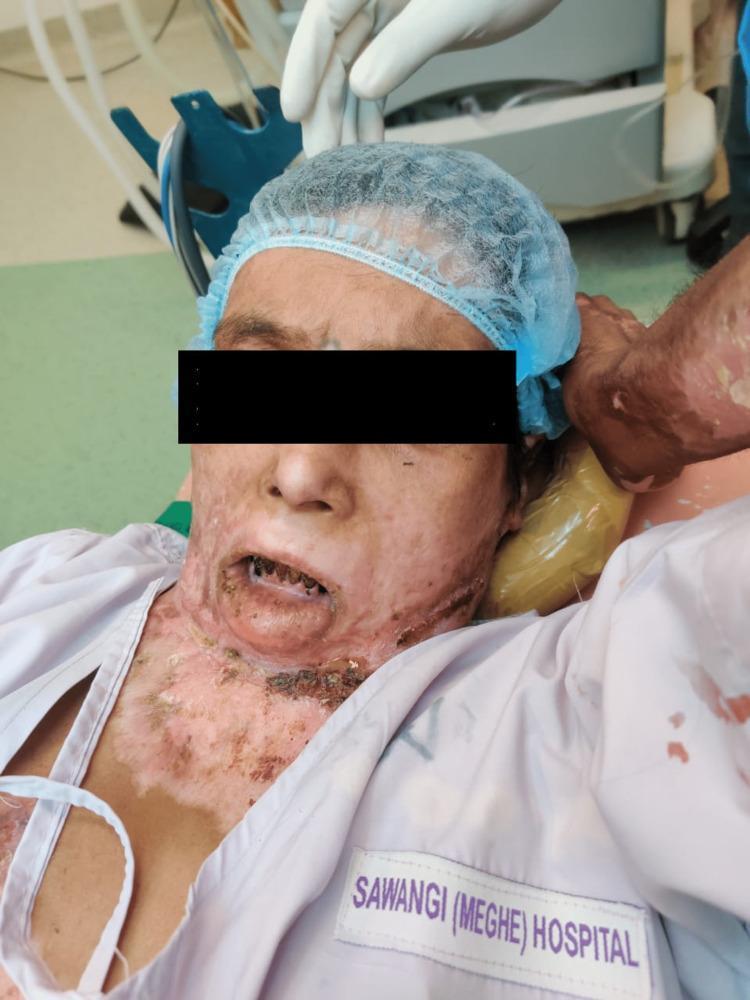
Clinical photograph of a patient in a supine position, demonstrating severe post-burn sequelae affecting the lower face, neck, and upper chest. Key clinical findings include extensive hypertrophic scarring and contracture bands extending from the submental region to the infraclavicular area. The neck contracture has resulted in a fixed flexion deformity at the atlanto-occipital joint, severely restricting cervical extension. Facial involvement is marked by microstomia (restricted mouth opening) and eversion of the lower lip (ectropion) with exposed mucosa. The skin exhibits multi-chromatic dyspigmentation, including areas of hypopigmentation, erythema, and hyperpigmented scarring, along with possible crusting or eschar near the base of the neck. The patient is shown in a perioperative or critical care setting, indicated by the surgical cap, head support, and gloved medical personnel, likely preparing for airway management or reconstructive surgery. This image serves as a significant clinical example of complex burn contractures and the associated challenges in managing difficult airways and physical rehabilitation.
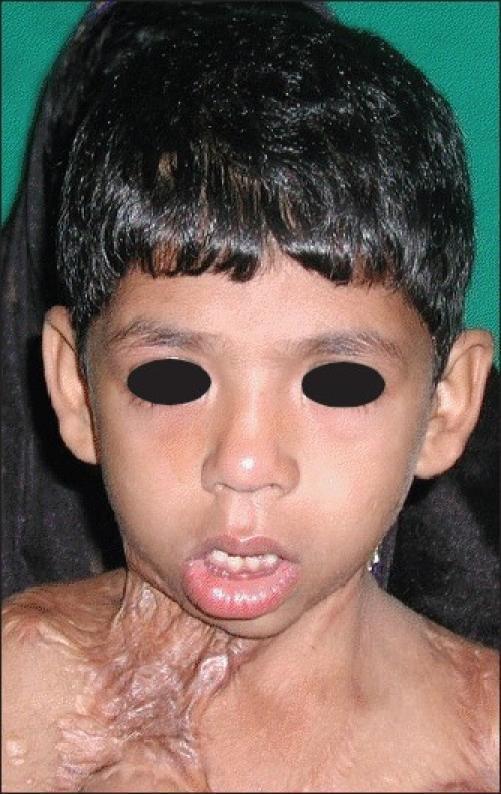
Clinical photograph of a pediatric patient (approximately 5 years old) presenting with a severe, recurrent post-burn contracture (PBC) of the neck and upper chest. The affected area exhibits extensive hypertrophic scarring and keloid-like tissue formation, characterized by irregular, raised textures and varying hyperpigmentation ranging from pink to deep reddish-brown. The contracture significantly affects the cervicomental angle and sternomental distance, causing a downward traction on the lower facial structures. Visually, this is manifested as an eversion or pulling down of the lower lip (ectropion of the lip), resulting in a partially open mouth and blunting of the mandibular definition on the affected side. The image illustrates the complex secondary deformities associated with severe burn sequelae in the head and neck region, specifically the functional and aesthetic impact of scar contracture on facial symmetry and range of motion. It serves as an educational example for plastic and reconstructive surgery planning, highlighting the challenges of managing recurrent scarring in pediatric burn patients.
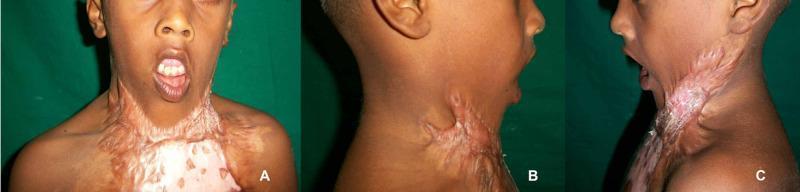
This composite clinical photograph series (A, B, C) demonstrates severe post-burn neck contracture in a pediatric patient. Frontal and lateral views reveal extensive hypertrophic scar tissue involving the anterior neck and extending inferiorly to the chest wall and superiorly toward the clavicles. The scar presents as a dense, irregular, and raised band of tissue with mixed hyper- and hypopigmentation. Key clinical findings include severe obliteration of the cervicomental angle (B), a permanent 'bowed down' head posture indicative of significant restriction in neck extension and flexion (C), and lower lip incompetence characterized by traction-induced ectropion where the lip is pulled inferiorly away from the gingiva (A). These visual features are consistent with Onah type 3c severe anterior neck contracture, illustrating the functional and aesthetic morbidity associated with unmanaged thermal injury, including restricted range of motion and facial secondary deformities.
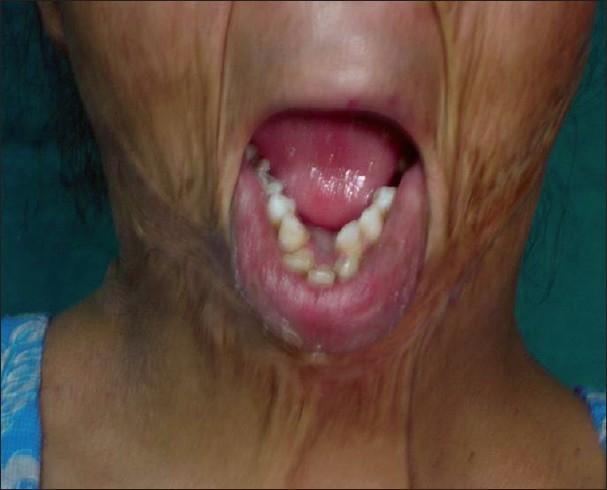
This clinical photograph displays a frontal view of a patient’s face and neck, illustrating the long-term sequelae of severe burn injuries. The image captures extensive, diffuse post-burn scarring across the lower face and neck, characterized by a mixture of hypopigmented and hyperpigmented areas and irregular, hypertrophic texture. A significant vertical scar contracture is visible on the neck, which is actively pulling down the mandible. This mechanical tension has resulted in a marked mandibular deformity and secondary dental malocclusion. The patient's mouth is open, revealing an asymmetrical, V-shaped dental arch in the lower jaw where the teeth are misaligned and tilted anteriorly due to the chronic traction from the neck contracture. The image serves as a clinical example of how unreleased soft tissue contractures can lead to permanent skeletal and occlusal changes, necessitating combined plastic surgical release and orthodontic or orthognathic intervention.
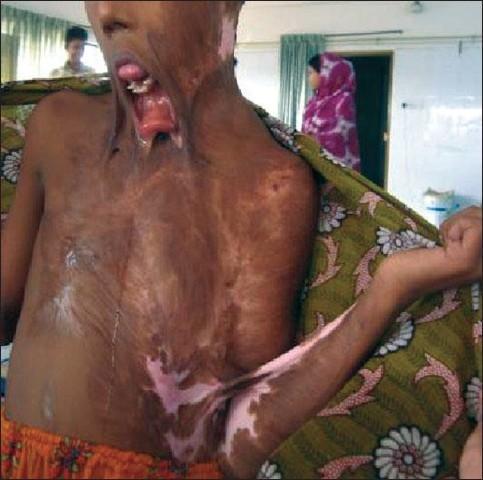
This clinical photograph displays severe, chronic post-burn complications in a pediatric or adolescent patient. The image shows extensive hypertrophic scarring and tissue contracture affecting the face, neck, and upper torso. Notable features include a severe neck contracture that has pulled the chin downward toward the chest, resulting in a marked mandibular deformity and persistent open-mouth posture (ectropion of the lower lip). The oral cavity exhibits significant distortion with dental malocclusion and a protruding tongue, likely exacerbated by soft tissue traction. The skin across the anterior chest and neck is characterized by irregular texture, areas of both hyperpigmentation and hypopigmentation (depigmentation), and dense fibrous bands. A web-like contracture is also visible in the left axillary and antecubital region, significantly restricting the range of motion. This image illustrates the long-term sequelae of inadequately managed severe burns, highlighting the critical need for early anti-contracture positioning, splinting, and surgical reconstruction in burn rehabilitation.
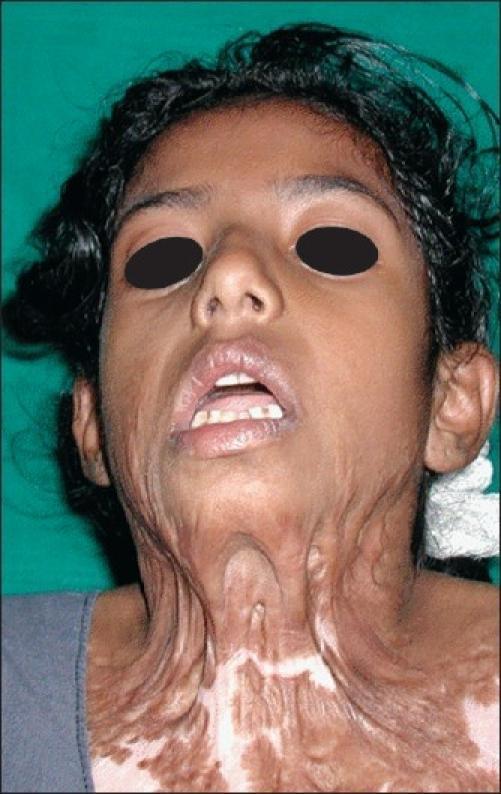
Clinical photograph of an 8-year-old female patient demonstrating a severe recurrent post-burn contracture of the neck. The image reveals extensive hypertrophic scarring extending from the lower face and perioral region down to the upper chest. Key findings include prominent longitudinal bands of scarred, thickened skin (cicatricial bands) that pull the chin toward the sternum, resulting in a distorted cervicomental angle and restricted neck extension. The skin exhibits significant dyspigmentation, characterized by a mosaic pattern of hyperpigmented dark brown patches and hypopigmented (depigmented) areas on the chest and neck. The lower lip appears slightly retracted due to the tension from the cervical contracture, and the normal anatomical contours of the neck are obliterated by tight, inelastic scar tissue. This case illustrates the functional and aesthetic impairment common in pediatric burn survivors with recurrent contractures following previous skin grafting.
post burn hand contracture grades severity clinical photo
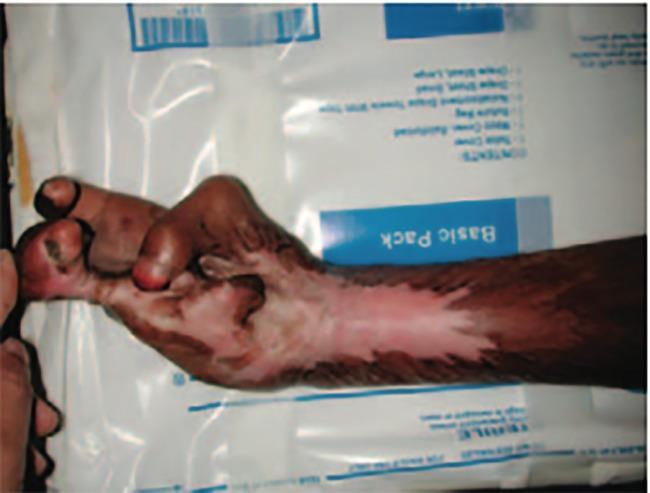
Clinical photograph of a young patient's hand and forearm demonstrating severe post-burn contractures, specifically following an electrical injury. The image shows extensive hypertrophic scarring and tissue fibrosis spanning the forearm and hand. There is a prominent mottled skin appearance with areas of hypopigmentation (leukoderma) centrally along the forearm and palm, surrounded by hyperpigmentation. The hand is fixed in a non-functional, clenched posture characterized by severe flexion contractures of the fingers and adduction of the thumb. These findings indicate a significant loss of range of motion and functional impairment, including inability to perform basic grasping or manipulation. The clinical presentation is characteristic of poorly managed or chronic severe burn wounds, where contracting scar tissue leads to permanent orthopedic and soft tissue deformities. This visual is used to teach the consequences of delayed plastic surgical intervention, such as contracture release and skin grafting, in resource-limited settings.
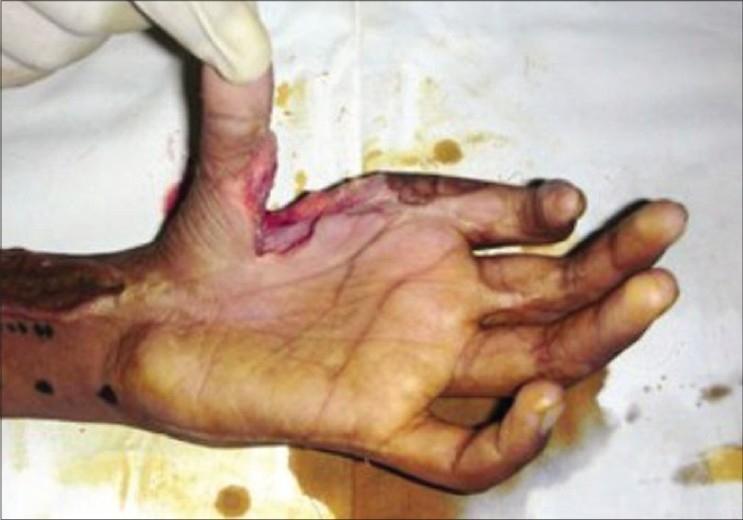
Clinical photograph of a human hand showing a surgical soft tissue defect following the release of a post-burn contracture in the first web space. The image depicts the hand in a supinated position, revealing an open surgical site between the thumb and index finger. The defect has irregular, slightly raised edges with exposed red underlying tissue, likely muscle or deep dermis. Linear hyperpigmented scars and markings are visible along the volar aspect of the wrist and palm, consistent with chronic burn sequelae. The thumb is being manually extended by a gloved hand to demonstrate the restored range of motion in the web space. This visual serves as a pre-operative or intra-operative educational tool for plastic and reconstructive surgery, illustrating the management of hand contractures and the preparation of a recipient site for subsequent flap coverage.
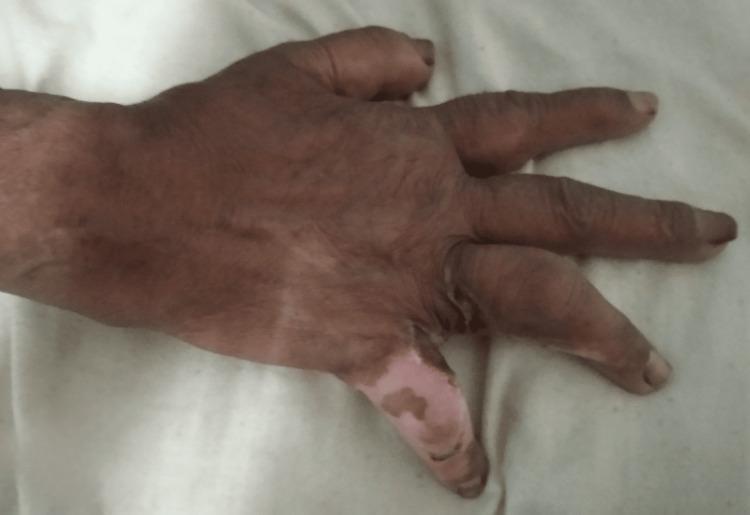
This clinical photograph displays the dorsum of a hand with significant post-burn sequelae and surgical interventions. The image illustrates a second-degree burn injury complicated by wound contracture, particularly affecting the fourth (ring) and fifth (little) digits. There is visible evidence of split skin grafting, characterized by well-demarcated patches of hypopigmented and differently textured skin on the dorsum of the hand and the fourth digit, contrasting with the patient's natural darker skin tone. The fourth and fifth digits show restricted extension and an inward pulling toward the palm, indicative of burn-induced contracture. The skin appears dry, with scattered pigmentation and scarring in the interdigital space between the affected fingers. This visual serves as an educational example of plastic and reconstructive surgery outcomes for thermal injuries, demonstrating the appearance of skin grafts and the clinical manifestation of post-burn functional impairment in the hand.
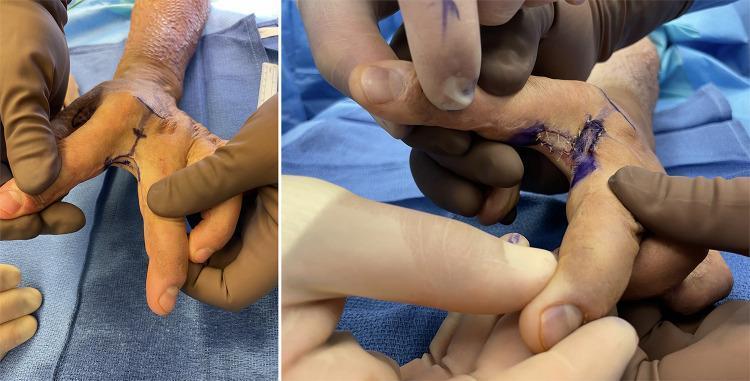
Two side-by-side intraoperative clinical photographs demonstrate the surgical management of a post-burn webspace contracture in a 32-year-old male. The image on the left shows the dorsal view of the hand, highlighting a severe second webspace contracture between the index finger and thumb, with visible surgical marking ink outlining planned incisions. The surrounding skin exhibits hyperpigmentation and pebbled texture consistent with mature split-thickness skin grafts (STSG) from prior burn treatment. The image on the right shows the immediate postoperative result following an ulnar-sided index finger transposition flap. Visible sutures are present along the newly reconstructed webspace, where the flap has been rotated to increase the depth and breadth of the web. A full-thickness skin graft has been applied to the donor site on the index finger. These images illustrate reconstructive techniques for restoring hand function and range of motion following cicatricial contracture.
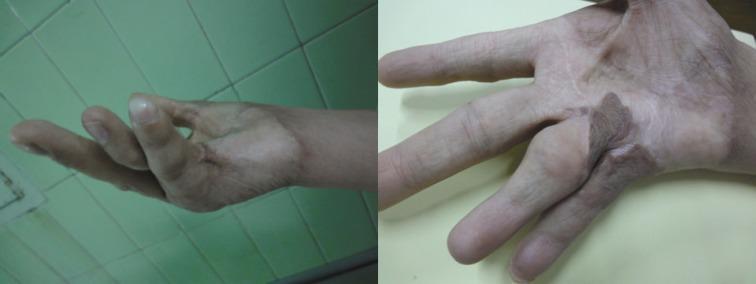
Clinical photograph presenting two views of a human hand following surgical reconstruction for burn contracture. The images demonstrate the long-term appearance of full-thickness skin grafts (FTSG) applied to the fourth and fifth digits. On the fourth finger, the graft exhibits significant post-inflammatory hyperpigmentation, appearing as a dark brown, demarcated patch that contrasts sharply with the surrounding paler skin of the palm and digit. In comparison, the graft on the fifth finger shows less pigmentation. Visually, the fourth and fifth fingers are in a state of adduction and partial flexion, suggesting residual contracture and restricted range of motion. The skin in the interdigital space and proximal phalanges shows altered texture and scarring typical of post-burn sequelae. This educational material illustrates common postoperative outcomes in plastic and reconstructive surgery, specifically highlighting variations in graft pigmentation and the physical manifestation of digital burn contractures.
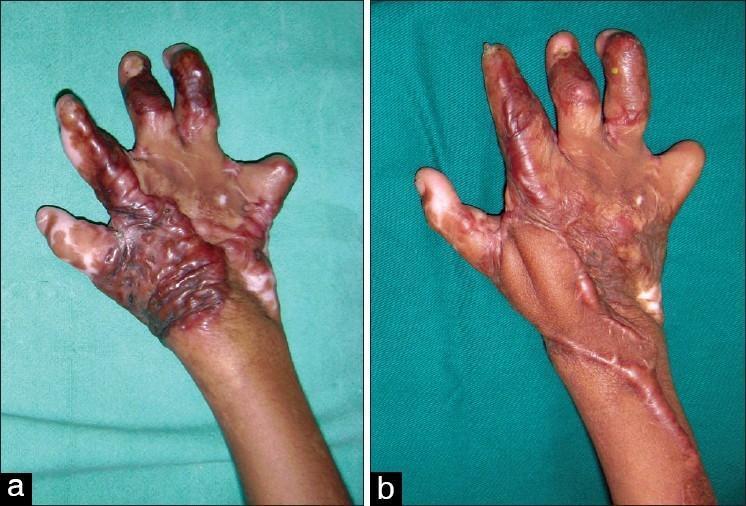
This clinical photograph comparison demonstrates the preoperative and postoperative states of a severe post-burn hand deformity in a pediatric patient. Image (a) shows a severe first-web space contracture with the thumb in a fixed adducted position. The skin exhibits extensive hypertrophic scarring, dark hyperpigmentation, and areas of hypopigmented patches, indicating deep thermal injury. The fingers also show signs of flexion deformities and scarring. Image (b) illustrates the hand following surgical intervention using a posterior interosseous flap. The first-web space has been successfully released, evidenced by the significantly improved abduction and pronation of the thumb. The surgical site is covered by a well-integrated skin flap that fills the previously contracted space. A longitudinal linear scar is visible on the dorsal forearm, corresponding to the flap harvest donor site. This comparison highlights the efficacy of regional flap reconstruction in restoring the functional anatomy of the thumb's range of motion and improving hand utility after severe burn contractures.
post burn axillary contracture web type grade clinical
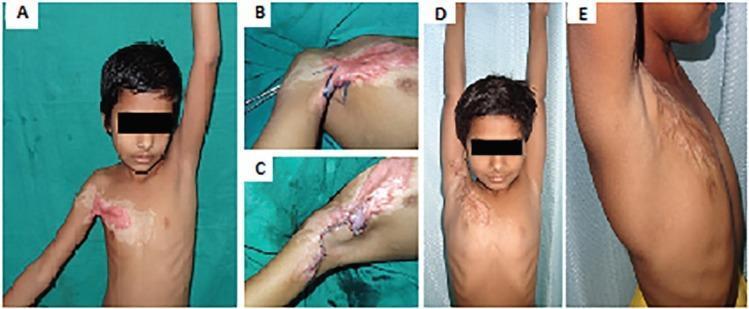
This clinical series documents the surgical management of a pediatric post-burn axillary contracture using a square flap and transposition flaps. Image A shows the preoperative state with a severe Type 1a contracture of the right anterior axillary fold, characterized by hypertrophic scarring, skin tethering, and significantly limited shoulder abduction. Image B displays the intraoperative preoperative markings for a square flap and two adjacent triangular flaps designed to release the tension. Image C illustrates the immediate postoperative result, showing the advancement of the square flap and transposition of the triangular flaps secured with sutures, effectively lengthening the axillary fold. Images D and E show the one-year follow-up results in frontal and lateral views, demonstrating successful scar remodeling and the restoration of full, 180-degree shoulder abduction. The series highlights surgical techniques in plastic and reconstructive surgery for burn sequelae, focusing on contracture release and regional flap design to improve functional and cosmetic outcomes.
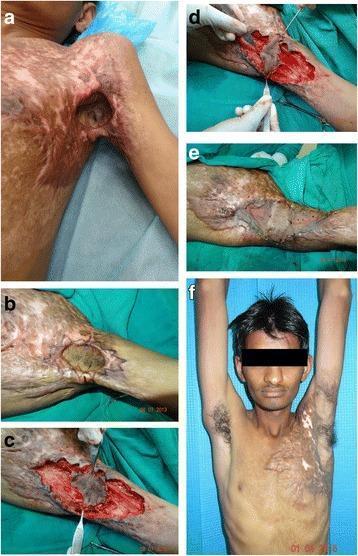
A clinical composite image series documenting the surgical management of a Type II left axillary post-burn contracture in a 29-year-old male. (a) Preoperative view showing severe anterior chest wall scarring and limited shoulder abduction (45°). (b) Intraoperative markings for a zig-zag modified propeller flap based on a central subcutaneous pedicle. (c, d) Contracture release and elevation of the islanded flap, followed by a 90-degree 'propeller' rotation to straddle the anterior and posterior axillary contracting bands. (e) Immediate postoperative view illustrating the flap inset with primary closure of partial donor sites and split skin grafting (SSG) for remaining defects. (f) Three-year follow-up demonstrating restoration of full range of motion (overhead abduction), improved skin contour, and aesthetic outcome. The sequence illustrates the utility of subcutaneous pedicled propeller flaps in reconstructing complex joint contractures by interposing healthy skin into the scar field to prevent recurrence.
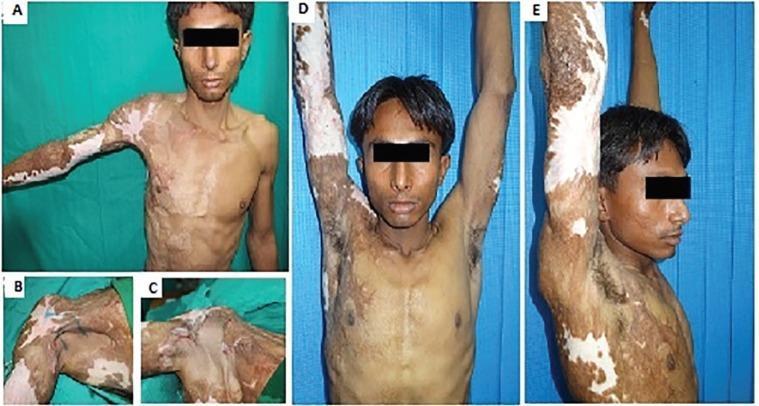
This composite of clinical photographs illustrates the surgical management of a Type 1a right axillary contracture resulting from thermal burns. Panel A shows the preoperative state, characterized by extensive hypertrophic scarring with mixed hyperpigmentation and hypopigmentation (vitiliginous areas) across the anterior chest and right arm, causing significant restriction in shoulder abduction. Panel B demonstrates the preoperative marking for a square flap technique, a modified Z-plasty designed to maximize tissue lengthening. Panel C displays the immediate postoperative appearance with the square flap advanced and triangular flaps transposed to release the contracture. Panels D (frontal) and E (lateral) show the long-term follow-up at 1.5 years, demonstrating a successful clinical outcome with full 180-degree shoulder abduction. The skin in the reconstructed axilla shows improved texture and elasticity, although residual post-burn pigmentary changes persist on the adjacent trunk and extremity. This sequence serves as an educational resource for plastic and reconstructive surgery, highlighting local flap techniques for post-burn scar contracture release.
post burn elbow flexion contracture scar classification
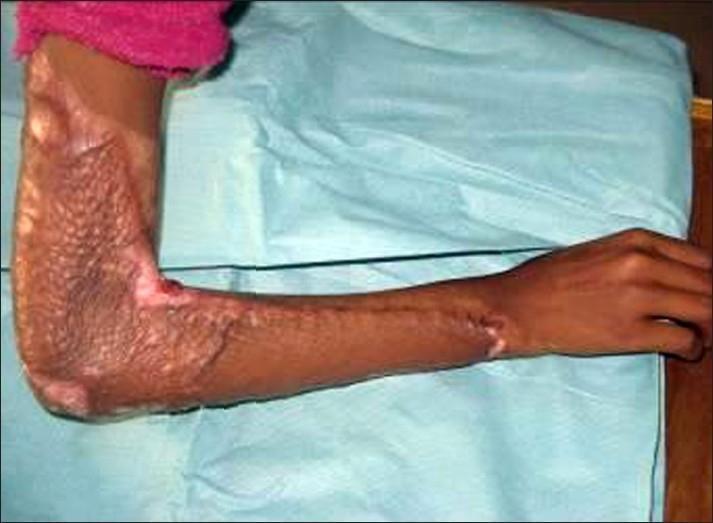
A clinical photograph of the right upper extremity of a patient showing a significant post-burn flexion contracture at the elbow joint. The skin over the upper arm and antecubital fossa displays extensive hypertrophic scarring with a thickened, pebbled, or 'mosaic-like' texture and hyperpigmentation, consistent with healed deep-partial or full-thickness thermal injury. There is a visible linear surgical scar extending down the volar forearm towards the wrist, featuring evenly spaced suture marks, likely representing a previous reconstructive procedure such as a contracture release or skin graft. At the distal forearm near the wrist, there is a prominent skin protrusion and irregular scar tissue. The photograph illustrates the complications of secondary intention healing in burn patients and highlights the importance of anti-contracture positioning and splinting to maintain range of motion and prevent permanent joint deformity.
Clinical photographs depicting the pre-operative and intra-operative stages of burn scar contracture release and reconstruction. Left: A 32-year-old female presents with severe post-burn sequelae on the bilateral upper extremities. The skin demonstrates diffuse, mottled dyspigmentation and textural irregularities consistent with extensive scarring and previous split-thickness skin grafting (STSG). A rigid 90-degree flexion contracture of the elbow is evident. Middle: Intra-operative view showing a large soft tissue defect at the elbow following release of the burn scar and lacertus fascia, and lengthening of the biceps tendon. The surgical field reveals exposed deeper tissues prepared for reconstruction. Right: Post-reconstruction view showcasing a successful free Anterolateral Thigh (ALT) flap used to cover the 12x12 cm defect. The flap is secured with visible circumferential sutures at the elbow joint, and the limb is shown in improved extension. The case illustrates advanced plastic surgery techniques including contracture release and microsurgical free flap reconstruction for complex burn injuries.
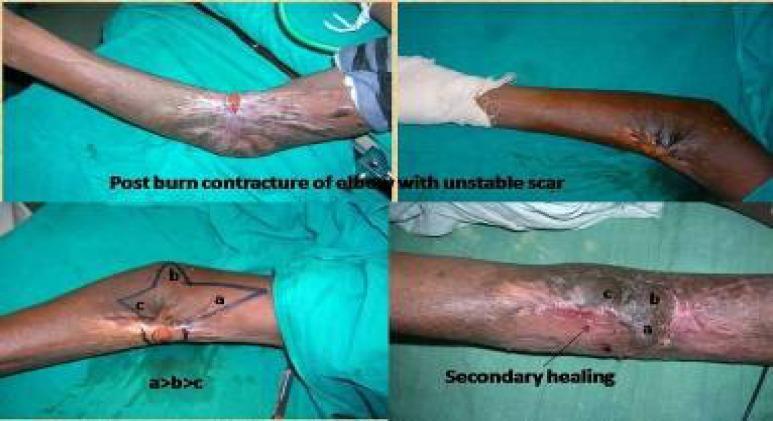
A composite of four clinical photographs demonstrating the preoperative state and surgical planning for a post-burn elbow contracture. The top panels show the affected arm with extensive scarring, hyperpigmentation, and hypopigmentation, illustrating an unstable scar and significant flexion contracture of the elbow joint. The bottom-left panel details the preoperative surgical markings for a trilobed perforator flap. The markings define three adjacent skin flaps labeled 'a', 'b', and 'c' in descending order of size (indicated by the notation 'a>b>c'), designed to be rotated to release the contracture. The bottom-right panel displays the area after initial surgical steps or secondary healing, with labels corresponding to the planned flap locations. This sequence illustrates the reconstructive plastic surgery approach using a specialized perforator flap technique to restore joint mobility and skin integrity in a patient with severe thermal injury sequelae.
Clinical Images: Grades of Post-Burn Contracture
NECK CONTRACTURE (Aydin's / Onah Classification)
Grade II - Severe restriction, decreased chin-sternum distance
Grade III - Complete fusion, chin-to-chest (Onah Type 3c)
Grade III with secondary skeletal deformity
Severe neck contracture - perioperative setting
Pediatric recurrent neck contracture (post-grafting)
AXILLARY CONTRACTURE
Type 1a - Anterior axillary fold contracture (mild-moderate)
Type II - Severe axillary contracture (shoulder abduction 45°)
HAND CONTRACTURE
First web space contracture

Second web space contracture (with intraoperative planning)
Digital flexion contracture (ring and little fingers)
Severe hand and forearm contracture (Grade III / complete functional loss)
ELBOW CONTRACTURE
Moderate elbow flexion contracture
Severe elbow contracture with perforator flap planning
Severe (90°) elbow contracture requiring free flap
Quick Grade Reference Summary
| Grade | Neck | Axilla | Hand/Elbow |
|---|---|---|---|
| Mild (I) | Restricted mobility, platysma visible | Slight restriction in abduction | Minor functional deficit, OT manageable |
| Moderate (II) | Severely restricted, chin-sternum distance decreased | Abduction 45-90°, anterior fold tethering | Moderate deficit, surgery needed |
| Severe (III) | Complete fusion, chin to chest | <45° abduction, web formation | Severe/complete loss of function (claw hand, fixed joint) |