
Lesion in web spaces Differentials
Reading File
Lesions in the web spaces (interdigital spaces) can arise from infections, inflammatory conditions, and neoplasms. Let me search the library for a thorough differential.
Searching sources...
Finding Sources
Finding Sources
Reading File
Finding Sources
Reading File
Reading File
Reading File
Finding Sources
Finding Sources
Reading File
Reading File
Now I have enough from textbook sources to compile a thorough answer. Let me also fetch the clinical image of the pitted keratolysis for visual context.
Loading Image
Loading Image
Here is a structured differential for lesions in the web spaces (interdigital spaces), covering both the hand and the foot, organized by category:
Differentials: Lesion in the Web Space
I. INFECTIONS
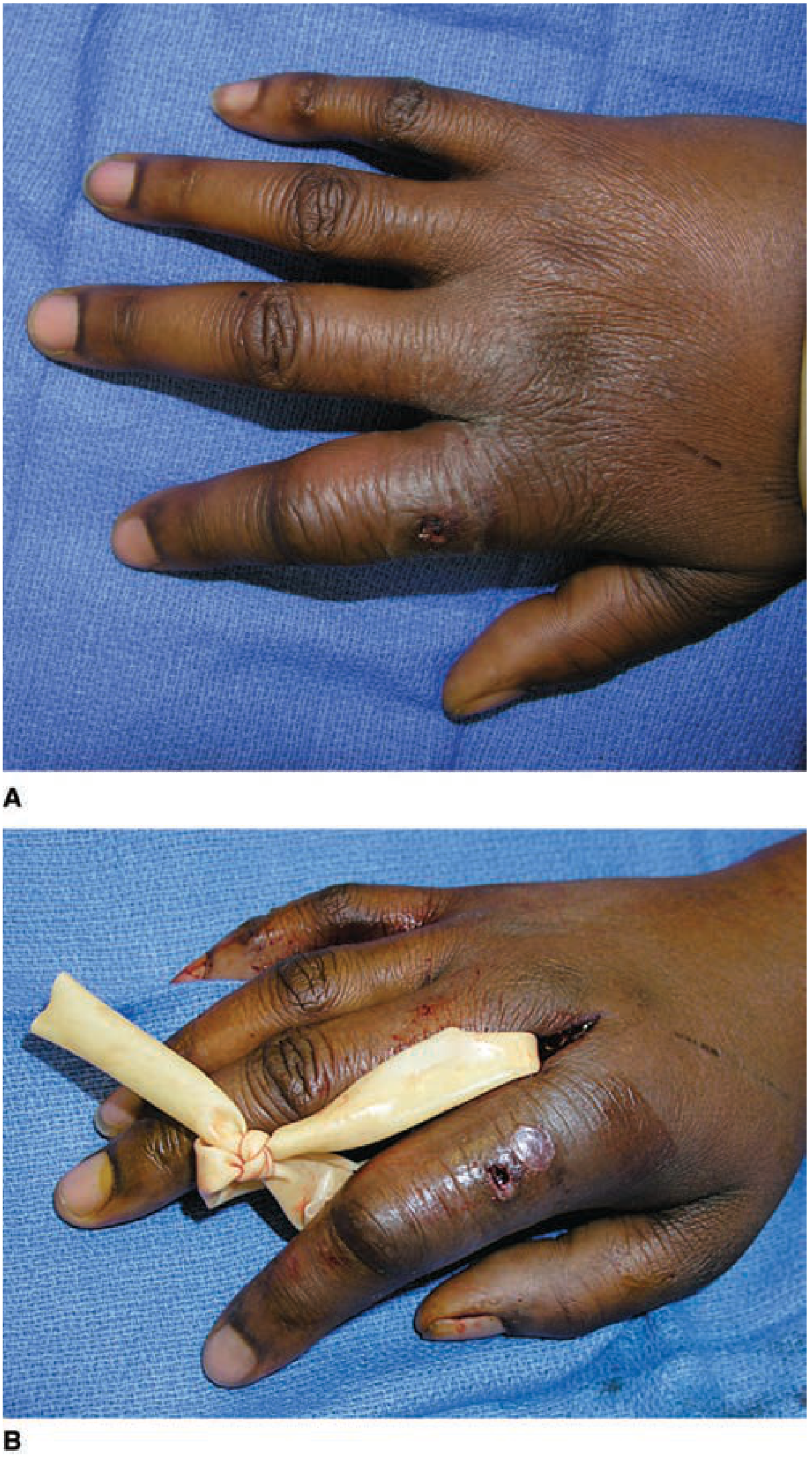
1. Web-Space Abscess (Collar-Button Abscess) - Hand
The most important surgical emergency in this category. A subfascial infection of the palmar web space, usually from skin trauma or spread from a pulp-space infection.
- Key features: Tender, fluctuant swelling at the web space; adjacent fingers held in abduction with pain on adduction; dorsal swelling (do NOT mistake for the infection site - the pus tracks from palmar to dorsal through the natatory ligament, creating the "collar-button" or "dumbbell" shape)
- Organism: S. aureus most common
- Treatment: I&D via transverse volar + longitudinal dorsal counterincisions
(Schwartz's Surgery 11e, p. 1976; Sabiston's Surgery 21e, p. 2758)
2. Tinea Pedis (Interdigital Type) - Foot
The most common fungal infection of the web spaces. Affects the 4th-5th toe cleft most often (sometimes 3rd-4th).
- Key features: Maceration, scaling, fissuring, pruritus; can be erosive; may co-exist with erythrasma
- Organism: Trichophyton rubrum, T. mentagrophytes
- Diagnosis: KOH preparation, culture
- Treatment: Topical azoles/allylamines
(Harrison's 22e; Fitzpatrick's Dermatology 9e)
3. Erythrasma - Foot (Toe Clefts)
Superficial bacterial infection caused by Corynebacterium minutissimum.
- Key features: Reddish-brown patches, fissuring, white maceration in toe clefts; hyperkeratotic but can be erosive; coral-red fluorescence on Wood's lamp (coproporphyrin III)
- Risk factors: Obesity, diabetes, tropical climate, male sex
- Differential trap: Commonly misdiagnosed as tinea pedis or pitted keratolysis
- Treatment: Topical/oral clindamycin or erythromycin
(Fitzpatrick's Dermatology 9e)
4. Pitted Keratolysis - Foot Web Spaces
Superficial bacterial infection of the stratum corneum; web spaces are a common (sometimes sole) site.
- Key features: Crateriform pits coalescing into large defects with serpiginous borders; slimy feel; malodor (two-thirds of patients); pain/burning in one-third; male predominance (~90%)
- Organisms: Kytococcus sedentarius, Dermatophilus congolensis, Corynebacterium spp.
- Pathophysiology: Warm, moist, occlusive footwear → neutral skin pH → proteolytic invasion of stratum corneum
- Differential trap: Misdiagnosed as interdigital tinea pedis
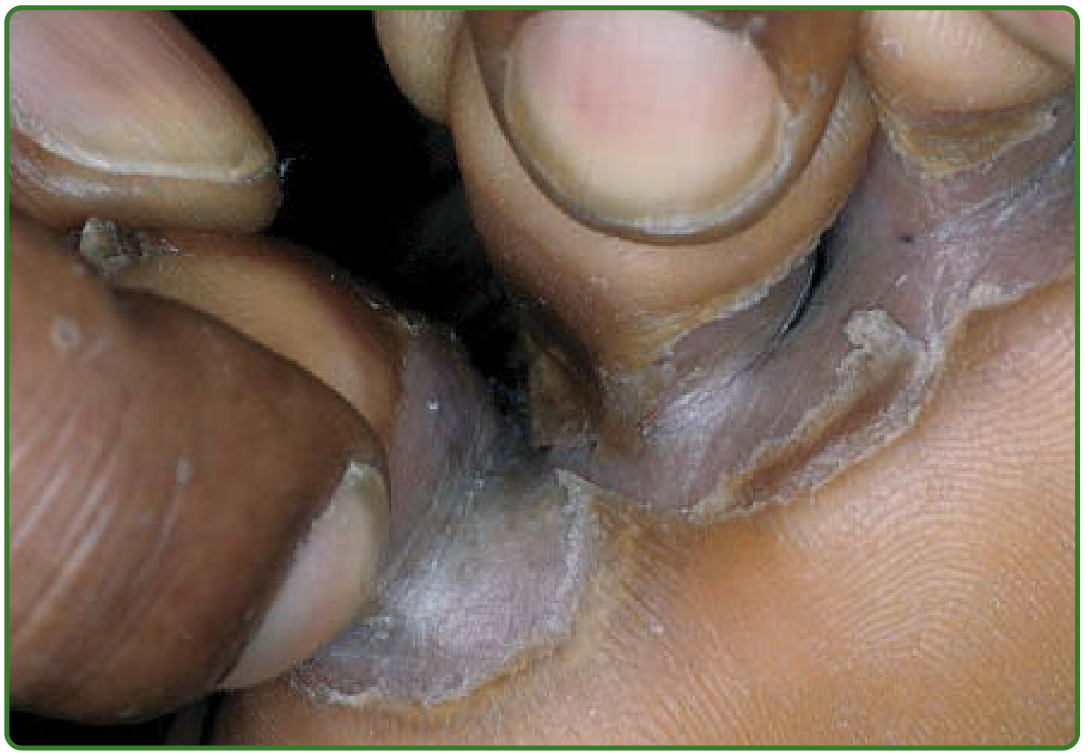
(Fitzpatrick's Dermatology 9e, p. 2770)
5. Cellulitis / Lymphangitis - Hand or Foot
Diffuse spreading infection without pus collection; typically from skin breach.
II. MECHANICAL / STRUCTURAL LESIONS
6. Soft Corn (Interdigital Corn / Heloma Molle) - Foot
Callosity in the web space between toes, classically on the inner aspect of the 4th toe at the base of the proximal phalanx.
- Key features: Whitish, macerated, soft lesion; pressure from adjacent bony prominences; can ulcerate and become infected by normal web-space flora; occasionally a sinus tract develops between the corn and the web space leading to suppuration
- Treatment: Spacers, footwear modification, paring, surgery if needed
(Campbell's Operative Orthopaedics 15e; Dermatology 5e)
7. Barber's Interdigital Pilonidal Sinus - Hand
Occupational lesion in barbers/hairdressers.
- Key features: Clipped hairs with bevelled tips penetrate the hair-free web-space skin like a hypodermic needle; black dot at the dorsum of the cleft; palpable nodule; 80% are multiple; prone to inflammation and secondary infection
- Location: Usually between middle and ring fingers of the dominant hand in barbers; between toes in female hairdressers who go barefoot
(S. Das - Manual on Clinical Surgery 13e, p. 323)
III. NEUROLOGICAL / ENTRAPMENT LESIONS
8. Morton's Neuroma (Interdigital Neuroma) - Foot
Entrapment neuropathy of the interdigital plantar nerve.
- Key features: Most common in the 3rd web space (between 3rd and 4th metatarsal heads), followed by the 2nd; burning/shooting pain radiating to toes; worse in tight footwear, relieved by removing shoe; Mulder's sign (palpable click with lateral compression); tenderness in the web space between metatarsal heads
- Imaging: MRI or ultrasound (hypoechoic mass plantar to the web space, expelled on forefoot compression)
- Treatment: Footwear modification, steroid injection, surgical excision
(Miller's Review of Orthopaedics 9e; Rheumatology 2022; Textbook of Family Medicine 9e)
IV. NEOPLASTIC / CYSTIC LESIONS
9. Ganglion Cyst
Can rarely arise from the web space or migrate there from adjacent joints/tendon sheaths.
- Key features: Smooth, fluctuant, transilluminant cystic swelling; may be tense or soft
10. Implantation Dermoid
From penetrating trauma (needle, fish bone, foreign body) driving epithelium subcutaneously.
- Key features: Soft cystic swelling; not attached to skin or deep structures; fluctuant; history of prick/penetrating injury
(S. Das - Manual on Clinical Surgery 13e)
V. SCABIES (Special Mention)
A classic early sign of scabies is burrows and papules in the interdigital web spaces (especially hands), as this is a favored site for the mite Sarcoptes scabiei.
- Key features: Intense nocturnal pruritus; affects multiple household contacts; burrows are pathognomonic; also affects wrists, finger sides, genitalia
- Treatment: Permethrin 5%, ivermectin
Summary Table
| Category | Lesion | Key Clue |
|---|---|---|
| Infection (Hand) | Web-space / Collar-button abscess | Fingers abducted, dorsal + palmar swelling |
| Infection (Foot) | Tinea pedis (interdigital) | Maceration, scaling, 4th-5th cleft |
| Infection (Foot) | Erythrasma | Coral-red Wood's lamp fluorescence |
| Infection (Foot) | Pitted keratolysis | Crateriform pits, malodor, sweaty feet |
| Infection (General) | Cellulitis | Diffuse erythema, warmth, no fluctuance |
| Mechanical | Soft corn (heloma molle) | Macerated corn between toes |
| Occupational | Barber's pilonidal sinus | Black dot, hairdresser/barber, hand |
| Neurological | Morton's neuroma | Burning pain, Mulder's sign, 3rd web space foot |
| Cystic | Ganglion cyst | Transilluminant, smooth |
| Cystic | Implantation dermoid | H/o penetrating trauma |
| Parasitic | Scabies | Nocturnal itch, burrows, contact history |
Clinical tip: In the hand, the surgical priority is always to exclude a collar-button abscess (requires urgent I&D). In the foot, tinea pedis, pitted keratolysis, and erythrasma are the "triple overlap" - all present with web-space maceration and require differentiation via KOH prep and Wood's lamp. Morton's neuroma should always be considered when there is pain centered at the 3rd or 2nd web space of the foot.
Everything about scabies
Reading File
**Searching sources...**Your credits are exhausted. You can purchase a top-up or subscribe to a plan to continue using Orris. If you're already subscribed, your daily credits will reset tomorrow.
This is a shared conversation. Sign in to Orris to start your own chat.