
Tuberculosis
Reading File
Searching sources...
Finding Sources
Searching PubMed
"tuberculosis"[MeSH Terms] AND "treatment"[MeSH Terms]
Finding Sources
Reading File
Now let me read the main TB sections from the most authoritative sources - Robbins Pathology, Goldman-Cecil Medicine, and Murray & Nadel's Respiratory Medicine.
Reading File
Reading File
Reading File
Reading File
Reading File
Finding Sources
Reading File
Reading File
Reading File
Finding Sources
Reading File
Reading File
I now have comprehensive information from multiple authoritative sources. Let me fetch a few key images and compile the full answer.
Loading Image
Loading Image
Here is a comprehensive, textbook-based overview of Tuberculosis.
Tuberculosis (TB)
Definition and Etiology
Tuberculosis is a chronic communicable granulomatous disease caused by Mycobacterium tuberculosis, a rod-shaped, non-spore-forming, obligate aerobe measuring ~0.5 x 3 μm. In 2023, after being displaced by COVID-19 for three years, TB likely returned as the leading infectious cause of death from a single pathogen. The WHO estimated 1.3 million TB deaths and 5.8 million new cases in 2021.
Key microbiologic features:
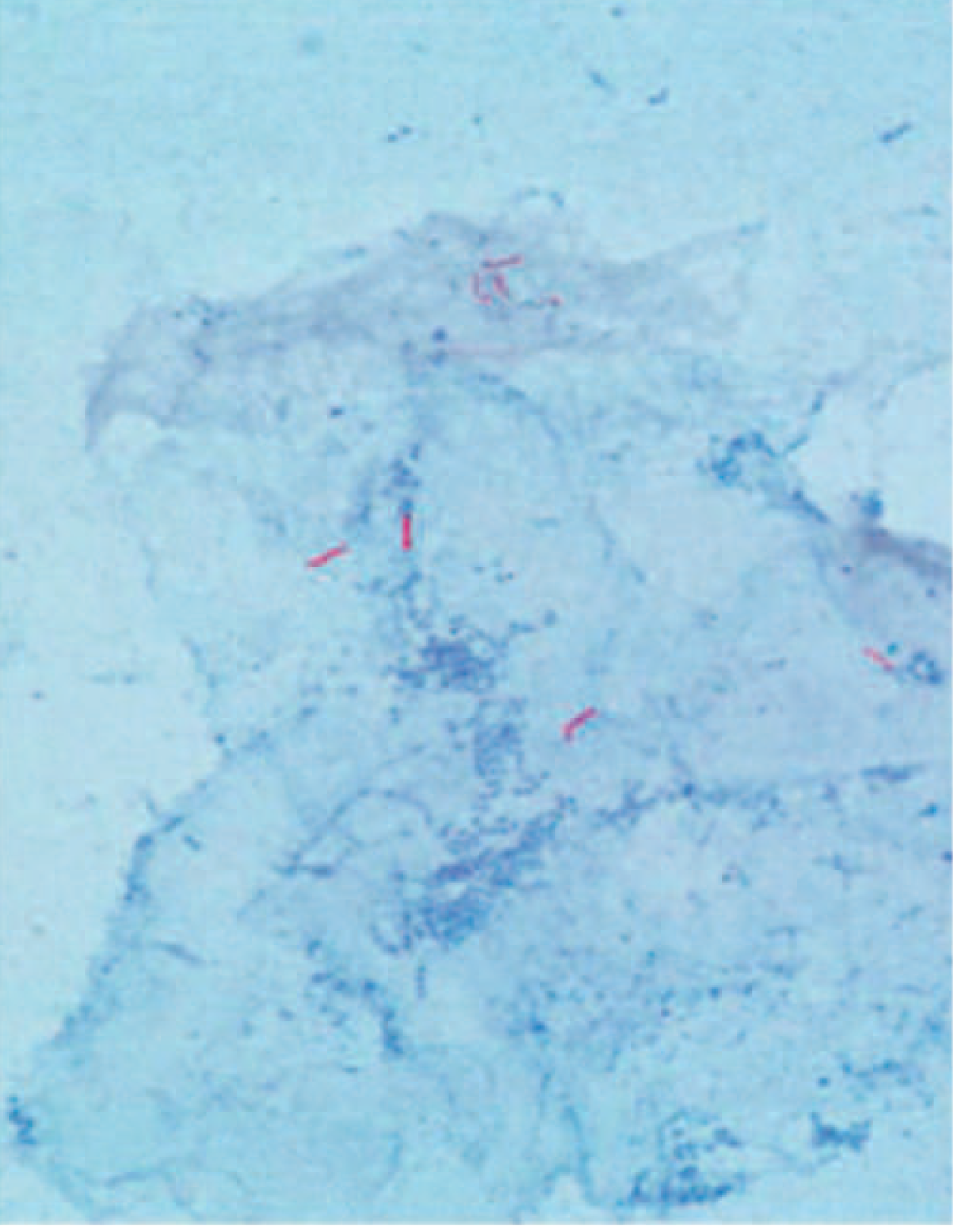
- Gram-stain neutral, but acid-fast - the hallmark characteristic. High mycolic acid content in the cell wall prevents decolorization by acid-alcohol after carbol fuchsin staining
- Extremely slow growth: doubles every 18-24 hours; cultures may take up to 10 weeks
- The complex, waxy cell envelope (mycolic acids, arabinogalactan, peptidoglycan, unique lipids like phthioceral dimycocerosate and trehalose dimycolates) creates a formidable barrier to antibiotic penetration
- Facultative anaerobe that can replicate intracellularly within macrophages
M. tuberculosis acid-fast bacilli under Ziehl-Neelsen stain (red rods on blue background):
The M. tuberculosis complex includes related species:
- M. africanum - causes TB in West/Central/East Africa
- M. bovis - transmitted via unpasteurized dairy; intrinsically pyrazinamide-resistant
- M. caprae, M. pinnipedii, M. microti - zoonotic members
Epidemiology and Risk Factors
TB flourishes in poverty, crowding, and chronic debilitating illness. High-risk groups include:
- HIV/AIDS patients (dominant risk factor in HIV-endemic regions; CD4 <200/μL carries greatest risk)
- The urban poor, elderly, foreign-born
- Patients with diabetes, Hodgkin lymphoma, silicosis, CRF, malnutrition, alcohol use disorder, immunosuppression
- Approximately 13 million people have latent TB in the United States (2019)
- ~80% of populations in some Asian and African countries are tuberculin-positive
Pathogenesis and Immunity
Transmission is via airborne droplet nuclei from a person with active pulmonary TB. Droplet nuclei are generated when infected individuals cough, sneeze, or speak - they are small enough to remain suspended in air and reach the alveoli.
Sequence of events after inhalation:
- Bacilli inhaled, reach alveolar spaces - phagocytosed by alveolar macrophages
- Mycobacteria evade phagolysosomal killing (via lipoarabinomannan inhibiting phagosome maturation)
- Local replication triggers cytokine release (TNF, IL-1, IL-12); Th1 CD4+ T-cell response develops
- Cell-mediated immunity (CMI) develops over 2-8 weeks, controlled by IFN-γ-activated macrophages
- Characteristic caseating granulomas form - epithelioid macrophages, Langhans giant cells, central caseous necrosis, surrounded by lymphocytes and fibroblasts
- In ~95% of immunocompetent individuals, the primary infection is controlled and becomes latent
Primary vs. Secondary (Reactivation) TB
Primary TB
- Develops in the previously unexposed, unsensitized host
- About 5% of newly infected immunocompetent individuals develop significant disease
- Lesion typically forms in the lower part of the upper lobe or upper part of the lower lobe (areas receiving the most inspired air)
- Forms a Ghon focus: 1-1.5 cm gray-white area of consolidation with central caseous necrosis
- Regional lymph node involvement (caseous) + Ghon focus = Ghon complex
- On healing, fibrosis and calcification form the Ranke complex (visible on X-ray)
- Lymphatic/hematogenous dissemination occurs in early weeks, seeding distant organs
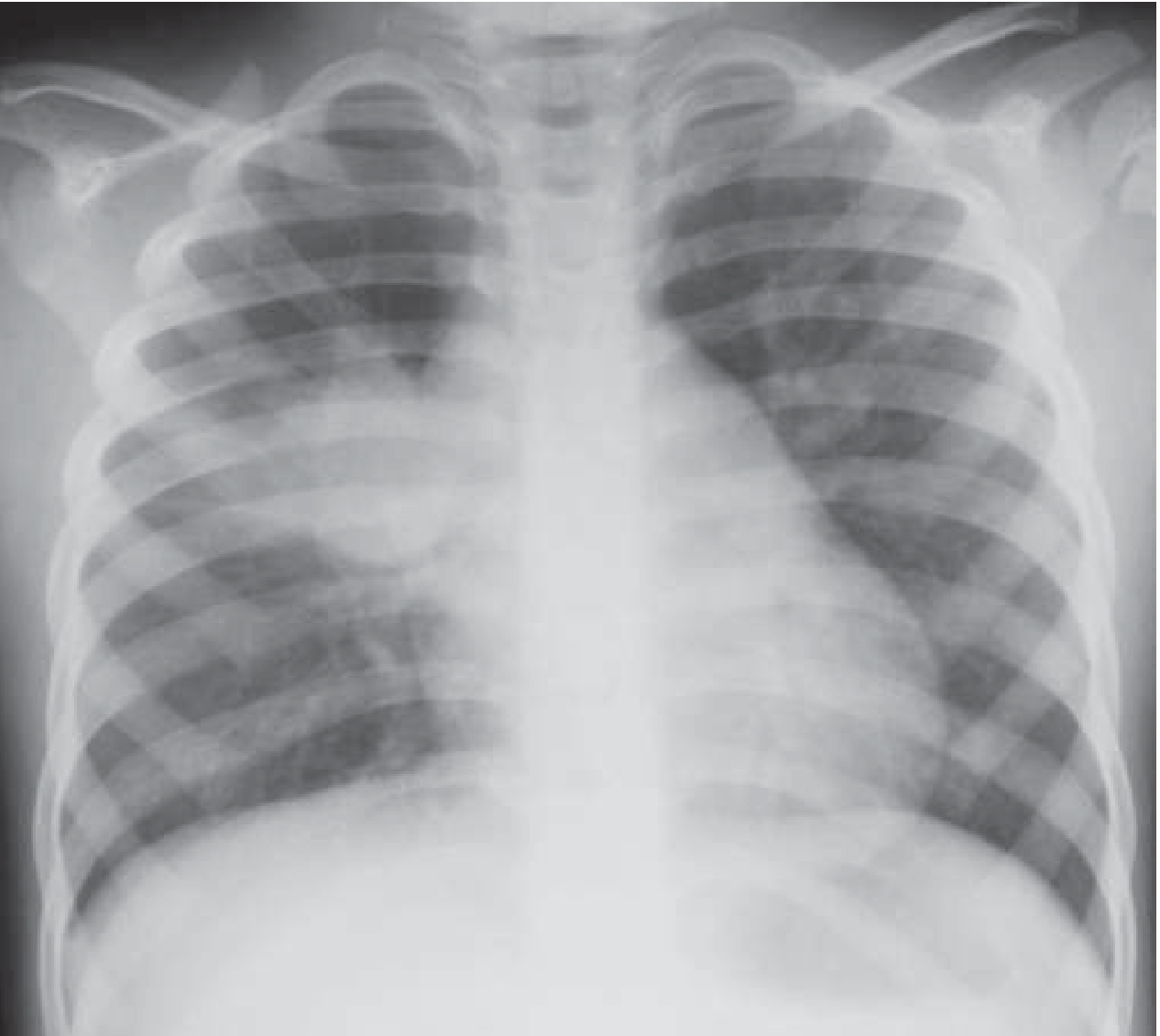
CXR showing right hilar lymphadenopathy with infiltration in primary TB in a child:
Secondary (Reactivation) TB
- Arises in a previously sensitized host - either from reactivation of dormant foci (decades later) or reinfection
- Less than 5% of patients with primary TB develop secondary TB
- Classically localizes to the apex of one or both upper lobes (possibly due to high oxygen tension)
- Prompt tissue response walls off the focus; regional lymph nodes are less prominently involved
- Cavitation is common: central caseous material liquefies and drains into bronchi, forming cavities (which are a major source of infectivity)
- Hallmark: productive chronic cough, hemoptysis, fever, night sweats, weight loss
Clinical Manifestations
Pulmonary TB (most common)
| Symptom | Notes |
|---|---|
| Cough | Initially dry, then productive and purulent |
| Hemoptysis | Present in ~50% of pulmonary cases |
| Fever | Low-grade, remittent; classically appears late afternoon |
| Night sweats | Classic constitutional feature |
| Weight loss, anorexia, malaise | Mediated by TNF and IL-1 from activated macrophages |
| Pleuritic chest pain | Extension of infection to pleural surfaces |
Extrapulmonary TB
Occurs in 10-40% of all TB patients; up to two-thirds of HIV-infected TB patients may have extrapulmonary involvement. Sites include:
| Site | Manifestation |
|---|---|
| Lymph nodes | Scrofula - cervical lymphadenitis (most common extrapulmonary form) |
| Pleura | Pleural effusion with exudative, lymphocyte-predominant fluid |
| CNS | Tuberculous meningitis: headache, neurologic deficits, high CSF protein, low glucose |
| Spine | Pott disease - vertebral collapse, back pain, paraplegia |
| Kidney | Hematuria, sterile pyuria, "putty kidney" calcification |
| Female genital tract | Salpingitis presenting as infertility |
| Pericardium | Constrictive pericarditis |
| Adrenal glands | Addison's disease |
| Disseminated | Miliary TB - hematogenous spread creating millet-seed size lesions in multiple organs |
Diagnosis
Tests for TB Infection (Latent TB)
-
Tuberculin Skin Test (TST / Mantoux / PPD)
- Intradermal injection of purified protein derivative
- Induration read at 48-72 hours
- Positive if ≥10 mm (≥5 mm in HIV+ patients/close contacts/immunosuppressed)
- Limitations: false-negative with anergy (HIV, malnutrition, overwhelming TB, sarcoidosis, Hodgkin's); false-positive from BCG vaccination and atypical mycobacteria
-
Interferon-Gamma Release Assays (IGRAs) (QuantiFERON-TB Gold, T-SPOT.TB)
- In vitro: patient T cells stimulated with M. tuberculosis antigens; IFN-γ production measured
- More specific than TST; not affected by BCG vaccination
- Both TST and IGRA cannot differentiate infection from active disease
Tests for Active TB
| Method | Details |
|---|---|
| Sputum AFB smear | Acid-fast staining (Ziehl-Neelsen or fluorescent auramine-rhodamine); most common first-line method |
| Culture | Gold standard; liquid media (radiometric assay) gives result in ~2 weeks vs. 10 weeks for solid media; required for drug-susceptibility testing |
| PCR / NAAT (e.g., Xpert MTB/RIF) | Rapid; can be done on sputum or tissue; detects M. tuberculosis and rifampin resistance simultaneously |
| CXR | Upper lobe infiltrates, cavitation in secondary TB; hilar adenopathy in primary TB |
| Bronchoscopy/BAL | When sputum cannot be obtained |
Treatment
Drug-Susceptible TB - Standard Regimen
Treatment uses two phases with directly observed therapy (DOT):
Intensive Phase (2 months): HRZE
- H - Isoniazid (INH)
- R - Rifampicin (Rifampin)
- Z - Pyrazinamide
- E - Ethambutol
Continuation Phase (4 months): HR (or HRE)
- Isoniazid + Rifampicin (+/- Ethambutol)
- Total duration: 6 months for most drug-susceptible pulmonary TB
- Extension by 12-24 weeks for CNS TB, skeletal TB, and disseminated TB
Key Drug Properties and Side Effects
| Drug | Mechanism | Key Adverse Effects |
|---|---|---|
| Isoniazid (H) | Inhibits mycolic acid synthesis (InhA) | Hepatotoxicity, peripheral neuropathy (prevent with pyridoxine/B6), drug-induced lupus |
| Rifampicin (R) | Inhibits RNA polymerase (beta subunit) | Hepatotoxicity, orange body fluids, potent CYP450 inducer (numerous drug interactions) |
| Pyrazinamide (Z) | Disrupts membrane energy metabolism (in acidic environment) | Hepatotoxicity, hyperuricemia/gout, arthralgias |
| Ethambutol (E) | Inhibits arabinosyltransferase (arabinogalactan synthesis) | Optic neuritis (monthly visual acuity/color vision monitoring required) |
Monitoring During Treatment
- Baseline: LFTs (ALT, bilirubin), creatinine, platelets, hepatitis serology
- Monthly: assessment for hepatotoxicity symptoms (nausea, vomiting, jaundice)
- Stop hepatotoxic drugs if ALT >5x ULN (or >3x ULN with symptoms)
- Monthly sputum cultures until clearance confirmed
- Monthly dispensing allows essential clinical monitoring
Latent TB Infection (LTBI) Treatment
Options include:
- 9H: 9 months of daily isoniazid (most widely used)
- 4R: 4 months of daily rifampicin
- 3HP: 3 months of weekly isoniazid + rifapentine (directly observed)
- 1HP: 1 month of daily isoniazid + rifapentine (newer regimen)
Drug-Resistant TB
- MDR-TB: Resistance to at least isoniazid AND rifampicin - the two most potent first-line drugs
- XDR-TB: MDR-TB + resistance to fluoroquinolones AND at least one injectable agent (bedaquiline, linezolid)
- WHO estimated 465,000 MDR-TB cases in 2019 (~3% of new cases, ~20% of previously treated cases)
- Epicenter: Eastern Europe, Russia, parts of Africa and Asia
- MDR-TB treatment requires 18-24+ months with second-line drugs (bedaquiline, delamanid, linezolid, fluoroquinolones); treatment is more toxic and less effective
Prevention and Control
- BCG vaccination: Effective against miliary TB and TB meningitis in children; provides variable protection against pulmonary TB in adults
- LTBI treatment: Prevents progression from infection to active disease
- Infection control: Airborne isolation of active cases; N95 respirators for healthcare workers; negative-pressure rooms; UV germicidal irradiation
- Contact tracing and DOT: Systematic identification and treatment of close contacts
- HIV treatment: ART markedly reduces TB risk in HIV-infected individuals
Prognosis
- Drug-susceptible TB properly treated: >95% cure rate
- Untreated active TB: fatal in >70% of cases
- MDR-TB: significantly worse outcomes, prolonged treatment, higher toxicity
- HIV co-infection: substantially increases morbidity and mortality
Sources: Harrison's Principles of Internal Medicine 22E (2025), Robbins & Kumar Basic Pathology, Goldman-Cecil Medicine, Park's Textbook of Preventive and Social Medicine
This is a shared conversation. Sign in to Orris to start your own chat.