MLI Of sexual asphyxia

Reading File
Finding Sources
Finding Sources
Finding Sources
Reading File
Reading File
Reading File
Reading File
Reading File
Reading File
Loading Image
I now have all the information needed for a comprehensive answer. Here is the full medico-legal importance (MLI) of Sexual Asphyxia:

Medico-Legal Importance (MLI) of Sexual Asphyxia

Definition

Sexual asphyxia (also called autoerotic asphyxia or asphyxiophilia) refers to asphyxial deaths - principally by hanging - in which transitory anoxia is intentionally induced to enhance sexual arousal produced by masturbation. Partial compression of the carotid vessels or partial obstruction of air passages causes cerebral disturbances and hallucinations of an erotic nature.
"These individuals use transitory anoxia produced by the noose to intensify the sexual gratification produced by masturbation; the impaired circulation leads to impaired consciousness which causes hallucinations and a feeling of erotic rapture."
  • P.C. Dikshit Textbook of Forensic Medicine and Toxicology

Methods Used

MethodDetails
Hanging (most common)Running noose around neck; weight of body controls pressure; noose tightened by extending limbs, relaxed by flexing
Plastic bag over headRe-breathing to induce partial anoxia; may contain soaked pads with inhalants (ether, amyl nitrate, glue)
Inhalant sniffingCarbon tetrachloride, trichloroethylene, aerosol sprays, petrol, paint thinners, ethylene chloride
Electrical stimulationLow-voltage electrodes applied to genitalia or abdominal wall
Foreign body insertionOccasionally; can cause death from rectal hemorrhage or bladder perforation
In hanging cases, the free end of the ligature is tied to a limb (wrists/ankles), so when consciousness is lost and limbs relax, the pressure on the neck is automatically released - a self-rescue mechanism that fails in fatal cases.

Typical Scene Findings

The crime scene carries highly characteristic features:
  1. Incomplete suspension - victim found with feet on or near the ground; a stool or chair is nearby (could have stood up to relieve pressure)
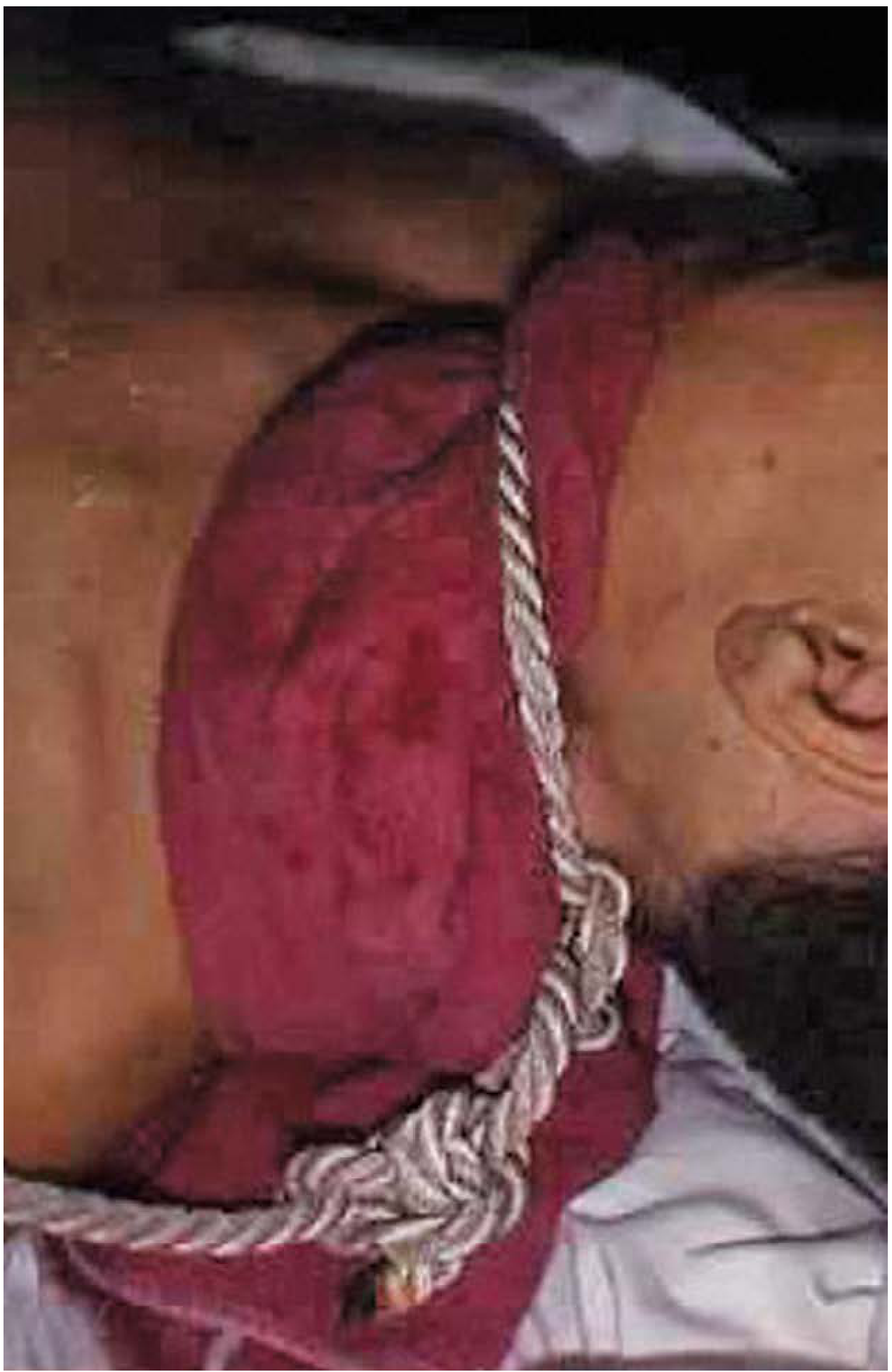
  2. Padding between ligature and neck - towel, cloth, or soft material used to prevent visible rope marks
  3. Nakedness or semi-nakedness - victim usually found nude or partially nude
  4. Cross-dressing - wearing female undergarments, padded brassieres to simulate breasts, wigs, sanitary pads, makeup
  5. Bondage - wrists, ankles, waist, or genitalia tied with rope, wire, chains, or padlocks
  6. Erotic/pornographic material - literature, photographs, videos at the scene
  7. Mirror opposite - so the victim can observe himself during the act
  8. Evidence of self-mutilation - puncture wounds, cuts, burns; clamps or weights attached to genitalia
  9. Evidence of previous episodes - old scar marks on the neck, grooves in the rafter/door from repeated rope use, self-taken photographs, diary entries
  10. Seminal stains - evidence of recent ejaculation must be looked for
  11. Locked door from inside
  12. Recreational drugs - toxicological analysis may reveal alcohol, cocaine, narcotics, or inhalants
Sexual asphyxia - 21-year-old male with towel padding between noose and skin (DiMaio's Forensic Pathology)
Fig: Sexual asphyxia - 21-year-old male with towel padding between noose and neck (DiMaio's Forensic Pathology, 3rd ed.)

Profile of the Victim

  • Virtually always male (only a few female cases reported in literature)
  • Usually young
  • Often has homosexual tendencies or preferences
  • Associated abnormal sexual behaviors: masochism and transvestism are the most common
  • Adult males with homosexual preferences tend to carry out the procedure in pairs for mutual protection from accidental death

Cause of Death

Death occurs accidentally due to failure of the self-rescue mechanism:
  • Equipment failure (e.g., rope slips, mechanism jams)
  • Flaw in the design or construction of the device
  • Loss of voluntary control once partial consciousness is lost
  • The individual misjudges the degree of asphyxia required
Since there is a very fine line between the compression needed for sexual pleasure and the compression that produces unconsciousness, accidental death can occur unexpectedly.

Medico-Legal Importance - Key Points

1. Manner of Death: Accidental vs Suicide vs Homicide

This is the single most important MLI question in these cases.
FeatureSexual Asphyxia (Accidental)Suicidal Hanging
SuspensionIncomplete; feet near groundOften complete
Padding on neckPresent (to prevent marks)Absent
DressNaked/cross-dressedNormal clothing
Pornographic materialPresentAbsent
Suicide noteAbsentOften present
Evidence of repetitionOld neck scars, rope groovesNone
Scene locationPrivate (bedroom/bathroom/attic)Secluded
The true accidental nature must be recognized to:
  • Avoid a costly homicide investigation
  • Prevent a false suicide verdict - which carries serious financial implications for life insurance claims (suicide exclusion clauses in insurance policies)
  • Protect the reputation of the deceased and family

2. Scene Examination Checklist

The forensic examiner must look for:
  1. Evidence of abnormal sexual behavior (masochism, transvestism)
  2. Evidence that the act was practiced previously (old scars on neck, grooves in rafters, photographs, diary entries, verbal communications)
  3. Evidence of attempts to conceal the act - padding to prevent ligature marks
  4. Absence of suicidal indicators - no suicide note, no known intent, no prior suicidal ideation

3. Postmortem Examination

  • Standard asphyxial signs may be present (petechiae, cyanosis, congestion)
  • Ligature mark may be faint or absent due to padding
  • Evidence of bondage injuries (ligature marks on wrists, ankles)
  • Seminal fluid may be found on body or clothing
  • Self-mutilation marks (puncture wounds, burns, cuts)
  • Toxicological analysis for inhalants, recreational drugs

4. Establishing Cause of Death

When a plastic bag is used, the face and head are pale with few petechial hemorrhages (unlike typical hanging), and the interior of the bag contains abundant moisture droplets - important autopsy finding.

5. Distinguishing from Homicide

Homicide by staging (suspending a body post-mortem) must be excluded by:
  • Vital reactions in the ligature mark (petechiae, ecchymoses)
  • Intimal tears of carotid arteries with extravasation
  • Congestion and hemorrhage in lymph nodes above/below the ligature
  • Analysis of binding - must demonstrate the individual could have bound himself
  • Absence of other fatal injuries

6. Legal/Insurance Implications

  • A false verdict of suicide means the family loses life insurance benefits (due to suicide exclusion clauses)
  • A false verdict of homicide leads to wrongful prosecution
  • The forensic pathologist's opinion is therefore critical in these cases to correctly classify the manner of death as accidental

Summary Table

AspectDetail
Manner of deathAccidental
Victim profileYoung male; masochism/transvestism
MechanismTransitory anoxia enhancing sexual gratification
Most common methodIncomplete hanging with padding
Hallmark scene findingsPadding, nakedness/cross-dressing, pornographic material, evidence of repetition
Key MLI questionAccidental vs Suicide vs Homicide
Insurance significanceFalse suicide verdict = denial of insurance benefits
Critical exam findingFaint/absent ligature mark due to padding; evidence of self-binding

Sources:
  • P.C. Dikshit Textbook of Forensic Medicine and Toxicology, p. 299
  • Parikh's Textbook of Medical Jurisprudence Forensic Medicine and Toxicology, pp. 208-209
  • The Essentials of Forensic Medicine and Toxicology, 36th Edition (2026), pp. 368-369
  • DiMaio's Forensic Pathology, 3rd Edition, pp. 270-271

Flowchart of choking

Asking for Preferences
Finding Sources
Finding Sources
Reading File
Reading File
Reading File
Reading File
Reading File
Reading File
Reading File
Generating Image

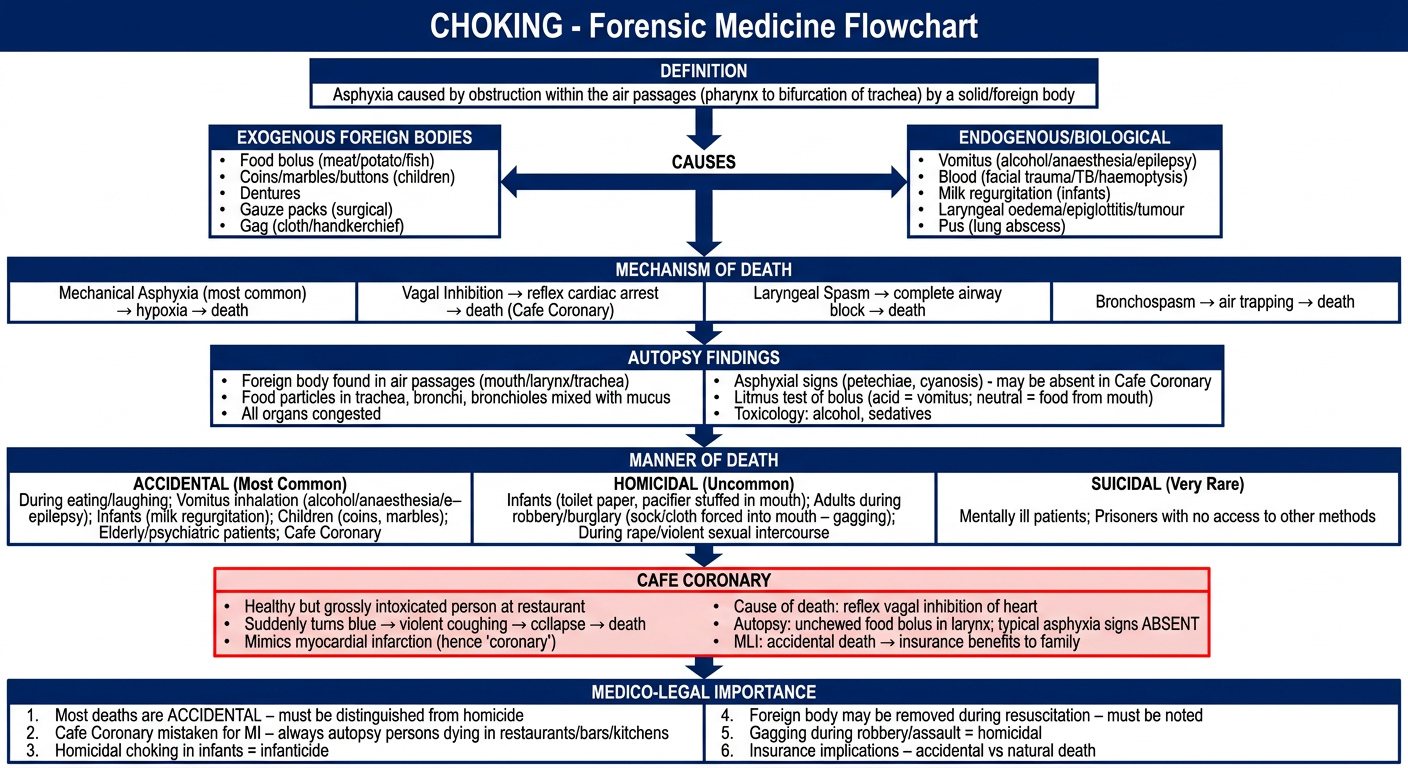
Forensic medicine flowchart of choking (asphyxia). Clean, professional medical diagram with multiple connected sections using boxes and arrows. Title at top: "CHOKING - Forensic Medicine Flowchart" Flow from top to bottom: Box 1 - DEFINITION: "Asphyxia caused by obstruction within the air passages (pharynx to bifurcation of trachea) by a solid/foreign body" Arrows to Box 2 - CAUSES (split into categories): Left branch - EXOGENOUS FOREIGN BODIES: Food bolus (meat/potato/fish), Coins/marbles/buttons (children), Dentures, Gauze packs (surgical), Gag (cloth/handkerchief) Right branch - ENDOGENOUS/BIOLOGICAL: Vomitus (alcohol/anaesthesia/epilepsy), Blood (facial trauma/TB/haemoptysis), Milk regurgitation (infants), Laryngeal oedema/epiglottitis/tumour, Pus (lung abscess) Arrow down to Box 3 - MECHANISM OF DEATH (4 pathways in row): 1. Mechanical Asphyxia (most common) → hypoxia → death 2. Vagal Inhibition → reflex cardiac arrest → death (Cafe Coronary) 3. Laryngeal Spasm → complete airway block → death 4. Bronchospasm → air trapping → death Arrow down to Box 4 - AUTOPSY FINDINGS: • Foreign body found in air passages (mouth/larynx/trachea) • Food particles in trachea, bronchi, bronchioles mixed with mucus • All organs congested • Asphyxial signs (petechiae, cyanosis) - may be absent in Cafe Coronary • Litmus test of bolus (acid = vomitus; neutral = food from mouth) • Toxicology: alcohol, sedatives Arrow down to Box 5 - MANNER OF DEATH (3 columns): ACCIDENTAL (Most Common): During eating/laughing; Vomitus inhalation (alcohol/anaesthesia/epilepsy); Infants (milk regurgitation); Children (coins, marbles); Elderly/psychiatric patients; Cafe Coronary | HOMICIDAL (Uncommon): Infants (toilet paper, pacifier stuffed in mouth); Adults during robbery/burglary (sock/cloth forced into mouth - gagging); During rape/violent sexual intercourse | SUICIDAL (Very Rare): Mentally ill patients; Prisoners with no access to other methods Arrow down to Box 6 - CAFE CORONARY (special highlight box in red border): • Healthy but grossly intoxicated person at restaurant • Suddenly turns blue → violent coughing → collapse → death • Mimics myocardial infarction (hence "coronary") • Gag reflex anesthetised by high blood alcohol • Cause of death: reflex vagal inhibition of heart • Autopsy: unchewed food bolus in larynx; typical asphyxia signs ABSENT • MLI: accidental death → insurance benefits to family Arrow down to Box 7 - MEDICO-LEGAL IMPORTANCE: 1. Most deaths are ACCIDENTAL - must be distinguished from homicide 2. Cafe Coronary mistaken for MI - always autopsy persons dying in restaurants/bars/kitchens 3. Homicidal choking in infants = infanticide 4. Foreign body may be removed during resuscitation - must be noted 5. Gagging during robbery/assault = homicidal 6. Insurance implications - accidental vs natural death Dark blue and white color scheme, clear Arial font, professional forensic textbook style

Choking Forensic Medicine Flowchart

Here is the complete written flowchart with all details for your notes and exam preparation:

Choking - Forensic Medicine Flowchart

DEFINITION

Choking is a form of asphyxia caused by obstruction within the air passages (usually between the pharynx and bifurcation of the trachea) by a solid foreign body. Even an object smaller than the lumen of the respiratory passage can cause fatal choking by inducing reflex spasm of the air passages.

CAUSES

Exogenous (Foreign Bodies)

  • Food bolus - meat, potato, onion, fish, fruit stone, corn
  • Children - coins, marbles, buttons, rubber balloons, pins
  • False dentures / extracted teeth (during anesthesia/dentistry)
  • Gauze packs during surgery (ENT operations, tonsillectomy)
  • Gag - cloth/handkerchief/sock stuffed into mouth (homicidal)

Endogenous / Biological

  • Vomitus inhaled during: alcohol intoxication, anesthesia, epileptic fit, coma, head injury
  • Blood - from facial trauma, broken nose, haemoptysis in TB, ruptured aortic aneurysm
  • Milk regurgitation in infants
  • Disease-related - laryngeal oedema, epiglottitis, pharyngeal abscess, bronchial growths, angioedema (hereditary/anaphylactic), Ludwig's angina, diphtheria
  • Neurological - poliomyelitis, bulbar palsy (impaired swallowing)
  • Tranquilizing drugs (suppress gag reflex in psychiatric patients)

MECHANISM OF DEATH

Foreign body enters air passage
           |
    ┌──────┴──────────────────────────────┐
    ▼                                     ▼
Mechanical obstruction          Entry of foreign material
(most common)                   into air passages
    |                                     |
    ▼                              ┌──────┴───────────────┐
Progressive hypoxia              ▼                       ▼
    |                        Vagal inhibition      Laryngeal spasm
    ▼                        (reflex cardiac       (irritating material
 ASPHYXIA                    arrest)               / acid gastric juice)
    |                             |                       |
    ▼                             ▼                       ▼
  DEATH                     Sudden death           Bronchospasm → Death
                             (CAFE CORONARY)
                             
         4th mechanism: Delayed death from
         pneumonia / lung abscess / bronchiectasis
4 Causes of Death in Choking:
  1. Asphyxia (most common)
  2. Vagal inhibition - reflex cardiac arrest
  3. Laryngeal spasm
  4. Bronchospasm
  5. Delayed: pneumonia, lung abscess, bronchiectasis

AUTOPSY FINDINGS

FindingDetail
Foreign bodyFound impacted in mouth, larynx, or trachea
Food particlesEmbedded in thick mucus in trachea, bronchi, and bronchioles
DistributionParticles drawn into bronchioles (distinguishes ante-mortem from post-mortem aspiration)
General signsAll organs congested
Asphyxial signsPetechiae, cyanosis (may be absent in Cafe Coronary)
Litmus test of bolusAcid = vomitus; Neutral/alkaline = food from mouth
ToxicologyAlcohol and sedatives - essential in all cafe coronary cases
Foreign body removalMay have been removed during resuscitation - must be documented
Epileptic chokingBite marks on tongue, empty urinary bladder, history of epilepsy

MANNER OF DEATH

ACCIDENTAL (Most Common)

  • During eating while laughing, crying, or being slapped on back
  • Vomitus inhalation - intoxication, anesthesia, epilepsy, coma
  • Infants - milk regurgitation into larynx
  • Children - coins, marbles, rubber toys
  • Elderly and psychiatric patients (impaired chewing/swallowing)
  • Cafe Coronary - drunk person at restaurant
  • Choking during rape / violent sexual intercourse

HOMICIDAL (Uncommon)

  • Infants - toilet paper / pacifier stuffed into mouth (infanticide)
  • Adults during robbery/burglary - sock or cloth rammed into mouth (gagging)
    • Cloth migrates backward → occludes posterior pharynx
    • Often used with gagging and tying
  • Choking associated with sexual assault

SUICIDAL (Very Rare)

  • Mentally ill patients
  • Prisoners with no access to other methods
  • Objects stuffed into own pharynx or larynx

CAFE CORONARY (Special Entity)

Grossly intoxicated person at restaurant / pub
              ↓
  Begins meal → gag reflex anesthetised by high BAC
              ↓
  Large poorly chewed food bolus → complete laryngeal obstruction
              ↓
  No coughing/choking signs (gag reflex suppressed)
              ↓
  Turns blue → collapses → appears like heart attack
              ↓
   REFLEX VAGAL INHIBITION → Cardiac arrest → Death
              ↓
  AUTOPSY: Unchewed food in larynx; asphyxial signs ABSENT
Key MLI point: Cafe Coronary is accidental death - important distinction from natural death (MI), as insurance benefits differ.

MEDICO-LEGAL IMPORTANCE (MLI)

PointDetail
1. Manner of deathAlmost always accidental; must be distinguished from homicide
2. Cafe Coronary vs MIAutopsy all deaths in restaurants, bars, kitchens regardless of history of cardiac disease
3. InfanticideHomicidal choking in newborns - foreign material in pharynx
4. Gagging in assaultCloth/sock in mouth during robbery = homicidal asphyxia
5. Foreign body removalMay have been removed during CPR/resuscitation - must be noted in autopsy report
6. Insurance implicationsAccidental death entitles family to additional insurance benefits vs natural/suicidal death
7. Litmus testDetermines origin of obstructing material (mouth food vs vomitus)
8. ToxicologyEssential - alcohol/tranquilizers suppress gag reflex and precipitate choking
9. Choking during rapeChoking from regurgitation of food during sexual assault - links to homicide investigation
10. Delayed deathPneumonia/lung abscess after initial choking - may die days later; cause still choking

Sources:
  • The Essentials of Forensic Medicine and Toxicology, 36th Edition (2026), pp. 367-368
  • P.C. Dikshit Textbook of Forensic Medicine and Toxicology, pp. 307-308
  • Parikh's Textbook of Medical Jurisprudence Forensic Medicine and Toxicology, pp. 220-221
  • DiMaio's Forensic Pathology, 3rd Edition, pp. 254-255
This is a shared conversation. Sign in to Orris to start your own chat.