
Amphotericin b
Reading File
Amphotericin B is a polyene antifungal antibiotic used for serious systemic fungal infections. It works by binding ergosterol in fungal cell membranes, forming pores that cause leakage of cellular contents. It has a broad spectrum including Candida, Aspergillus, Cryptococcus, Histoplasma, and most endemic fungi. Known for significant nephrotoxicity and infusion-related reactions.
Searching sources...
Finding Sources
Finding Sources
Searching PubMed
"amphotericin B" AND "liposomal"
Now let me read the key pharmacology sections from Katzung and Goodman & Gilman:
Reading File
Reading File
Reading File
Reading File
Reading File
Reading File
Reading File
Reading File
Reading File
Loading Image
Here is a comprehensive overview of Amphotericin B based on authoritative pharmacology textbooks (Katzung's Basic & Clinical Pharmacology 16th Ed. and Goodman & Gilman's Pharmacological Basis of Therapeutics):
Amphotericin B
Source & Chemistry
Amphotericin B is produced by the bacterium Streptomyces nodosus (along with the clinically unused Amphotericin A). It is an amphoteric polyene macrolide - "polyene" refers to its many conjugated double bonds (it is a heptaene, containing 7 trans-double bonds), and "macrolide" refers to its large lactone ring. The drug contains a mycosamine sugar (3-amino-3,6-dideoxymannose) attached via a glycosidic bond. It is nearly insoluble in water.
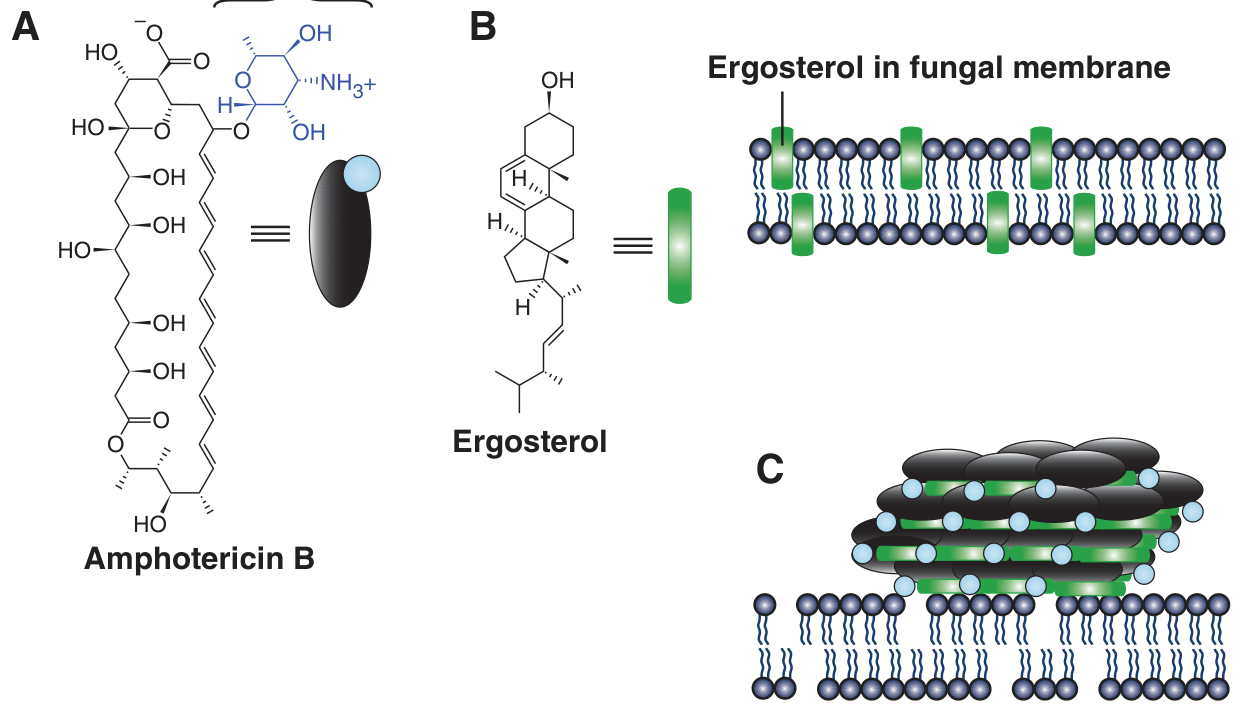
Mechanism of Action
Amphotericin B exploits the difference in membrane sterol composition between fungi and humans:
- Fungal membranes contain ergosterol
- Human/bacterial membranes contain cholesterol
The drug selectively binds ergosterol and:
- Classical view: Forms transmembrane pores/channels that allow leakage of intracellular ions and macromolecules, causing cell death
- Updated view (Goodman & Gilman): Recent evidence suggests it forms aggregates that sequester ergosterol from lipid bilayers, like a selective sponge, disrupting membrane integrity
Some binding to human cholesterol does occur, which accounts for the drug's significant toxicity.
Resistance occurs when ergosterol binding is impaired - either by decreasing membrane ergosterol concentration or by modifying the sterol target to reduce drug affinity. Intrinsically resistant organisms include Candida lusitaniae and Pseudallescheria boydii.
Formulations
| Formulation | Brand | Physical Form | Dose (mg/kg/d) | Nephrotoxicity | Infusional Toxicity |
|---|---|---|---|---|---|
| Conventional (C-AMB) + deoxycholate | Fungizone | Micelles | 0.5-1 | High | High |
| Liposomal (L-AMB) | AmBisome | Spheres | 3-5 | Reduced | Reduced |
| Lipid complex (ABLC) | Abelcet | Ribbons | 5 | Reduced | Reduced |
| Colloidal dispersion (ABCD) | Amphotec | Disks | 5 | Reduced | Increased |
Why lipid formulations? Amphotericin binds to the lipid vehicle with affinity between that for fungal ergosterol and human cholesterol. The lipid acts as a reservoir, reducing nonspecific binding to human membranes. Some fungi also have lipases that liberate free amphotericin directly at the infection site.
Pharmacokinetics of conventional formulation:
- IV dosing 0.5-1 mg/kg/d achieves blood levels of 0.3-1 mcg/mL
-
90% protein-bound
- Half-life ~15 days
- Widely distributed in most tissues
- Only 2-3% penetrates CSF (may require intrathecal therapy for some fungal meningitides)
- No dose adjustment needed for renal or hepatic impairment; dialysis has little impact
Antifungal Spectrum (Broadest of All Antifungals)
- Yeasts: Candida albicans, C. tropicalis, Cryptococcus neoformans
- Endemic mycoses: Histoplasma capsulatum, Blastomyces dermatitidis, Coccidioides immitis
- Molds: Aspergillus fumigatus, agents of mucormycosis
- Resistant organisms: Candida lusitaniae, Pseudallescheria boydii
Clinical Uses
- First-line induction therapy for nearly all life-threatening systemic mycoses
- Used as initial induction to rapidly reduce fungal burden, then switched to an azole for chronic/maintenance therapy
- Especially important in immunosuppressed patients - severe cryptococcal meningitis, disseminated histoplasmosis, coccidioidomycosis, invasive aspergillosis
- Cryptococcal meningitis: AmB + flucytosine (synergy via enhanced flucytosine penetration through damaged fungal membranes)
- Mucormycosis: AmB is the drug of choice (azoles are largely ineffective)
- Visceral leishmaniasis: Liposomal AmB is the preferred treatment in India (where resistance to stibogluconate is high); a single IV dose of 10 mg/kg has been used
- Local uses: Bladder irrigation for Candida UTIs, topical drops for fungal keratitis/corneal ulcers, intra-articular injection for fungal arthritis
- Intrathecal (cisterna magna, lumbar, lateral ventricle) for Coccidioidal meningitis unresponsive to other agents
Adverse Effects
1. Infusion-Related (Acute) Reactions
Nearly universal with conventional AmB. Mediated via TLR2 and CD14 signaling:
- Fever, chills, muscle spasms, vomiting, headache, hypotension, tachypnea
- Frank anaphylaxis and bronchospasm are rare
- Reactions end spontaneously in 30-45 minutes
Management:
- Slow infusion rate or reduce daily dose
- Premedicate with antipyretics (acetaminophen/ibuprofen), antihistamines, meperidine (shortens fever duration), or IV hydrocortisone 0.7 mg/kg
- Test dose of 1 mg IV before first infusion to gauge reaction severity
- Febrile reactions tend to lessen with subsequent infusions
2. Cumulative (Chronic) Toxicity
| Toxicity | Details |
|---|---|
| Nephrotoxicity | Azotemia occurs in ~80% of patients on C-AMB. Dose-dependent, usually transient; worsened by concurrent aminoglycosides or cyclosporine. Permanent tubular histological changes can occur |
| Hypokalemia/Hypomagnesemia | From renal tubular wasting; requires supplementation |
| Anemia | Normochromic, normocytic; due to reduced erythropoietin production from damaged renal tubular cells |
| Liver toxicity | Occasional elevation of liver function tests |
| Intrathecal | Seizures and chemical arachnoiditis with serious neurologic sequelae |
Lipid formulations are significantly less nephrotoxic than C-AMB.
Synergy with Flucytosine
Amphotericin B + flucytosine is a classic synergistic combination for cryptococcal meningitis. The mechanism: AmB damages the fungal membrane, enhancing penetration of flucytosine into fungal cells. Note that flucytosine must not be used as monotherapy because resistance develops rapidly.
Key Points to Remember
- Produced by Streptomyces nodosus
- Polyene macrolide; heptaene (7 double bonds)
- Target: ergosterol in fungal cell membrane
- Broadest spectrum antifungal available
- C-AMB is nephrotoxic in ~80% of patients; lipid formulations dramatically reduce this
- CSF penetration is poor (2-3%) - may need intrathecal dosing
- Half-life ~15 days; no dose adjustment for renal/hepatic impairment
- Drug of choice for mucormycosis and severe endemic mycoses
- "Gold standard" induction agent before azole step-down therapy
Sources:
- Katzung's Basic and Clinical Pharmacology, 16th Ed., pp. 1330-1332
- Goodman & Gilman's Pharmacological Basis of Therapeutics, pp. 1213-1216
Recent Evidence Update: A 2024 systematic review and meta-analysis on high-dose liposomal AmB (PMID 37971463) confirmed its safety and effectiveness profile, and a 2025 systematic review on liposomal AmB prophylaxis in pediatrics (PMID 40493030) supports its use in immunocompromised children - both consistent with current textbook guidance.
This is a shared conversation. Sign in to Orris to start your own chat.