What Serum conc
What is serum conc
Endocarditis
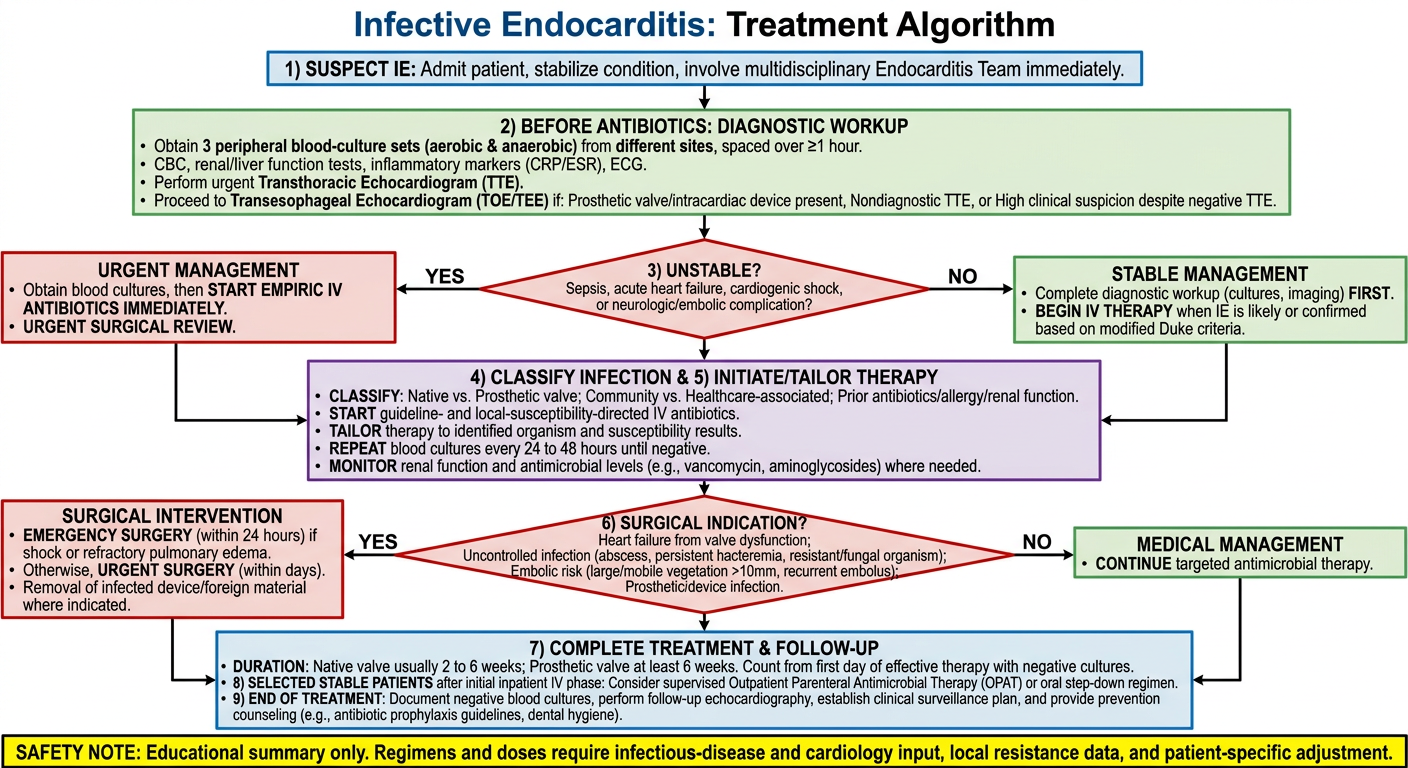
Endocarditis treatment algorithm
"endocarditis"[MeSH Terms] AND treatment
2023 ESC Guidelines management infective endocarditis antibiotic treatment blood cultures surgery
https://www.escardio.org/static-file/Escardio/Guidelines/Pro…
Infective endocarditis treatment algorithm
1. Stabilize and obtain microbiology first
- Assess for sepsis, acute heart failure, shock, stroke, embolism, and conduction block.
- Draw 3 sets of peripheral blood cultures from separate venepuncture sites before antibiotics, if the patient is stable.
- Send baseline CBC, renal and liver function, CRP/ESR, urinalysis, ECG.
- Start empiric therapy immediately after cultures if septic, unstable, or there is acute heart failure.
2. Confirm and define infection
- TTE promptly.
- TOE/TEE if prosthetic valve/device, nondiagnostic or negative TTE with high suspicion, or to assess abscess/perforation.
- Repeat echo in about 5-7 days if initial imaging is negative but suspicion remains.
- Obtain targeted CT, PET/CT, brain imaging, or body imaging when prosthetic/device infection or embolic/metastatic infection is suspected.
- If cultures remain negative, review prior antibiotics and investigate fastidious organisms with microbiology.
3. Start intravenous antibiotics
- Native valve vs prosthetic valve
- Community-acquired vs hospital/healthcare-associated infection
- Early vs late prosthetic-valve infection
- Previous antibiotics
- Renal function, allergy, local resistance patterns
- Viridans streptococci / Streptococcus gallolyticus: penicillin/ceftriaxone-based therapy.
- MSSA: anti-staphylococcal beta-lactam preferred.
- MRSA or serious beta-lactam allergy: vancomycin or another guideline-directed alternative.
- Enterococcus faecalis: commonly ampicillin plus ceftriaxone, or another susceptibility-based regimen.
- Fungal IE: antifungal treatment plus early surgical assessment, usually valve surgery.
4. Monitor response
- Repeat blood cultures every 24-48 hours until clearance.
- Monitor renal function, liver function, CBC, inflammatory markers, and drug levels when applicable, especially vancomycin or aminoglycosides.
- Reassess echo and screen for complications: heart failure, abscess, heart block, stroke, splenic/renal infarct, septic emboli.
5. Decide urgently about surgery
| Indication | Examples |
|---|---|
| Heart failure | Acute severe regurgitation, valve obstruction, fistula, pulmonary edema, cardiogenic shock |
| Uncontrolled infection | Persistent bacteremia/fever despite appropriate therapy, abscess, pseudoaneurysm, fistula, enlarging vegetation, resistant organism, fungal IE |
| Prevention of embolism | Large/mobile vegetations, especially after embolism or with other surgical indications |
| Prosthetic/device infection | Prosthetic valve dysfunction, perivalvular extension, persistent infection; infected cardiac-device leads generally require complete system removal |
6. Complete antimicrobial course
- Native-valve IE: typically 2-6 weeks, depending on organism, susceptibility, complications, and regimen.
- Prosthetic-valve IE: usually at least 6 weeks.
- Count duration from the first day of effective antimicrobial therapy, commonly the date blood cultures become negative, rather than the operation date.
- After approximately 2 weeks of inpatient IV therapy, carefully selected stable patients may complete treatment through supervised outpatient IV therapy or an oral step-down protocol. This is not appropriate for uncontrolled infection, major complications, poor adherence capacity, or patients needing surgery.
7. Follow-up after treatment
- Obtain blood cultures at completion of treatment and if fever recurs.
- Repeat echocardiography to establish the post-treatment valve baseline.
- Counsel regarding dental hygiene, avoidance of injection-drug use, and follow-up for valve dysfunction, recurrent infection, heart failure, and embolic complications.
- Evaluate S. gallolyticus infection for colorectal neoplasia.
Create a one-page endocarditis treatment flowchart
A one-page clinical flowchart titled “Infective Endocarditis: Treatment Algorithm” for healthcare education. Use clear, concise decision boxes and arrows. Content: 1) Suspect IE: admit, stabilize, involve Endocarditis Team. 2) Before antibiotics: obtain 3 peripheral blood-culture sets, CBC, renal/liver function, ECG; perform urgent TTE, then TOE/TEE if prosthetic valve/device, nondiagnostic TTE, or high suspicion. 3) Unstable, sepsis, acute heart failure, shock, or neurologic/embolic complication? Yes: cultures then start empiric IV antibiotics immediately and urgent surgical review. No: obtain cultures/imaging first, then begin IV therapy when IE is likely/confirmed. 4) Classify infection: native versus prosthetic valve; community versus healthcare-associated; prior antibiotics/allergy/renal function. 5) Start guideline- and local-susceptibility-directed IV antibiotics, then tailor to organism and susceptibility; repeat blood cultures every 24 to 48 hours until negative; monitor renal function and antimicrobial levels where needed. 6) Surgical indication? Heart failure from valve dysfunction; uncontrolled infection, abscess, persistent bacteremia, resistant or fungal organism; embolic risk from large/mobile vegetation or recurrent embolus; prosthetic/device infection. Yes: emergency surgery within 24 hours if shock/refractory pulmonary edema, otherwise urgent surgery within days, with removal of infected device/foreign material where indicated. No: continue targeted antimicrobial therapy. 7) Complete treatment: native valve usually 2 to 6 weeks; prosthetic valve at least 6 weeks; count from first effective therapy/negative cultures. 8) Selected stable patients after initial inpatient IV phase: supervised OPAT or oral step-down. 9) End of treatment: blood cultures, follow-up echocardiography, clinical surveillance and prevention counseling. Include a bottom safety note: “Educational summary only. Regimens and doses require infectious-disease and cardiology input, local resistance data, and patient-specific adjustment.”