
I have my university exam of 1 st year of subject biochemistry These are the important long answer give me answer of this "Regulation of blood glucose" and remeber it's a university examination
Reading File
Now let me search the medical library for regulation of blood glucose.
Finding Sources
Finding Sources
Excellent results. Let me now read the most relevant sections from multiple textbooks in parallel.
Reading File
Reading File
Reading File
Now let me read the most comprehensive biochemistry-focused sections from Lippincott and Guyton.
Reading File
Reading File
Let me now read the Guyton summary section and also get the insulin mechanism section from Lippincott.
Reading File
Reading File
Let me get the insulin mechanism of action and its effects on glucose metabolism from Lippincott:
Reading File
I now have comprehensive information from multiple authoritative sources. Let me also fetch the key diagram showing opposing actions of insulin and glucagon, and the hormonal regulation diagram.
Loading Image
Loading Image
I now have everything I need for a thorough university-level answer. Let me compose the full answer.
Regulation of Blood Glucose
Introduction
Blood glucose concentration is one of the most tightly regulated parameters in human physiology. In a normal fasting adult, blood glucose is maintained between 70-100 mg/dL (some sources quote 80-90 mg/dL). After a meal, it may rise to 120-140 mg/dL, but returns to baseline within about 2 hours. Maintaining this narrow range is essential because glucose is the primary - and often the only - fuel for the brain, retina, and germinal epithelium of the gonads.
Normal Blood Glucose Values
| State | Blood Glucose Level |
|---|---|
| Fasting (normal) | 70-100 mg/dL |
| Postprandial (2h) | <140 mg/dL |
| Impaired fasting glucose | 100-125 mg/dL |
| Diabetes diagnosis | ≥126 mg/dL (fasting) |
Sources of Blood Glucose
Blood glucose is maintained by a balance between glucose entry into the blood and its removal:
Sources that raise blood glucose:
- Intestinal absorption - after carbohydrate-containing meals
- Glycogenolysis - breakdown of glycogen in liver (primary source during short fasting)
- Gluconeogenesis - synthesis of glucose from non-carbohydrate precursors (amino acids, lactate, glycerol) - becomes progressively more important with prolonged fasting
Pathways that lower blood glucose:
- Glycolysis - oxidation of glucose for energy
- Glycogenesis - storage of glucose as glycogen (liver and muscle)
- Lipogenesis - conversion of glucose to fat
- Pentose phosphate pathway - generates NADPH and ribose-5-phosphate
Hormonal Regulation - The Key Players
Blood glucose regulation is primarily hormonal, involving a carefully orchestrated interplay of several hormones. They can be divided into:
- Hypoglycemic hormone: Insulin (only one)
- Hyperglycemic (counterregulatory) hormones: Glucagon, Epinephrine, Cortisol, Growth Hormone, Somatostatin
1. Insulin (the Major Hypoglycemic Hormone)
Source: Beta (β) cells of the Islets of Langerhans in the pancreas
Synthesis: Insulin is synthesized as preproinsulin → proinsulin → insulin + C-peptide. The C-peptide is released in equimolar amounts with insulin and serves as a marker of endogenous insulin secretion.
Stimuli for Insulin Secretion
- Elevated blood glucose (primary stimulus) - glucose enters β cells via GLUT-2 transporters; glucokinase phosphorylates it, raising the ATP/ADP ratio, which closes K⁺ channels, depolarizes the cell membrane, opens Ca²⁺ channels, and triggers exocytosis of insulin granules
- Elevated plasma amino acids (arginine, lysine)
- Gastrointestinal hormones - GLP-1 and GIP (incretins) - these cause an "anticipatory" insulin rise even before food is fully absorbed
- Glucagon, growth hormone, cortisol (potentiate the glucose response)
- Parasympathetic stimulation (vagal activity after a meal)
Stimuli that Decrease Insulin Secretion
- Low blood glucose
- Somatostatin (from δ cells)
- Sympathetic stimulation (α-adrenergic, stress response)
Actions of Insulin on Blood Glucose (Hypoglycemic Effects)
| Tissue | Action |
|---|---|
| Liver | Increases glycogenesis; inhibits glycogenolysis; inhibits gluconeogenesis; promotes glycolysis |
| Muscle | Increases glucose uptake via GLUT-4 translocation; increases glycogenesis; promotes protein synthesis |
| Adipose | Increases glucose uptake via GLUT-4; promotes lipogenesis; inhibits lipolysis (inhibits hormone-sensitive lipase) |
Mechanism of action: Insulin binds to its receptor - a tetrameric receptor tyrosine kinase (α₂β₂ structure). Binding activates the β-subunit's intrinsic tyrosine kinase, leading to autophosphorylation. This triggers phosphorylation of insulin receptor substrates (IRS), activating downstream signaling cascades (PI3K/Akt pathway) that ultimately stimulate GLUT-4 translocation to the cell membrane.
2. Glucagon (the Major Hyperglycemic Hormone)
Source: Alpha (α) cells of the Islets of Langerhans
Primary target: Liver (hepatocytes)
Stimuli for Glucagon Secretion
- Low blood glucose (primary stimulus)
- Elevated plasma amino acids (especially arginine) - prevents hypoglycemia after protein meals
- Catecholamines (epinephrine, norepinephrine) - during stress
Stimuli that Decrease Glucagon Secretion
- Elevated blood glucose
- Insulin (paracrine inhibition)
- Somatostatin
Actions of Glucagon on Blood Glucose (Hyperglycemic Effects)
- Stimulates hepatic glycogenolysis - activates glycogen phosphorylase via cAMP → PKA → phosphorylation cascade
- Stimulates gluconeogenesis - promotes use of amino acids, lactate, glycerol as substrates
- Inhibits glycolysis - decreases fructose 2,6-bisphosphate levels (the allosteric activator of PFK-1)
- Inhibits glycogenesis - phosphorylates and inactivates glycogen synthase
- Promotes lipolysis and fatty acid oxidation - frees glycerol for gluconeogenesis and provides energy
Mechanism: Glucagon binds to Gs-protein coupled receptor → activates adenylyl cyclase → ↑ cAMP → activates PKA → phosphorylates key enzymes.
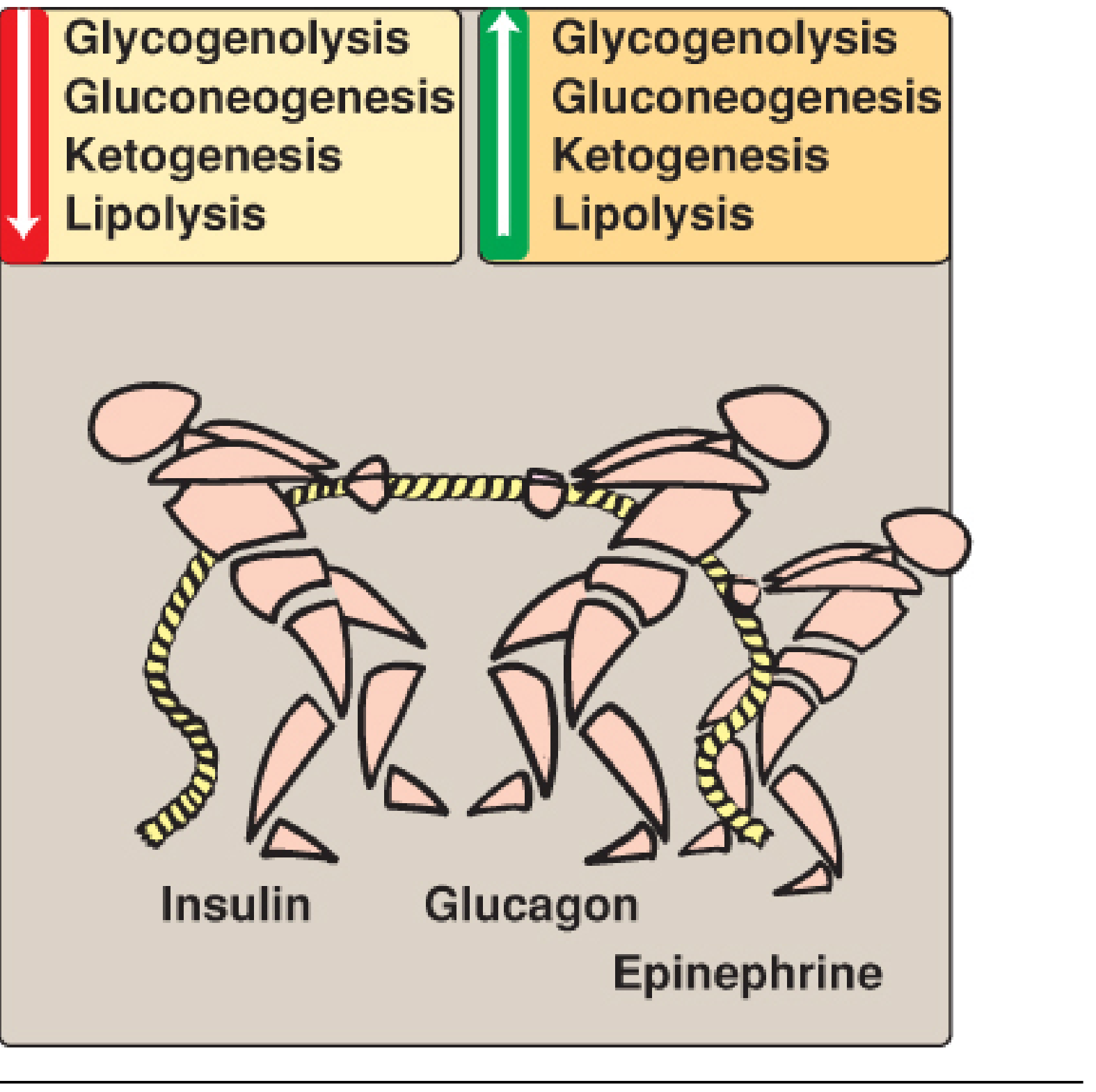
Figure: Tug-of-war between insulin (lowers glycogenolysis, gluconeogenesis, ketogenesis, lipolysis) vs glucagon + epinephrine (raises all of these). - Lippincott's Biochemistry, 8th ed.
3. Epinephrine (Adrenaline)
Source: Adrenal medulla (chromaffin cells)
Trigger: Hypoglycemia, stress, exercise - mediated via hypothalamus → sympathetic nervous system
Actions:
- Strongly stimulates hepatic glycogenolysis (via β-adrenergic receptors → cAMP pathway, and α-adrenergic receptors → IP₃/DAG pathway)
- Stimulates gluconeogenesis in liver
- Stimulates glycogenolysis in muscle
- Promotes lipolysis in adipose (liberates glycerol and fatty acids)
- Inhibits insulin secretion (via α₂-receptors)
4. Cortisol
Source: Adrenal cortex (zona fasciculata); secreted in response to ACTH from the pituitary
Actions (longer-term, over hours to days):
- Stimulates gluconeogenesis (promotes breakdown of muscle protein → amino acids → glucose)
- Decreases glucose utilization by peripheral tissues (anti-insulin effect)
- Decreases glucose uptake by muscles and adipose (reduces GLUT expression)
- Promotes lipolysis
5. Growth Hormone
Source: Anterior pituitary; secreted during hypoglycemia via hypothalamic signaling
Actions:
- Decreases glucose uptake and utilization by muscle and fat
- Promotes lipolysis (spares glucose)
- Stimulates gluconeogenesis
- Called "diabetogenic" because it antagonizes insulin action
6. Somatostatin
Source: Delta (δ) cells of the Islets of Langerhans; also secreted from the hypothalamus
Action: Inhibits both insulin and glucagon secretion, thereby modulating the rate of glucose entry into blood after a meal (acts as a "governor").
The Liver as the Central Buffer Organ
The liver plays a uniquely important role in blood glucose regulation because it:
- Is the only organ (besides kidney) that expresses glucose-6-phosphatase, allowing it to release free glucose into the blood
- Rapidly takes up glucose after a meal (stores up to 2/3 of absorbed glucose as glycogen)
- Releases glucose back during fasting via glycogenolysis and gluconeogenesis
- Monitors blood glucose via glucokinase (hepatic glucose sensor), which is not inhibited by its product glucose-6-phosphate, and increases activity proportionally with glucose concentration
Without the liver buffer, fluctuations in blood glucose after meals would be approximately 3 times greater.
Integrated Response: Fed vs. Fasted State
Postprandial (Fed) State - "Anabolic"
Blood glucose rises → Insulin ↑, Glucagon ↓
- Liver: glycogenesis ↑, glycolysis ↑, gluconeogenesis ↓
- Muscle: glucose uptake ↑ (GLUT-4), glycogenesis ↑, protein synthesis ↑
- Adipose: glucose uptake ↑ (GLUT-4), lipogenesis ↑, lipolysis ↓
Fasting State - "Catabolic"
Blood glucose falls → Glucagon ↑, Insulin ↓
- Liver: glycogenolysis ↑ (first 12 hours), then gluconeogenesis ↑
- Muscle: amino acid release (alanine) → substrate for gluconeogenesis
- Adipose: lipolysis ↑ → glycerol and fatty acids released
Prolonged Fasting / Starvation
- Glucagon + cortisol + growth hormone dominate
- Ketone bodies produced by liver become fuel for the brain
- Muscle protein catabolism supplies amino acids for gluconeogenesis
Counterregulatory Response to Hypoglycemia
When blood glucose falls below ~70 mg/dL, a sequential series of counterregulatory responses is triggered:
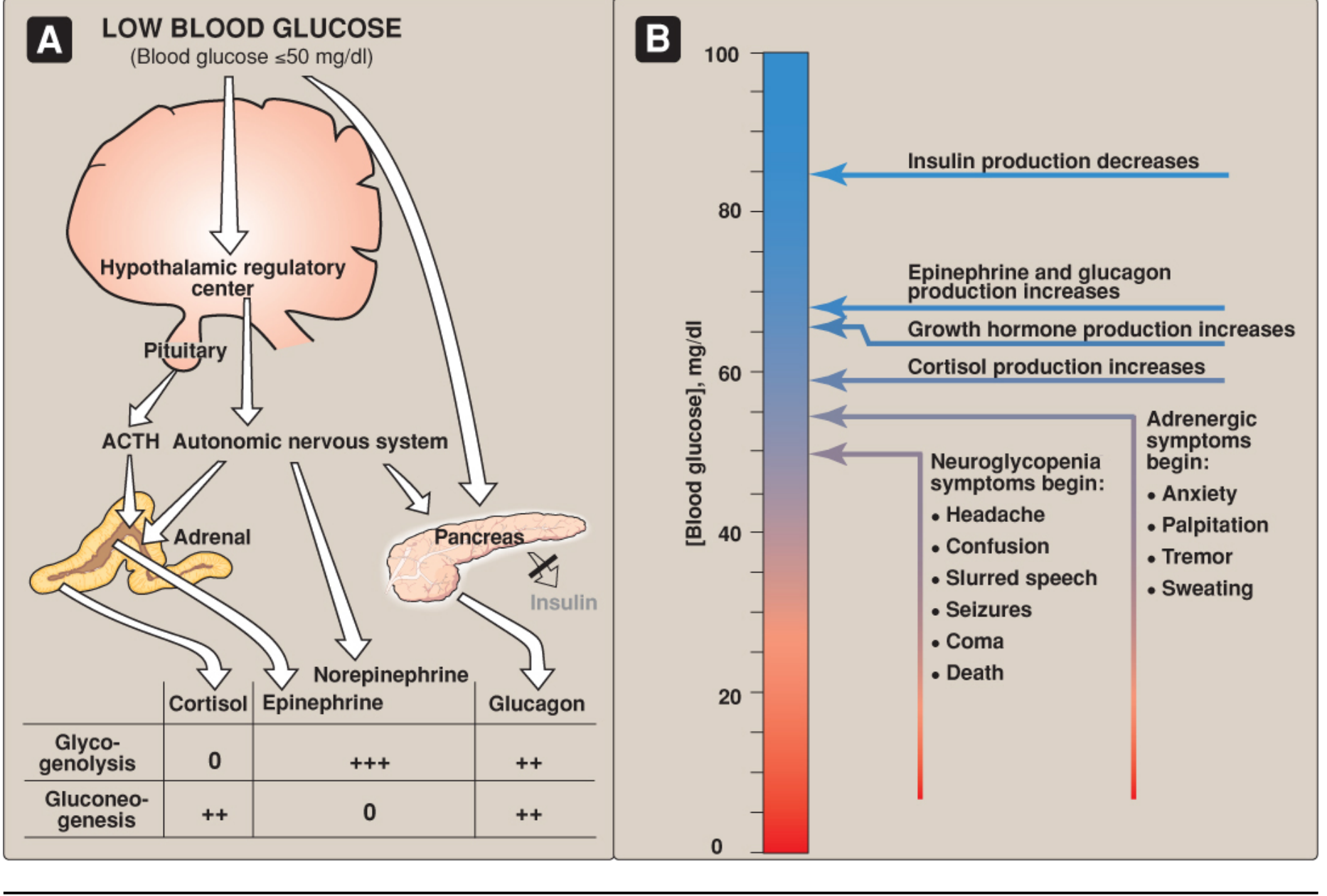
Figure: (A) Hypothalamic-pituitary-adrenal and autonomic responses to hypoglycemia. (B) Sequential glycemic thresholds at which each counterregulatory response is activated. - Lippincott's Biochemistry, 8th ed.
Order of activation (as glucose falls progressively):
- ~85 mg/dL: Insulin secretion decreases
- ~68 mg/dL: Glucagon and epinephrine secretion increases
- ~66 mg/dL: Growth hormone secretion increases
- ~58 mg/dL: Cortisol secretion increases
- ~50 mg/dL: Adrenergic symptoms appear (anxiety, sweating, palpitations, tremor)
- <50 mg/dL: Neuroglycopenic symptoms appear (confusion, seizures, coma, death)
The hypothalamic glucoreceptors detect low glucose and activate:
- The sympathetic nervous system → epinephrine release
- The anterior pituitary → ACTH release → cortisol; GH release
Summary Table: Hormonal Regulation at a Glance
| Hormone | Source | Blood Glucose Effect | Key Mechanism |
|---|---|---|---|
| Insulin | β cells, pancreas | Decreases ↓ | Glycogenesis ↑, Glycolysis ↑, GLUT-4 translocation, gluconeogenesis ↓ |
| Glucagon | α cells, pancreas | Increases ↑ | Glycogenolysis ↑, gluconeogenesis ↑ (cAMP pathway) |
| Epinephrine | Adrenal medulla | Increases ↑ | Glycogenolysis ↑↑↑ (liver+muscle), gluconeogenesis ↑ |
| Cortisol | Adrenal cortex | Increases ↑ | Gluconeogenesis ↑↑, peripheral glucose use ↓ |
| Growth Hormone | Anterior pituitary | Increases ↑ | Anti-insulin effect, gluconeogenesis ↑, lipolysis ↑ |
| Somatostatin | δ cells, pancreas | Modulator | Inhibits both insulin and glucagon |
| GLP-1, GIP | Intestinal L/K cells | Indirect ↓ | Potentiate insulin secretion (incretins) |
Why Blood Glucose Regulation Matters
- Brain dependency - the brain cannot synthesize or store glucose; it requires a continuous supply (uses ~120 g/day)
- Hyperglycemia causes osmotic diuresis, glycation of proteins, damage to blood vessels and nerves
- Hypoglycemia causes neurological dysfunction, seizures, coma, and death if uncorrected
- Failure of this regulatory system leads to Diabetes Mellitus (Type 1: no insulin; Type 2: insulin resistance)
Key Points for Examination
- Normal fasting blood glucose: 70-100 mg/dL
- Insulin is the only hormone that lowers blood glucose
- Glucagon is insulin's principal antagonist and the first responder to hypoglycemia
- The insulin receptor is a receptor tyrosine kinase (α₂β₂ tetramer)
- GLUT-4 translocation to the cell membrane requires insulin (in muscle and adipose)
- GLUT-2 (liver and β cells) and glucokinase act together as the glucose sensor system
- The liver is the central glucose buffer - expresses glucose-6-phosphatase (allows glucose release)
- Cortisol and growth hormone are long-term counterregulatory hormones; epinephrine and glucagon are short-term
- The C-peptide is released in equimolar amounts with insulin and measures endogenous insulin production
Sources: Lippincott Illustrated Reviews: Biochemistry, 8th ed. | Guyton & Hall Textbook of Medical Physiology | Basic Medical Biochemistry - A Clinical Approach, 6th ed. | Tietz Textbook of Laboratory Medicine, 7th ed.
This is a shared conversation. Sign in to Orris to start your own chat.