
If Hba1c is 8.1 what oral hypoglycaemias should be taken
Reading File
An HbA1c of 8.1% indicates poorly controlled type 2 diabetes (target is usually <7%). At this level, metformin alone is typically insufficient and a second (or third) oral agent is usually needed. Common choices include metformin + an SGLT2 inhibitor, metformin + a DPP-4 inhibitor, or metformin + a sulfonylurea.
Searching sources...
Finding Sources
Searching PubMed
"type 2 diabetes" AND "oral hypoglycemic agents" AND "HbA1c"
Finding Sources
Finding Sources
Finding Sources
Finding Sources
Finding Sources
Finding Sources
Finding Sources
Reading File
Reading File
I now have excellent textbook-based information. Let me also fetch the treatment algorithm diagram.
Loading Image
Here is a full, evidence-based answer for an HbA1c of 8.1% in type 2 diabetes.
Oral Hypoglycaemic Agents for HbA1c of 8.1%
An HbA1c of 8.1% is above the standard target of ≤7% (ADA) or ≤6.5% (IDF/AACE), meaning glycaemic control is inadequate. The approach depends on current therapy and patient-specific factors.
Step 1 - Context matters
| Scenario | What to do |
|---|---|
| On no medication | Start metformin (if tolerated) + assess lifestyle |
| Already on metformin monotherapy | Add a second agent (dual therapy) |
| Already on dual therapy | Add a third agent |
| HbA1c >9% | Start with dual therapy from day 1 |
| HbA1c >10% | Consider injectable (insulin or GLP-1 RA) combination from the outset |
At 8.1%, dual therapy (metformin + one agent) is the standard starting point if metformin has been tried alone.
Treatment Algorithm
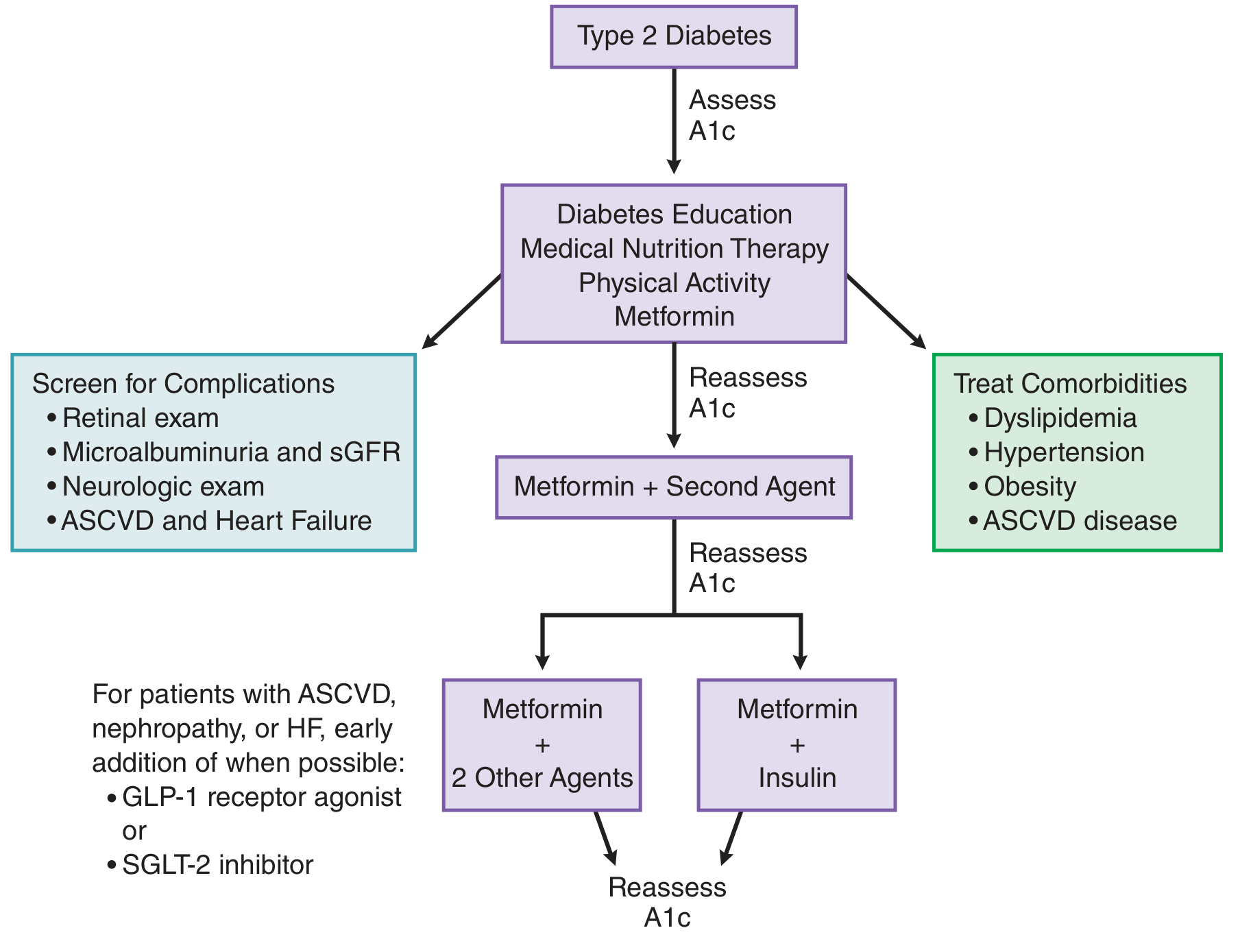
Source: Goodman & Gilman's The Pharmacological Basis of Therapeutics, Fig. 51-11
Oral Agents for Dual Therapy (Metformin + One of the Following)
Per the Symptom to Diagnosis textbook, Table 12-10, choice of the second agent depends on comorbidities, side-effect profile, cost, and HbA1c goal:
| Drug Class | Example Drugs | HbA1c Lowering | Hypoglycaemia Risk | Effect on Weight | Key Considerations |
|---|---|---|---|---|---|
| Sulfonylureas | Glipizide, Glimepiride, Gliclazide, Glibenclamide | High | Moderate | Weight gain | Cheap, widely available; avoid in elderly / renal impairment |
| SGLT-2 Inhibitors | Empagliflozin, Dapagliflozin, Canagliflozin | Intermediate | Low | Weight loss | Preferred if heart failure or CKD; also cardioprotective |
| DPP-4 Inhibitors | Sitagliptin, Vildagliptin, Saxagliptin, Alogliptin | Intermediate | Low | Neutral | Well-tolerated, few side effects; expensive |
| Thiazolidinediones | Pioglitazone | High | Low | Weight gain | Avoid in heart failure; risk of oedema and fractures |
| GLP-1 Receptor Agonists (injectable, but included for completeness) | Liraglutide, Semaglutide | High | Low | Weight loss | Preferred if ASCVD; not oral except semaglutide tablet |
| Basal Insulin | Glargine, Degludec | Highest | High | Weight gain | Used when oral agents fail or HbA1c very high |
Note: GLP-1 agonists are mostly injectable, but oral semaglutide (Rybelsus) is an oral option.
Preferred Second Agent Based on Comorbidities
This is the most important clinical decision at HbA1c 8.1%:
- Established cardiovascular disease (ASCVD) / heart failure / CKD - Prefer SGLT-2 inhibitor (empagliflozin or dapagliflozin) or GLP-1 receptor agonist (liraglutide, semaglutide) - Goodman & Gilman's, p. 1061
- Obesity - Prefer SGLT-2 inhibitor or GLP-1 RA (both cause weight loss)
- Cost constraint - Prefer sulfonylurea (low cost, high efficacy)
- Risk of hypoglycaemia (elderly, drivers, erratic meals) - Avoid sulfonylureas; prefer DPP-4 inhibitor or SGLT-2 inhibitor
- CKD stage 3-4 - Metformin may need dose reduction; SGLT-2 inhibitors have eGFR thresholds (check before prescribing)
If Dual Therapy Fails (HbA1c Still >7% After 3 Months)
Move to triple therapy. Common combinations include:
- Metformin + Sulfonylurea + SGLT-2i or DPP-4i or GLP-1 RA
- Metformin + SGLT-2i + DPP-4i or Sulfonylurea or GLP-1 RA
- Metformin + any two agents above + Insulin if still uncontrolled
Summary for HbA1c 8.1%
- Confirm metformin is optimised (up to 2000 mg/day if tolerated)
- Add a second oral agent - SGLT-2 inhibitor is preferred if there is ASCVD/CKD/heart failure; sulfonylurea if cost is the limiting factor; DPP-4 inhibitor if hypoglycaemia risk is high
- Reinforce lifestyle changes at every visit
- Recheck HbA1c in 3 months and escalate if target not reached
- Symptom to Diagnosis: An Evidence Based Guide, 4th Ed., Table 12-10
- Goodman & Gilman's The Pharmacological Basis of Therapeutics, pp. 1061-1062
- Harrison's Principles of Internal Medicine, 22E
Tennis elbow
Reading File
Tennis elbow (lateral epicondylitis) is a common overuse tendinopathy of the extensor carpi radialis brevis origin at the lateral epicondyle. It presents with lateral elbow pain, tenderness over the epicondyle, and pain on resisted wrist/finger extension. Treatment is mostly conservative - rest, physiotherapy, NSAIDs, and occasionally steroid injection.
Searching sources...
Finding Sources
Searching PubMed
"lateral epicondylitis" AND treatment
Reading File
Reading File
Reading File
Reading File
I have comprehensive textbook content. Here is the full answer:
Tennis Elbow (Lateral Epicondylitis)
Definition & Epidemiology
Tennis elbow is a tendinopathy at the origin of the extensor carpi radialis brevis (ECRB) at the lateral epicondyle of the humerus. Despite its name, it is more common in non-athletes than athletes, with peak incidence in the early 5th decade (40s). It affects both sexes but is slightly more common in women.
Risk factors:
- Repetitive supination/pronation of the forearm with elbow near full extension
- Female gender
- Smoking history
- Manual labour
- Statin use (hypercholesterolaemia medications)
Pathology
Originally described as inflammatory ("epicondylitis"), the current consensus is that it is a degenerative tendinopathy - not a true inflammatory process. It begins as a microtear within the ECRB origin. Microscopy shows angiofibroblastic hyperplasia (immature reparative tissue), not classical inflammation. The extensor carpi radialis longus and extensor digitorum communis tendons may also be involved.
- Campbell's Operative Orthopaedics 15th Ed 2026, p. 2851
Clinical Presentation
- Lateral elbow pain - aching, worse with activity
- Point tenderness over the lateral epicondyle - typically 5 mm distal and anterior to the midpoint of the condyle
- Pain on resisted wrist dorsiflexion (Cozen's test) and forearm supination
- Pain on gripping objects
Key tests:
| Test | How to perform | Positive if |
|---|---|---|
| Cozen's test | Resist wrist extension with elbow extended | Pain at lateral epicondyle |
| Mill's test | Passive wrist flexion with forearm pronated | Reproduces lateral pain |
| Chair test | Patient lifts a chair with pronated forearm | Pain at lateral epicondyle |
Note: Lateral epicondylitis coexists with radial tunnel syndrome in ~5% of patients. Radial tunnel pain is located 3-4 cm distal to the epicondyle and is reproduced by resisted long-finger extension.
Differential Diagnosis
- Radial tunnel syndrome (most common mimic)
- Osteochondritis dissecans of the capitellum
- Lateral compartment arthrosis
- Varus instability
- Brachioradialis tendinitis
Imaging
- Plain X-ray: Usually normal; may show calcific tendinosis
- MRI: Tendon thickening with increased T1 and T2 signal at the ECRB origin - high T2 signal correlates with better surgical outcomes
- Ultrasound: Can show tendon hypoechogenicity, thickening, and neovascularity
Treatment
Non-operative (first-line; successful in 84-95% of patients)
| Modality | Evidence |
|---|---|
| Rest + activity modification | Core of initial management |
| Ice/cold therapy | Symptomatic relief |
| NSAIDs (topical or oral) | Short-term pain relief |
| Counterforce bracing (forearm strap) | Reduces load at ECRB origin |
| Physiotherapy - stretching, eccentric strengthening, soft-tissue mobilisation | Standard rehab; most effective long-term strategy |
| Corticosteroid injection | Effective for short-term pain relief (6-12 weeks); does not improve long-term outcomes; may be repeated once |
| PRP / autologous blood injection | Better for intermediate-term outcomes than steroids; no consensus on superiority over each other |
| ESWT (extracorporeal shockwave therapy) | Conflicting evidence; some benefit in chronic cases |
| Dry needling | Emerging evidence of benefit (2024 meta-analysis, PMID 38484834) |
| Kinesiotaping | Not superior to placebo in RCTs |
Important: A meta-analysis of 2280 patients found no intermediate- or long-term benefit of any specific non-operative treatment over observation alone. Most patients improve with time regardless.
Operative Treatment (only ~2% require surgery)
Indicated after 6-12 months of failed conservative management.
Options:
- Open debridement - resection of degenerative ECRB tissue + repair to bone (most established technique; ~90% success in selected patients)
- Arthroscopic debridement - equally effective to open, with possible earlier return to work; allows intraarticular inspection for co-pathology
Arthroscopic lesion classification:
- Type I - intact capsule
- Type II - linear capsular tears
- Type III - complete capsular tear ± ECRB avulsion
Predictors of needing surgery: worker's compensation claim, prior steroid injection, concurrent radial tunnel syndrome, symptoms >12 months.
Only 1-2% of patients fail both non-operative and operative treatment.
- Campbell's Operative Orthopaedics 15th Ed 2026
Prognosis
The natural history is generally favourable. Most cases resolve within 6-24 months with or without treatment. Patients who improve after surgery typically do so within 3-4 months of the procedure.
Recent Evidence (2023-2024)
- A 2023 umbrella review (PMID 38310528) confirmed no single treatment is clearly superior for tennis elbow
- A 2024 meta-analysis (PMID 38484834) found dry needling has significant therapeutic effects on pain and function in lateral epicondylitis
- A 2024 systematic review (PMID 38228375) found ESWT has evidence in athletes but results remain inconsistent across populations
This is a shared conversation. Sign in to Orris to start your own chat.