
Ozempic drug management
Ozempic semaglutide drug management clinical guidelines 2025
semaglutide type 2 diabetes cardiovascular outcomes
GLP-1 receptor agonist mechanism of action semaglutide diagram
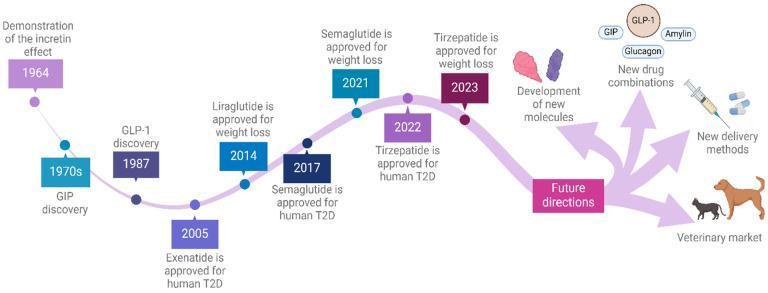
A timeline/progression infographic detailing critical milestones in the development of Glucagon-Like Peptide-1 (GLP-1) receptor agonists for Type 2 Diabetes (T2D) and obesity. The timeline follows a sinusoidal path from left to right, starting with basic science discoveries: the demonstration of the incretin effect (1964), the discovery of Gastric Inhibitory Polypeptide (GIP) (1970s), and the identification of GLP-1 (1987). It then transitions to clinical pharmacology and regulatory approvals, starting with exenatide for T2D (2005), followed by liraglutide for weight loss (2014), semaglutide for T2D (2017) and weight loss (2021), and tirzepatide (a dual GIP/GLP-1 agonist) for T2D (2022) and weight loss (2023). The rightmost section, titled 'Future directions,' branches into four pathways illustrated with icons: development of new molecules (molecular structures), new drug combinations (GLP-1, GIP, Glucagon, Amylin clusters), new delivery methods (syringe and capsule icons), and expansion into the veterinary market (canine and feline silhouettes). This visual represents the evolution from metabolic endocrinology research to modern pharmacotherapy and next-generation obesity management.
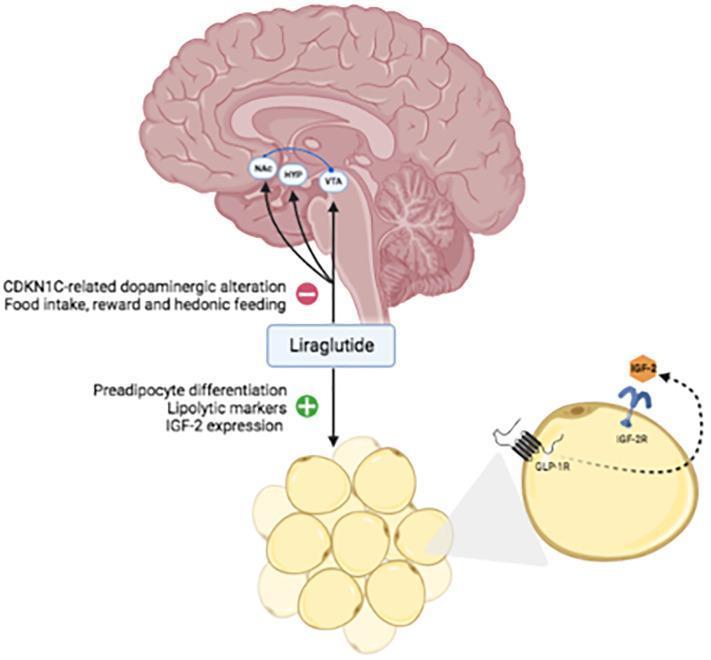
This pathophysiology diagram illustrates the hypothetical central and peripheral mechanisms of Liraglutide, a GLP-1 receptor agonist, in the context of Beckwith-Wiedemann Syndrome (BWS). The upper section shows a sagittal anatomical diagram of the human brain, highlighting the mesolimbic and homeostatic pathways involving the Nucleus Accumbens (NAc), Hypothalamus (HYP), and Ventral Tegmental Area (VTA), interconnected by blue neural pathways. Arrows from Liraglutide point to these regions, indicating a regulatory effect on food intake, reward, and hedonic feeding, potentially counteracting CDKN1C-related dopaminergic alterations. The lower section depicts the peripheral effect on adipose tissue. Liraglutide is shown stimulating a cluster of adipocytes, with positive signs (+) associated with preadipocyte differentiation, lipolytic markers, and IGF-2 expression. A detailed inset shows a single adipocyte expressing GLP-1R and IGF-2R receptors on its membrane, with IGF-2 acting as an extracellular ligand. This educational graphic demonstrates the drug's multi-organ approach to managing obesity by modulating central appetite signaling and peripheral lipid metabolism.
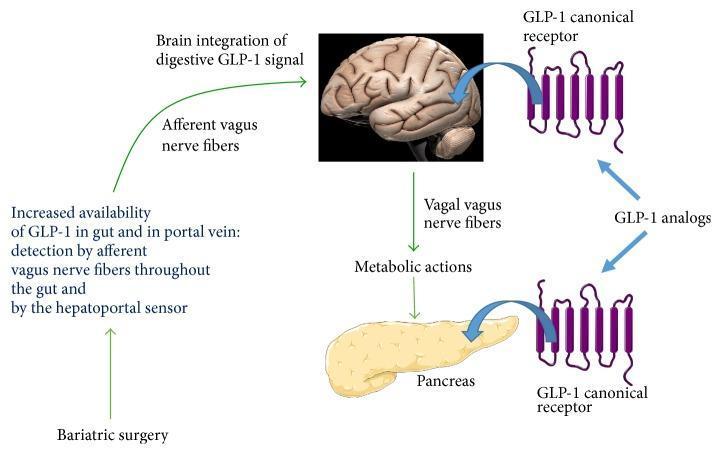
This pathophysiology diagram illustrates the comparative mechanisms of GLP-1 (glucagon-like peptide-1) action following bariatric surgery versus the administration of GLP-1 analogs. The bariatric surgery pathway is depicted as a gut-brain-periphery axis: surgery increases GLP-1 availability in the gut and portal vein, which is detected by hepatoportal sensors and afferent vagus nerve fibers. This signal travels to the brain for integration, which then sends efferent signals via vagal nerve fibers to trigger metabolic actions in peripheral organs like the pancreas. In contrast, the diagram shows GLP-1 analogs bypassing the gut-brain circuit to act directly on GLP-1 canonical receptors (represented by 7-transmembrane G protein-coupled receptor icons) located in tissues such as the brain and pancreas. Key anatomical landmarks included are the brain and the pancreas. This visual serves as an educational tool for endocrinology and metabolic surgery, highlighting the neuro-hormonal integration involved in endogenous GLP-1 signaling compared to direct pharmacological receptor activation.
Ozempic (Semaglutide) - Complete Drug Management Guide
Drug Overview
Approved Indications (FDA, updated January 2025)
- Glycemic control - Adjunct to diet and exercise in adults with type 2 diabetes mellitus (T2DM)
- Cardiovascular risk reduction - Reduce the risk of major adverse cardiovascular events (MACE: CV death, non-fatal MI, non-fatal stroke) in adults with T2DM and established cardiovascular disease
- Chronic kidney disease - Reduce the risk of worsening kidney disease in adults with T2DM and CKD
Note: Ozempic is approved for T2DM regardless of weight status. The higher-dose formulation (Wegovy, semaglutide 2.4 mg) is separately approved for chronic weight management.
Mechanism of Action
- Enhances glucose-dependent insulin secretion from pancreatic beta cells
- Decreases postprandial glucagon secretion from alpha cells
- Slows gastric emptying - reduces postprandial glucose spikes
- Promotes satiety and reduces food intake via hypothalamic receptors
- Promotes beta-cell proliferation
- Reduces hepatic glucose output
Pharmacokinetics
| Parameter | Details |
|---|---|
| Structure | Modified GLP-1 with aminobutyric acid substitution at position 2; α-glutamic acid-oligoethylene glycol linker at position 26; coupled to C-18 diacid |
| Half-life | ~7 days (due to tight albumin binding + DPP-4 resistance) |
| Route | SC injection (once weekly) OR oral tablet (once daily) |
| Steady state | 1-2 months after initiation |
| Renal impairment | No dose adjustment required |
| Hepatic impairment | No dose adjustment required |
Dosing & Dose Escalation
| Week | Dose | Purpose |
|---|---|---|
| Weeks 1-4 | 0.25 mg SC once weekly | Initiation (not therapeutic) |
| Weeks 5-8 | 0.5 mg SC once weekly | First therapeutic dose |
| If additional control needed after 4+ weeks | 1 mg SC once weekly | Increased efficacy |
| Maximum (T2DM + CV/renal) | 2 mg SC once weekly | Maximum glycemic benefit |
- Inject into abdomen, thigh, or upper arm
- Rotate injection sites
- Administer on the same day each week; can change day if last dose was 2+ days ago
- Storage: Refrigerate (2-8°C) until first use; after first use, store at room temperature (≤30°C) or refrigerated for up to 56 days
Drug Interactions
| Interaction | Mechanism | Management |
|---|---|---|
| Insulin / sulfonylureas | Additive glucose-lowering effect | Reduce insulin or SU dose to prevent hypoglycemia |
| Oral medications (general) | Delayed gastric emptying slows drug absorption | Monitor; administer time-critical drugs (e.g., antibiotics, contraceptives) consistently relative to Ozempic |
| Warfarin / anticoagulants | Altered absorption kinetics | Monitor INR closely |
Adverse Effects
- Nausea (most frequent, especially during dose escalation)
- Vomiting
- Diarrhea
- Constipation
- Abdominal pain
| Effect | Details |
|---|---|
| Pancreatitis | Avoid in patients with history of pancreatitis; discontinue if suspected |
| Thyroid C-cell tumors | Demonstrated in rodents; humans: unknown risk; black box warning |
| Diabetic retinopathy worsening | Rapid glycemic improvement can transiently worsen retinopathy |
| Hypoglycemia | Mainly if combined with insulin or sulfonylureas (not with monotherapy) |
| Severe GI reactions | New warning added January 2025 - severe nausea/vomiting requiring hospitalization |
| Aspiration risk (anesthesia) | New warning January 2025 - delayed gastric emptying increases aspiration risk; consult anesthesiologist pre-operatively |
| Acute kidney injury | Secondary to severe dehydration from GI side effects |
| Gallbladder disease | Increased risk of cholelithiasis and cholecystitis |
Contraindications
- Personal or family history of medullary thyroid carcinoma (MTC)
- Multiple Endocrine Neoplasia syndrome type 2 (MEN 2)
- Hypersensitivity to semaglutide or any excipients
Use in Special Populations
| Population | Guidance |
|---|---|
| Pregnancy | Discontinue at least 2 months before planned pregnancy (long washout due to ~7-day half-life); not recommended during pregnancy |
| Breastfeeding | Avoid - unknown if present in breast milk |
| Renal impairment | No dose adjustment needed; however, monitor for dehydration-related AKI |
| Hepatic impairment | No dose adjustment needed |
| Pediatric | Not approved under 18 years |
| Elderly | Use with caution; greater susceptibility to GI side effects and dehydration |
Cardiovascular Benefits (SUSTAIN Trials & Meta-Analysis Evidence)
Weight Loss Benefits
- In T2DM trials: 3-5 kg weight reduction over 4-6 months
- At higher dose (2.4 mg/week as Wegovy in non-diabetic obesity): ~13 kg weight reduction vs. placebo (STEP-1 trial, ~15% total body weight)
- 86.4% of patients on semaglutide achieved ≥5% weight loss vs. 31.5% on placebo
Monitoring Parameters
| Parameter | Frequency |
|---|---|
| HbA1c | Every 3 months until stable, then every 6 months |
| Fasting blood glucose / self-monitoring | As per individualized plan |
| Renal function (eGFR, creatinine) | Annually or if GI dehydration occurs |
| Thyroid (clinical exam, calcitonin) | If clinically indicated |
| Lipase / amylase | Only if pancreatitis is suspected (not routine) |
| Diabetic retinopathy | Eye exam at initiation and follow-up |
| Gallbladder (abdominal symptoms) | Clinical assessment; ultrasound if symptomatic |
| Weight | Every visit |
| Blood pressure | Every visit |
Place in Therapy (T2DM Algorithm)
First-line: Metformin + lifestyle modification
↓ (if HbA1c above target, or CVD/CKD present)
Add GLP-1RA (semaglutide preferred if CVD, CKD, or obesity)
↓ (if still not at goal)
Add SGLT2 inhibitor, or intensify to combination
↓ (if persistent hyperglycemia)
Add basal insulin (reduce dose to prevent hypoglycemia)
Patient Counseling Key Points
- Inject once weekly, same day each week - if you miss a dose and the next dose is >2 days away, administer it; otherwise skip
- GI side effects are expected initially - small meals, avoid fatty food, stay hydrated
- Report immediately: severe abdominal pain (pancreatitis), vision changes, neck lump/hoarseness (thyroid), signs of dehydration
- Do not use if personal/family history of medullary thyroid cancer or MEN2
- Women planning pregnancy: stop at least 2 months before conception
- Inform anesthesiologist before any surgery - risk of aspiration from delayed gastric emptying (new 2025 warning)
- Not a substitute for insulin in type 1 diabetes or diabetic ketoacidosis
Summary Table
| Feature | Detail |
|---|---|
| Drug class | GLP-1 receptor agonist |
| Dosing | 0.25→0.5→1→2 mg SC once weekly |
| HbA1c reduction | ~1-1.5% (T2DM doses) |
| Weight effect | -3 to -5 kg (T2DM); up to -15% body weight (obesity dose) |
| CV benefit | Reduces MACE in established CVD |
| Hypoglycemia risk | Low (monotherapy); higher with insulin/SU combinations |
| Key contraindications | MTC history, MEN2, hypersensitivity |
| Key new warnings (2025) | Severe GI reactions; perioperative aspiration risk |