
Transnasal endoscopic skull base surgery in detail and principles and advantage of image guided endoscopic sinus and skull base surgery from standard ENT textbook
Reading File
Now let me search the medical library for relevant content on transnasal endoscopic skull base surgery and image-guided endoscopic sinus surgery.
Finding Sources
Finding Sources
Finding Sources
Finding Sources
Finding Sources
Reading File
Reading File
Excellent content found. Now let me read more from both textbooks, including the complications section and more of the Cummings content, and also search for image-guided navigation content.
Reading File
Reading File
Finding Sources
Reading File
Finding Sources
Found the image-guided navigation section in Cummings. Let me read it and continue reading the skull base content.
Reading File
Reading File
Reading File
Reading File
Now let me get the full image-guided navigation systems section from Cummings:
Finding Sources
Reading File
Reading File
Reading File
I now have comprehensive content from both major textbooks. Let me also fetch the image-guided navigation figure to include in the response:
Loading Image
I now have all the content needed for a comprehensive answer. Let me compile everything from both textbooks.
Transnasal Endoscopic Skull Base Surgery & Image-Guided Navigation
Sources: K.J. Lee's Essential Otolaryngology (KJL) and Cummings Otolaryngology Head and Neck Surgery (Cummings)
Part I: Transnasal Endoscopic Skull Base Surgery
Overview and Historical Context
Improved understanding of endoscopic endonasal anatomy, combined with advances in endoscopic technology and instrumentation over the last several decades, has led to the popularization of the endonasal route to the skull base. Reduced surgical morbidity, improved recovery time, greater surgical exposure, and avoidance of external scars have allowed endoscopic skull base procedures to become the gold standard technique for the sella and beyond.
- KJL Essential Otolaryngology, p. 627
Initially limited to the transsphenoidal approach for pituitary lesions, endoscopic skull base surgery (ESBS) has burgeoned into a dynamic field with a wide breadth of surgical application, in many cases now replacing traditional open cranial and combined cranio-facial approaches. In 2005, Kassam and colleagues from the University of Pittsburgh published their landmark series on the expanded endonasal endoscopic approach (EEA) to the ventral skull base, describing surgical modules for access to the entire ventral skull base along a rostrocaudal axis - from the crista galli to the sella turcica and from the posterior clinoids to the foramen magnum.
- Cummings Otolaryngology, p. 3366
Advantages of Endoscopic Skull Base Surgery (ESBS)
Documented outcomes include:
- Avoidance of facial scars
- Decreased trauma to normal tissue
- Decreased hospital length of stay
- Improved quality of life
- Diminished morbidity compared to open approaches
- Reduced brain retraction
- Tension pneumocephalus is less common after endoscopic versus open approaches
The Expanded Endonasal Approach (EEA) - Surgical Modules
The EEA is organized into modular approaches along two axes:
TABLE: Expanded Endonasal Approaches to the Anterior Skull Base
| Module (Plane) | Areas of Access | Bone Removed | Key Pathologies |
|---|---|---|---|
| Transfrontal (sagittal) | Posterior table and floor of frontal sinus | Posterior table and floor of frontal sinus | Sinus mucocele, osteoma, nasal dermoid |
| Transcribriform (sagittal) | Crista galli to planum sphenoidale | Cribriform plate, crista galli | Olfactory groove meningiomas, esthesioneuroblastomas, encephaloceles, CSF leak |
| Transplanum/Transtuberculum (sagittal) | Suprasellar region, posterior anterior cranial base | Planum sphenoidale, tuberculum, optic strut, medial clinoid | Planum meningiomas, suprasellar pituitary adenoma, craniopharyngioma |
| Transsellar | Sella turcica | Sellar floor | Pituitary adenoma, Rathke cleft cyst |
| Supraorbital (coronal) | Orbital roof | Medial orbital wall, orbital roof | Benign fibro-osseous lesions |
| Transorbital (coronal) | Intraconal lesions | Medial orbital wall | Hemangiomas, schwannomas |
- Cummings Otolaryngology, p. 3366
Regional Anatomy for Endoscopic Skull Base Surgery
1. The Sellar Region
Boundaries:
- Anterior: anterior wall of the sphenoid sinus
- Posterior: middle third of clivus
- Superior: planum sphenoidale
- Inferior: floor of sphenoid sinus
- Lateral: optic nerve, lateral optico-carotid recess (OCR), cavernous sinus, parasellar carotid artery
Key anatomical points:
- The sphenoid sinus has three pneumatization types: sellar (75%), presellar (24%), and concha (1%)
- The concha type has no pneumatization below the sella - a solid block of bone
- The presellar type does not extend beyond the vertical plane of the anterior sellar wall - landmark identification is more challenging
- The sellar type (most common) has pneumatization extending into the body of the sphenoid below the sella and to the clivus
- The pituitary fossa occupies the central part of the body of the sphenoid, bounded anteriorly by the tuberculum sellae and posteriorly by the dorsum sellae
- The chiasmatic groove is bounded by the planum sphenoidale anteriorly and the tuberculum sellae posteriorly
- Onodi cell: a posterior ethmoidal air cell that has pneumatized posteriorly into the sphenoid sinus, defined by a horizontal sphenoid sinus septation above the posterior bony choana - it may contain the optic nerve
Important recesses in a well-pneumatized sphenoid:
-
Tuberculum recess - at the junction of the anterior sellar wall and planum sphenoidale
-
Medial optico-carotid recess (OCR) - where the lateral tuberculum recess and optic nerve meet (position of middle clinoid process)
-
Lateral optico-carotid recess - at the junction of optic nerve and anterior genu of carotid artery (position of optic strut and anterior clinoid process)
-
Clival recess - junction of the middle third of clivus and pituitary fossa
-
KJL Essential Otolaryngology, p. 627
2. The Anterior Cranial Fossa / Cribriform Region
Boundaries:
- Anterior: frontal sinus posterior wall
- Posterior: planum sphenoidale
- Medial: perpendicular plate of the ethmoid (midline)
- Lateral: lamina papyracea
Key anatomical points:
- The ethmoid bone forms the anterior and middle thirds of the anterior cranial fossa, separated by the cribriform plate (with olfactory fila), the perpendicular plate (nasal septum), and two lateral plates (laminae papyraceae)
- The cribriform plate gives rise to the crista galli, onto which the falx cerebri attaches anteriorly
- The roof of the ethmoidal sinuses is the fovea ethmoidalis (part of the frontal bone), attaching the lamina papyracea laterally to the lateral lamella medially
- The anterior ethmoidal artery passes along the fovea ethmoidalis from lateral to medial in an anteromedial direction; it may run on the skull base or in a mesentery (14-43% of cases). It is found 1 or 2 air cells behind the frontal recess in 85% of cases.
- The posterior ethmoidal artery is located at the junction of the planum sphenoidale with the fovea ethmoidalis anteriorly
Surgical Technique for Anterior Cranial Fossa:
(a) A bilateral complete sphenoethmoidectomy is required to expose the skull base
(b) If pathology extends anterior to the anterior ethmoidal artery, a frontal drill-out/endoscopic modified Lothrop procedure (EMLP) is required
(c) The anterior and posterior ethmoidal arteries are located, cauterized, and divided - away from the lateral aspect to prevent inadvertent retraction into the orbit
(d) The upper portion of the nasal septum is removed to create a single cavity
(e) Unilateral or bilateral middle and superior turbinates are resected
(f) Osteotomies are performed to drop the skull base into the nasal cavity; the attachment of the falx cerebri to the crista galli must be divided first
(b) If pathology extends anterior to the anterior ethmoidal artery, a frontal drill-out/endoscopic modified Lothrop procedure (EMLP) is required
(c) The anterior and posterior ethmoidal arteries are located, cauterized, and divided - away from the lateral aspect to prevent inadvertent retraction into the orbit
(d) The upper portion of the nasal septum is removed to create a single cavity
(e) Unilateral or bilateral middle and superior turbinates are resected
(f) Osteotomies are performed to drop the skull base into the nasal cavity; the attachment of the falx cerebri to the crista galli must be divided first
- KJL Essential Otolaryngology, p. 629
3. The Suprasellar Region
Boundaries:
- Anterior: ethmoid roof
- Posterior: third ventricle, basilar apex, mammary body
- Superior: frontal lobe gyri
- Inferior: sella
- Lateral: optic nerves and supracavernous carotid artery
The suprasellar region is divided into suprachiasmal and subchiasmal cisterns.
4. The Cavernous Sinus Region
Key anatomical points:
- The intracavernous ICA is divided into five segments: posterior vertical, posterior genu, horizontal, anterior genu, and anterior vertical segment
- Along the lateral wall of the sphenoid, boney projections from superior to inferior: cavernous sinus roof (at the inferior aspect of lateral OCR), trigeminal maxillary impression (V2), and trigeminal mandibular nerve (V3)
- The oculomotor, trochlear, and V1 nerves run in the lateral wall of the cavernous sinus, seen by retracting the anterior genu of the carotid medially
- The abducens nerve runs within the cavernous sinus lumen, hugging the horizontal portion of the intracavernous carotid
Surgical Technique for Cavernous Sinus:
- For lesions limited to the medial cavernous sinus: standard sellar approach
- For tumor extending to the lateral and inferior portion: entry into the maxillary sinus required (accessing the lateral recess of the sphenoid sinus)
- Unicinectomy and maxillary antrostomy performed; the sphenopalatine artery is cauterized and divided
- The posterior maxillary sinus wall is exposed and the pterygoid root identified; bone over the carotid protuberance is drilled with a diamond bur
5. The Posterior Cranial Fossa / Clivus
Boundaries:
- Anterior: anterior wall of sphenoid sinus, nasopharynx, and oropharynx
- Posterior: pons, basilar artery
- Lateral: vidian nerve, eustachian tube
- Superior: posterior clinoid
- Inferior: foramen magnum
The clivus extends from the dorsum sellae to the craniocervical junction:
- Upper third: the dorsum sellae
- Middle third: between the floor of the sella and floor of the sphenoid sinus
- Lower third: between the floor of the sphenoid sinus and the foramen magnum
The vidian nerve is a critical landmark - running posteriorly toward the clivus to the lateral edge of the intrapetrous carotid. The lower clivus extends laterally to the occipital condyles.
6. Pterygopalatine Fossa
Surgical Technique:
(a) A posterior fontanelle is palpated until the orbital process of the palatine bone is felt and the crista ethmoidalis is exposed
(b) A portion of the crista is removed and the sphenopalatine artery is identified, cauterized, and divided
(c) Depending on access required, a medial maxillectomy may be needed (removal of inferior turbinate)
(d) The posterior wall of the maxillary sinus is exposed and the pterygoid root identified
(e) Bone of the posteromedial maxillary sinus is removed exposing the fatty soft tissue of the pterygopalatine fossa
(f) The maxillary artery is identified and ligated for vascular control
7. Infratemporal Fossa
Boundaries:
- Superior: greater wing of the sphenoid bone
- Inferior: medial pterygoid muscles attaching to the mandible
- Medial: lateral pterygoid plate, cartilaginous eustachian tube
- Lateral: temporalis muscle and ramus of the mandible
- Posterior: tympanic bone
- Anterior: posterolateral wall of the maxillary sinus
8. Orbital Apex
Boundaries:
- Superior: lesser wing of the sphenoid bone
- Inferior: optic strut
- Medial: body of sphenoid sinus
- Lateral: anterior clinoid process
- Anterior: lamina papyracea at the foramen of the posterior ethmoidal artery
The optic canal is located in the superior medial aspect of the orbital apex, containing the optic nerve and ophthalmic artery.
Reconstruction After Endoscopic Skull Base Surgery
Nasoseptal Flap (Hadad Flap)
The nasoseptal flap (vascular pedicle, first described by Hadad and Bassagasteguy, 2006) is the workhorse for skull base reconstruction:
- Blood supply: posterior nasal artery (branch of sphenopalatine artery)
- Used for small to large defects, especially transsellar and transcribriform defects
Pericranial Flap
-
Indication: large anterior skull base defect
-
Traditionally harvested via bicoronal incision; an endoscopic approach has been described
-
Endoscopic harvesting uses two endoscopes, similar to an endoscopic brow lift approach
-
A horizontal incision is made at the glabella with an osteotomy; the flap is retrieved from the supraorbital region and placed intranasally
-
Blood supply: supratrochlear artery
-
KJL Essential Otolaryngology, p. 639
Contraindications to Purely Endonasal Approach
Absolute contraindications to a purely EEA include:
- Involvement of the nasal bones
- Anterior table of the frontal sinus
- Skin overlying nasal dorsum or frontal sinus
- Orbital involvement that necessitates exenteration
Relative contraindications:
-
Tumor involvement of superficial tissues
-
Need for vascular reconstruction
-
Expected very long duration of surgery
-
Cummings Otolaryngology, p. 3367
Complications of Endoscopic Skull Base Surgery
- CSF leak - the most common complication; multilayered reconstruction based on defect size and location reduces risk
- Tension pneumocephalus - less common than after open approaches; presents with rapid neurologic decline, confusion, and loss of consciousness
- Perioperative bleeding - ranges from venous bleeding to carotid injury
- Hemostatic techniques: warm irrigation, Gelfoam with thrombin packing, Floseal, cautery, aneurysm clipping
- Carotid injury (rare but life-threatening):
- Immediate management: placement of a paddle over the injured vessel with pressure while muscle is harvested from the neck or thigh
- A piece of crushed muscle is placed over the injured carotid until bleeding ceases
- The area is covered by a nasoseptal flap and supported by gentle cavity packing
- After bleeding control: urgent transfer to interventional radiology for angiogram assessment
- Cerebrovascular accident - due to accidental injury to circulation, venous infarct from CSF pressure changes, or embolic phenomena
- Infectious complications - rare; typically from postoperative crust formation
- Minor complications: sinusitis, vestibular burns, anosmia, synechiae
- KJL Essential Otolaryngology, p. 639
Part II: Image-Guided Navigation in Endoscopic Sinus and Skull Base Surgery
Principle and Technology
An inherent problem with endoscopic surgery is the two-dimensional view afforded by the single lens. Navigational systems were developed specifically to reduce the risks of ESS.
These systems use thin-cut CT scans reformatted in multiple planes to create a three-dimensional configuration. This 3D view is then correlated with actual patient anatomy intraoperatively via a computer. The surgeon places a probe on any structure to obtain a real-time, three-dimensional view of the probe's position.
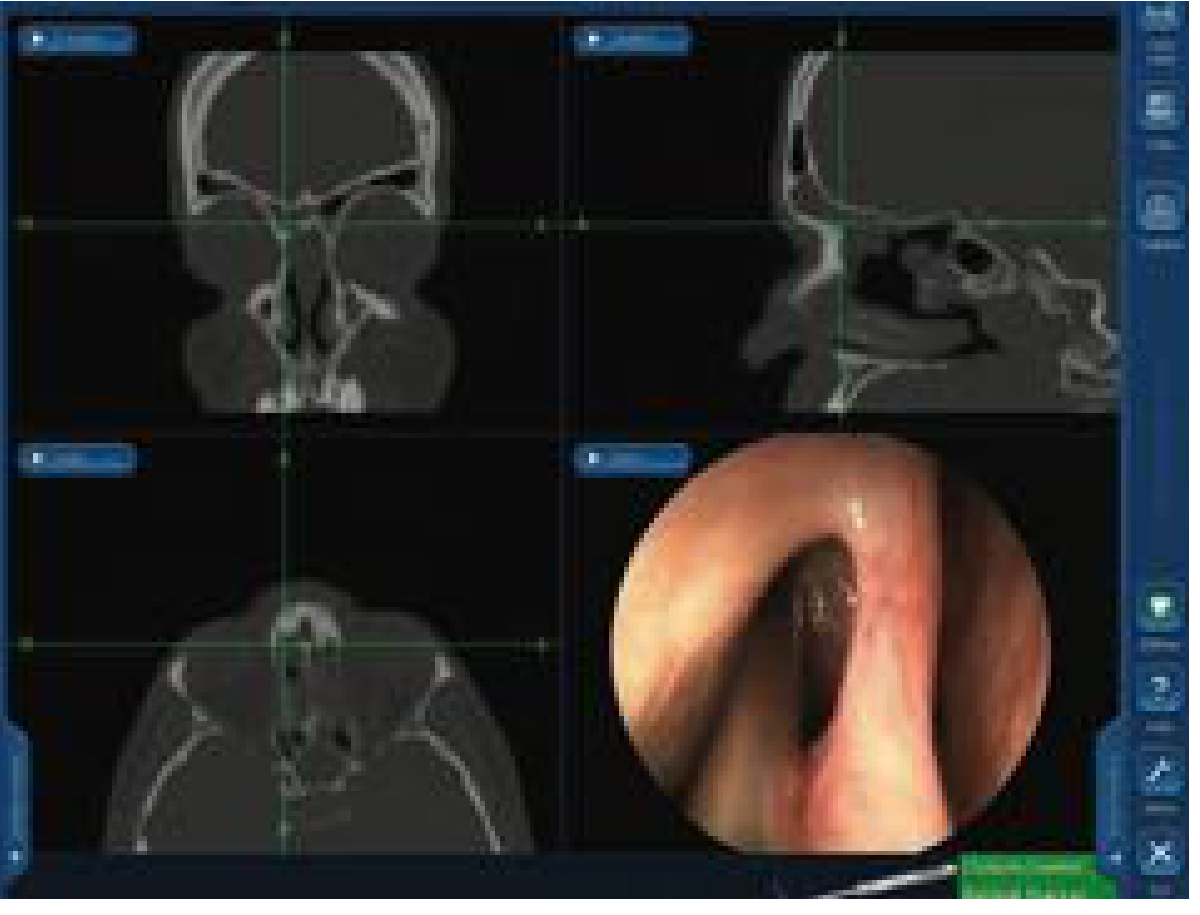
Fig. 44.14 (Cummings): Image-guided navigation systems use reformatted thin-cut CT scans in coronal (top left), sagittal (top right), and axial section (bottom left) to create a three-dimensional view that is correlated intraoperatively with actual patient anatomy as seen through the endoscope (bottom right).
- Cummings Otolaryngology, p. 878
Accuracy
- Accuracy of within 2 to 3 mm is considered acceptable for image guidance systems
- This makes them most useful for confirming the identity of large compartments (e.g., posterior ethmoid vs. sphenoid sinus) rather than distinguishing millimeter-level increments (e.g., at the skull base itself)
- Navigation systems are aids to the surgeon - they are not a substitute for thorough knowledge of surgical anatomy
Sources of Error
- Variables introduced during CT scanning (slice thickness, timing relative to surgery)
- Fiducial (reference device) or headset shift intraoperatively
- Soft tissue effects during surface registration
- Operator-dependent errors during registration
Indications for Use (American Academy of Otolaryngology - Head and Neck Surgery Guidelines)
Image guidance is particularly recommended for:
- Revision sinus surgery (altered anatomy from prior surgery)
- Distorted anatomy from previous disease, trauma, or congenital anomalies
- Extensive sinonasal polyposis
- Surgery involving the frontal sinus, especially with frontal recess dissection
- Pathology involving the skull base, orbit, optic nerve, or carotid artery
- CSF rhinorrhea or conditions where skull base/intracranial anatomy is at risk
Advantages of Image-Guided Surgery (IGS)
- Improved confidence and safety in complex anatomical regions
- Reduction in complications - particularly orbital and intracranial injuries
- Particularly valuable in revision cases where normal landmarks are obliterated
- Real-time 3D orientation within the surgical field
- Especially useful in endoscopic skull base surgery, where two surgeons operate simultaneously and where surgical corridors are narrow and critical structures nearby
- Enables surgeons to navigate safely in distorted post-inflammatory or post-traumatic anatomy
Limitations and Practical Considerations
-
Navigation systems are not needed for every ESS case
-
Come with an associated increase in operative time and cost
-
Accuracy is limited at the millimeter level - cannot replace anatomical knowledge
-
System calibration must be verified before and confirmed during the case (image guidance calibration is conducted and confirmed accurate as part of the pre-surgical checklist)
-
Preoperative CT scans must be protocoled specifically for use in navigation systems (non-contrast, thin-cut protocol)
-
Cummings Otolaryngology, pp. 878-879
Surgical Technique: Key Steps in ESS Using Image Guidance
The basic steps in ESS (Box 44.4, Cummings):
- Patient positioning (reverse Trendelenburg to reduce bleeding)
- CT review (correct patient orientation confirmed)
- Diagnostic nasal endoscopy and topical anesthetic injections
- Medialization of the middle turbinate
- Image guidance calibration confirmed accurate
- Surgery tailored to disease using Messerklinger (anterior-to-posterior) or Wigand (posterior-to-anterior) technique, or a combination
- Systematic progression through the sinuses with continuous landmark verification using navigation
Messerklinger technique (anterior-to-posterior): starts with uncinate process removal, proceeds through the ethmoid bulla, frontal sinus ostium, then posteriorly through the ethmoids to the sphenoid.
Wigand technique (posterior-to-anterior): begins with partial middle turbinate resection, opening posterior ethmoidal cells, and removing the anterior sphenoid wall. Advantage is early skull base identification.
In practice, a combination of these two techniques is most commonly used.
- Cummings Otolaryngology, p. 881
Summary Table
| Feature | Transnasal ESBS | Image-Guided Navigation |
|---|---|---|
| Primary advantage | No facial scars, minimal brain retraction, faster recovery | Real-time 3D orientation, safety in difficult anatomy |
| Gold standard for | Pituitary/sellar lesions, anterior skull base | Revision ESS, skull base surgery, frontal sinus surgery |
| Key landmark | Sphenopalatine artery, ICA, sellar floor | Navigation probe position correlated to reformatted CT |
| Key complication | CSF leak (most common) | System error if not calibrated |
| Essential reconstruction | Nasoseptal flap (vascular pedicle) | N/A |
| Two-surgeon technique | Applicable (wider 4-mm endoscope helpful) | Facilitates two-surgeon orientation |
References:
- K.J. Lee's Essential Otolaryngology, 11th Edition, pp. 627-639 (Endoscopic Skull Base Surgery)
- Cummings Otolaryngology Head and Neck Surgery, 7th Edition, pp. 878-881 (Image-Guided Navigation Systems, FESS technique) and pp. 3366-3367 (Endoscopic Surgery of the Anterior Skull Base)
This is a shared conversation. Sign in to Orris to start your own chat.