
A patient having cervical spondylitis and iron deficiency anemia and migraine recently got some pain in the hands thumb and foot thumb. What should be the next step
Reading File
This is a complex clinical scenario. A patient with cervical spondylitis, iron deficiency anemia, and migraine now presenting with pain in the thumb of the hand and the big toe - this pattern strongly suggests gout (podagra = big toe involvement is classic) or possibly cervical radiculopathy causing referred thumb pain. Let me search the textbooks in parallel.
Finding Sources
Finding Sources
Finding Sources
Finding Sources
Finding Sources
Reading File
Reading File
Now I have strong textbook support. Let me also quickly search for how the background conditions (cervical spondylitis, iron deficiency anemia, migraine) interact with gout workup and treatment.
Finding Sources
Finding Sources
I now have comprehensive information. Let me also fetch the clinical image to include it.
Loading Image
I now have everything needed for a thorough, well-sourced answer.
Clinical Assessment and Next Steps
What Does the Presentation Suggest?
This patient's new complaint of pain in the hand thumb (first MCP/IP joint) and foot's big toe (first MTP joint) on a background of cervical spondylitis, iron deficiency anemia, and migraine strongly points to acute gouty arthritis (gout) as the most likely new diagnosis. The hallmark of gout is:
- Sudden, severe joint pain - classically in the first metatarsophalangeal (MTP) joint of the big toe - a presentation called podagra
- Involvement of the hand/thumb joints is also classic
- Pain at rest as well as with movement
- Peak symptoms within 1-2 days, self-limiting over ~1 week if untreated
Gout occurs when monosodium urate crystals precipitate in joints from supersaturated body fluids, triggering an intense PMN-driven inflammatory response. - ROSEN's Emergency Medicine, p.2337; Tietz Textbook of Laboratory Medicine, p.1091
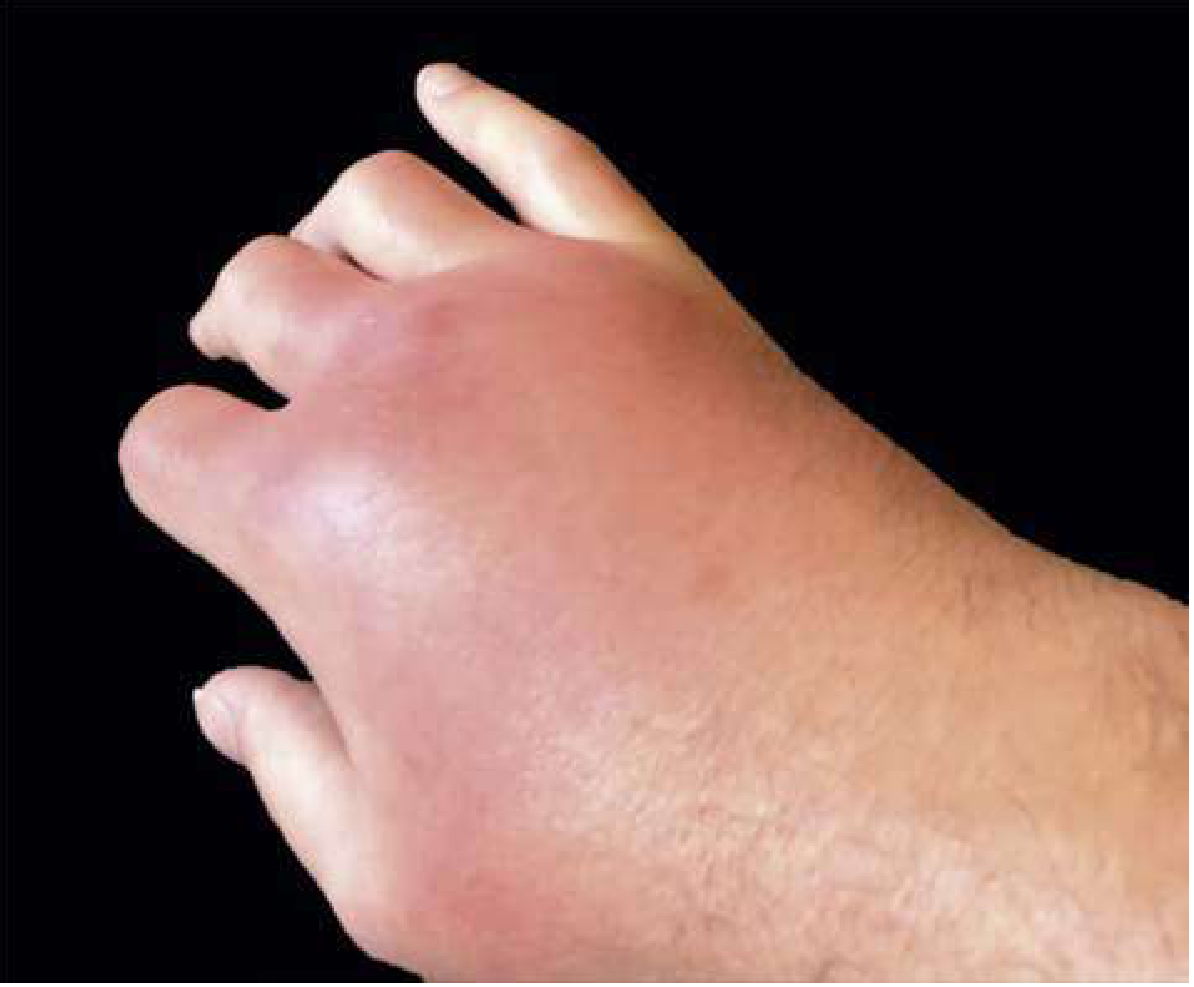
Why Is This Patient at Risk?
Several background factors may have contributed:
- Cervical spondylitis treatment: NSAIDs or diuretics used for cervical pain can raise uric acid levels by reducing renal excretion
- Iron deficiency anemia: Chronic anemia from any cause can be associated with altered purine metabolism
- Migraine medications: Some drugs (e.g., aspirin at low doses) can paradoxically raise serum uric acid by blocking tubular secretion
Recommended Next Steps
1. History and Examination (Immediate)
- Characterize the joint pain: onset, severity, swelling, redness, warmth
- Check for fever (raises concern for septic arthritis - a critical differential)
- Look for tophi (chalky nodules near joints or ears) suggesting chronic gout
- Review all current medications for hyperuricemia-inducing drugs (thiazides, aspirin, cyclosporin)
2. Investigations (Order Now)
| Investigation | Rationale |
|---|---|
| Serum uric acid | Elevated in most cases, but NOTE: can be normal during an acute attack - does not rule out gout |
| Joint aspiration (arthrocentesis) | Gold standard - synovial fluid showing negatively birefringent needle-shaped crystals under polarized microscopy is pathognomonic for gout |
| Serum creatinine / eGFR | Gout is associated with renal insufficiency; many gout treatments are nephrotoxic |
| CBC with differential | WBC may be elevated (nonspecific); also check anemia status |
| Joint X-ray | May show soft tissue swelling acutely; in chronic gout, "rat-bite" erosions with overhanging edges are characteristic |
| Blood culture / joint fluid culture | If fever is present, to rule out septic arthritis |
Important: "Demonstration of uric acid crystals in joint aspirate fluid is pathognomonic for gout... the serum uric acid concentration is often normal during an acute attack." - Tietz Textbook of Laboratory Medicine, p.1091
3. Immediate Treatment (Acute Attack)
The three first-line options are:
-
NSAIDs (e.g., indomethacin, naproxen) - preferred first-line for acute gout; caution given the patient may already be on NSAIDs for cervical spondylitis - assess GI and renal status
-
Colchicine - 1.2 mg loading dose followed by 0.6 mg one hour later; must be started within 36 hours of attack onset to be effective; alternative for those with GI concerns from NSAIDs
-
Corticosteroids - for patients who cannot tolerate NSAIDs or colchicine (e.g., renal impairment)
-
Lippincott Illustrated Reviews: Pharmacology, p.4872; Swanson's Family Medicine Review, p.2152
4. Long-Term / Urate-Lowering Therapy (After Acute Episode Resolves)
- Allopurinol (xanthine oxidase inhibitor) - reduces uric acid production; target serum urate <0.36 mmol/L (<6 mg/dL)
- Probenecid (uricosuric) - increases renal excretion; avoid if renal disease
- Dietary advice: avoid red meat, organ meats, shellfish, anchovies, beer, and high-fructose drinks
- Do NOT start urate-lowering therapy during an acute attack - it can prolong or worsen the flare
5. Key Differential to Exclude
| Condition | How to Distinguish |
|---|---|
| Septic arthritis | Fever, very high WBC in joint fluid, positive culture - requires IV antibiotics urgently |
| Pseudogout (CPPD) | Calcium pyrophosphate crystals - positively birefringent, rhomboid shape; often affects knees/wrists |
| Cervical radiculopathy (C6) | Cervical spondylitis can cause referred thumb/hand pain from nerve compression - but would not explain big toe pain |
| Reactive arthritis | Follows infection; asymmetric oligoarthritis |
Summary of Priority Steps
- Joint aspiration of the most symptomatic joint (first MTP or thumb) - to confirm gout crystals and exclude septic arthritis
- Serum uric acid + renal function (acknowledge that normal uric acid does not exclude gout)
- Start acute anti-inflammatory treatment - NSAIDs or colchicine (within 36 hours)
- Review all current medications for interactions and hyperuricemia-inducing drugs
- Plan urate-lowering therapy (allopurinol) after the acute attack resolves if recurrent/confirmed gout
This is a shared conversation. Sign in to Orris to start your own chat.