
All assessment scale and score in nursing
Reading File
Nursing assessment scales and scores cover a broad range of clinical domains. Let me search the medical library comprehensively.
Searching sources...
Finding Sources
Finding Sources
Finding Sources
Finding Sources
Finding Sources
Searching the Web
nursing assessment scales scores complete list clinical practice 2024
Finding Sources
Finding Sources
Finding Sources
Reading File
Reading File
I now have sufficient foundational information from the medical library combined with my clinical knowledge. Let me compile the comprehensive reference guide.
Loading Image
Here is a complete, organized reference guide to all major nursing assessment scales and scores used in clinical practice.
Nursing Assessment Scales and Scores - Complete Reference Guide
1. NEUROLOGICAL ASSESSMENT SCALES
Glasgow Coma Scale (GCS)
The most widely used neurological assessment tool in nursing and emergency care.
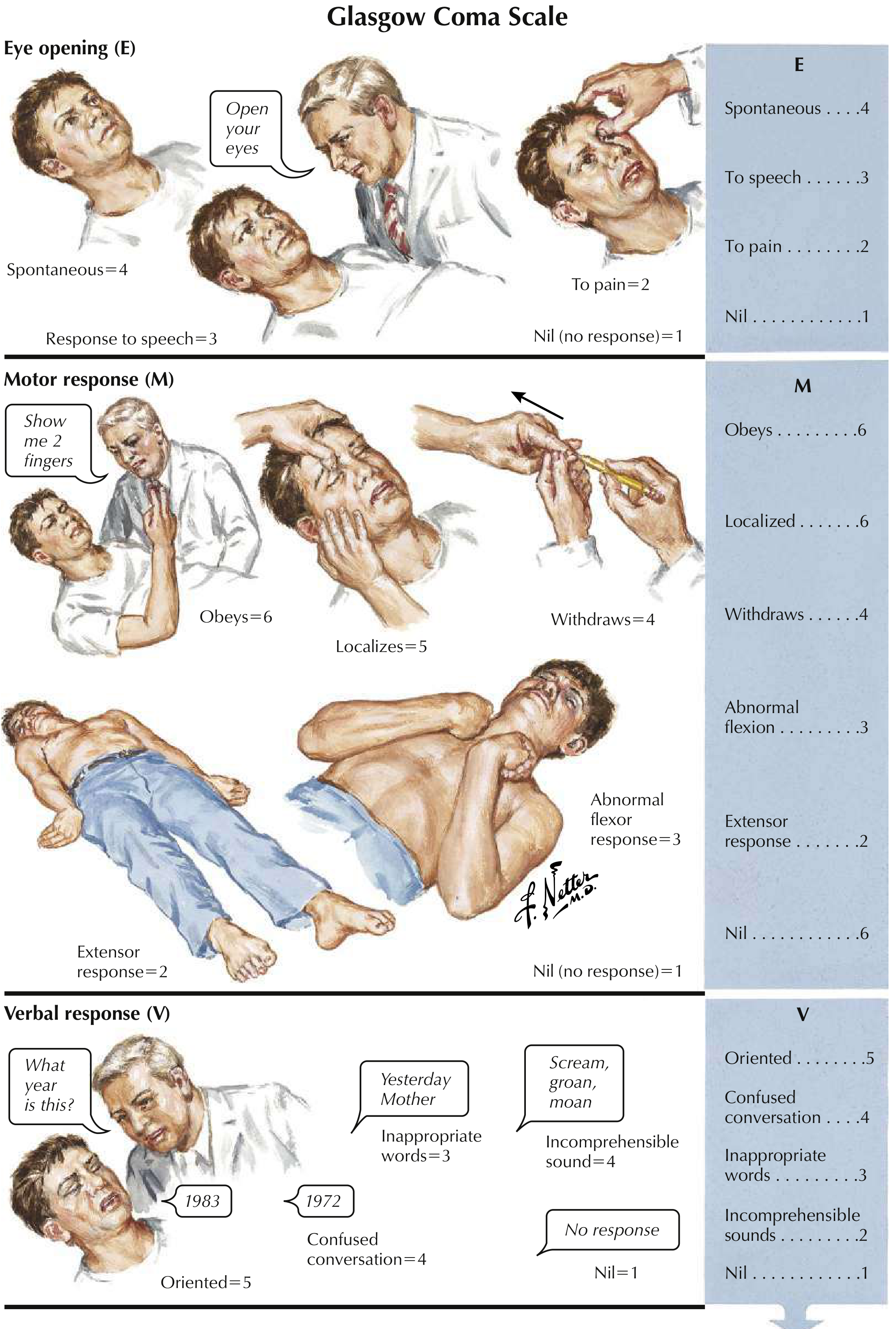
| Component | Response | Score |
|---|---|---|
| Eye Opening (E) | Spontaneous | 4 |
| To speech | 3 | |
| To pain | 2 | |
| None | 1 | |
| Verbal Response (V) | Oriented | 5 |
| Confused | 4 | |
| Inappropriate words | 3 | |
| Incomprehensible sounds | 2 | |
| None | 1 | |
| Motor Response (M) | Obeys commands | 6 |
| Localizes pain | 5 | |
| Withdraws | 4 | |
| Abnormal flexion (decorticate) | 3 | |
| Extension (decerebrate) | 2 | |
| None | 1 |
Total Score: 3-15
- 13-15 = Mild impairment
- 9-12 = Moderate impairment
- 3-8 = Severe impairment / coma
- Used for TBI, stroke, post-op, ICU monitoring
- - Gray's Anatomy for Students; ROSEN's Emergency Medicine
AVPU Scale
A rapid, simplified level of consciousness tool used in emergency triage and quick patient checks.
| Letter | Meaning |
|---|---|
| A | Alert |
| V | Responds to Voice |
| P | Responds to Pain |
| U | Unresponsive |
- Quick bedside tool used in NEWS/early warning systems
FOUR Score (Full Outline of Unresponsiveness)
An alternative to GCS used in ICUs - assesses Eye response, Motor response, Brainstem reflexes, and Respiration. Scores 0-16. Useful for intubated patients (no verbal component).
Ramsay Sedation Scale
Used to assess level of sedation in ICU/sedated patients.
| Score | Description |
|---|---|
| 1 | Anxious/agitated, restless |
| 2 | Cooperative, oriented, tranquil |
| 3 | Responds to commands only |
| 4 | Asleep, brisk response to light stimulus |
| 5 | Asleep, sluggish response |
| 6 | No response |
Target sedation: Score 2-3 for most ICU patients
Richmond Agitation-Sedation Scale (RASS)
Standard ICU sedation scale ranging from -5 (unarousable) to +4 (combative). Target is typically 0 (alert and calm) to -2 (light sedation).
| Score | Term | Description |
|---|---|---|
| +4 | Combative | Violent, danger to staff |
| +3 | Very agitated | Pulls/removes tubes |
| +2 | Agitated | Frequent non-purposeful movements |
| +1 | Restless | Anxious, not aggressive |
| 0 | Alert and calm | |
| -1 | Drowsy | Sustained awakening >10 sec |
| -2 | Light sedation | Briefly awakens <10 sec |
| -3 | Moderate sedation | Movement, no eye contact |
| -4 | Deep sedation | No response to voice |
| -5 | Unarousable | No response to stimulation |
CAM - Confusion Assessment Method
Gold-standard delirium screening tool in nursing.
Delirium present if features 1 + 2 + (3 OR 4):
- Acute onset and fluctuating course
- Inattention
- Disorganized thinking
- Altered level of consciousness
Also exists as CAM-ICU (for non-verbal/intubated patients) and NuDESC (Nursing Delirium Screening Scale - scored 0-10 by nurses based on observation).
- - Harrison's Principles of Internal Medicine 22E
2. PAIN ASSESSMENT SCALES
Numeric Rating Scale (NRS)
- Patient rates pain from 0 (no pain) to 10 (worst pain)
- 0 = None, 1-3 = Mild, 4-6 = Moderate, 7-10 = Severe
- Most commonly used in adult patients who can communicate
Visual Analogue Scale (VAS)
- A 10 cm horizontal line from "no pain" to "worst possible pain"
- Patient marks their pain level; distance measured in mm
- Used in research and clinical settings
Wong-Baker FACES Pain Rating Scale
- 6 faces ranging from smiling (0) to crying (10)
- Designed for children ages 3+ and adults with communication difficulties
- Scores: 0, 2, 4, 6, 8, 10
FLACC Scale (Face, Legs, Activity, Cry, Consolability)
Used for non-verbal patients and children under 3.
| Category | 0 | 1 | 2 |
|---|---|---|---|
| Face | No expression | Occasional grimace | Frequent grimace |
| Legs | Normal/relaxed | Uneasy, restless | Kicking |
| Activity | Lying quietly | Squirming | Arched, rigid |
| Cry | No cry | Moans, whimpers | Crying steadily |
| Consolability | Content | Reassured by touch | Difficult to console |
Total Score: 0-10 (0-2 = Relaxed, 3-4 = Mild, 5-6 = Moderate, 7-10 = Severe)
PAINAD Scale (Pain Assessment in Advanced Dementia)
For patients with severe dementia who cannot self-report pain.
- Assesses: Breathing, Vocalization, Facial expression, Body language, Consolability
- Each scored 0-2, Total: 0-10
CPOT (Critical Care Pain Observation Tool)
Used in ICU for sedated, intubated, or non-verbal patients.
- Assesses: Facial expression, Body movements, Muscle tension, Compliance with ventilator/vocalization
- Score 0-8; score ≥3 = significant pain
PQRST Pain Assessment (Nursing Mnemonic)
Used in admission assessment to characterize pain:
- P - Precipitating/Palliating factors
- Q - Quality (sharp, dull, burning, throbbing)
- R - Region/Radiation
- S - Severity (0-10 scale)
- T - Time (onset, duration, pattern)
3. FALL RISK ASSESSMENT SCALES
Morse Fall Scale (MFS)
Most widely used fall risk tool in hospital settings.
| Item | Scale | Score |
|---|---|---|
| History of falling | No = 0, Yes = 25 | |
| Secondary diagnosis | No = 0, Yes = 15 | |
| Ambulatory aid | None/bed rest/nurse = 0; Crutches/cane/walker = 15; Furniture = 30 | |
| IV therapy / heparin lock | No = 0, Yes = 20 | |
| Gait | Normal/bed rest = 0; Weak = 10; Impaired = 20 | |
| Mental status | Aware of own ability = 0; Overestimates/forgets = 15 |
Risk Levels:
- 0-24 = Low risk
- 25-44 = Moderate risk (implement standard fall prevention)
- ≥45 = High risk (implement high-risk fall prevention protocol)
Hendrich II Fall Risk Model
Commonly used in hospitals; scores 8 items including confusion, depression, altered elimination, dizziness, gender, antiepileptics/benzodiazepines use, and timed "Get Up and Go" test.
- Score ≥5 = High fall risk
STRATIFY (St. Thomas's Risk Assessment Tool in Falling Elderly Inpatients)
5-item tool; score ≥2 = at risk.
- Transfer/mobility, vision, urinary incontinence, agitation, history of falls
4. PRESSURE INJURY / WOUND ASSESSMENT SCALES
Braden Scale for Predicting Pressure Injury Risk
Standard pressure ulcer risk tool used in most hospitals.
| Subscale | Lowest Score | Highest Score |
|---|---|---|
| Sensory Perception | 1 | 4 |
| Moisture | 1 | 4 |
| Activity | 1 | 4 |
| Mobility | 1 | 4 |
| Nutrition | 1 | 4 |
| Friction and Shear | 1 | 3 |
Total Score: 6-23
- ≥19 = Low risk
- 15-18 = Mild risk
- 13-14 = Moderate risk
- 10-12 = High risk
- ≤9 = Very high risk
- - Swanson's Family Medicine Review
Norton Scale
Older pressure ulcer risk tool.
- Assesses: Physical condition, Mental condition, Activity, Mobility, Incontinence
- Each item scored 1-4; Total: 5-20
- Score ≤14 = At risk; ≤12 = High risk
Waterlow Scale
Widely used in the UK.
- Assesses: Build/weight, Height, Skin type, Sex/age, Malnutrition screening, Continence, Mobility, Tissue malnutrition, Neurological deficit, Surgery/trauma, Medication
- Score 10-14 = At risk; 15-19 = High risk; ≥20 = Very high risk
PUSH Tool (Pressure Ulcer Scale for Healing)
Used to monitor healing progress of an existing pressure injury.
- Assesses: Wound length x width (area), Exudate amount, Tissue type
- Total score 0-17; decreasing score = healing
BWAT (Bates-Jensen Wound Assessment Tool)
Comprehensive wound assessment tool with 13 items scoring wound size, depth, edges, undermining, necrotic tissue, exudate, surrounding skin, edema, granulation, epithelialization.
- Score 13-65
5. NUTRITIONAL ASSESSMENT SCALES
NRS-2002 (Nutritional Risk Screening)
Used in hospitals; screens for nutritional risk.
- Considers: BMI, recent weight loss, reduced food intake, disease severity
- Score ≥3 = Nutritional risk - refer to dietitian
MNA (Mini Nutritional Assessment)
Gold standard for nutritional assessment in elderly patients.
- Short form (6 items) and full form (18 items)
- Score 0-30
- 24-30 = Well nourished
- 17-23.5 = At risk of malnutrition
- <17 = Malnourished
MUST (Malnutrition Universal Screening Tool)
Used in community and hospital; 3-step process:
- BMI score (0-2)
- Weight loss score (0-2)
- Acute disease effect score (0 or 2)
- 0 = Low risk; 1 = Medium risk; ≥2 = High risk
6. RESPIRATORY ASSESSMENT SCALES
Modified Borg Scale (Dyspnoea Scale)
Used to rate breathlessness/exertion.
- 0 = Nothing at all
- 0.5 = Very, very slight
- 1 = Very slight
- 2 = Slight
- 3 = Moderate
- 4 = Somewhat severe
- 5-6 = Severe
- 7-9 = Very severe
- 10 = Maximal
MRC Dyspnoea Scale (Modified Medical Research Council)
Used in COPD and respiratory nursing.
- Grade 0: Breathless only with strenuous exercise
- Grade 1: Short of breath when hurrying or walking uphill
- Grade 2: Walks slower than peers on level ground
- Grade 3: Stops for breath after ~100 m on level ground
- Grade 4: Too breathless to leave the house or breathless when dressing
NEWS2 (National Early Warning Score 2)
Standard early warning system used by nurses to detect patient deterioration.
| Parameter | Score 3 | Score 2 | Score 1 | Score 0 | Score 1 | Score 2 | Score 3 |
|---|---|---|---|---|---|---|---|
| Respiration rate | ≤8 | 9-11 | 12-20 | 21-24 | ≥25 | ||
| SpO2 (Scale 1) | ≤91 | 92-93 | 94-95 | ≥96 | |||
| Systolic BP | ≤90 | 91-100 | 101-110 | 111-219 | ≥220 | ||
| Pulse | ≤40 | 41-50 | 51-90 | 91-110 | 111-130 | ≥131 | |
| Consciousness | Alert | CVPU | |||||
| Temperature | ≤35.0 | 35.1-36.0 | 36.1-38.0 | 38.1-39.0 | ≥39.1 |
Total Score:
- 0-4 = Low
- 5-6 or any single score of 3 = Medium (increase monitoring)
- ≥7 = High (emergency response)
7. MENTAL HEALTH AND COGNITIVE ASSESSMENT SCALES
MMSE (Mini-Mental State Examination)
Classic 30-point cognitive screening tool.
- Tests: Orientation (10), Registration (3), Attention/Calculation (5), Recall (3), Language (8), Visuospatial (1)
- 24-30 = Normal; 18-23 = Mild cognitive impairment; 0-17 = Severe impairment
MoCA (Montreal Cognitive Assessment)
More sensitive than MMSE for mild cognitive impairment.
- 30-point test covering visuospatial, naming, memory, attention, language, abstraction, delayed recall, orientation
- ≥26/30 = Normal
PHQ-9 (Patient Health Questionnaire-9)
9-item depression screening tool.
- Each item scored 0-3; Total 0-27
- 0-4 = Minimal; 5-9 = Mild; 10-14 = Moderate; 15-19 = Moderately severe; 20-27 = Severe depression
GAD-7 (Generalized Anxiety Disorder-7)
7-item anxiety screening.
- 0-4 = Minimal; 5-9 = Mild; 10-14 = Moderate; ≥15 = Severe anxiety
Beck Depression Inventory (BDI-II)
21-item self-report tool for depression severity.
- 0-13 = Minimal; 14-19 = Mild; 20-28 = Moderate; 29-63 = Severe
Hamilton Anxiety Rating Scale (HAM-A)
14-item clinician-rated scale.
- <17 = Mild; 18-24 = Mild to moderate; 25-30 = Moderate to severe
8. FUNCTIONAL AND MOBILITY ASSESSMENT SCALES
Barthel Index (BI)
Gold standard for measuring functional independence in ADLs.
- 10 items: Feeding, Bathing, Grooming, Dressing, Bowel control, Bladder control, Toilet use, Transfer (bed to chair), Mobility, Stairs
- Total: 0-100
- 0-20 = Total dependence; 21-60 = Severe dependence; 61-90 = Moderate dependence; 91-99 = Slight dependence; 100 = Independent
Katz Index of Independence in ADLs
Assesses 6 basic ADLs: Bathing, Dressing, Toileting, Transferring, Continence, Feeding
- Score 6 = Full independence; 4 = Moderate impairment; 2 or below = Severe impairment
Functional Independence Measure (FIM)
18-item scale used in rehabilitation nursing.
- 13 motor tasks + 5 cognitive tasks
- Each item scored 1-7 (1 = total assistance, 7 = complete independence)
- Total: 18-126
Timed Up and Go Test (TUG)
Functional mobility and fall risk test.
- Time patient rising from chair, walking 3 m, turning, returning, sitting
- <12 seconds = Normal; 12-20 s = Some risk; >20 s = High fall risk
Berg Balance Scale
14-item balance assessment; each 0-4.
- Total 0-56
- 41-56 = Low fall risk; 21-40 = Medium; 0-20 = High fall risk
9. NEONATAL AND PAEDIATRIC ASSESSMENT SCALES
APGAR Score
Assessed at 1 and 5 minutes after birth; repeated at 10 minutes if <7.
| Sign | 0 | 1 | 2 |
|---|---|---|---|
| Appearance (skin color) | Blue/pale all over | Blue extremities, pink body | Pink all over |
| Pulse (heart rate) | Absent | <100 bpm | ≥100 bpm |
| Grimace (reflex irritability) | No response | Grimace | Cry/cough/sneeze |
| Activity (muscle tone) | Limp | Some flexion | Active motion |
| Respiration | Absent | Weak/irregular | Strong cry |
- 7-10 = Normal; 4-6 = Moderate concern; 0-3 = Immediate resuscitation needed
- - Textbook of Family Medicine 9e; ROSEN's Emergency Medicine
New Ballard Score
Assesses gestational age in newborns using neuromuscular maturity (posture, arm recoil, popliteal angle, scarf sign, heel-to-ear) and physical maturity (skin, lanugo, plantar surface, breast, eye/ear, genitals).
- Scores -10 to +50; correlated to gestational age 20-44 weeks
- - Textbook of Family Medicine 9e
Pediatric Assessment Triangle (PAT)
Rapid initial assessment for children using:
- Appearance (TICLS: Tone, Interactiveness, Consolability, Look/Gaze, Speech/Cry)
- Work of Breathing (abnormal sounds, retractions, positioning)
- Circulation to Skin (pallor, mottling, cyanosis)
PEWS (Pediatric Early Warning Score)
Equivalent of NEWS2 for pediatric patients. Assesses behavior, cardiovascular, and respiratory domains.
10. CARDIOVASCULAR AND HAEMODYNAMIC ASSESSMENT
NYHA Classification (New York Heart Association)
Functional classification of heart failure.
| Class | Description |
|---|---|
| I | No symptoms with ordinary activity |
| II | Slight limitation; comfortable at rest |
| III | Marked limitation; comfortable only at rest |
| IV | Symptoms at rest; unable to carry out any activity |
CHA₂DS₂-VASc Score
Stroke risk in atrial fibrillation (used by nurses in anticoagulation clinics).
- C: Congestive HF (1), H: Hypertension (1), A2: Age ≥75 (2), D: Diabetes (1), S2: Stroke/TIA (2), V: Vascular disease (1), A: Age 65-74 (1), Sc: Sex (female) (1)
- Score ≥2 (men) or ≥3 (women) = Anticoagulation recommended
11. SEPSIS AND DETERIORATION ASSESSMENT
qSOFA (Quick Sequential Organ Failure Assessment)
Rapid bedside tool for sepsis identification.
- Altered mental status (GCS <15)
- Respiratory rate ≥22/min
- Systolic BP ≤100 mmHg
- Score ≥2 = High risk for sepsis; investigate further
SOFA Score (Sequential Organ Failure Assessment)
Used in ICU to quantify organ dysfunction.
- Assesses: Respiratory (PaO2/FiO2), Coagulation (platelets), Liver (bilirubin), Cardiovascular (MAP/vasopressors), CNS (GCS), Renal (creatinine/urine output)
- Total 0-24; higher score = greater organ failure
12. SKIN AND WOUND ASSESSMENT
Skin Assessment (General)
Nurses use the HEENT/head-to-toe approach and document:
- Color, temperature, turgor, moisture
- Lesions: Type, size, distribution
- Pressure injury staging (NPIAP Staging: Stage 1-4, Unstageable, Deep Tissue Injury)
NPIAP Pressure Injury Stages
| Stage | Description |
|---|---|
| Stage 1 | Non-blanchable erythema, intact skin |
| Stage 2 | Partial thickness skin loss, open wound/blister |
| Stage 3 | Full thickness skin loss, fat visible |
| Stage 4 | Full thickness, bone/tendon/muscle exposed |
| Unstageable | Base obscured by slough/eschar |
| Deep Tissue | Persistent non-blanchable deep red/purple discoloration |
13. URINARY AND BOWEL ASSESSMENT
Bristol Stool Form Scale
7-category classification of stool consistency.
- Types 1-2: Constipation (hard, lumpy)
- Types 3-4: Normal (smooth, sausage-shaped)
- Types 5-7: Diarrhea (soft, liquid)
IPSS (International Prostate Symptom Score)
7-question tool for lower urinary tract symptoms (LUTS); used in men's health nursing.
- 0-7 = Mild; 8-19 = Moderate; 20-35 = Severe
14. SPECIALIST NURSING SCALES
CIWA-Ar (Clinical Institute Withdrawal Assessment for Alcohol)
10-item scale for alcohol withdrawal severity in nursing/addiction settings.
- Assesses: Nausea, tremor, diaphoresis, anxiety, agitation, headache, perceptual disturbances, paroxysmal sweats, orientation
- <8 = Mild; 8-15 = Moderate; >15 = Severe (pharmacological treatment needed)
COWS (Clinical Opiate Withdrawal Scale)
For opioid withdrawal assessment.
- 11 items including pulse rate, sweating, restlessness, pupil size, bone/joint aches, GI upset, tremor, yawning, anxiety/irritability, gooseflesh, skin
- 5-12 = Mild; 13-24 = Moderate; 25-36 = Moderately severe; >36 = Severe
Malignant Hyperthermia Grading Scale (MH Clinical Grading Scale)
Used in surgical/anaesthesia nursing to assess likelihood of malignant hyperthermia event.
- 6 domains scored; raw score converted to rank (1-6) indicating probability.
AUDIT (Alcohol Use Disorders Identification Test)
10-item screening for hazardous/harmful alcohol use.
- 0-40; ≥8 = Hazardous/harmful use; ≥20 = Alcohol dependence
Karnofsky Performance Scale
Used in oncology nursing to assess functional status.
- 100% = Normal, no complaints; 0% = Dead
- ≥70% = Self-care; <50% = Significant assistance required
ECOG Performance Status (Eastern Cooperative Oncology Group)
5-level scale (0-4) used in oncology nursing.
- 0 = Fully active; 1 = Light work; 2 = Self-care, up >50% of day; 3 = Limited self-care; 4 = Completely disabled
Summary Table: Quick Reference
| Scale | Domain | Score Range | Nursing Use |
|---|---|---|---|
| GCS | Neuro/consciousness | 3-15 | Acute/ICU/trauma |
| AVPU | Consciousness | 4 levels | Triage/quick check |
| RASS | Sedation/agitation | -5 to +4 | ICU |
| CAM | Delirium | Positive/negative | All wards |
| NRS | Pain | 0-10 | All adult patients |
| FLACC | Pain | 0-10 | Pediatric/non-verbal |
| PAINAD | Pain | 0-10 | Dementia patients |
| CPOT | Pain | 0-8 | ICU/intubated |
| Morse Fall Scale | Fall risk | 0-125 | All inpatients |
| Hendrich II | Fall risk | 0-16 | Inpatients |
| Braden Scale | Pressure injury risk | 6-23 | All inpatients |
| Norton Scale | Pressure injury risk | 5-20 | All inpatients |
| NRS-2002 | Nutrition | 0-7 | All inpatients |
| MNA | Nutrition (elderly) | 0-30 | Elderly patients |
| MUST | Malnutrition | 0-6 | Community/hospital |
| NEWS2 | Deterioration | 0-20 | All wards |
| MMSE | Cognition | 0-30 | Geriatrics/neuro |
| MoCA | Cognition | 0-30 | Cognitive impairment |
| PHQ-9 | Depression | 0-27 | Mental health |
| GAD-7 | Anxiety | 0-21 | Mental health |
| Barthel Index | Functional status | 0-100 | Rehab/elderly |
| Katz Index | ADLs | 0-6 | Geriatrics |
| FIM | Functional status | 18-126 | Rehabilitation |
| APGAR | Newborn assessment | 0-10 | Neonatal |
| New Ballard | Gestational age | -10 to +50 | Neonatal |
| NYHA | Heart failure | Class I-IV | Cardiology |
| qSOFA | Sepsis | 0-3 | All wards |
| SOFA | Organ failure | 0-24 | ICU |
| CIWA-Ar | Alcohol withdrawal | 0-67 | Addiction/general |
| COWS | Opioid withdrawal | 0-48 | Addiction |
| AUDIT | Alcohol use | 0-40 | Community/admissions |
| IPSS | Urinary symptoms | 0-35 | Urology |
| Bristol Stool | Bowel | 7 types | All wards |
| Karnofsky | Oncology performance | 0-100% | Oncology |
| ECOG | Oncology performance | 0-4 | Oncology |
Key Points for Nurses:
- Always document scores with time and date
- Reassess at regular intervals and after any clinical change
- Use the appropriate scale for the patient population (age, communication ability, clinical setting)
- Escalate promptly when scores indicate deterioration (e.g., NEWS2 ≥7, GCS drop of 2 or more, Morse ≥45)
- Pain and fall risk tools should be assessed on every shift
Make a PDF quick reference guide for nursing assessment scales
Reading File
Your credits are exhausted. You can purchase a top-up or subscribe to a plan to continue using Orris. If you're already subscribed, your daily credits will reset tomorrow.
This is a shared conversation. Sign in to Orris to start your own chat.