
IUCD types, side-effects,indication, contraindications.... All in detail
Reading File
Now let me search the medical library for comprehensive IUCD content in parallel.
Finding Sources
Finding Sources
Finding Sources
Finding Sources
Good - found key sources. Now let me read the most comprehensive sections in parallel.
Reading File
Reading File
The Berek & Novak section was about fibroids/GnRH. Let me look at the dedicated IUCD insertion chapter and the Berek & Novak progesterone IUD section:
Reading File
Reading File
I need to find the actual IUD insertion chapter. Let me search more specifically:
Finding Sources
Finding Sources
Finding Sources
Reading File
That was the hysteroscopy chapter. Let me search the Berek & Novak Gynecology book for the dedicated IUD chapter, and also search the Goldman-Cecil and Swanson's books:
Finding Sources
Reading File
Excellent! Park's Textbook has a dedicated "Types of IUD" section. Let me read it now:
Reading File
Reading File
I found that Park's Textbook has the Types of IUD section at line 7806. Let me read that now, and also the Berek & Novak IUD section:
Reading File
Reading File
I found the key Park's Textbook content. Let me continue reading the IUD section:
Reading File
I now have rich content. Let me fetch the IUD images and read a bit more of the Park's section for complete side effects:
Reading File
Loading Image
Reading File
Loading Image
Reading File
I now have comprehensive content from Park's Textbook. I have everything I need to write a detailed answer. Let me compile this into a thorough response.
Intrauterine Contraceptive Device (IUCD) - Complete Overview
Based on: Park's Textbook of Preventive & Social Medicine, Berek & Novak's Gynecology, Pfenninger & Fowler's Procedures for Primary Care
What is an IUCD?
An IUCD (Intrauterine Contraceptive Device) is a small device inserted into the uterine cavity to prevent pregnancy. It is one of the most effective long-acting reversible contraceptive (LARC) methods available. Devices are usually made of polyethylene or other inert polymers; medicated types additionally release copper ions or hormones.
Types of IUCDs
IUCDs are classified into three generations based on their composition and mechanism:
First Generation - Non-Medicated (Inert) IUDs
These are made entirely of polyethylene or other polymers with no added medicament. They work purely via the foreign-body reaction in the uterus. They appeared in many shapes: loops, spirals, coils, rings, and bows.
Lippes Loop - the most well-known device in this category:
- Double-S shaped polyethylene device
- Non-toxic, non-tissue-reactive, extremely durable
- Contains barium sulphate for X-ray visibility
- Has a nylon "tail" that projects into the vagina for position checking and easy removal
- Available in 4 sizes: A, B, C, D (D = largest)
- Larger sizes (C, D) are more suitable for multiparous women
- Advantage: does NOT need replacement (permanent unless removed)
- Disadvantage: higher side-effect rate (pain, bleeding) vs. copper devices
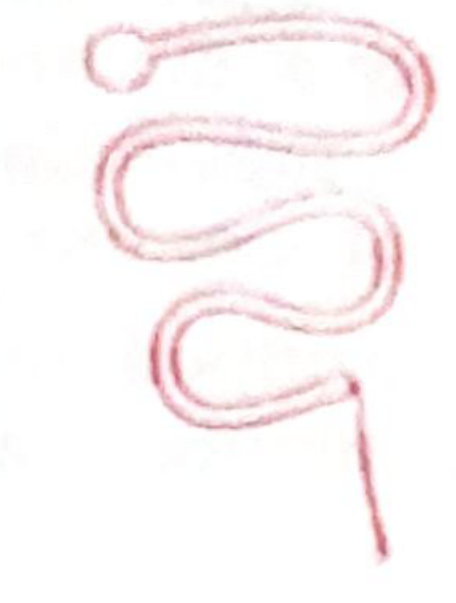
Lippes Loop - the classic first-generation inert IUD (Park's Textbook of Preventive & Social Medicine)
Second Generation - Copper-Bearing IUDs
Developed in the 1970s when it was discovered that metallic copper has a strong anti-fertility effect. Adding copper allowed development of smaller devices that are easier to insert, even in nulliparous women.
The numbers in device names refer to the surface area of copper (in mm²).
Earlier devices:
- Copper-7 (Gravigard) - shaped like the numeral 7
- Copper T-200 - T-shaped, 200 mm² copper surface
Newer devices (in current use):
| Device | Copper Surface | Notes |
|---|---|---|
| Cu-T-220C | 220 mm² | T-shaped variant |
| Cu-T-380A (ParaGard) | 380 mm² | Most widely studied; approved for 10+ years; used as emergency contraception |
| Cu-T-380 Ag | 380 mm² | Silver core with copper wire wrapped over it |
| Nova T | ~200 mm² | Silver core over which copper is wound |
| ML-Cu-250 (Multiload) | 250 mm² | Flexible arms conform to uterine walls |
| ML-Cu-375 | 375 mm² | More effective Multiload variant |
In India's National Family Welfare Programme: Cu-T-200B was used historically; Cu-T-380A was introduced in 2002 as the standard.
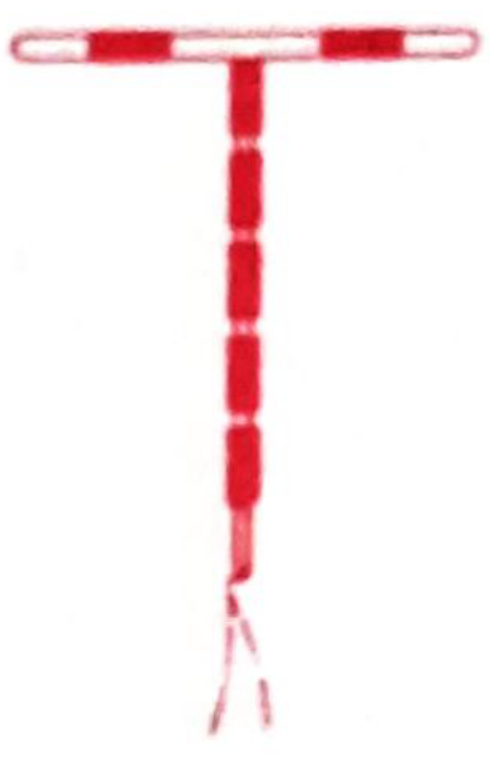
Cu-T-220C - second generation copper-bearing IUD (Park's Textbook)
Advantages of copper devices over inert IUDs:
- Lower expulsion rate
- Lower incidence of side-effects (pain, bleeding)
- Easier to fit even in nulliparous women
- Better tolerated by nulliparae
- Increased contraceptive effectiveness
- Effective as post-coital contraceptives if inserted within 3-5 days of unprotected intercourse (99% reduction in pregnancy risk)
- Effective life of at least 5-10 years
Third Generation - Hormone-Releasing IUDs
Based on slow release of a progestogen within the uterine cavity. Produce local hormonal effects on endometrium and cervical mucus.
1. Progestasert
- T-shaped device filled with 38 mg of progesterone (natural hormone)
- Releases 65 mcg/day locally
- Effective life: 1 year (needs annual replacement)
- Direct local effect on endometrium, cervical mucus, and sperm
2. LNG-IUS (Mirena / Levosert)
- T-shaped device releasing 20 mcg levonorgestrel/day
- Pregnancy rate: 0.2 per 100 women (very low)
- Fewer ectopic pregnancies than copper devices
- Associated with decreased menstrual blood loss and fewer bleeding days vs. copper
- Effective life: 5-10 years (Mirena approved for 8 years in US, up to 10 years in some guidelines)
- Particularly valuable where anaemia from heavy bleeding is a concern
- Also used therapeutically for menorrhagia, endometriosis, and fibroid-related bleeding
Mechanism of Action
| Device Type | Primary Mechanism |
|---|---|
| Inert IUDs | Foreign-body reaction in uterus → cellular and biochemical changes in endometrium and uterine fluids → impairs gamete viability and reduces fertilization |
| Copper IUDs | Same foreign-body reaction + copper ions enhance cellular response in endometrium, alter enzymes, modify cervical mucus biochemistry → impairs sperm motility, capacitation, and survival |
| Hormone-releasing IUDs | Progestogen increases viscosity of cervical mucus (prevents sperm entry), maintains high endometrial progesterone + low oestrogen (unfavourable to implantation), suppresses ovulation partially |
The most accepted current view is that IUDs primarily act by preventing fertilization, not by preventing implantation of an already-fertilized egg.
Effectiveness
The IUCD is one of the most effective reversible contraceptive methods available:
- Theoretical effectiveness is slightly less than oral/injectable hormonal contraceptives
- However, because IUDs have much higher continuation rates than pills or injections, the overall effectiveness in practice is comparable or superior
- Copper devices are more effective than Lippes Loop, with fewer expulsions
- LNG-IUS has the lowest failure rate of any IUD (~0.2/100 women-years)
Indications
- Women who desire long-term, highly effective, reversible contraception
- Women who cannot or do not want to use hormonal contraception (copper IUD option)
- Women seeking emergency contraception within 5 days of unprotected intercourse (copper Cu-T-380A)
- Women with menorrhagia or dysmenorrhoea (LNG-IUS is therapeutic)
- Women with endometriosis (LNG-IUS)
- Women with endometrial hyperplasia - in select cases (LNG-IUS protective effect)
- Postpartum women (can be inserted immediately postpartum or post-caesarean)
- Perimenopausal women wanting long-acting contraception
- Breastfeeding women (copper IUD is non-hormonal; LNG-IUS has minimal systemic effect)
- Women who need contraception but have difficulty with daily compliance (pills)
Ideal IUD candidate (per Planned Parenthood Federation of America):
- Has borne at least one child
- No history of pelvic inflammatory disease
- Normal menstrual periods
- Willing to check the IUD tail periodically
- Has access to follow-up and treatment of potential problems
- Is in a monogamous relationship
Contraindications
Absolute Contraindications
- Suspected or confirmed pregnancy
- Active pelvic inflammatory disease (PID) - current or within 3 months
- Vaginal/uterine bleeding of undiagnosed aetiology
- Cancer of the cervix, uterus, or adnexa; other pelvic tumours
- Previous ectopic pregnancy (especially for copper IUD)
- Known allergy to copper or Wilson's disease (for copper IUDs specifically)
- Septic abortion in the past 3 months
Relative Contraindications
- Anaemia (copper IUD can worsen blood loss)
- Menorrhagia (copper IUD may worsen; LNG-IUS is actually beneficial here)
- History of PID since last pregnancy
- Purulent cervical discharge / STI
- Distortions of the uterine cavity - congenital malformations, fibroids (especially submucous)
- Coagulopathies (ITP, von Willebrand disease)
- Previous uterine perforation or recent uterine surgery
- Nulliparity (relative - smaller copper devices can still be used)
- Multiple sexual partners (increased STI/PID risk)
- Immunosuppression / HIV (increased infection risk)
- Unmotivated patient (less suitable candidate for continuation of use)
Side-Effects
1. Menstrual Disturbances (most common)
- Increased menstrual blood loss (menorrhagia) - most common with inert and copper IUDs; average 40-50% increase in blood flow
- Prolonged menstruation - longer duration of bleeding
- Intermenstrual bleeding - spotting between periods
- Dysmenorrhoea - increased period pain, especially in the first few months
- Note: LNG-IUS causes the opposite - reduced bleeding and amenorrhoea over time
2. Pain
- Insertion pain - cramping during and immediately after device insertion
- Lower abdominal pain/pelvic cramps - may persist for weeks after insertion
- More common in nulliparous women
3. Expulsion
- Partial or complete expulsion of the device from the uterus, particularly in the first year
- Higher with larger inert devices and with devices used in nulliparous women
- Copper devices have a lower expulsion rate than inert IUDs
- May go unnoticed - patient advised to regularly check the tail string
4. Pelvic Inflammatory Disease (PID)
- Risk is highest in the first 20 days post-insertion (from insertion-related contamination)
- Long-term risk relates to the patient's own STI risk (multiple partners), not the IUD itself
- Can lead to subfertility if not treated promptly
5. Ectopic Pregnancy
- If pregnancy occurs despite an IUD in place, a higher proportion are ectopic (~50%)
- The absolute risk of ectopic pregnancy is LOW (since IUDs prevent most pregnancies)
- The LNG-IUS has the lowest risk of ectopic pregnancy among IUDs
- Copper IUD does NOT prevent ectopic pregnancies as effectively as it prevents intrauterine ones
6. Uterine Perforation
- Uncommon but serious complication (~1 in 1,000 insertions)
- Usually occurs at the time of insertion
- Can be partial (myometrium) or complete (into peritoneal cavity)
- Requires surgical retrieval if complete perforation
7. Pregnancy with IUD In Place
- Increased risk of: spontaneous miscarriage, septic abortion, preterm labour
- IUD should be removed if strings are visible (reduces risk of complications)
- If IUD is left in place and pregnancy continues: risk of premature rupture of membranes, chorioamnionitis, preterm birth
8. Lost/Missing Threads
- Strings may ascend into the uterine cavity or break
- Requires ultrasound or hysteroscopy for localization
9. Hormonal Side-Effects (LNG-IUS specific)
- Irregular spotting and breakthrough bleeding in the first 3-6 months
- Headaches
- Breast tenderness
- Mood changes / depression (less common; systemic absorption is low)
- Acne (rare due to minimal systemic levels)
- Amenorrhoea (20% at 1 year, 50% at 5 years - often seen as a benefit)
- Ovarian cysts (functional) - occur in ~7% but mostly resolve spontaneously
10. Other
- Actinomyces-like organisms on cervical smear (associated with long-term IUD use; significance uncertain)
- Partner discomfort from strings (can be trimmed)
- Vaginal discharge (foreign body reaction)
Timing of Insertion
- Best time: During menstruation or within 10 days of the first day of a period - cervical canal is slightly dilated, pregnancy is excluded, insertion is technically easier
- Postpartum: Can be inserted immediately (within 48 hours) or after 4-6 weeks postpartum
- Post-abortion: Can be inserted immediately after a complete first-trimester abortion
- Emergency contraception use: Copper IUD inserted within 5 days of unprotected intercourse (99% effective)
Duration of Use
| Device | Effective Life |
|---|---|
| Lippes Loop | Indefinite (no replacement needed) |
| Cu-T-200 | 3-5 years |
| Cu-T-380A | 10+ years (FDA-approved 10 years; studies support 12+ years) |
| ML-Cu-375 | 5 years |
| Progestasert | 1 year |
| LNG-IUS (Mirena) | 5-8 years (up to 10 years per newer evidence) |
Summary Comparison Table
| Feature | Lippes Loop | Copper IUD (Cu-T-380A) | LNG-IUS (Mirena) |
|---|---|---|---|
| Generation | 1st | 2nd | 3rd |
| Material | Polyethylene | Polyethylene + copper | Polyethylene + LNG |
| Mechanism | Foreign body | Foreign body + spermicidal | Foreign body + cervical mucus + endometrial |
| Effect on bleeding | Increases | Increases | Decreases (amenorrhoea) |
| Duration | Indefinite | 10 years | 5-8 years |
| Ectopic risk | Moderate | Moderate | Low |
| Failure rate (typical) | 2-3% | 0.6-0.8% | 0.1-0.2% |
| Emergency use | No | Yes (within 5 days) | No |
| Cost | Low | Moderate | Higher |
Sources: Park's Textbook of Preventive and Social Medicine; Berek & Novak's Gynecology; Pfenninger & Fowler's Procedures for Primary Care
This is a shared conversation. Sign in to Orris to start your own chat.