
Hi
I guess I have mild to moderate phimosis as my foreskin can retractable half only and there is a tight phimosis ring 0.7 below the opening of foreskin I also very very sensitive g glans head I cant even touch it it pains a lot of I touch it
phimosis treatment steroid cream stretching
phimosis topical steroid treatment
PMID: 35536559
What You're Describing
First-Line Treatment: Topical Steroid Cream + Stretching
- A medium-to-high potency topical steroid (most commonly betamethasone 0.05-0.1%) is applied directly to the tight phimotic ring twice daily for 4-8 weeks
- The steroid softens and loosens the tight ring tissue, making it more elastic
- Combined with daily gentle manual stretching, this gradually widens the preputial opening
- Multiple studies support betamethasone 0.05-0.1% twice daily for 1-2 months, combined with daily manual preputial retraction, as an effective non-surgical management option (Tintinalli's Emergency Medicine)
- A 2022 systematic review (Lygas & Joshi, PMID 35536559) found topical steroids are likely safe and can reduce signs and symptoms, though they note that high-quality patient-reported outcome data is still limited
- After a warm bath or shower (skin is more pliable), gently retract the foreskin as far as it goes comfortably - do NOT force it past the point of pain
- Hold the stretch for 30-60 seconds, 2-3 times
- Apply steroid cream to the ring after stretching
- Do this consistently every day for at least 4-8 weeks
Important: Never forcibly retract beyond the tight ring. Forcing it can cause small tears, scarring, and worsen the condition, or cause paraphimosis (foreskin stuck behind the glans - a medical emergency).
Addressing Glans Hypersensitivity
- Gradual exposure - start by retracting just enough to expose the glans during baths, letting warm water run over it
- Air exposure - leave it retracted while at home for short periods
- Over weeks to months, the glans will naturally desensitize through repeated gentle contact
- This process is called glans desensitization and is completely normal physiology - the nerve endings adapt
When to See a Doctor
- Steroid cream + stretching for 8 weeks shows no improvement
- You have pain during urination or ballooning of the foreskin during urination
- There is any discharge, odor, white patchy areas on the foreskin (could indicate Lichen Sclerosus - a skin condition that makes phimosis worse and needs different treatment)
- You have pain during erections
- Preputioplasty - widening the foreskin opening without removing it (foreskin-preserving)
- Circumcision - full removal of the foreskin (definitive but permanent)
Summary
| Step | What to do |
|---|---|
| 1 | See a GP or urologist to confirm the diagnosis and rule out Lichen Sclerosus |
| 2 | Get a prescription for betamethasone 0.05% cream |
| 3 | Apply twice daily to the tight ring for 4-8 weeks |
| 4 | Do daily gentle stretching (post-warm shower) |
| 5 | Gradually expose the glans to water/air to desensitize it |
| 6 | If no improvement in 8 weeks, discuss surgical options |
Disclaimer: This is general medical information, not a personal medical consultation. Please see a doctor (ideally a urologist) for a proper examination and prescription. Never self-diagnose or self-treat without professional guidance.
Explain in detail
Which part would you like me to explain in more detail?
Last 3
- Topical steroid cream treatment
- Stretching technique
- Glans hypersensitivity
phimosis betamethasone topical steroid outcome
PMID: 33991205
PMID: 39079875
phimosis stretching technique step by step how to use betamethasone cream correctly
https://www.hamiltonhealthsciences.ca/wp-content/uploads/201…
glans penis hypersensitivity desensitization after phimosis foreskin retraction how long
I need everything with pics
phimosis diagram anatomy tight foreskin ring betamethasone cream application site diagram
phimosis grades classification diagram betamethasone application tight ring site
glans penis desensitization hypersensitivity gradual exposure technique diagram
Complete Guide: Phimosis Treatment, Stretching & Glans Desensitization
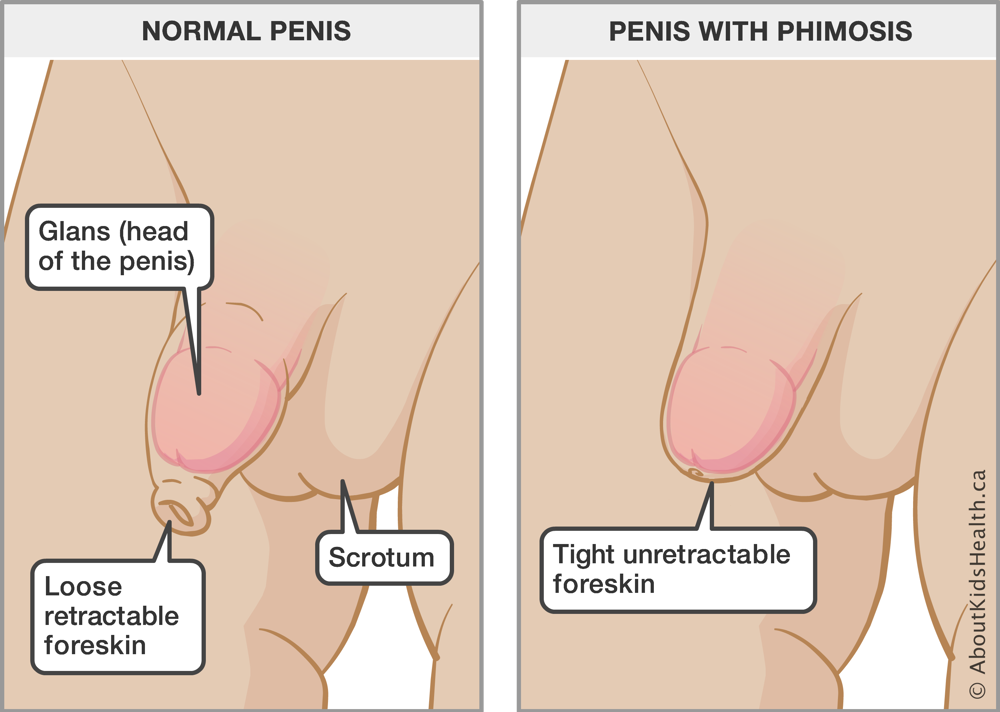
PART 1 - Understanding Your Condition (What & Where)
Normal vs. Phimosis - Side by Side
The Phimosis Grading System

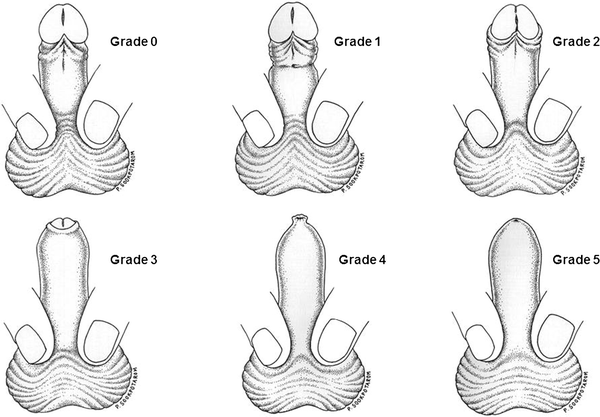
| Grade | What it means |
|---|---|
| Grade 0 | Fully retractable - normal |
| Grade 1 | Fully retractable but tight behind glans |
| Grade 2 | Partial retraction - glans partially visible |
| Grade 3 | Partial retraction - only urethral opening visible |
| Grade 4 | Slight retraction only - barely opens |
| Grade 5 | No retraction at all - pinhole opening |
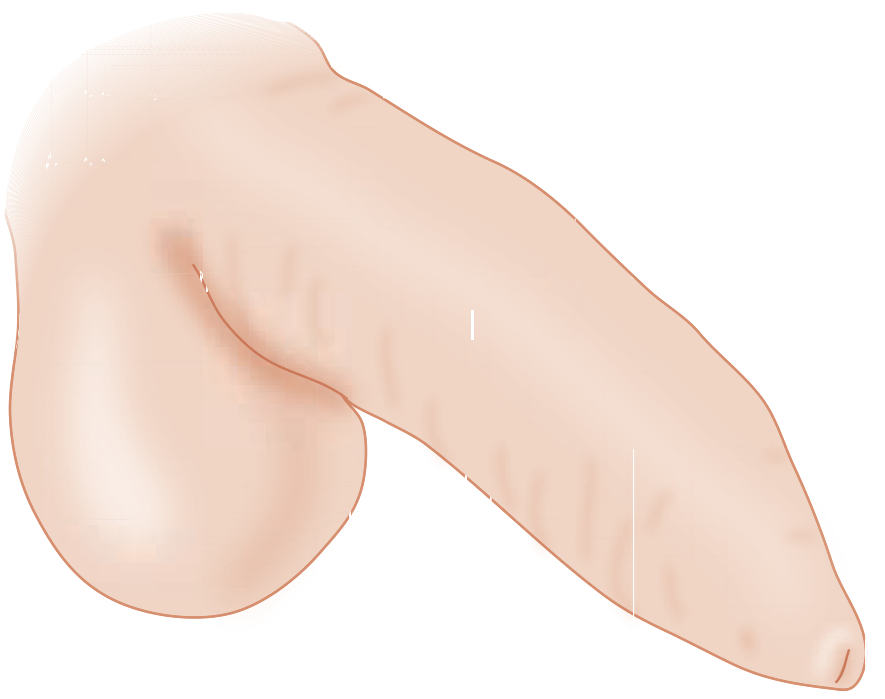
What the Phimosis Ring Looks Like When Retracted
PART 2 - Topical Steroid Cream Treatment (Detailed)
What Does the Cream Actually Do?
- Reducing inflammation in the tight ring tissue
- Increasing skin elasticity - makes the collagen fibers in the ring softer and more stretchable
- Thinning the tight fibrous band gradually over weeks
- It does NOT thin healthy skin elsewhere - it only works on areas of abnormal tension
Which Cream to Get
| Steroid | Strength | Notes |
|---|---|---|
| Betamethasone valerate 0.05% | Medium | Most commonly prescribed - first choice |
| Betamethasone valerate 0.1% | Medium-high | Slightly stronger, also used widely |
| Betamethasone valerate 0.2% | Higher | Used in RCTs with ~70% success rate |
| Hydrocortisone 1% | Low | Over-the-counter option, works but slower |
| Clobetasol 0.05% | High potency | Used if betamethasone fails |
You need a prescription for betamethasone - see a GP or urologist. Ask specifically for "betamethasone valerate 0.05% or 0.1% cream/ointment for phimosis."
Exactly How to Apply the Cream - Step by Step
- Patients with partial retraction (like you) needed 30-60 days of application
- 94% of patients with your grade of phimosis achieved complete resolution
- Only 4 of 70 patients in the partial retraction group did NOT respond
What to Expect Week by Week
| Week | What you'll notice |
|---|---|
| 1-2 | Little visible change, but the ring begins softening internally |
| 3-4 | The foreskin may start to retract slightly more than before |
| 5-6 | Noticeably easier retraction, ring feels less rigid |
| 7-8 | Most people achieve full or near-full retraction |
Important Warnings About the Cream
- Do not apply inside the urethra (pee hole)
- Do not use for more than 3-4 months continuously - prolonged use can thin normal skin
- The cream is safe - a 2024 RCT (PMID 39079875) confirmed there is no significant systemic absorption (the steroid does not enter your bloodstream in meaningful amounts)
- If after 3-6 months there is no change, see a urologist for evaluation
PART 3 - Stretching Technique (Detailed Step-by-Step)
The Principle: Controlled Tension = Tissue Growth
The Stretching Guide - 3 Methods Based on Your Grade

Method A - External Thumb-and-Index Stretch (Your starting point - Grade 2-3)
- After a warm shower (skin is pliable), apply betamethasone to the ring
- Wait 5 minutes for the cream to absorb
- Place your thumb and index finger on either side of the foreskin opening, at the level of the tight ring
- Apply gentle outward pressure - pulling the ring sideways in opposite directions
- Hold for 30-60 seconds - you should feel a mild stretching sensation, NOT sharp pain
- Relax for 10 seconds
- Repeat 10 times per session
- Do this twice daily
The golden rule: A mild pulling sensation = good. Any sharp sting or burning = stop immediately. Sharp pain means tearing, which causes scar tissue, which makes phimosis worse.
Method B - Two-Finger Internal Stretch (When retraction improves enough to insert fingers)
- Insert your little finger (pinky) inside the foreskin opening
- Once comfortable, insert a second finger (index) back-to-back alongside it
- Slowly spread the two fingers apart - expanding the opening
- Hold for 20-30 seconds, then relax
- Repeat 5-10 times per session, twice daily
Stretching Schedule
| Time | Action |
|---|---|
| Morning (after shower) | Apply cream → wait 5 min → stretch 10 reps |
| Night (before bed) | Apply cream → wait 5 min → stretch 10 reps |
The Phimosis Grading Degrees - Seeing Where You're Going
PART 4 - Glans Hypersensitivity: Why It Happens & How to Fix It
Why Your Glans Is So Sensitive It Hurts to Touch
- Shields the glans from air, clothing, and friction
- Keeps the glans mucosa moist (the glans is technically a mucous membrane, not regular skin)
- Prevents any sensory adaptation to external stimuli
The Desensitization Plan - Step by Step
Phase 1 - Water Exposure (Week 1-2)
- During your shower, let warm water directly run over the exposed glans after retracting as far as comfortable
- Start with 10-15 seconds, then re-cover
- Increase by 10 seconds each day
- Goal: 2-3 minutes of warm water contact comfortably
Phase 2 - Air Exposure (Week 2-4)
- After showering, retract the foreskin and leave the glans exposed to air for short periods at home
- Start with 1-2 minutes, re-cover
- Gradually increase to 10-15 minutes over 2 weeks
- The air contact begins adapting the surface nerve receptors
Phase 3 - Soft Fabric Contact (Week 3-6)
- Use a very soft, clean cloth (like microfiber or cotton) and gently touch the glans surface
- Begin with the lightest possible touch, just resting the cloth
- Gradually increase light pressure over days
- This is the key phase - direct tactile stimulation trains the nerve receptors
Phase 4 - Direct Touch (Week 4-8)
- Begin gently touching the glans directly with a clean finger
- Start with a feather-light touch, progress to firmer
- Any discomfort = back off slightly, don't push through sharp pain
What's Happening in Your Nerves
Tips to Speed Up Desensitization
- Warm water is the gentlest first stimulus - start here
- Never force it - gradual exposure works; forced exposure causes pain and avoidance
- As the phimosis improves with stretching + cream, keep incrementally exposing the newly revealed glans surface
- The sensitivity will improve in parallel with your phimosis treatment
Summary Timeline: What to Do Each Day
| Day | Morning | Night |
|---|---|---|
| Day 1-14 | Warm shower → apply betamethasone to ring → external stretch 10 reps → water exposure 15-30 sec | Apply betamethasone → external stretch 10 reps |
| Day 15-30 | Same + increase water/air exposure time daily | Same |
| Day 30-60 | Progress to 2-finger stretch if retraction has improved → continue cream → add soft cloth phase | Continue cream + stretch |
| Day 60+ | Assess: if full retraction achieved, continue stretching without cream to maintain → desensitization phase 3-4 | Continue maintenance stretching |
When to See a Doctor
- No improvement after 8 weeks of consistent daily treatment
- You notice white patches on the foreskin (may be Lichen Sclerosus - a skin condition requiring different treatment)
- Pain during urination or a very weak/deflected urine stream
- Any discharge or foul smell (infection)
Disclaimer: This is medical education information, not a personal diagnosis or prescription. Please visit a doctor (GP or urologist) to confirm the diagnosis, rule out Lichen Sclerosus, and obtain a betamethasone prescription. Do not self-treat without at least one medical consultation.
How does betamethasone work on phimosis
betamethasone phimosis mechanism collagen elasticity prepuce
topical corticosteroid skin collagen fibroblast mechanism
betamethasone mechanism of action phimosis collagen remodeling anti-inflammatory skin elasticity molecular
topical corticosteroid mechanism action skin anti-inflammatory vasoconstriction collagen synthesis immunosuppression molecular
https://www.ncbi.nlm.nih.gov/books/NBK532940
glucocorticoid receptor mechanism action diagram skin inflammation NF-kB lipocortin
How Betamethasone Works on Phimosis
Step 1 - The Drug Enters the Skin Cells
Step 2 - Binding to the Glucocorticoid Receptor (GR) - The Master Switch
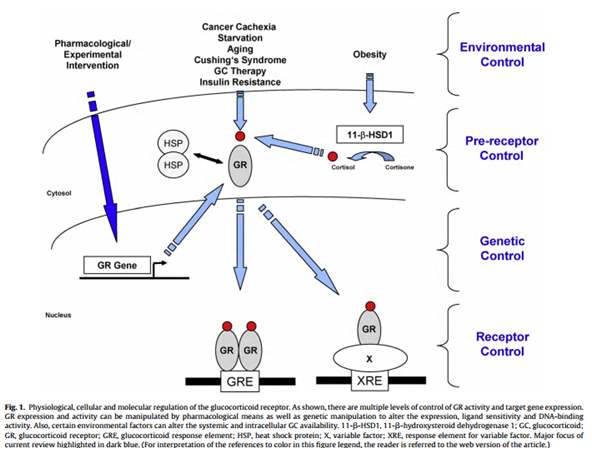
- Moves into the nucleus of the cell (this is the "translocation")
- Binds to specific DNA sequences called glucocorticoid response elements (GRE) - essentially turning certain genes on or off
Step 3 - The 4 Mechanisms That Loosen the Phimotic Ring
Mechanism 1: Anti-Inflammatory Action (Most Important for Phimosis)
- Betamethasone stimulates production of a protein called lipocortin-1 (Annexin A1)
- Lipocortin blocks an enzyme called phospholipase A2
- Phospholipase A2 normally releases arachidonic acid from cell membranes
- Arachidonic acid is the raw material for making prostaglandins and leukotrienes - the main chemicals that drive inflammation, swelling, and pain
- By blocking this cascade at its source, betamethasone cuts off the entire inflammatory response
Betamethasone
    → Lipocortin ↑
        → Phospholipase A2 blocked
            → Arachidonic acid ↓
                → Prostaglandins ↓ + Leukotrienes ↓
                    → Inflammation, swelling, pain in the ring ↓
- The betamethasone-GR complex directly blocks NF-kB (nuclear factor kappa B), which is the "master switch" of inflammation in cells
- NF-kB normally turns on dozens of pro-inflammatory genes (IL-1, IL-6, TNF-α, etc.)
- With NF-kB suppressed, the entire inflammatory gene program shuts down
- Fewer inflammatory cells (T-cells, eosinophils) are recruited to the tissue
Mechanism 2: Vasoconstriction - Reducing Blood Flow to the Ring
- Less blood flow = fewer inflammatory mediators being delivered to the area
- Less histamine, bradykinin, and prostaglandin release
- This reduces local swelling (edema) within the ring tissue
- The ring literally becomes physically less bulky and tense
This vasoconstriction is actually what doctors use to measure how potent a steroid is - the stronger it constricts blood vessels, the more potent it is clinically. Betamethasone falls in the medium-high potency range (Class 3-4 out of 7), making it strong enough to work on the dense preputial ring tissue without being so potent it causes skin thinning at therapeutic doses.
Mechanism 3: Collagen Remodeling - Making the Ring More Elastic
- Fibroblasts are the cells that produce collagen in connective tissue
- Betamethasone suppresses fibroblast activity through its anti-mitotic effect
- This slows new collagen production in the ring tissue
- Less dense new collagen = the ring becomes less rigid over time
- Existing collagen fibers in the ring are cross-linked (bonded together), making them stiff
- Betamethasone alters the expression of metalloproteinases (enzymes that break down collagen) - specifically, it modulates collagen type I and III synthesis and collagenase activity
- The net result is a gradual softening of the collagen network in the ring
Mechanism 4: Immunosuppression - Halting the Inflammatory Cycle
- Tight ring → minor friction/microtrauma → immune cell infiltration → more scarring/fibrosis → ring gets tighter
- Inhibiting T-cell activation and proliferation
- Reducing mast cell numbers in the dermis (mast cells release histamine and prostaglandins)
- Suppressing eosinophil function and migration
- Reducing cytokine production (IL-1, IL-2, IL-6, TNF-α)
Summary Diagram
BETAMETHASONE APPLIED TO PHIMOTIC RING
             ↓
    Enters skin cells (lipophilic)
             ↓
    Binds Glucocorticoid Receptor (GR)
             ↓
    GR-Betamethasone complex → Nucleus
             ↓
    ┌────────────────────────────────────────┐
    │  4 PARALLEL MECHANISMS                 │
    ├────────────────────────────────────────┤
    │ 1. Lipocortin↑ → Arachidonic acid↓   │
    │    → Prostaglandins/Leukotrienes↓     │
    │    = Less inflammation in ring        │
    │                                        │
    │ 2. Capillary vasoconstriction         │
    │    = Less swelling, less rigidity     │
    │                                        │
    │ 3. Fibroblast suppression             │
    │    → Less new collagen synthesis      │
    │    → Collagen remodeling              │
    │    = Ring becomes softer, elastic     │
    │                                        │
    │ 4. Immune suppression (NF-kB↓)       │
    │    = No new scar tissue formation     │
    └────────────────────────────────────────┘
             ↓
    PHIMOTIC RING: softer, less inflamed,
    more elastic, stretchable
             ↓
    + DAILY GENTLE STRETCHING
             ↓
    RING GRADUALLY WIDENS OVER 4-8 WEEKS
Why It Needs to Be Combined with Stretching
- Betamethasone = softens the clay
- Stretching = actually shapes and widens the clay
Why Betamethasone Specifically and Not Just Any Steroid?
| Property | Why It Matters for Phimosis |
|---|---|
| Medium-high potency (Class 3-4) | Strong enough to penetrate dense preputial ring tissue |
| Fluorinated molecule | The fluorine atom makes it more potent and longer-lasting at the site |
| Good skin penetration | Preputial skin is thinner than most body skin, allowing effective absorption |
| No significant systemic absorption at low doses | Confirmed safe - salivary cortisol unchanged (RCT, PMID 39079875) |
| Half-life of 36-54 hours | Twice-daily dosing maintains adequate tissue levels |
In short: Betamethasone works by entering skin cells, binding the glucocorticoid receptor, then triggering a genetic cascade that simultaneously kills inflammation, constricts blood vessels, softens and remodels the collagen in the tight ring, and prevents the immune system from laying down new scar tissue. Combined with daily stretching, this results in gradual but reliable widening of the phimotic ring over 4-8 weeks.
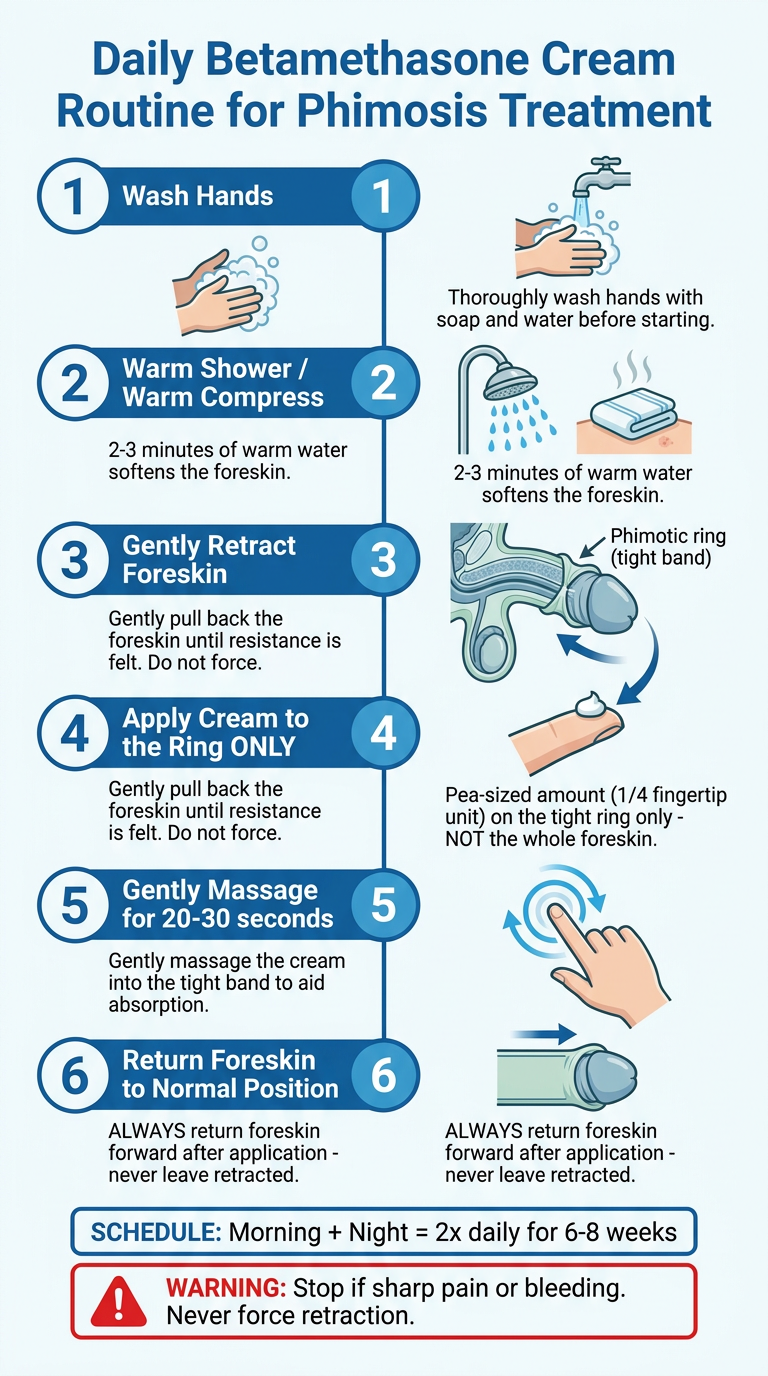
Generate a detailed visual guide for using betamethasone cream daily
A detailed medical visual guide poster titled "Daily Betamethasone Cream Routine for Phimosis Treatment". Clean medical illustration style with a white background. Show 6 numbered steps in a vertical flowchart layout with clear icons and text labels for each step: Step 1 - "Wash Hands" - icon of hands being washed under water with soap bubbles Step 2 - "Warm Shower / Warm Compress" - icon of shower water and a warm towel on skin, text says "2-3 minutes of warm water softens the foreskin" Step 3 - "Gently Retract Foreskin" - medical cross-section diagram showing partial retraction of foreskin revealing the tight phimotic ring, labeled with arrow pointing to "Phimotic ring (tight band)" - clinical/anatomical illustration style, not graphic Step 4 - "Apply Cream to the Ring ONLY" - icon showing pea-sized amount of cream on fingertip being applied precisely to the tight ring area, arrow indicating exact location, text: "Pea-sized amount (1/4 fingertip unit) on the tight ring only - NOT the whole foreskin" Step 5 - "Gently Massage for 20-30 seconds" - icon of gentle circular massage motion Step 6 - "Return Foreskin to Normal Position" - arrow showing foreskin sliding back forward, text: "ALWAYS return foreskin forward after application - never leave retracted" At the bottom: a schedule box showing "Morning + Night = 2x daily for 6-8 weeks". Include a WARNING box in red: "Stop if sharp pain or bleeding. Never force retraction." Color scheme: clean blues, greens, and white. Medical poster style, professional and informative.
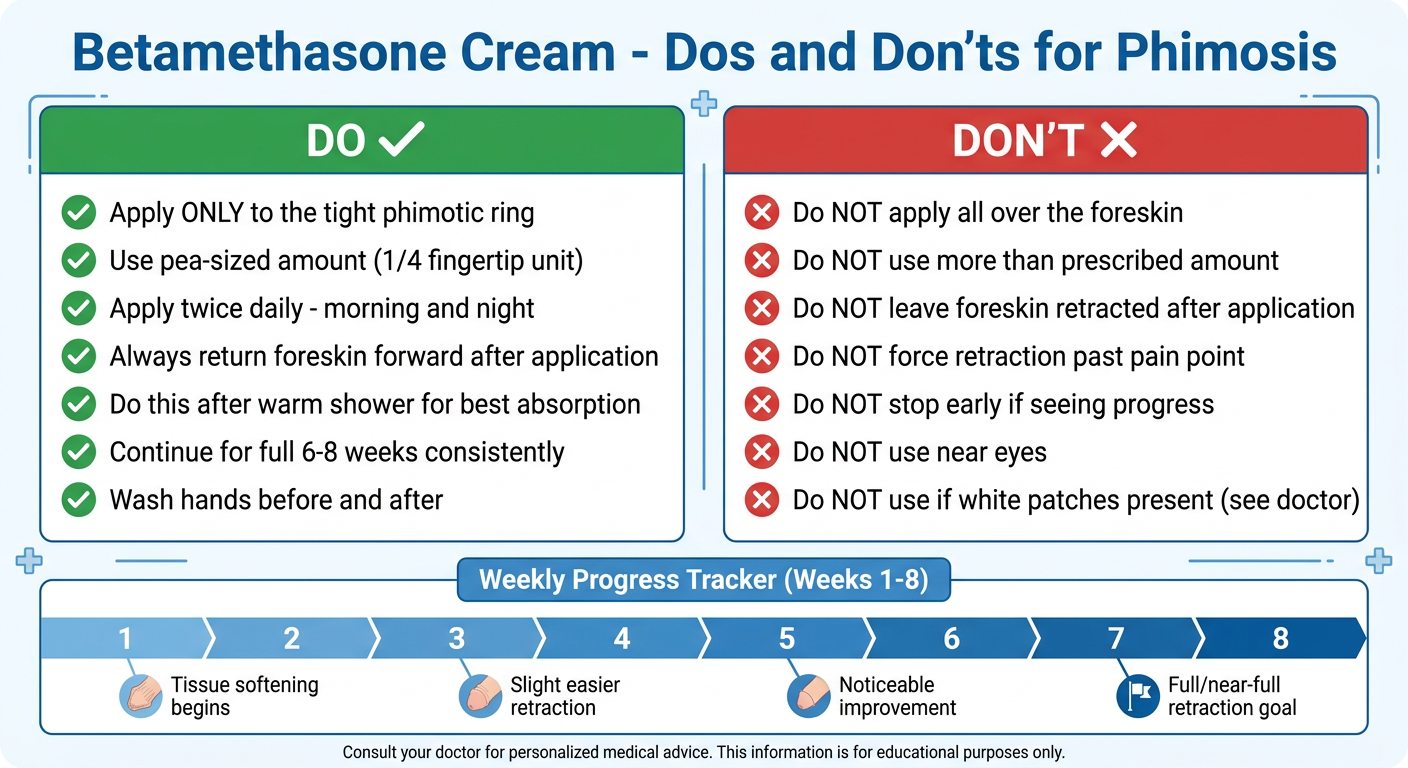
A medical reference card titled "Betamethasone Cream - Dos and Don'ts for Phimosis". Clean infographic style with white background. Two columns side by side: LEFT COLUMN - GREEN header "DO ✓": - Green checkmark icons next to each point - "Apply ONLY to the tight phimotic ring" - "Use pea-sized amount (1/4 fingertip unit)" - "Apply twice daily - morning and night" - "Always return foreskin forward after application" - "Do this after warm shower for best absorption" - "Continue for full 6-8 weeks consistently" - "Wash hands before and after" RIGHT COLUMN - RED header "DON'T ✗": - Red X icons next to each point - "Do NOT apply all over the foreskin" - "Do NOT use more than prescribed amount" - "Do NOT leave foreskin retracted after application" - "Do NOT force retraction past pain point" - "Do NOT stop early if seeing progress" - "Do NOT use near eyes" - "Do NOT use if white patches present (see doctor)" Below both columns, a weekly progress tracker showing Weeks 1-8 with small milestone notes: Week 1-2: "Tissue softening begins" Week 3-4: "Slight easier retraction" Week 5-6: "Noticeable improvement" Week 7-8: "Full/near-full retraction goal" Professional medical infographic, blue and white color scheme with green and red accents.
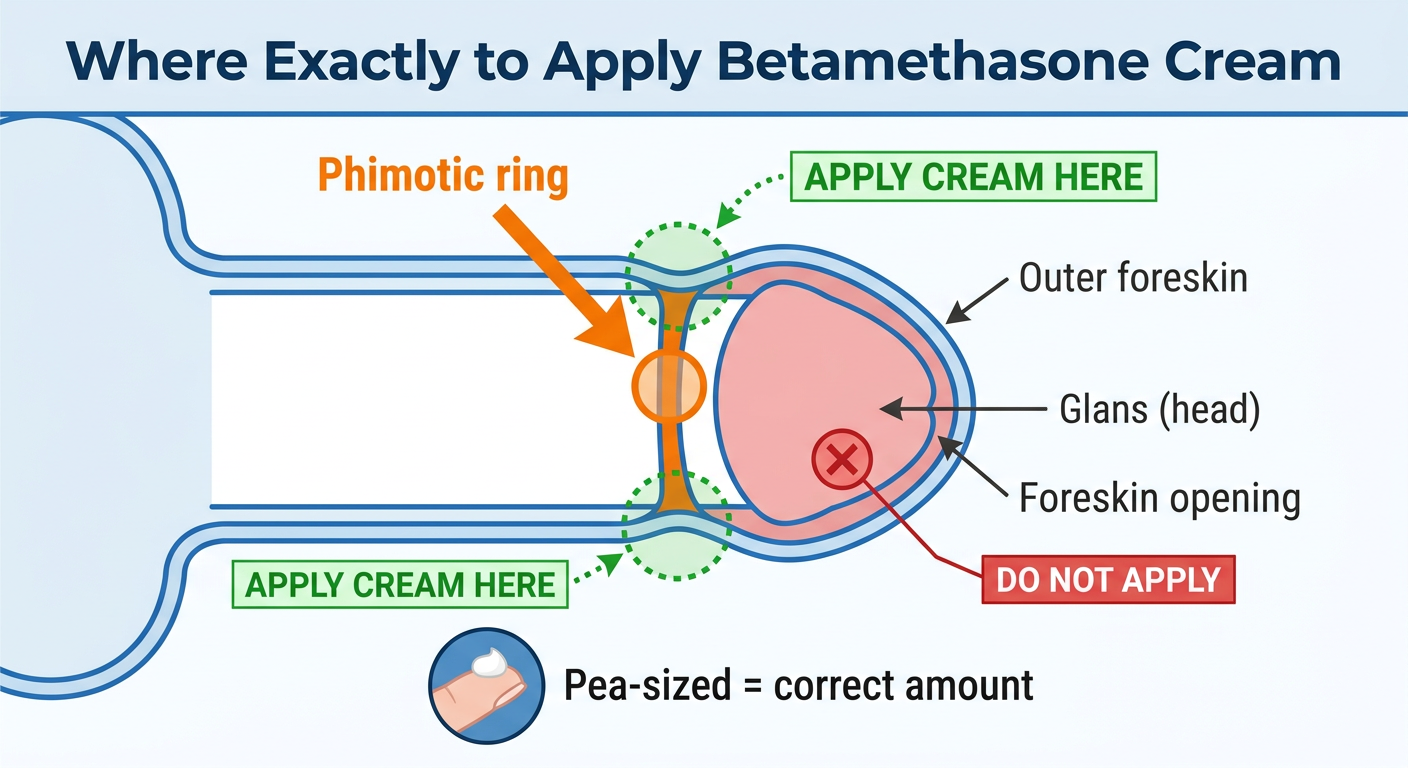
A medical diagram titled "Where Exactly to Apply Betamethasone Cream". Clean anatomical cross-section illustration in medical textbook style. Shows a side-view cross-section diagram of the tip of an uncircumcised penis with the foreskin partially retracted. Clear labeled arrows pointing to: - "Glans (head)" - the exposed tip - "Phimotic ring" highlighted in orange/yellow - the tight constricting band approximately 0.5-1cm from the foreskin opening - with a bold arrow and circle highlighting exactly this narrow band - "Outer foreskin" - the outer skin layer - "Foreskin opening" - the tip A green highlighted zone labeled "APPLY CREAM HERE" with a dotted circle specifically around just the phimotic ring band only A red zone labeled "DO NOT APPLY" covering the glans and the rest of the foreskin shaft Below the diagram, a small icon showing the correct fingertip amount: a finger with a small dot of cream labeled "Pea-sized = correct amount" Medical illustration style, clean lines, educational labels, blue and white color palette with orange highlighting on the phimotic ring. Clinical and informative, suitable for patient education.
Visual Guide 1 - The 6-Step Daily Routine
Visual Guide 2 - Where Exactly to Apply the Cream
Visual Guide 3 - Dos and Don'ts + Weekly Progress Tracker
Quick Reference Summary
| Amount | Pea-sized (1/4 fingertip unit) |
| Where | Tight phimotic ring ONLY |
| When | Morning + Night (2x daily) |
| How long | 6-8 weeks minimum |
| After applying | Always return foreskin forward |
| Best time | After a warm shower |
| Stop if | Sharp pain, bleeding, or white patches appear |
| See doctor if | No change after 8 weeks |
I'm adulr male of 22 years age .how much percentage to be used
phimosis adult betamethasone concentration dose
betamethasone cream percentage concentration adult phimosis 0.05 0.1 which strength best
betamethasone valerate 0.05 vs 0.1 vs 0.2 phimosis adult which concentration recommended urology
Recommended Betamethasone Concentration for Adults
The Short Answer
All Available Concentrations Compared
| Concentration | Common Name | Who It's For | Notes |
|---|---|---|---|
| 0.05% | Betamethasone valerate | Children & mild adult cases | Works well, slightly lower potency |
| 0.1% ✅ | Betamethasone valerate | Adults (your best option) | Most widely used, best balance of efficacy and safety |
| 0.2% | Betamethasone valerate | Adults with resistant cases | Used in clinical trials, slightly stronger |
| 0.05% clobetasol | Clobetasol propionate | Only if Lichen Sclerosus confirmed | High potency - reserved for specific cases |
Why 0.1% is Right for You Specifically
- 0.05% (children's dose) may absorb less effectively through adult skin
- 0.1% provides adequate potency to penetrate and act on the phimotic ring
- 0.2% is equally effective per RCTs but not necessary as a first try
Exact Prescription to Ask For
"Betamethasone valerate 0.1% cream or ointment"
- Ointment form is slightly preferred over cream - it penetrates better and stays on the ring longer
- Brand names vary by country (e.g., Betnovate 0.1%, Celestone, Betaderm in Canada)
Dosing Summary for You
| Parameter | Your Regimen |
|---|---|
| Concentration | Betamethasone valerate 0.1% |
| Amount per application | Pea-sized (~1/4 fingertip unit) |
| How often | Twice daily (morning + night) |
| Duration | 6-8 weeks minimum |
| Where | Phimotic ring ONLY (the tight band) |
| When to apply | After warm shower for best skin absorption |
What If 0.1% Doesn't Work?
- Step up to 0.2% betamethasone for another 4 weeks
- Rule out Lichen Sclerosus (a skin condition that may need clobetasol 0.05%)
- Discuss surgical options (preputioplasty or circumcision)
Reminder: Betamethasone is a prescription medication in most countries. Visit a GP or urologist to get it prescribed officially. They will also confirm the diagnosis and rule out any underlying skin condition. Do not purchase unverified concentrations online.