
Give the Latest and most effective Tuberculosis Treament Algorithm
"tuberculosis"[MeSH Terms] AND "drug therapy"[MeSH Terms]
WHO tuberculosis treatment guidelines 2025 algorithm drug resistant
https://www.wikidoc.org/index.php/Treatment_of_Drug-Suscepti…
tuberculosis treatment algorithm drug susceptible drug resistant MDR-TB
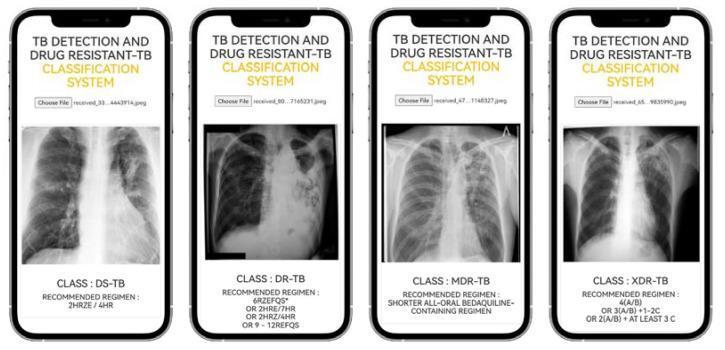
This infographic showcases the user interface of the TB-DRC-DSS, a web-based decision support system for tuberculosis (TB) detection and drug resistance classification, displayed across four mobile device frames. Each screen follows a consistent layout: a header titled 'TB DETECTION AND DRUG RESISTANT-TB CLASSIFICATION SYSTEM', an image upload button, a central posterior-anterior (PA) chest X-ray (CXR), and a diagnostic results section at the bottom. The visual demonstrates four distinct clinical categories: Drug-Susceptible TB (DS-TB), Drug-Resistant TB (DR-TB), Multidrug-Resistant TB (MDR-TB), and Extensively Drug-Resistant TB (XDR-TB). Each X-ray displays varying pulmonary pathologies, including consolidations, cavitary lesions, and diffuse opacities. Below each radiographic image, the system provides a specific 'CLASS' label and a 'RECOMMENDED REGIMEN' according to established treatment protocols (e.g., 2HRZE/4HR for DS-TB or Bedaquiline-containing regimens for MDR-TB). The tool is designed for pulmonologists and TB specialists to integrate diagnostic imaging with pharmaceutical decision-making at the point of care.
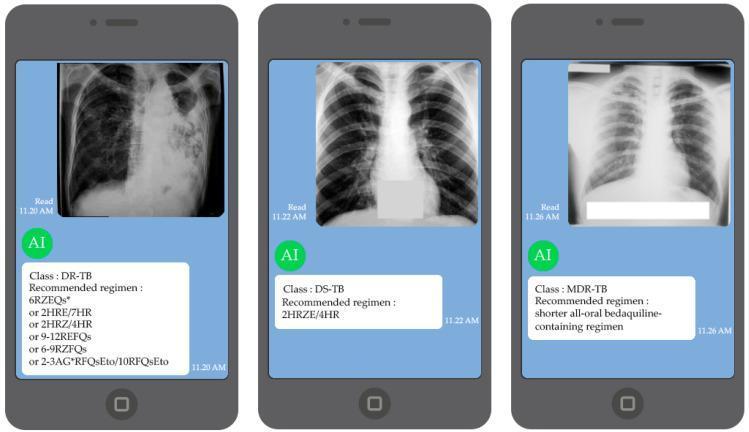
This infographic depicts a mobile-based diagnostic support system for tuberculosis (TB) management, presenting three separate smartphone interface frames. Each frame features a posterior-anterior (PA) chest X-ray (CXR) with AI-generated classifications and treatment regimens. The first image shows significant opacification and consolidation in the upper lung fields, classified as Drug-Resistant TB (DR-TB), with complex multidrug regimens listed. The second image displays relatively clear lung fields with normal vascular markings, classified as Drug-Susceptible TB (DS-TB), suggesting early-stage disease or a normal baseline, paired with a standard '2HRZE/4HR' regimen. The third image illustrates mild interstitial markings and apical opacities, classified as Multi-Drug Resistant TB (MDR-TB), recommending a shorter all-oral bedaquiline-containing regimen. This visual demonstrates the clinical application of deep learning algorithms in identifying TB drug-response phenotypes (DS, DR, MDR) and providing automated therapeutic guidance based on WHO protocols for infectious disease specialists and healthcare providers.
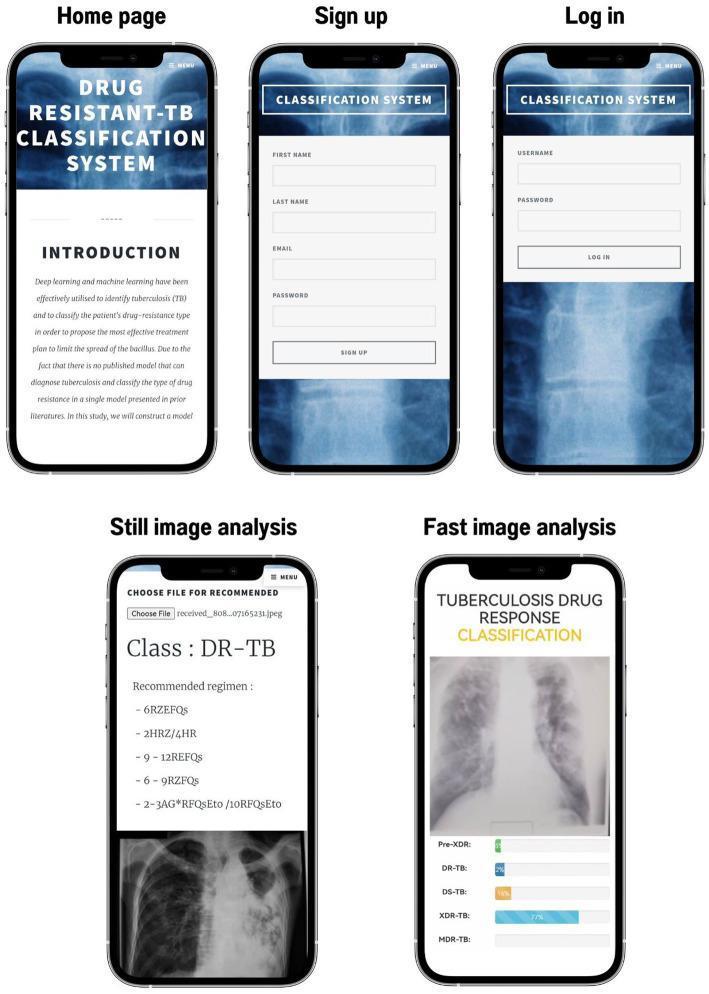
This infographic presents the mobile user interface (UI) of the TB-DRD-CXR application, an artificial intelligence tool designed for diagnosing drug-resistant tuberculosis (TB) using chest X-rays (CXR). The UI is displayed across five screens. The top row includes the 'Home page' with introductory text, followed by 'Sign up' and 'Log in' registration modules. The bottom row demonstrates the diagnostic functionalities: 'Still image analysis' and 'Fast image analysis'. The 'Still image analysis' screen allows for local file uploads, displaying the identified classification (e.g., DR-TB) and suggesting associated clinical treatment regimens. The 'Fast image analysis' screen features a live-camera interface that performs real-time classification. It provides a probability distribution for five distinct categories: drug-susceptible TB (DS-TB), drug-resistant TB (DR-TB), multidrug-resistant TB (MDR-TB), extensively drug-resistant TB (XDR-TB), and pre-extensively drug-resistant TB (Pre-XDR). These probabilities are visually represented using color-coded progress bars to assist medical professionals in rapid triage and diagnosis.
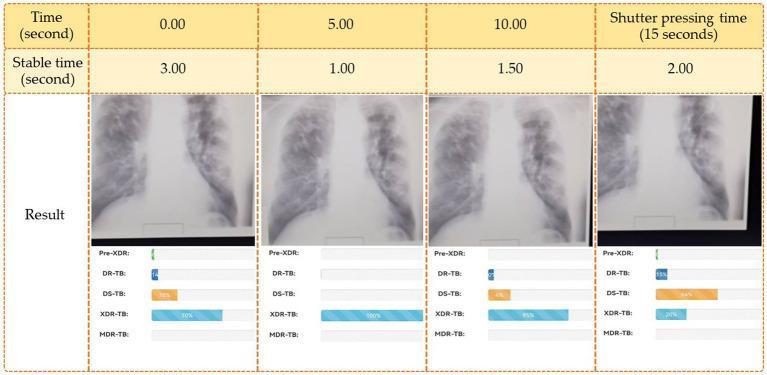
A comparison chart demonstrating a live image analysis interface for tuberculosis (TB) drug resistance diagnosis from chest X-rays (CXR). The graphic is divided into four chronological columns: 0.00 seconds, 5.00 seconds, 10.00 seconds, and shutter pressing time at 15 seconds. Each column displays a cropped diagnostic image focusing on the bilateral mid-to-lower lung fields and mediastinal borders. Below each image are AI-generated probability bars for five clinical classifications: Pre-XDR (pre-extensively drug-resistant TB), DR-TB (drug-resistant TB), DS-TB (drug-susceptible TB), XDR-TB (extensively drug-resistant TB), and MDR-TB (multidrug-resistant TB). The visual illustrates the real-time evolution of the deep learning model's diagnostic confidence. For instance, at 5.00 seconds, XDR-TB shows a 100% probability, while at the final shutter time (15 seconds), DS-TB becomes the most likely prediction at 66%. This infographic highlights the application of 'fast image analysis' in clinical informatics and infectious disease screening.
Tuberculosis Treatment Algorithm (2025 - Latest Guidelines)
STEP 1: INITIAL DIAGNOSTIC WORKUP
- Bacteriological confirmation - sputum AFB smear, culture (solid and liquid media), Xpert MTB/RIF
- Drug susceptibility testing (DST) - molecular (LPA, Xpert) for rifampin + isoniazid resistance at minimum
- HIV status (affects regimen choice and ART timing)
- Baseline labs - LFTs, CBC, renal function, ECG (if cardiac risk or QT-prolonging drugs planned)
- Site of disease - pulmonary vs extrapulmonary
- Severity - cavitary disease, smear-positive status, bilateral disease
ALGORITHM BRANCH A: DRUG-SUSCEPTIBLE TB (DS-TB)
Adults (Age ≥12 years) - Pulmonary DS-TB
Option 1: NEW 4-Month Regimen (2025 Preferred - Conditional Recommendation)
| Phase | Drugs | Duration |
|---|---|---|
| Intensive | INH + Rifapentine + Pyrazinamide + Moxifloxacin | 8 weeks (daily) |
| Continuation | INH + Rifapentine | 8 weeks (daily) |
| Total | 4 months |
- Eligibility: Age ≥12 years, pulmonary DS-TB, rifampin-susceptible
- Obtain molecular/phenotypic fluoroquinolone DST before initiating
- DOT preferred ≥5/7 days per week
- Not validated in pregnancy - avoid unless no alternative
- Monitor: LFTs at baseline; ECG if cardiac disease/age >50/QT-prolonging drugs; watch for moxifloxacin-related neuropathy, QT prolongation, tendinitis
Option 2: Standard 6-Month Regimen (Established Regimen)
| Phase | Drugs | Duration |
|---|---|---|
| Intensive | INH + Rifampin + Pyrazinamide + Ethambutol | 8 weeks (daily) |
| Continuation | INH + Rifampin | 18 weeks |
| Total | 6 months |
Children (3 months to 16 years) - Non-Severe DS-TB (2025 Strong Recommendation)
| Phase | Drugs | Duration |
|---|---|---|
| Intensive | INH + Rifampin + Pyrazinamide ± Ethambutol | 8 weeks |
| Continuation | INH + Rifampin | 8 weeks |
- Ethambutol may be omitted in HIV-uninfected, treatment-naive children in low DR-TB prevalence settings (though AAP includes it routinely)
- Severe TB, age <3 months, or severe malnutrition: use 6-month regimen
ALGORITHM BRANCH B: LATENT TB INFECTION (LTBI)
| Regimen | Duration | Frequency | Notes |
|---|---|---|---|
| INH + Rifapentine (3HP) | 3 months | Weekly | Preferred; DOT or self-administered |
| Rifampin | 4 months | Daily | Alternative; preferred over longer INH |
| INH + Rifapentine (1HP) | 1 month | Daily | HIV-infected age ≥13 years |
| INH | 9 months | Daily/BIW | Preferred in pregnancy (high-risk contacts) |
| INH | 6 months | Daily | Not for HIV+ or fibrotic lesions |
Shorter rifamycin-based regimens are preferred to improve adherence and completion. - Murray & Nadel's Textbook of Respiratory Medicine
ALGORITHM BRANCH C: DRUG-RESISTANT TB
Classification
- MDR-TB: Resistant to INH + Rifampin
- RR-TB: Rifampin-resistant (treat as MDR)
- Pre-XDR-TB: MDR/RR-TB + resistant to any fluoroquinolone
- XDR-TB: MDR/RR-TB + resistant to fluoroquinolones + bedaquiline or linezolid
C1: Rifampin-Resistant, Fluoroquinolone-SUSCEPTIBLE (MDR/RR-TB)
BPaLM Regimen - 6 months (Strong Recommendation - ATS/CDC 2025 & WHO 2025)
| Drug | Dose | Duration |
|---|---|---|
| Bedaquiline (BDQ) | 400 mg daily x 2 weeks, then 200 mg 3x/week x 24 weeks | 26 weeks |
| Pretomanid (Pa) | 200 mg daily | 26 weeks |
| Linezolid (LZD) | 600 mg daily | 26 weeks |
| Moxifloxacin (M) | 400 mg daily | 26 weeks |
- All-oral, 6-month - replaces the old 15-20 month injectable-containing regimens
- Administer 7 days/week with food (avoid milk, antacids, cationic items); DOT 5/7 days
- Monitoring: Baseline + monthly ECG (QTc risk from BDQ + moxifloxacin), CBC monthly (linezolid myelosuppression), LFTs monthly, sputum culture weekly → biweekly → monthly until conversion, vision checks (linezolid optic neuropathy)
C2: Rifampin-Resistant, Fluoroquinolone-RESISTANT (Pre-XDR/XDR-TB)
BPaL Regimen - 6 months (Strong Recommendation)
| Drug | Dose | Duration |
|---|---|---|
| Bedaquiline (BDQ) | 400 mg daily x 2 weeks, then 200 mg 3x/week x 24 weeks | 26 weeks |
| Pretomanid (Pa) | 200 mg daily | 26 weeks |
| Linezolid (LZD) | 600 mg daily | 26 weeks |
- For age ≥14 years adults/adolescents with fluoroquinolone resistance or intolerance, prior BDQ/LZD exposure <1 month
- Monitoring: ECG at baseline, weeks 2, 12, 24; CBC weekly x 1 month then monthly; screen for paresthesias/visual disturbances; post-treatment relapse surveillance for 12-24 months
WHO 2025 New Addition: BDLLfxC (All-oral 6-month for MDR/pre-XDR)
MONITORING SUMMARY TABLE
| Parameter | DS-TB (Standard 6-mo) | DS-TB (4-mo new) | MDR BPaLM | MDR BPaL |
|---|---|---|---|---|
| LFTs | Baseline (routine only if risk factors) | Baseline | Monthly | Monthly |
| ECG | Only if cardiac risk | Only if cardiac risk | Baseline + monthly | Baseline, wk 2, 12, 24 |
| CBC | Not routine | Not routine | Monthly | Weekly x1mo, then monthly |
| Sputum culture | At 2 months | At 2 months | Weekly → monthly until conversion | Weekly → monthly |
| Vision | Not routine | Not routine | Monthly (LZD) | Monthly (LZD) |
| Post-Rx follow-up | 3, 6, 12 months | 3, 6, 12 months | 12-24 months | 12-24 months |
KEY ADVERSE EFFECTS TO WATCH
| Drug | Major Toxicities |
|---|---|
| Isoniazid (H) | Hepatotoxicity, peripheral neuropathy (prevent with B6) |
| Rifampin/Rifapentine (R/RPT) | Hepatotoxicity, drug interactions (CYP450 inducer), orange secretions |
| Pyrazinamide (Z) | Hepatotoxicity, hyperuricemia, arthralgia |
| Ethambutol (E) | Optic neuritis (dose-dependent; check color vision/acuity monthly) |
| Moxifloxacin (M) | QT prolongation, tendinopathy, neuropathy, dysglycemia |
| Bedaquiline (BDQ) | QT prolongation, hepatotoxicity |
| Linezolid (LZD) | Myelosuppression, peripheral/optic neuropathy, serotonin syndrome |
| Pretomanid (Pa) | Hepatotoxicity, peripheral neuropathy |
Stop anti-TB drugs if AST/ALT >5x upper limit of normal, or bilirubin >3 mg/dL. - Tintinalli's Emergency Medicine
SPECIAL SITUATIONS
HIV Co-infection
- Start TB treatment first; initiate ART within 2-8 weeks (within 2 weeks if CD4 <50)
- Rifampin has major interactions with most ARTs - consider rifabutin substitution
- Extend DS-TB treatment to 9 months if slow response
- Immune reconstitution inflammatory syndrome (IRIS) may occur after ART initiation
Pregnancy
- Standard 6-month regimen (HRZE) is safe; avoid pyrazinamide in first trimester per some guidelines
- 4-month rifapentine-moxifloxacin regimen: not validated in pregnancy
- LTBI: INH 9 months preferred if high-risk contact
- Supplement with pyridoxine 50 mg/day
Extrapulmonary TB
- CNS/meningeal TB: 9-12 months; add dexamethasone
- Skeletal/bone TB: 9 months
- Pericardial TB: 6 months + adjuvant corticosteroids
WHAT'S NEW IN 2025 (Key Changes)
| Change | Old Standard | New 2025 |
|---|---|---|
| DS-TB adults | 6-month 2HRZE/4HR | 4-month 2HPZM/2HP (conditional recommendation) |
| DS-TB children (non-severe) | 6-month 2HRZ/4HR | 4-month 2HRZ/2HR (strong recommendation) |
| MDR/RR-TB (FQ-susceptible) | 15-20 month injectable regimens | 6-month BPaLM (strong recommendation) |
| Pre-XDR/XDR-TB | Long complex regimens | 6-month BPaL (strong recommendation) |
| WHO MDR-TB (April 2025) | - | New BDLLfxC 6-month all-oral regimen |
| Nutrition | Not formally addressed | Nutritional assessment now a core WHO TB strategy |
RECENT EVIDENCE (2025 Meta-Analyses)
- A 2025 meta-analysis (PMID: 40194835, BMJ Global Health) confirmed all-oral bedaquiline-based shorter regimens significantly improve treatment success and reduce mortality in DR-TB compared to older injectable regimens.
- A 2025 meta-analysis (PMID: 40172415, J Bras Pneumol) showed bedaquiline + linezolid combinations achieve high culture conversion rates in MDR-TB with acceptable safety profiles.
- The 2024 meta-analysis (PMID: 38296395) confirmed bedaquiline + delamanid combination therapy is both efficacious and safe for DR-TB.