
Multisection tomography in detail
Multisection (Multidetector) CT — Detailed Overview
1. Historical Development
| Era | Technology | Key Limitation |
|---|---|---|
| Pre-1990 | Sequential (step-and-shoot) single-slice CT | Inter-slice gaps; patient must hold breath for each slice |
| ~1990 | Spiral (helical) single-slice CT | Volumetric acquisition possible but slow; thick slices |
| 1998 | 4-slice MDCT introduced by multiple manufacturers | Began the MDCT era |
| 2000s | 16- → 64-slice MDCT | Near-isotropic voxels; single breath-hold chest |
| Present | 128-, 256-, 320-detector-row systems; dual-source | Temporal resolution <100 ms; whole-organ coverage in one rotation |
"In 1998 several CT manufacturers introduced multidetector systems, which provided considerable improvement in acquisition speed, coverage, and temporal and spatial resolution." — Grainger & Allison's Diagnostic Radiology
2. Core Technical Principles
2.1 Detector Array and Simultaneous Section Acquisition
- A multirow detector array replaces the single detector row. Each row independently acquires a slice, so N rows → N simultaneous slices per rotation.
- Pitch = table speed ÷ gantry rotation speed. A higher pitch increases z-axis coverage per unit time but can reduce signal-to-noise ratio.
- Section collimation (beam width per detector element) and reconstruction thickness are now independently controllable — the raw data can be retrospectively reconstructed at any thickness from the archived dataset.
2.2 Isotropic Voxels
- Reformation in any arbitrary plane (axial, coronal, sagittal, oblique) with no loss of resolution
- Accurate 3D post-processing and volumetric measurements
- Computer-aided detection (CAD) of pulmonary nodules and emboli
2.3 Gantry Rotation Speed
- Single breath-hold chest coverage — feasible even in tachypnoeic patients
- Reduced motion artefact
- In paediatrics, reduced need for sedation
2.4 Novel Technologies for Further Improvement
| Technology | Mechanism | Benefit |
|---|---|---|
| Dual-source CT | Two x-ray tubes at 90° to each other | Temporal resolution ~75 ms; dual-energy capability |
| Flying focal spot | Alternates focal spot position rapidly | Converts 128-row → virtual 256-row array; improved z-resolution |
| Wide-area detector (320-row) | 16 cm z-axis coverage per rotation | Entire heart or organ imaged in a single rotation |
3. Dose Profile and Geometric Efficiency
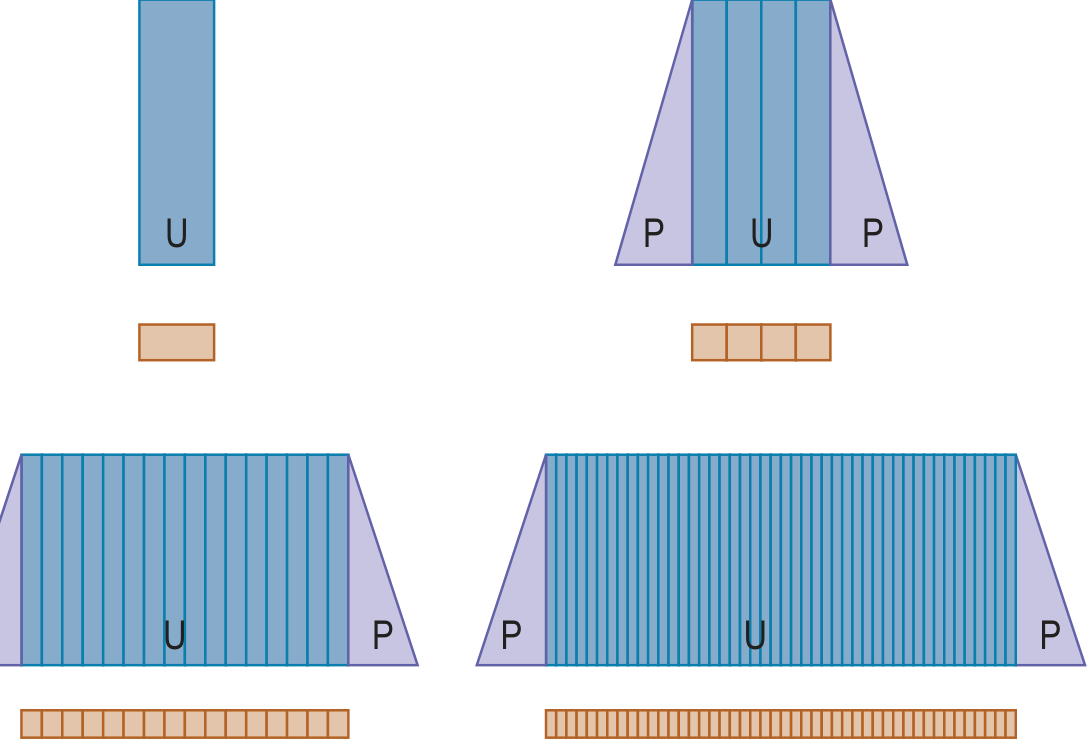
- Umbral (plateau) region: the entire focal spot illuminates the detector → uniform signal → used for reconstruction
- Penumbral regions (beam edges): partial focal spot illumination → non-uniform signal → discarded by post-patient collimator
- Decreases as section width increases (wider beam → penumbra is a smaller fraction)
- Decreases as the number of simultaneous sections increases (4→16 MDCT: significant waste; 64-MDCT: penumbra is minimal)
4. Image Reconstruction
4.1 Reconstruction Kernels (Algorithms/Filters)
| Algorithm type | Effect | Clinical use |
|---|---|---|
| Low spatial frequency (smooth) | Reduces noise; lower spatial resolution | Soft tissue, vascular structures, mediastinum |
| High spatial frequency (sharp/lung) | Enhances fine detail; increases noise | Lung parenchyma, airways, bone, HRCT |
4.2 Section Thickness Flexibility
- 0.6–1.25 mm thin sections — high spatial resolution, 3D post-processing, pulmonary nodule characterisation, interstitial lung disease, pulmonary embolism
- 2.5–5 mm thick sections — better contrast resolution, faster review; adequate for mediastinal masses, lung cancer staging
4.3 Iterative Reconstruction
5. Window Settings
- Window centre ≈ midpoint between the density of the structure of interest and surrounding tissue
- Wide windows (e.g., −600/1600 HU) → lung parenchyma
- Narrow windows (e.g., 40/400 HU) → mediastinum, soft tissue
6. Postprocessing Techniques
| Technique | Method | Key Application |
|---|---|---|
| MPR / CMPR (multiplanar/curved MPR) | 1-voxel-thick tomographic sections in any plane | Pulmonary emboli, airways evaluation |
| MIP (maximum intensity projection) | Only highest-attenuation voxels rendered | Vascular imaging, micronodular disease distribution |
| MinIP (minimum intensity projection) | Only lowest-attenuation voxels rendered | Emphysema, air trapping (augments air-trapping conspicuity) |
| Shaded surface display (SSD) | Threshold-based surface rendering | Large airway/vessel overview |
| Volume rendering (VR) | All voxels, opacity assigned by HU | Surgical planning, complex anatomy |
| Virtual bronchoscopy | Fly-through of airway lumen | Airway stenosis evaluation |
7. Contrast Medium Protocols
- Faster peak enhancement → need higher iodine delivery rate (faster injection rate + higher iodine concentration)
- Typical 64-slice thoracic MDCT: 60–120 mL of 320–400 mg/mL iodine at 3.5–5 mL/s, followed by 20–40 mL saline chaser
- Biphasic (dual-bolus) protocols are standard: the saline chaser dilutes contrast density in brachiocephalic veins, eliminating streak/beam-hardening artefacts and providing more homogeneous enhancement
- Triphasic protocols (contrast → contrast:saline mix → saline) used for "triple rule-out" CT (simultaneous coronary, pulmonary, and aortic evaluation)
- Bolus tracking / automated triggering (rather than fixed delays) is preferred given the narrow acquisition windows
8. Cardiac MDCT (ECG Gating)
| Mode | Mechanism | Radiation dose | Use |
|---|---|---|---|
| Prospective gating | Scan triggered at fixed interval after R-wave; pauses between beats | Low (<1 mSv achievable) | Calcium scoring, coronary CTA at stable HR |
| Retrospective gating | Continuous acquisition throughout cardiac cycle; retrospective phase selection (0–90% R-R at 10% intervals) | High (~10× prospective) | Functional assessment (ejection fraction, wall motion) |
- Heart rate ≤60 bpm (β-blockade preparation) — ensures R-R interval >1000 ms
- End-diastole selected for final reconstruction (period of least cardiac motion)
9. Dual-Energy CT (DECT)
- Dual-source: two tubes operating simultaneously at different kVp (e.g., 80 and 140 kVp)
- Rapid kVp switching: single tube alternates between energies
- Dual-layer ("sandwich") detector: separate detector layers absorb different energy spectra
- Virtual unenhanced images — eliminates need for a separate pre-contrast scan → dose reduction
- Iodine maps → pulmonary blood volume maps (perfusion assessment in pulmonary embolism, comparable to scintigraphy)
- Nodule characterisation by differential iodine uptake
10. Dose Reduction Strategies
| Category | Strategies |
|---|---|
| Tube current | AEC; weight/size-based modulation; ECG gating; low-dose protocols (40–70 mAs for chest) |
| Tube voltage | Reduced kVp (especially in thin patients or paediatrics) |
| Beam shaping | Bowtie filters |
| Acquisition | Higher pitch; shorter z-coverage; faster rotation; wider collimation |
| Reconstruction | Iterative reconstruction (especially model-based); high-sensitivity detectors |
| Protocol | Patient shielding; restrict FOV to area of interest |
Summary
- Simultaneous multi-section acquisition → dramatically reduced scan time
- Isotropic voxels → unrestricted multiplanar and 3D reformatting
- Flexible retrospective reconstruction → single acquisition, multiple slice thicknesses and kernels
- ECG gating → non-invasive cardiac and coronary imaging
- Dual-energy capability → material decomposition, virtual unenhanced, perfusion maps
No I am talking about thisHere are **complete, exam-oriented, concept + mechanism based notes on Multisection (Multilayer) Tomography**, strictly built from your provided pages and expanded for clarity without losing any detail. --- # 🌟 MULTISECTION TOMOGRAPHY ## 📌 1. Definition **Multisection (or multilayer) radiography** is a type of tomography in which **multiple body layers are imaged simultaneously**, with **each layer recorded on a separate film** during a **single exposure**. 👉 Key idea: Instead of taking one slice at a time → **many slices are obtained at once** --- ## ⚙️ 2. Principle (Core Concept) ### 🔑 Basic Tomography Principle: * X-ray tube (T) and film (F) move in **opposite directions** around a **fulcrum (pivot point)**. * The **plane passing through the fulcrum (Y)** remains **sharp**. * Structures above and below → blurred. --- ### 🔑 Multisection Extension: In multisection tomography: * Multiple films are placed **at different vertical levels**. * Each film has its **own effective fulcrum**. 👉 So: * Film at level F₁ → records plane at fulcrum Y * Film at level F₂ → records plane at fulcrum Y₂ * Additional films → create additional focal planes --- ### 🧠 Conceptual Diagram ``` Tube movement T1 → T2 \ / \ / \ / \ / Y ← Fulcrum for upper film (F1) / \ / \ / \ Y2 ← Fulcrum for lower film (F2) / \ F1 F2 ← Films at different levels ``` --- ### 🔑 Important Principle Statement (from your text): > “The layer recorded on a film is at the level of the fulcrum of the lever system, provided the film position coincides with the film-moving point on the lever.” ✔️ Films above fulcrum → record higher planes ✔️ Films below fulcrum → record lower planes --- ## ⚙️ 3. Technique ### 🧪 Step-by-step Working: 1. **Arrangement of Films** * Multiple films stacked vertically * Separated by spacers 2. **Tube-Film Motion** * X-ray tube and film move in opposite directions * Rotation occurs around fulcrum(s) 3. **Simultaneous Exposure** * Single exposure produces multiple images 4. **Plane Formation** * Each film corresponds to a different focal plane * Achieved due to different effective fulcrum levels --- ### 🔬 Important Observations: ✔ All radiographs are taken **at exactly the same moment** → Same respiratory phase → No motion mismatch ✔ Useful for **rapid transient phenomena** → Example: angiography (vascular filling) --- ## ⭐ 4. Advantages 1. **Reduced radiation dose** * Multiple images in single exposure 2. **Same physiological phase imaging** * No breathing mismatch 3. **Best for transient processes** * e.g., angiography 4. **Time saving** * For patient and department 5. **Reduced tube loading** * Less repeated exposures --- ## ⚠️ 5. Limitation ❗ Sequential tomography (one section at a time) gives: → **Better detail (higher resolution)** 👉 So: Multisection = faster Sequential = more detailed --- # 🧰 6. EQUIPMENTS (VERY IMPORTANT) ## 🟦 A. Multisection Cassette ### 📦 Structure: * A **metal box (cassette)** containing multiple films * Depth: up to **7.5 cm (3 inches)** * Holds **3, 4, 5 or 7 films** --- ### 📏 Film Spacing: * Films separated by fixed distance * Example: **5 mm spacing for 4 films** --- ### ⚙️ Placement: * Shallow cassette → fits in standard bucky tray * Deep cassette → requires **special support tray** --- ### 🧠 Function: * Maintains fixed geometry * Allows simultaneous imaging of multiple layers --- ## 🟦 B. Intensifying Screens & Separators ### 📚 “Book Arrangement” Concept: * Screens + spacers assembled like a **book** * Films inserted between “pages” --- ### ✅ Advantages: ✔ Prevents wrong film placement ✔ Ensures proper alignment ✔ Easy handling --- ### ⚠️ Density Problem (VERY IMPORTANT CONCEPT) As X-ray beam passes through cassette: * It gets **progressively attenuated** * Lower films receive **less radiation** 👉 Result: * Upper film → more exposure * Lower film → less exposure --- ### 🔧 Solution: * Use **different speed intensifying screens** ✔ Lower films → **faster screens** ✔ Upper films → **slower screens** 👉 To maintain **uniform density** --- ### 🧠 Key Statement: > “The last intensifying screens must be greater in speed than those nearer to the X-ray tube.” --- ## 🟦 C. Separators ### 📌 Material: * Usually **plastic foam** ### 📏 Thickness: * Typically **5 mm or 10 mm** * Can be reduced to **1 mm** in special cases --- ### ⚠️ Requirements: ✔ Should NOT absorb X-rays significantly ✔ Must be **artifact-free** --- ## ⚠️ 7. Exposure Considerations ### 📉 System Speed: * Multisection system is **photographically slower** 👉 Why? * Multiple layers + attenuation * Complex screen-film interaction --- ### 📊 Exposure Adjustment: * kVp increase: **~8–19 kVp** * mAs increase: **~1.6 to 2.5 times** --- ### 🧠 Important: * No fixed formula → depends on setup * Often determined by: 👉 **Trial and error** 👉 **Step wedge experiments** --- ### ⚠️ Practical Note: * First-time users should assume: 👉 System is **4–5 times slower** than standard cassette --- ## ⚠️ 8. Practical Errors ❗ Wrong orientation of “book” cassette: → Leads to **radiographic chaos** 👉 Always ensure: * Correct side facing X-ray tube * Proper identification marking --- # 🎯 FINAL SUMMARY (Quick Revision) | Feature | Multisection Tomography | | ---------- | ------------------------------ | | Imaging | Multiple layers simultaneously | | Exposure | Single | | Fulcrum | Multiple (one per film level) | | Advantage | Time + dose saving | | Limitation | Less detail than sequential | | Cassette | Multi-film stacked system | | Problem | Unequal density | | Solution | Variable speed screens | --Got it — you want **fully detailed, point-wise notes** (no skipping, no compression). Here’s a **structured, exam-ready breakdown** of *Multisection Tomography* strictly based on your pages + explained clearly. --- # 🌟 MULTISECTION (MULTILAYER) TOMOGRAPHY — DETAILED POINTS --- # 📌 1. Definition 1. Multisection (multilayer) radiography is a form of tomography. 2. It involves imaging of **multiple body layers simultaneously**. 3. Each layer is recorded on a **separate film**. 4. All films are exposed **in a single exposure**. 5. It is designed to overcome limitations of single-layer tomography. --- # ⚙️ 2. Principle ### 🔑 Basic Tomography Principle 1. X-ray tube (T) and film (F) are connected by a **mechanical lever system**. 2. They move in **opposite directions** during exposure. 3. Movement occurs around a fixed point called the **fulcrum (Y)**. 4. The plane passing through the fulcrum: * Remains **stationary relative to film** * Appears **sharp (in focus)** 5. Structures above and below: * Move relative to film * Become **blurred** --- ### 🔑 Multisection Principle (Extension) 6. In multisection tomography, **multiple films** are used. 7. Films are placed at **different vertical levels**. 8. Each film has a **different effective fulcrum**. 9. Example: * Film F₁ → records plane at fulcrum Y * Film F₂ → records plane at fulcrum Y₂ (lower level) 10. Each additional film creates its **own focal plane**. --- ### 🔑 Key Principle Statement 11. The layer recorded on a film corresponds to the **level of the fulcrum**. 12. This is valid only if: * Film position coincides with **film-moving point on lever** 13. Films above this point: * Record **higher planes** 14. Films below: * Record **lower planes** --- ### 🔬 Important Concept 15. Multiple fulcrum levels are **created geometrically**, not physically shifted. 16. Each film “selects” a different anatomical layer due to position difference. --- # ⚙️ 3. Technique ### 🧪 Film Arrangement 1. Multiple films are arranged: * One above the other 2. They are separated by: * **Spacing material (separators)** --- ### 🧪 Movement 3. X-ray tube moves in one direction. 4. Films move in the opposite direction. 5. Movement is synchronized via **lever system**. --- ### 🧪 Exposure 6. Only **one exposure** is given. 7. All films are exposed **simultaneously**. --- ### 🧪 Image Formation 8. Each film records a **different tomographic layer**. 9. The layer corresponds to: * Its **relative position in cassette** 10. Blurring occurs for: * Structures not in that plane --- ### 🧪 Physiological Advantage 11. All images are taken: * At the **same moment** 12. Therefore: * Same respiratory phase * Same cardiac phase (if relevant) --- ### 🧪 Special Use 13. Useful in **rapid transient processes** * Example: angiography (vascular filling) --- # ⭐ 4. Advantages 1. **Reduced radiation dose** * Multiple images from single exposure 2. **Same time imaging** * No variation due to breathing/motion 3. **Captures transient phenomena** * e.g., contrast flow 4. **Time-saving** * For patient and radiology department 5. **Reduced X-ray tube load** * Fewer exposures needed --- # ⚠️ 5. Disadvantage 1. Sequential tomography (single layer at a time): * Provides **better detail** 2. Multisection: * Slightly **lower image sharpness** --- # 🧰 6. Equipment --- ## 🟦 A. Multisection Cassette ### 📦 Structure 1. It is a **metal box**. 2. Designed to hold **multiple films**. 3. Depth: * Up to **7.5 cm (3 inches)** --- ### 📦 Capacity 4. Available models: * 3 films * 4 films * 5 films * 7 films --- ### 📦 Film Spacing 5. Films are separated by fixed distances. 6. Example: * 4 films → spaced **5 mm apart** --- ### 📦 Placement 7. Shallow cassette: * Fits into **standard bucky tray** 8. Deep cassette: * Requires **special tray or drawer** --- ### 📦 Function 9. Maintains: * Alignment * Proper geometry 10. Allows simultaneous imaging of multiple layers --- ## 🟦 B. Intensifying Screens & Separators --- ### 📚 Book Arrangement 1. Screens and separators are fixed together. 2. Arranged like a **book**. 3. Films inserted between layers (like pages). --- ### ✅ Advantages 4. Prevents incorrect film placement. 5. Ensures correct alignment with screens. --- ### ⚠️ Unequal Density Problem 6. X-ray beam passes through multiple layers. 7. It is **progressively attenuated**. 8. Lower films receive: * Less radiation 9. Upper films receive: * More radiation --- ### 🔧 Solution 10. Use **different speed intensifying screens**: * Upper films → slower screens * Lower films → faster screens 11. Ensures: * Uniform density across all films --- ### 🧠 Key Concept 12. Screens farther from X-ray tube must be: * **Higher speed** --- ## 🟦 C. Separators --- ### 📌 Material 1. Usually made of: * **Plastic foam** --- ### 📏 Thickness 2. Common thickness: * 5 mm * 10 mm 3. Special cases: * As low as **1 mm separation** --- ### ⚠️ Requirements 4. Must NOT: * Absorb significant X-rays 5. Must: * Be free from artifacts --- # ⚠️ 7. Exposure Factors --- ### 📉 System Speed 1. Multisection system is: * **Photographically slower** --- ### 📉 Reason 2. Due to: * Multiple layers * X-ray attenuation * Screen-film complexity --- ### 📊 Exposure Adjustment 3. kVp increase: * Approximately **8–19 kVp** 4. mAs increase: * Approximately **1.6 to 2.5 times** --- ### ⚠️ Practical Issue 5. No fixed exposure formula. 6. Depends on: * Cassette type * Film-screen combination --- ### 🧪 Best Method 7. Use: * **Trial and error** * **Step wedge experiments** --- ### ⚠️ Important Note 8. System may be: * **4–5 times slower** than standard cassette --- # ⚠️ 8. Practical Considerations --- ### ❗ Orientation Error 1. Cassette has correct and wrong side. 2. If placed incorrectly: * Produces **radiographic errors (chaos)** --- ### ❗ Identification 3. Proper marking is provided. 4. Must ensure: * Correct side faces X-ray tube --- # 🎯 FINAL QUICK POINTS 1. Multiple films → multiple layers 2. Single exposure → reduced dose 3. Different film levels → different fulcrum planes 4. Unequal exposure → corrected by screen speed 5. System slower → increase kVp & mAs 6. Cassette design → key role 7. Sequential tomography → better detail --- If you want next step (highly recommended for exams):
MULTISECTION (MULTILAYER) TOMOGRAPHY — COMPREHENSIVE NOTES
1. DEFINITION
- Multisection (multilayer) tomography is a form of conventional X-ray tomography.
- Multiple body layers are imaged simultaneously in a single exposure.
- Each layer is recorded on a separate film within the same cassette.
- Contrast with standard tomography, which images only one layer per exposure.
2. BASIC TOMOGRAPHY PRINCIPLE (Foundation)
- The X-ray tube (T) and film (F) are mechanically linked by a rigid lever arm.
- During exposure, the tube moves in one direction while the film moves in the opposite direction — they are coupled and synchronised.
- The lever rotates around a fixed pivot point called the fulcrum (Y).
- The plane passing through the fulcrum remains in a fixed relationship to the film throughout movement → it appears sharp.
- All structures above and below the fulcrum plane move relative to the film → their images are blurred (unsharpened) across the film.
- The degree of blurring increases with distance from the fulcrum plane and with the amplitude of tube-film travel.
3. MULTISECTION EXTENSION OF THE PRINCIPLE
3.1 Multiple Films, Multiple Focal Planes
- Several films are placed one above the other at different vertical levels within a single cassette.
- Because each film sits at a different height, each film has a different geometric relationship to the lever system.
- This means each film effectively has its own fulcrum level — i.e., a different anatomical plane stays sharp on each film.
- A single tube-film sweep across the patient exposes all films simultaneously.
- Result: N films = N tomographic slices from one exposure.
3.2 The Governing Principle Statement
"The layer recorded on a film is at the level of the fulcrum of the lever system, provided the film position coincides with the film-moving point on the lever."
- Films above the film-moving point on the lever → record higher planes
- Films below the film-moving point → record lower planes
3.3 How Multiple Fulcra Are Created
- Multiple fulcrum levels are created geometrically, not by physically shifting the pivot.
- Each film's vertical displacement from the nominal film position introduces a geometric offset → this shifts the effective focal plane for that film.
- The interval between focal planes = determined by the separator thickness between films and the geometric magnification factor of the system.
4. TECHNIQUE — STEP BY STEP
Step 1: Film Arrangement
- Films stacked vertically one above the other inside the multisection cassette.
- Separated by spacers (separators) of fixed, known thickness.
- Each film is accompanied by its pair of intensifying screens.
Step 2: Cassette Placement
- Cassette placed in the bucky tray (or special support tray for deep cassettes).
- Correct orientation: the side facing the X-ray tube must be identified and placed correctly — incorrect orientation causes radiographic chaos.
Step 3: Patient Positioning
- Patient positioned as for standard tomography.
- Fulcrum height set to the desired mid-plane of anatomy.
Step 4: Single Exposure
- One exposure is made.
- Tube and film assembly move simultaneously during exposure.
- All films exposed at exactly the same instant → same respiratory phase, same cardiac phase, same contrast bolus phase.
Step 5: Image Retrieval
- Films removed from cassette and processed individually.
- Each yields a tomographic slice of a different anatomical level.
5. ADVANTAGES
| Advantage | Explanation |
|---|---|
| Reduced radiation dose | Multiple slices from one exposure vs. multiple separate exposures in sequential tomography |
| Same physiological moment | All slices represent identical respiratory phase, cardiac phase, and vascular filling phase — no mismatch |
| Captures transient phenomena | Ideal for angiography — all slices show the same moment of contrast filling |
| Time efficiency | Saves examination time for patient and department |
| Reduced X-ray tube loading | Fewer total exposures → less tube wear and heat accumulation |
6. DISADVANTAGE
- Sequential tomography (one slice per exposure) produces better spatial detail (higher resolution) than multisection tomography.
- The multisection system has inherently lower image sharpness per slice because:
- Each film sits at a slightly non-optimal position relative to the lever geometry
- X-ray beam attenuation through multiple screen-film layers degrades lower films
- Rule: Multisection = faster, less detail. Sequential = slower, more detail.
7. EQUIPMENT
7A. Multisection Cassette
| Feature | Detail |
|---|---|
| Construction | Metal box designed to hold multiple films stacked vertically |
| Depth | Up to 7.5 cm (3 inches) |
| Capacity | 3, 4, 5, or 7 films |
| Film spacing | Fixed; example: 5 mm between 4 films |
| Shallow cassette | Fits standard bucky tray |
| Deep cassette | Requires special support tray or drawer |
| Function | Maintains fixed geometry and alignment; enables simultaneous multi-layer imaging |
7B. Intensifying Screens and the Unequal Density Problem
Book Arrangement
- Each film is sandwiched between two intensifying screens.
- The screen-film "sandwiches" are assembled together with separators, like a book (screens = covers, film = page, separator = gap between pages).
- This arrangement:
- Prevents incorrect film placement
- Ensures correct film-screen alignment
- Simplifies handling and loading
The Core Problem: Progressive X-ray Attenuation
X-ray beam enters from above
        ↓
Film 1 (top)     ← receives MOST radiation
        ↓  [attenuated]
Film 2            ← receives less
        ↓  [further attenuated]
Film 3            ← receives even less
        ↓  [further attenuated]
Film 4 (bottom)  ← receives LEAST radiation
- As the beam passes through each screen-film layer, it is progressively absorbed (attenuated).
- Without correction, lower films would be underexposed → insufficient density → non-diagnostic images.
Solution: Graded Intensifying Screen Speed
- Different-speed intensifying screens are used for each level:
| Film position | Screen speed required |
|---|---|
| Top (nearest X-ray tube) | Slow screens (require more radiation to produce same light output) |
| Bottom (farthest from tube) | Fast screens (produce more light per unit of radiation) |
- Fast screens at the bottom compensate for lower beam intensity → all films receive equivalent effective exposure → uniform radiographic density across all films.
"The last intensifying screens must be greater in speed than those nearer to the X-ray tube."
7C. Separators
| Property | Detail |
|---|---|
| Material | Plastic foam (preferred) |
| Standard thickness | 5 mm or 10 mm |
| Special thin separators | As low as 1 mm (for closely spaced planes) |
| X-ray absorption | Must be minimal — should not absorb significant radiation |
| Artefact requirement | Must be artefact-free — any structure in the foam would appear on the films |
- Separator thickness directly determines the interval between focal planes.
- Thinner separators → planes are closer together (higher z-resolution, more slices in same anatomical region).
- Thicker separators → planes are further apart (wider anatomical coverage per cassette depth).
8. EXPOSURE FACTORS
8.1 Why the Multisection System Is Photographically Slower
- The X-ray beam must penetrate multiple screen-film layers — significant total attenuation.
- Energy is absorbed by each screen layer sequentially.
- The combination of multiple screens, films, and separators creates a more absorbing assembly.
8.2 Exposure Adjustments Required
| Parameter | Adjustment |
|---|---|
| kVp | Increase by approximately 8–19 kVp |
| mAs | Increase by approximately 1.6–2.5 times |
- These are approximate ranges — no universal fixed formula exists.
- Exact values depend on:
- Number of films in the cassette
- Screen-film combination used
- Separator material and thickness
- Specific cassette manufacturer design
8.3 How to Determine Correct Exposure
- Trial and error — expose test films, assess density, adjust until uniform density achieved across all layers.
- Step wedge experiments — expose a calibrated aluminium step wedge under the cassette; analyse the density gradient across films to calculate required exposure adjustments.
9. PRACTICAL ERRORS AND PRECAUTIONS
| Error | Consequence | Prevention |
|---|---|---|
| Cassette inverted (wrong side facing tube) | Film order reversed; incorrect planes labelled; radiographic "chaos" | Always check orientation markings before placement |
| Incorrect screen-film matching | Density variation across films; diagnostic failure | Follow manufacturer's loading guide; use book arrangement |
| Insufficient exposure increase | Lower films underexposed | Apply correct kVp/mAs uplifts; verify with step wedge |
| Separator with artefacts | Artefact lines or densities on films | Inspect separators before use; replace damaged foam |
10. MULTISECTION vs. SEQUENTIAL TOMOGRAPHY — COMPARISON
| Feature | Multisection | Sequential |
|---|---|---|
| Exposures per session | One | Multiple (one per slice) |
| Number of slices | Multiple simultaneously | One at a time |
| Radiation dose | Lower | Higher |
| Image detail/resolution | Lower | Higher |
| Physiological phase consistency | Perfect (same instant) | Variable (different breath-holds) |
| Best for | Transient phenomena, angiography, dose reduction | When fine detail is the priority |
| Tube loading | Less | More |
| Time | Faster | Slower |
11. CLINICAL APPLICATIONS
- Pulmonary tomography — assess lung lesions at multiple levels simultaneously
- Angiographic tomography — capture contrast filling at multiple planes in a single bolus pass
- Renal tomography (nephrotomography) — assess renal parenchyma and collecting system
- Skeletal tomography — especially for fractures where multiple planes aid characterisation
- Any situation where the physiological state must be identical across all images
12. QUICK REVISION SUMMARY
| Concept | Key Point |
|---|---|
| Core mechanism | Multiple films at different heights → different effective fulcra → different focal planes |
| Single exposure | All films exposed simultaneously → identical physiological moment |
| Governing principle | Focal plane = level of fulcrum for that film's position on the lever |
| Films above lever point | Record higher planes |
| Films below lever point | Record lower planes |
| Cassette depth | Up to 7.5 cm; holds 3–7 films |
| Film spacing example | 4 films at 5 mm intervals |
| Separator material | Plastic foam; must be radiolucent and artefact-free |
| Density problem | Progressive beam attenuation → lower films underexposed |
| Solution | Faster screens for lower films; slower screens for upper films |
| Exposure increase | kVp +8–19; mAs ×1.6–2.5 |
| Starting assumption | System 4–5× slower than standard cassette |
| Key disadvantage | Less image detail than sequential tomography |
| Key advantage | Dose saving + physiological phase consistency |
Give me notes on scan converter or scan converter memory and also define difference in two , image formation, image storage, display in ultrasound in detail and steps how it done and give me notes as u give to a msc radiology student
SCAN CONVERTER, IMAGE FORMATION, STORAGE & DISPLAY IN ULTRASOUND
MSc Radiology — Comprehensive Notes
SECTION 1: BACKGROUND — THE FUNDAMENTAL PROBLEM
- Ultrasound data is acquired in polar coordinates (radial scan lines radiating from the transducer face — like spokes of a wheel).
- A standard video monitor displays data in rectangular (Cartesian) coordinates — rows and columns of pixels arranged in a square matrix.
- These two coordinate systems are geometrically incompatible.
- The scan converter is the hardware/software system that bridges this mismatch — converting polar ultrasound data into a rectangular pixel matrix for display.
SECTION 2: SCAN CONVERTER — DEFINITION AND ROLE
- Receives the processed echo signal data (in polar/scan-line format)
- Converts it into a standard rectangular video matrix
- Stores the resulting image as a digital matrix
- Outputs it to the display monitor as a real-time video image
SECTION 3: ANALOG SCAN CONVERTER vs. DIGITAL SCAN CONVERTER (SCAN CONVERTER MEMORY)
3A. ANALOG SCAN CONVERTER
Definition
Construction
- A storage tube — a glass vacuum tube with an electron gun and a target screen coated with a charge-retaining material (e.g., silicon or mica)
- The electron gun writes image data as a pattern of electrical charges directly onto the storage screen
- A separate read beam scans the screen to output the stored charge pattern to the display
How It Worked (Mechanism)
- Echo signals from each scan line were converted into a voltage-modulated electron beam
- The beam struck the storage screen in a pattern corresponding to the ultrasound scan geometry
- Positive charges accumulated at points struck by stronger echoes → encoded spatial and amplitude information as a charge map
- A low-current read beam continuously scanned the storage screen
- The charge pattern was read as a varying current → converted to a video signal → sent to monitor
Characteristics
| Feature | Detail |
|---|---|
| Storage medium | Electrical charge on a physical storage tube |
| Data format | Analogue (continuous, not discrete) |
| Coordinate conversion | Achieved geometrically by controlling electron beam deflection |
| Grey scale | Limited — typically 8–16 grey levels |
| Noise | High — charge distribution is unstable; image degrades over time |
| Flicker | Present — the stored image "fades" as charge dissipates |
| Image freeze | Possible but image quality deteriorated rapidly |
| Portability | Low — bulky, fragile glass tube |
| Post-processing | None — image was fixed once written |
Key Limitation
- Charge instability → image brightness drifts, fades, produces flicker
- Limited grey scale → reduced diagnostic information
- Cannot re-process stored image — what was written is what you get
- Geometric distortion — charge distribution was non-uniform across the storage screen
3B. DIGITAL SCAN CONVERTER (SCAN CONVERTER MEMORY)
Definition
Structure
- A rectangular matrix of memory locations (pixels)
- Typical matrix size: 512 × 512 or 1024 × 1024 elements
- Each memory location (pixel) stores a digital value representing echo amplitude
- Standard grey scale: 256 levels (8-bit: 2⁸ = 256) — far superior to analogue
Core Components
| Component | Function |
|---|---|
| Analog-to-Digital Converter (ADC) | Converts analogue echo voltage signals → binary numbers |
| Write Memory (Frame Buffer) | Stores the incoming scan-line data as pixel values |
| Scan Conversion Algorithm | Maps polar coordinate scan-line data → rectangular pixel matrix |
| Interpolation Circuit | Fills in gaps in the rectangular matrix between scan lines |
| Read Memory | Reads stored matrix data and sends to display |
| Digital-to-Analog Converter (DAC) | Converts digital pixel values → analogue video signal for monitor |
3C. KEY DIFFERENCES — ANALOG vs. DIGITAL SCAN CONVERTER
| Feature | Analog Scan Converter | Digital Scan Converter |
|---|---|---|
| Storage medium | Electrical charge on CRT storage tube | Binary numbers in RAM |
| Data type | Continuous analogue | Discrete digital |
| Grey levels | 8–16 | 256 (8-bit) or more |
| Image stability | Unstable — charge fades, flickers | Perfectly stable — no degradation |
| Image freeze | Possible but degrades rapidly | Perfect freeze — indefinite |
| Noise | High | Low |
| Post-processing | None | Full — zoom, edge enhancement, filtering, measurements |
| Geometric accuracy | Limited by beam deflection mechanics | High — mathematical coordinate conversion |
| Image storage | Temporary — charge lost on power off | Permanent — can archive to disk/PACS |
| Quantitative analysis | Not possible | Full — distance, area, volume, Doppler measurements |
| Portability | Bulky, fragile | Compact, robust |
| Current use | Obsolete | Standard in all modern machines |
SECTION 4: IMAGE FORMATION IN ULTRASOUND — COMPLETE STEP-BY-STEP
STEP 1 — ULTRASOUND PULSE GENERATION
- The pulser/transmitter sends a short electrical voltage pulse to the transducer.
- The piezoelectric crystal in the transducer deforms in response → generates a brief ultrasound pulse (~1–3 cycles).
- Typical frequencies used: 2.5 MHz (adult TTE deep structures) → 7.5–20 MHz (superficial/intravascular).
- The pulse travels through tissue as a longitudinal pressure wave (compressions and rarefactions).
- Speed of sound in soft tissue ≈ 1540 m/s (this constant is used for all depth calculations).
- Pulse Repetition Frequency (PRF) = number of pulses emitted per second
- Duty factor = percentage of time ultrasound is actively being transmitted (typically <1% for 2D imaging)
STEP 2 — BEAM-TISSUE INTERACTION
- Reflection — part of the energy returns to the transducer (specular reflection from smooth surfaces)
- Scattering — part is scattered in all directions (from rough surfaces and small structures; important for parenchymal imaging)
- Transmission — attenuated beam continues forward
- Refraction — beam direction changes at oblique interfaces
- Echo amplitude decreases with depth: attenuation ~0.5 dB/cm/MHz in soft tissue
- Lower frequencies penetrate deeper; higher frequencies give better resolution
STEP 3 — ECHO RECEPTION AND SIGNAL DETECTION
- The transducer switches to receive mode after transmitting (the crystal is a transmitter and receiver simultaneously).
- Returning echoes strike the piezoelectric crystal → generate a tiny electrical signal.
- Signal amplitude is proportional to:
- Incident angle between beam and interface (perpendicular → maximum reflection)
- Acoustic impedance mismatch at the interface
- Signal timing encodes depth: depth = (speed of sound × time of flight) ÷ 2
STEP 4 — SIGNAL PROCESSING CHAIN
a) Pre-Amplification
- The received echo signal is extremely weak (microvolt range)
- A pre-amplifier increases signal strength while minimising added noise
b) Time-Gain Compensation (TGC)
- Echoes from deeper structures are weaker due to attenuation
- TGC applies progressively increasing gain with depth
- Near-field gain set low (strong echoes); far-field gain set high (weak echoes)
- Goal: uniform brightness across all depths for similar tissue types
- Operator-adjustable via TGC sliders on the machine
c) Filtering
- Band-pass filter removes frequencies outside the transducer bandwidth
- Reduces electronic noise and artefacts
d) Rectification and Envelope Detection
- The received radio-frequency (RF) signal is a rapidly oscillating waveform
- Rectification converts it to a positive-only signal
- Envelope detection extracts the smooth amplitude profile (the outline/envelope of the oscillating signal)
- This amplitude profile represents echo strength at each depth point
e) Compression (Dynamic Range Reduction)
- The amplitude range of all echoes spans 100+ dB — far more than a monitor can display (typically 30–40 dB)
- Logarithmic compression maps the wide dynamic range of echoes to the available grey-scale range
- Adjustable by the operator as "dynamic range" or "compression" control
- Higher compression → more grey levels used → softer, more textured image
- Lower compression → fewer grey levels → higher contrast, starker image
STEP 5 — ANALOG-TO-DIGITAL CONVERSION (ADC)
- The processed analogue echo amplitude signal along each scan line is sampled at regular intervals by the ADC.
- Each sample is converted to a digital number (8-bit → 0–255; representing echo amplitude at that depth point).
- Sampling must satisfy the Nyquist criterion: sampling rate ≥ 2× highest signal frequency.
- This step generates a string of digital values for each scan line, representing echo amplitude vs. depth.
STEP 6 — SCAN CONVERSION (THE CRITICAL STEP)
The Problem
- Each scan line is a radius emanating from the transducer face at a defined angle
- Scan lines are in polar format: (r, θ) where r = depth, θ = beam angle
- The display monitor uses Cartesian format: (x, y) pixel addresses
The Solution — Scan Conversion Algorithm
- Calculate the corresponding (x, y) pixel address:
- x = r × sin θ
- y = r × cos θ
- Write the digital amplitude value to that pixel address in the frame buffer (memory matrix)
Interpolation
- Scan lines are not evenly distributed across the pixel matrix — gaps exist between scan lines at greater depths (sector format diverges with depth)
- Interpolation algorithms fill in pixels between scan lines using:
- Nearest neighbour — quick but produces blocky image
- Bilinear interpolation — weighted average from adjacent scan lines → smoother, more accurate
STEP 7 — FRAME BUFFER STORAGE (IMAGE MEMORY)
- The complete rectangular pixel matrix for one image frame is stored in the frame buffer — a block of RAM in the digital scan converter.
- Typical frame: 512 × 512 pixels × 8 bits = 2 MB per frame
- The frame buffer is continuously written as new data arrives → real-time imaging
- A cine loop buffer stores the last several seconds (typically 256–1024 frames) of imaging in RAM → allows review of recent frames
- When image freeze is activated: writing to the frame buffer stops; the last complete frame remains stored; it is read out continuously to the display
STEP 8 — POST-PROCESSING (DIGITAL IMAGE MANIPULATION)
| Post-processing Function | Effect |
|---|---|
| Grey-scale mapping (post-processing curves) | Remaps digital values to different grey-scale output — adjust contrast of stored image |
| Edge enhancement | Sharpens boundaries between structures |
| Smoothing/averaging | Reduces speckle noise |
| Zoom (write vs. read zoom) | Write zoom: acquires data from smaller region → higher resolution. Read zoom: magnifies stored data → no added resolution |
| Frame averaging (persistence) | Averages 2–4 consecutive frames → reduces noise but reduces temporal resolution |
| Measurements | Electronic callipers read pixel coordinates → calculate distance, area, volume |
| Colour assignment | Assigns false colour maps to grey-scale values |
STEP 9 — DISPLAY (DIGITAL-TO-ANALOG CONVERSION AND MONITOR OUTPUT)
- The digital-to-analog converter (DAC) reads pixel values from the frame buffer and converts them back to an analogue voltage signal.
- The analogue video signal drives the display monitor (historically CRT; now LCD/LED flat panel).
- The monitor maps signal voltage → screen brightness at each pixel location:
- 0 (digital) → black (no echo / anechoic)
- 255 (digital) → white (maximum reflection)
- Intermediate values → 254 shades of grey
- The display refreshes at standard video frame rates (25 Hz PAL / 30 Hz NTSC or higher) — updates continuously with new incoming data in real time.
- Additional overlay information is added at this stage: depth markers, callipers, patient data, ECG trace, Doppler spectral display.
SECTION 5: IMAGE STORAGE — COMPLETE PATHWAY
5A. Short-Term (Real-Time) Storage
- Frame buffer: holds the current frame being displayed
- Cine loop RAM buffer: holds 256–1024 frames (last ~10–30 seconds of scanning)
- Volatile — lost when machine is switched off unless archived
5B. Long-Term Storage
| Method | Format | Notes |
|---|---|---|
| DICOM (Digital Imaging and Communications in Medicine) | .dcm files | Universal standard; preserves raw pixel data + patient metadata |
| PACS (Picture Archiving and Communication System) | Network server storage | Central archive; accessible from multiple workstations |
| Local hard disk | Proprietary or DICOM | On-machine storage |
| USB / optical media | JPEG, MPEG, AVI, or DICOM | For portable review |
| Cine loops | MPEG/DICOM video | Essential for cardiac imaging — captures motion |
5C. DICOM in Ultrasound
- Ultrasound stores both still frames and cine loops as DICOM objects
- DICOM header contains: patient ID, date/time, transducer frequency, frame rate, depth setting, institution
- Enables structured reporting and measurement annotation to be stored with images
SECTION 6: THE COMPLETE CHAIN — SUMMARY DIAGRAM
TRANSDUCER
    │
    ▼ Electrical pulse → Ultrasound pulse
TISSUE INTERACTION
    │
    ▼ Reflected echo → Electrical signal
PRE-AMPLIFIER
    │
    ▼ Amplified RF signal
TIME-GAIN COMPENSATION (TGC)
    │
    ▼ Depth-corrected signal
FILTERING → RECTIFICATION → ENVELOPE DETECTION
    │
    ▼ Amplitude profile per scan line
COMPRESSION (Dynamic range reduction)
    │
    ▼ Compressed analogue signal
ADC (Analog-to-Digital Converter)
    │
    ▼ Digital values per scan line (polar coordinates)
DIGITAL SCAN CONVERTER
    │
    ├─ Scan conversion (polar → rectangular)
    ├─ Interpolation (fill matrix gaps)
    ▼
FRAME BUFFER (Digital Image Matrix: 512×512 or 1024×1024 pixels)
    │
    ├─ Post-processing (grey map, zoom, averaging, measurements)
    ▼
DAC (Digital-to-Analog Converter)
    │
    ▼
DISPLAY MONITOR (Grey-scale real-time image)
    │
    ▼
ARCHIVING (PACS / DICOM / Cine loop)
SECTION 7: GREY SCALE AND BIT DEPTH
| Bit depth | Grey levels | Clinical implication |
|---|---|---|
| 6-bit | 64 | Older systems; limited tissue differentiation |
| 8-bit | 256 | Current standard; adequate for most clinical use |
| 10-bit | 1024 | High-end systems; better differentiation of low-contrast structures |
| 12-bit | 4096 | Research/premium systems |
SECTION 8: FRAME RATE AND ITS TRADE-OFFS
Frame rate = PRF ÷ (number of scan lines per frame)
PRF(max) = 1540 m/s ÷ (2 × imaging depth in metres)
- Greater depth → lower PRF → lower frame rate (or fewer scan lines)
- More scan lines → better lateral resolution → but lower frame rate
- Narrower sector angle → fewer scan lines for same depth → higher frame rate
SECTION 9: QUICK REVISION TABLE
| Concept | Key Point |
|---|---|
| Why scan converter is needed | Polar scan-line data ≠ rectangular monitor pixel matrix |
| Analog scan converter | Charge on storage tube; 8–16 grey levels; fades, flickers; obsolete |
| Digital scan converter | Binary values in RAM; 256 grey levels; stable, post-processable; current standard |
| ADC | Converts analogue echo → digital number |
| Frame buffer | Digital RAM matrix storing one complete image frame |
| Scan conversion | Mathematical mapping of (r,θ) → (x,y) using x = r·sinθ, y = r·cosθ |
| Interpolation | Fills pixel gaps between scan lines |
| TGC | Corrects for depth-dependent attenuation |
| Compression | Reduces wide dynamic range of echoes to displayable grey-scale range |
| Post-processing | Manipulates stored digital image — grey map, zoom, averaging |
| DICOM | Universal standard for ultrasound image storage and communication |
| Frame rate | PRF ÷ number of scan lines; limited by depth |
| 8-bit grey scale | 256 grey levels; current standard |