
Explain me about veterbral coloumn from greys anatomy with images
Reading File
Now let me search the library for Gray's Anatomy and the vertebral column topic.
Finding Sources
Finding Sources
Good - I found Gray's Anatomy for Students (ISBN 9780323934237). Let me now search specifically in that book for vertebral column content and images.
Finding Sources
Finding Sources
Finding Sources
Finding Sources
Excellent! Now let me read the key sections from Gray's Anatomy for Students in parallel.
Reading File
Reading File
I have image URLs. Now let me read the remaining sections (cervical, thoracic, lumbar, joints, curves) and fetch images in parallel.
Reading File
Reading File
Loading Image
Loading Image
Excellent! Now let me fetch more key images and read the sections on curves, joints, and intervertebral discs.
Loading Image
Loading Image
Reading File
Reading File
Now let me fetch the remaining key images (curves, intervertebral disc, zygapophysial joints) and read the section on curvatures.
Loading Image
Loading Image
Reading File
I now have comprehensive content and images from Gray's Anatomy for Students. Let me also get the curvatures section and the overview figure of the whole vertebral column.
Reading File
Loading Image
I now have all the content and images needed. Let me fetch one more important image - the spinal cord/vertebral canal diagram and the overview figure.
Loading Image
I now have all the images and content needed for a comprehensive answer. Let me compile the full explanation from Gray's Anatomy for Students.
The Vertebral Column - Gray's Anatomy for Students
Overview
The vertebral column is the central axis of the skeleton. It contains approximately 33 vertebrae subdivided into five regions based on morphology and location:
| Region | Number of Vertebrae | Key Features |
|---|---|---|
| Cervical (C1-C7) | 7 | Smallest; foramen transversarium in each transverse process |
| Thoracic (T1-T12) | 12 | Articulate with ribs; costal facets |
| Lumbar (L1-L5) | 5 | Largest; no rib facets; large transverse processes |
| Sacral | 5 (fused = sacrum) | Triangular; articulates with pelvic bones |
| Coccygeal | 3-4 (fused = coccyx) | Small triangular bone; no vertebral canal |
Functions by Region
- Cervical - supports and moves the head; transmits spinal cord and vertebral arteries between head and neck
- Thoracic - support for thorax
- Lumbar - support for abdomen
- Sacral - transmits weight to lower limbs through pelvic bones; framework for posterior pelvis
A Typical Vertebra
A typical vertebra has two main parts: a vertebral body (anterior) and a vertebral arch (posterior).
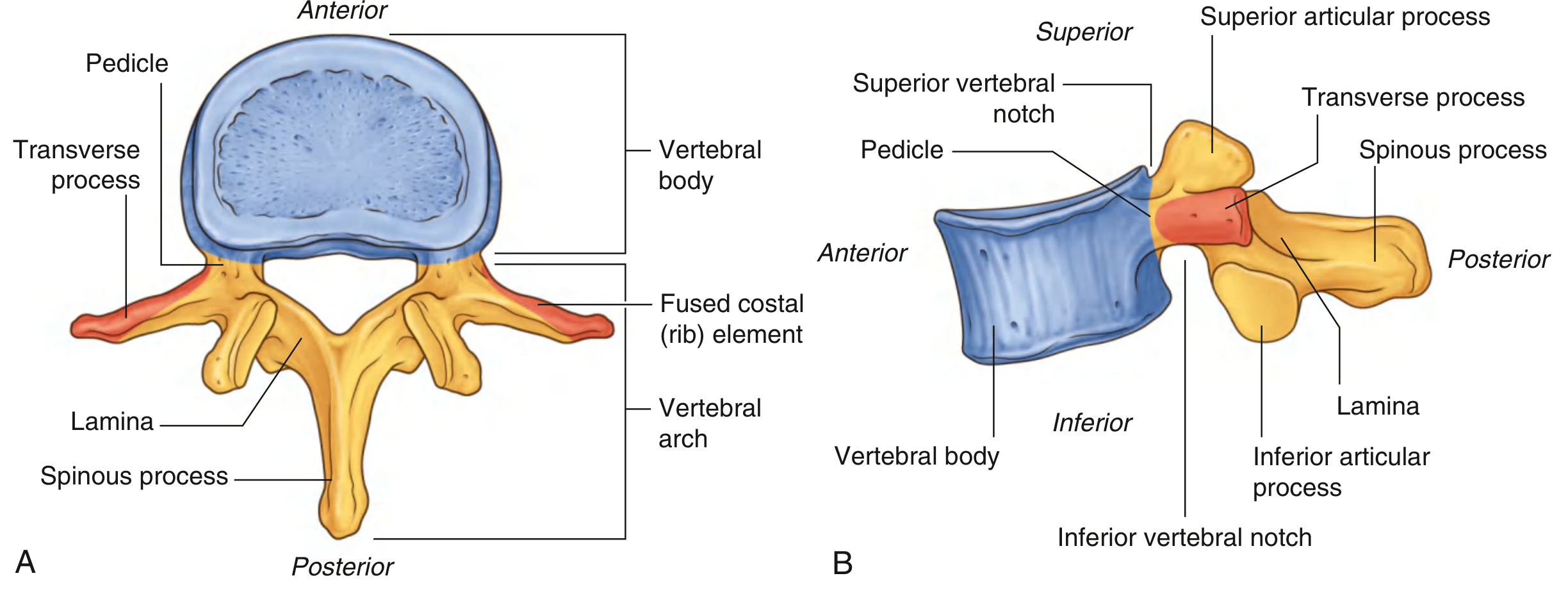
Key components:
- Vertebral body - anterior; major weight-bearing component; increases in size from CII to LV; separated from adjacent vertebrae by fibrocartilaginous intervertebral discs
- Pedicles - two lateral pillars anchoring the arch to the body
- Laminae - form the roof of the arch; fuse at midline
- Spinous process - projects posteriorly and inferiorly from the arch roof
- Transverse processes - extend laterally from where lamina meets pedicle; serve as muscle/ligament attachment points
- Superior and inferior articular processes - articulate with adjacent vertebrae
- Fused costal (rib) elements - incorporated into transverse processes in non-thoracic regions
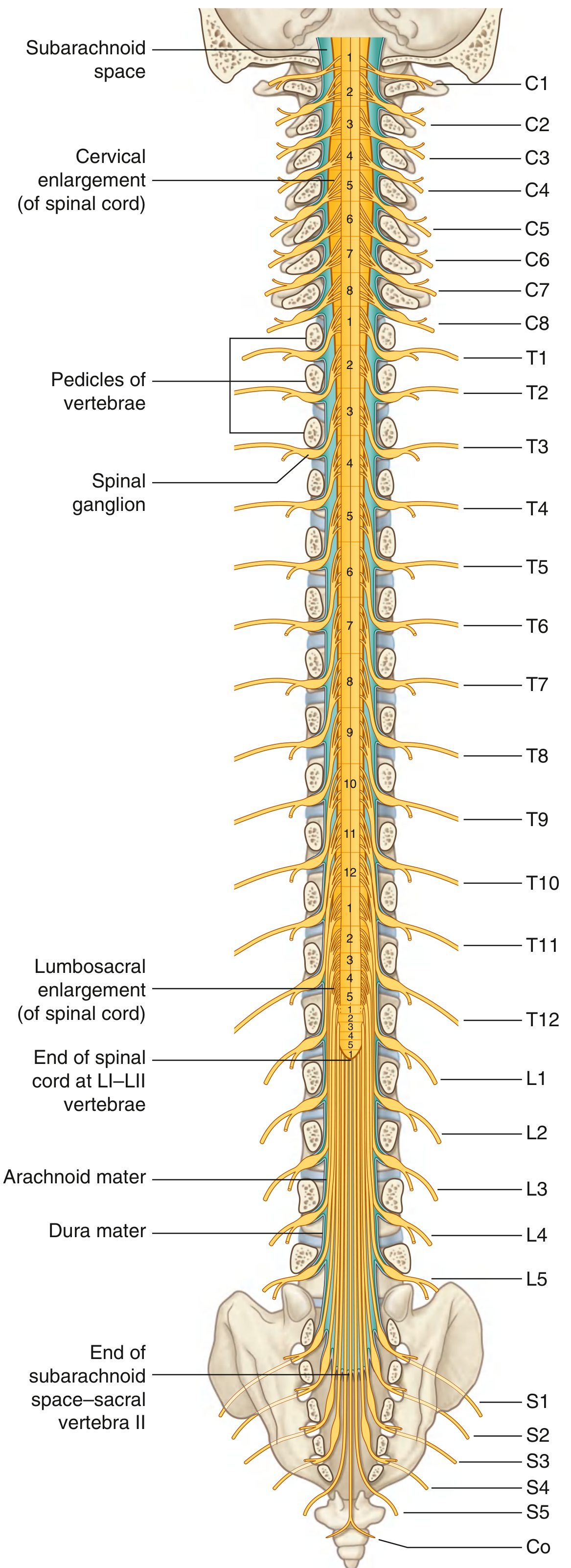
The vertebral canal runs from C1 to S5, formed by the alignment of all vertebral arches, and houses the spinal cord with its membranes, vessels, and proximal spinal nerve roots.
Vertebral Canal, Spinal Cord and Spinal Nerves
During development, the vertebral column grows faster than the spinal cord, so the spinal cord ends at the LI-LII level in adults (can range from TXII to the LII-LIII disc). Spinal nerves below this level travel obliquely downward as the cauda equina.
Regional Vertebrae
Cervical Vertebrae (C1-C7)
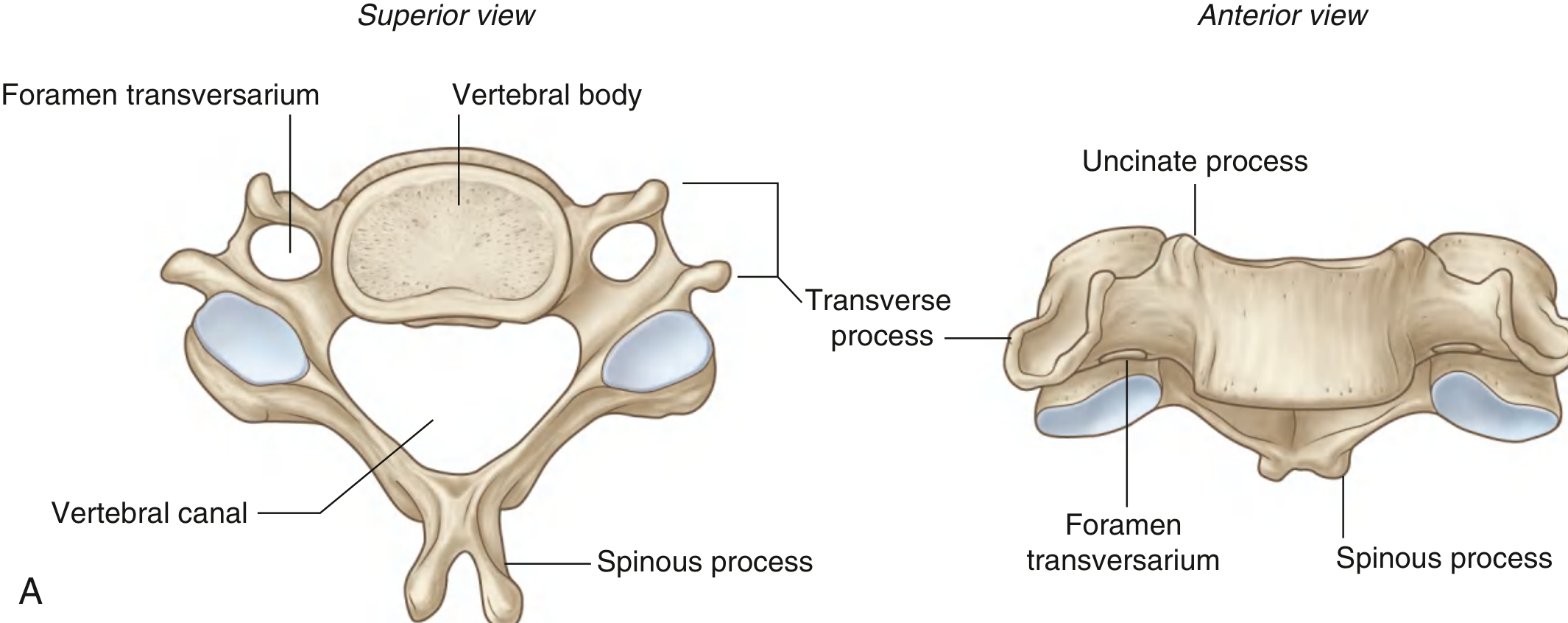
A typical cervical vertebra (C3-C6) has:
- Short, bifid spinous process
- Square-shaped vertebral body with concave superior and convex inferior surfaces
- Trough-shaped transverse process perforated by a foramen transversarium (transmits vertebral artery, vein, and sympathetic nerves)
- Triangular vertebral foramen
- Uncinate processes on the superior lateral surface (unique to cervical)
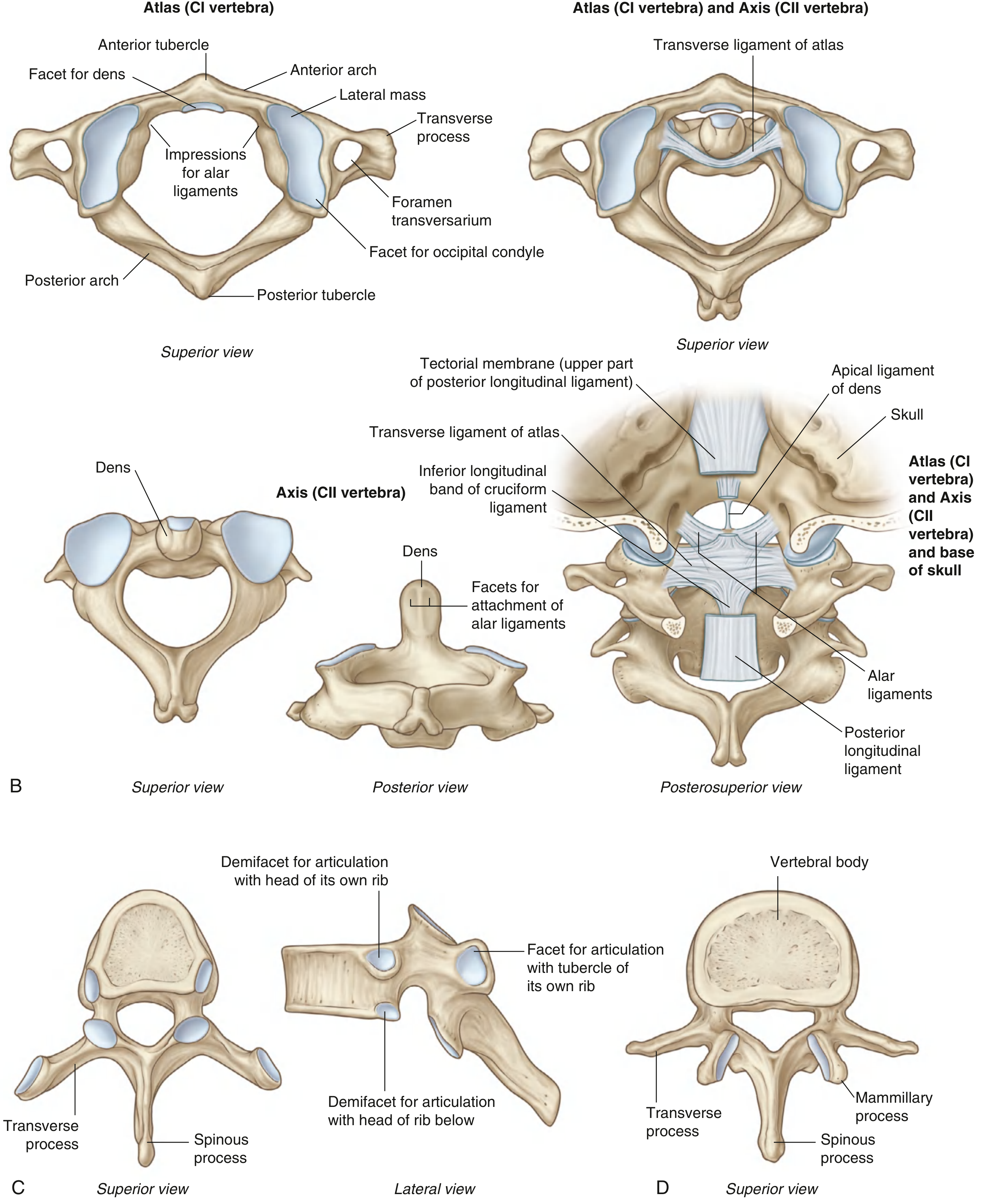
The Atlas (C1) and Axis (C2)
These are specialized for head movement:
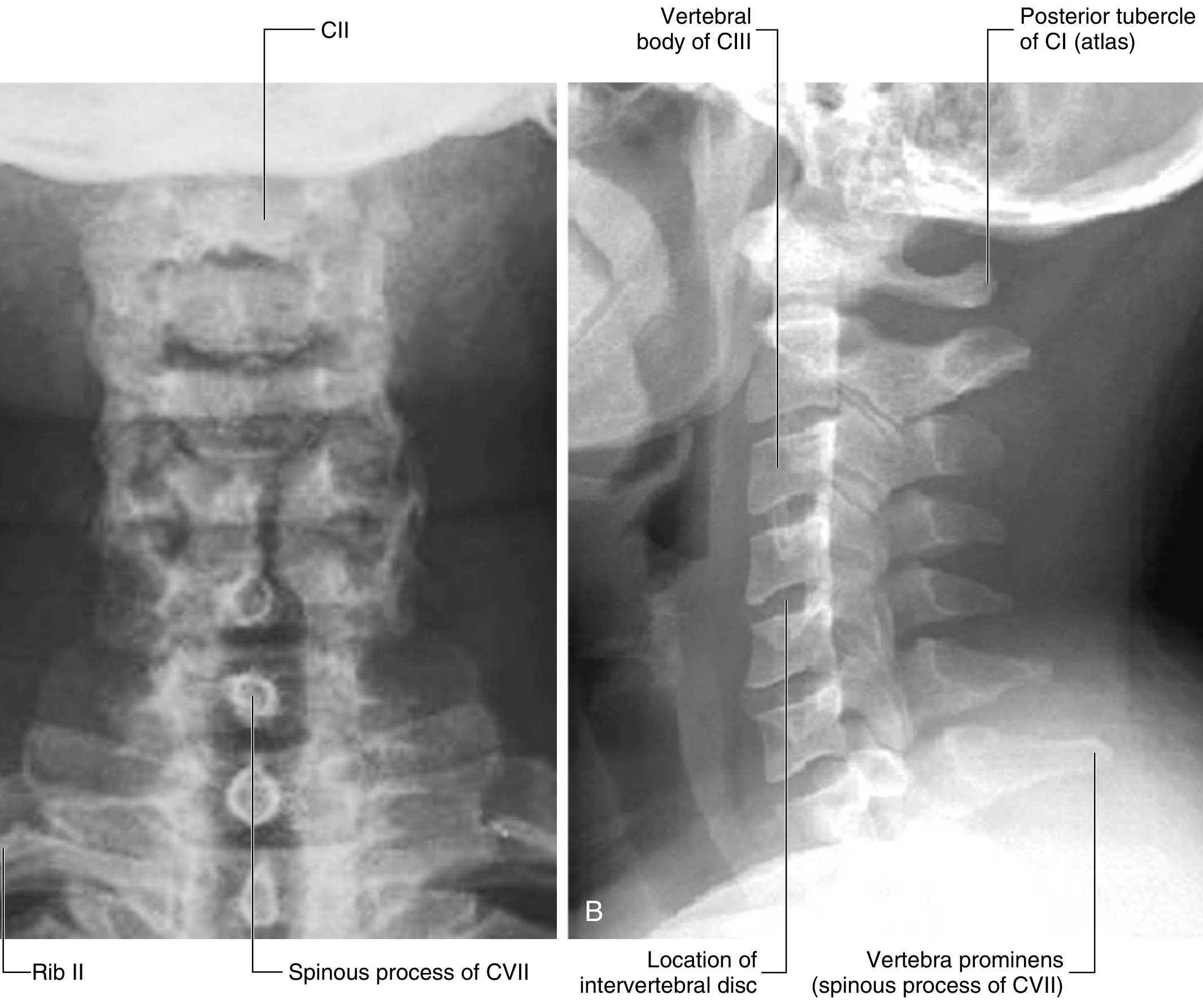
- Atlas (CI) - has no vertebral body (it fused with C2's body during development to form the dens/odontoid process); no intervertebral disc between CI and CII; ring-shaped with anterior and posterior arches and two lateral masses; has facets for the occipital condyles (atlanto-occipital joint = nodding "yes")
- Axis (CII) - distinguished by the dens (odontoid process) projecting superiorly; held against anterior arch of atlas by the transverse ligament; atlanto-axial joint allows rotation ("no" movement)
Thoracic Vertebrae (T1-T12)
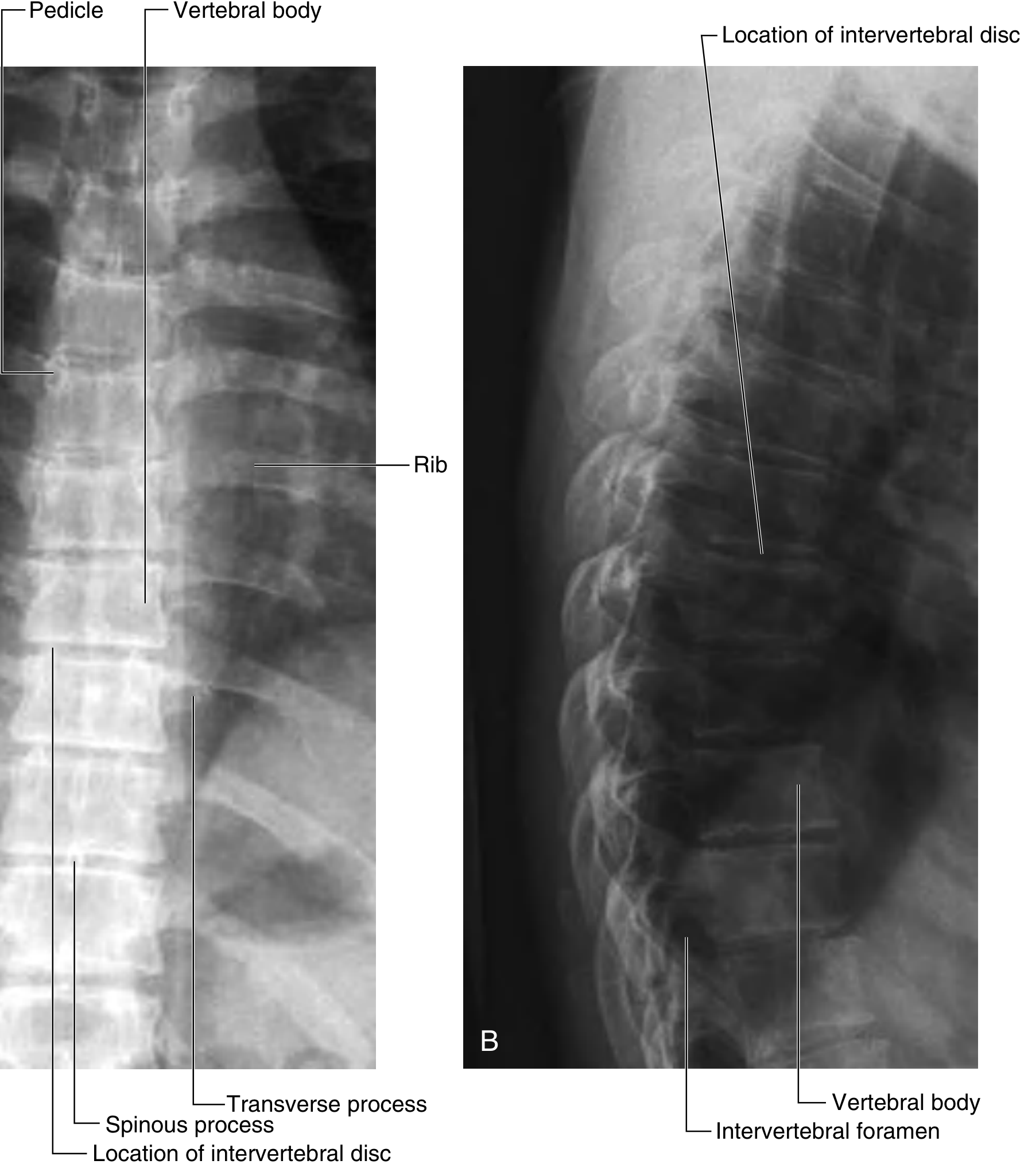
All 12 thoracic vertebrae are characterized by articulation with ribs:
- Superior and inferior costal (demi)facets on the vertebral body for rib head articulation
- Transverse costal facets on the transverse process for rib tubercle articulation
- Heart-shaped vertebral body (superior view)
- Circular vertebral foramen
- Long, inferiorly directed spinous processes
Lumbar Vertebrae (L1-L5)
- Largest vertebrae in the column
- No costal facets (no rib articulation)
- Cylindrical vertebral body; triangular vertebral foramen (larger than thoracic)
- Thin, long transverse processes (except LV - massive, cone-shaped for iliolumbar ligaments)
- Mammillary processes on the superior articular processes
Sacrum
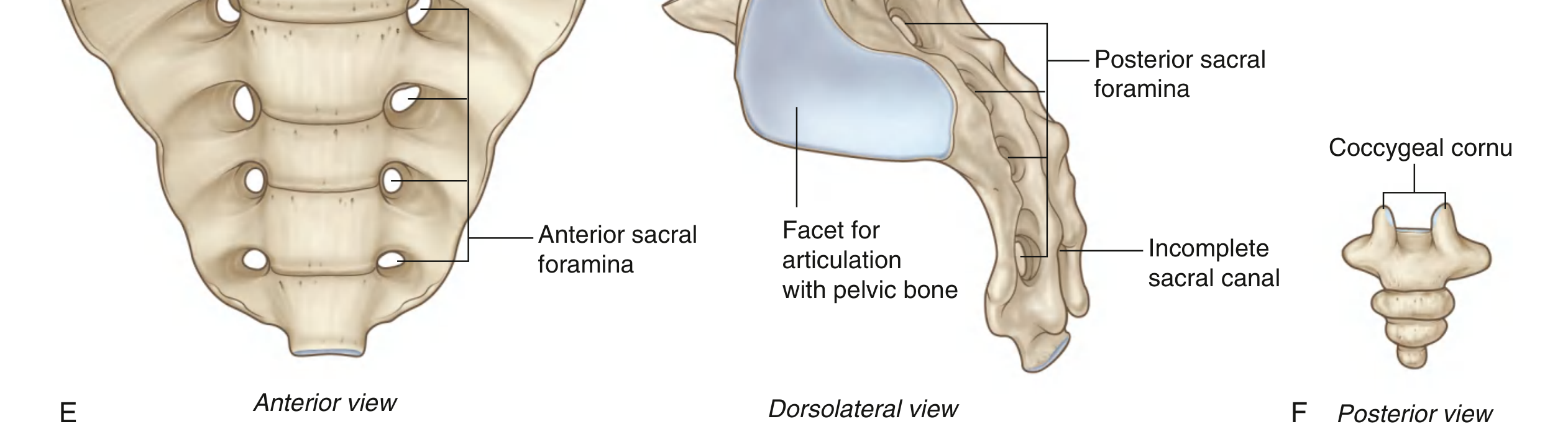
Five fused sacral vertebrae form a single triangular bone:
- Apex pointed inferiorly; concave anterior and convex posterior surfaces
- Articulates superiorly with LV and inferiorly with the coccyx
- Two large L-shaped facets laterally for sacroiliac joints (articulation with pelvic bones)
- 4 pairs of anterior sacral foramina (anterior rami of S1-S4)
- 4 pairs of posterior sacral foramina (posterior rami of S1-S4)
Coccyx
- Small triangular bone; 3-4 fused coccygeal vertebrae
- No vertebral arches, therefore no vertebral canal
- Characterized by coccygeal cornua
Intervertebral Foramina
Each intervertebral foramen is formed by:
- Above: inferior vertebral notch on the pedicle of the superior vertebra
- Below: superior vertebral notch on the pedicle of the inferior vertebra
- Anteriorly: the vertebral body and intervertebral disc
- Posteriorly: the zygapophysial joint
These foramina transmit spinal nerves and blood vessels. In the lumbar region, large gaps also exist between adjacent laminae and spinous processes - these widen further during flexion, providing access for procedures like lumbar puncture and epidural anesthesia.
Joints of the Vertebral Column
Each vertebra has 6 joints with adjacent vertebrae:
- 2 symphyses (one above, one below) via intervertebral discs
- 4 synovial joints (two superior and two inferior zygapophysial joints)
Intervertebral Discs (Symphyses)
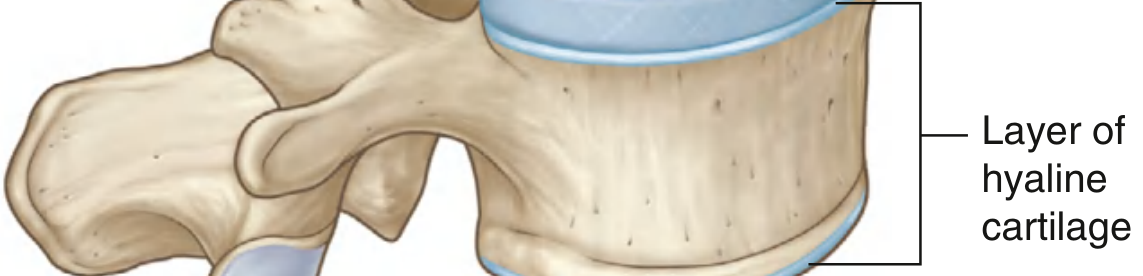
Each disc consists of:
- Annulus fibrosus - outer ring of collagen + wider zone of fibrocartilage in a lamellar arrangement; limits rotation
- Nucleus pulposus - central gel-like core; remnant of the embryological notochord; acts as a shock absorber
A layer of hyaline cartilage separates the disc from the vertebral body on each side.
Zygapophysial (Facet) Joints
Synovial joints between the articular processes of adjacent vertebrae. Their orientation varies by region and determines the type of movement possible:
- Cervical: oblique facets - allow flexion, extension, lateral flexion, and rotation
- Thoracic: near-coronal orientation - limit flexion/extension but permit some rotation
- Lumbar: near-sagittal orientation - permit flexion/extension; limit rotation
Curvatures of the Vertebral Column
The vertebral column has four curvatures in the sagittal plane:
| Curvature | Region | Direction | Type |
|---|---|---|---|
| Cervical lordosis | Cervical | Convex anteriorly | Secondary (develops when infant holds head up) |
| Thoracic kyphosis | Thoracic | Convex posteriorly | Primary (fetal position) |
| Lumbar lordosis | Lumbar | Convex anteriorly | Secondary (develops when infant stands) |
| Sacral kyphosis | Sacral | Convex posteriorly | Primary (fetal position) |
Clinical deformities:
- Scoliosis - abnormal lateral curvature with a rotational component; commonest type is idiopathic; can also be congenital or secondary to muscular dystrophy, tumors, or disc protrusion
- Kyphosis - abnormal thoracic posterior curvature ("hunchback"); classic cause is tuberculosis producing a gibbus deformity
- Lordosis - exaggerated anterior lumbar curve; often associated with pregnancy or obesity
Clinical Notes from Gray's Anatomy for Students
Spina bifida - failure of vertebral arch fusion, usually in lower vertebrae. Two types:
- Spina bifida occulta - posterior arch defect at LV or SI (up to 10% of population); often asymptomatic, may show a tuft of hair over the spinous processes
- Severe spina bifida - complete failure of posterior arch fusion with outpouching: meningocele (CSF only) or myelomeningocele (contains spinal cord tissue); can cause neurological deficits including impaired walking and bladder dysfunction
Vertebroplasty - injection of bone cement (methyl methacrylate) into a collapsed vertebral body; most commonly used for osteoporotic wedge fractures
Osteoporosis and vertebral fractures - wedge fractures commonly occur at L1 in osteoporotic patients; DXA scanning identifies at-risk patients
Disc herniation - the nucleus pulposus can herniate through the annulus fibrosus posterolaterally, compressing adjacent nerve roots and causing radiculopathy
Source: Gray's Anatomy for Students (ISBN 9780323934237), Chapter 2 - Back
This is a shared conversation. Sign in to Orris to start your own chat.