
Angular cheilitis
Reading File
Finding Sources
Finding Sources
Searching PubMed
angular cheilitis
Reading File
Reading File
Reading File
Searching Images
angular cheilitis oral commissure
I have comprehensive information from multiple authoritative sources. Here is a thorough clinical overview:
Angular Cheilitis (Perleche)
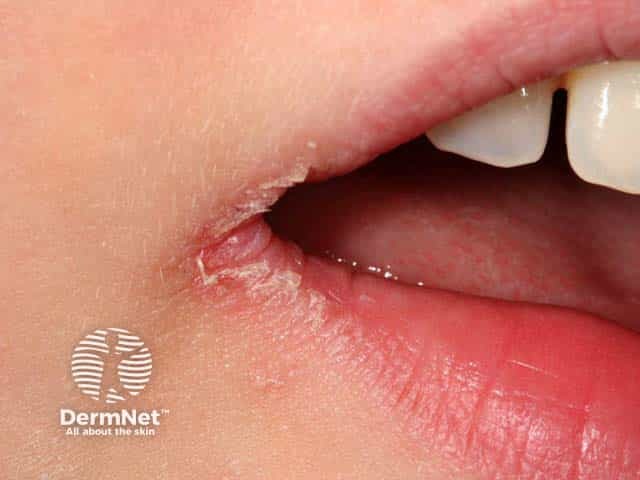
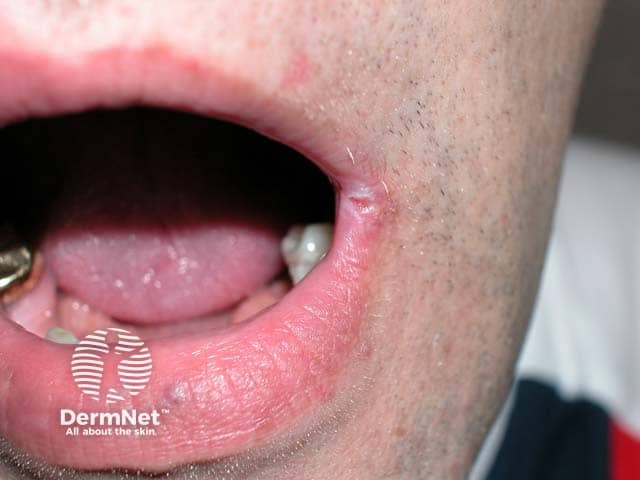
Definition & Synonyms
Angular cheilitis (also called perleche, angular cheilosis, or angular stomatitis) is an intertriginous dermatitis at the oral commissures presenting with fissures, erythema, maceration, and crusting radiating downward and outward from the corners of the mouth. — Andrews' Diseases of the Skin, p. 918
Pathophysiology
The fundamental mechanism is a cycle of excessive moisture accumulation (from saliva pooling) or, paradoxically, excessive dryness, creating a microenvironment that breaks down the epidermal barrier at the commissures. This is then complicated by secondary or primary microbial infection. — Andrews'
The two main pathogens are:
- Candida albicans — the predominant organism, especially when dentures are a factor
- Staphylococcus aureus — may co-infect or cause independent bacterial angular cheilitis
Predisposing Factors
Anatomical / Mechanical
- Ill-fitting dentures — the most common cause in elderly patients; loss of vertical facial dimension allows saliva to pool at the commissures
- Overhanging upper lip, alveolar ridge atrophy
- Thumb sucking, gum chewing, lollipop use (in children)
- Lip-licking habits (extend inflammation onto perioral skin)
- Orthodontic treatment
Nutritional Deficiencies
- Riboflavin (vitamin B2) deficiency — classic cause
- Iron deficiency — angular stomatitis is a recognized feature
- Vitamin B6 (pyridoxine) deficiency
- Vitamin A deficiency — produces dyskeratotic mucosal changes including angular cheilitis
Systemic / Immunologic
- Diabetes mellitus — promotes intraoral candidiasis and angular cheilitis
- HIV/AIDS — angular cheilitis is a WHO Stage 2 clinical feature
- Chronic mucocutaneous candidiasis
- Sjögren syndrome (xerostomia impairs normal oral flora balance)
- Anorexia nervosa
- Down syndrome
- Drug-induced xerostomia
— Andrews' Diseases of the Skin, p. 918; Cummings Otolaryngology; Sleisenger & Fordtran's GI and Liver Disease
Clinical Features
| Feature | Description |
|---|---|
| Location | Bilateral or unilateral labial commissures |
| Morphology | Fissures, maceration, erythema, crusting |
| Extension | May spread to adjacent perioral skin |
| Symptoms | Soreness, burning, pain on wide mouth opening |
Angular cheilitis is listed as a clinical form of oral candidiasis alongside pseudomembranous candidiasis, erythematous candidiasis, and hyperplastic candidiasis. — Cummings Otolaryngology
Differential Diagnosis
- Irritant or allergic contact dermatitis
- Herpes simplex virus (typically vesicular)
- Syphilitic mucous patches
- Aphthous disease
- Impetigo
- Eczema / atopic dermatitis
- Plummer-Vinson syndrome (angular cheilitis + iron-deficiency dysphagia + esophageal webs)
Management
Treatment is directed at the underlying cause and the microbial component:
Address Anatomical Factors
- Improve denture fit; increase denture height to restore vertical facial dimension
- Replace or cap lost teeth
- Collagen injection or Softform implants to obliterate deep angular creases (resistant cases)
Topical Antimicrobial / Anti-inflammatory
| Agent | Indication |
|---|---|
| Nystatin + iodochlorhydroxyquin in hydrocortisone ointment | First-line for Candida-associated, denture-related cases |
| Desonide + topical anticandidal | Stubborn cases requiring slightly stronger corticosteroid |
| Mupirocin ointment | If S. aureus identified |
| Clotrimazole / miconazole | Topical antifungal option |
| Petroleum jelly / zinc oxide paste | Barrier repair and moisture protection |
Address Systemic Factors
- Correct nutritional deficiencies (riboflavin, iron, vitamins B6/B12)
- Optimize diabetes control
- Manage HIV/immunosuppression
- Treat underlying Sjögren syndrome or xerostomia
Surgery
- Excision with rotating flap graft — reserved for severe, resistant cases only
— Andrews' Diseases of the Skin, p. 918; Cummings Otolaryngology, p. 1586
Key Associations to Remember
| Association | Significance |
|---|---|
| Elderly + dentures | Most common clinical scenario |
| HIV (WHO Stage 2) | Screen for immunosuppression in atypical/recurrent cases |
| Riboflavin / iron deficiency | Nutritional screen warranted in persistent cases |
| Diabetes | Poor glycemic control drives candidal overgrowth |
| Plummer-Vinson syndrome | Angular cheilitis + dysphagia + iron-deficiency anemia |
| Children | Thumb sucking, lip licking — often self-limiting |
This is a shared conversation. Sign in to Orris to start your own chat.