
Types of drain
Reading File
Finding Sources
Finding Sources
Reading File
Reading File
Reading File
Finding Sources
Found the "Classification of drains" section in Bailey and Love - exactly what's needed. Let me pull that section in full.
Reading File
Loading Image
Now I have enough to give a comprehensive, well-organized answer.
Types of Surgical Drains
Surgical drains are classified mainly by mechanism of action and, separately, by purpose/site of use.
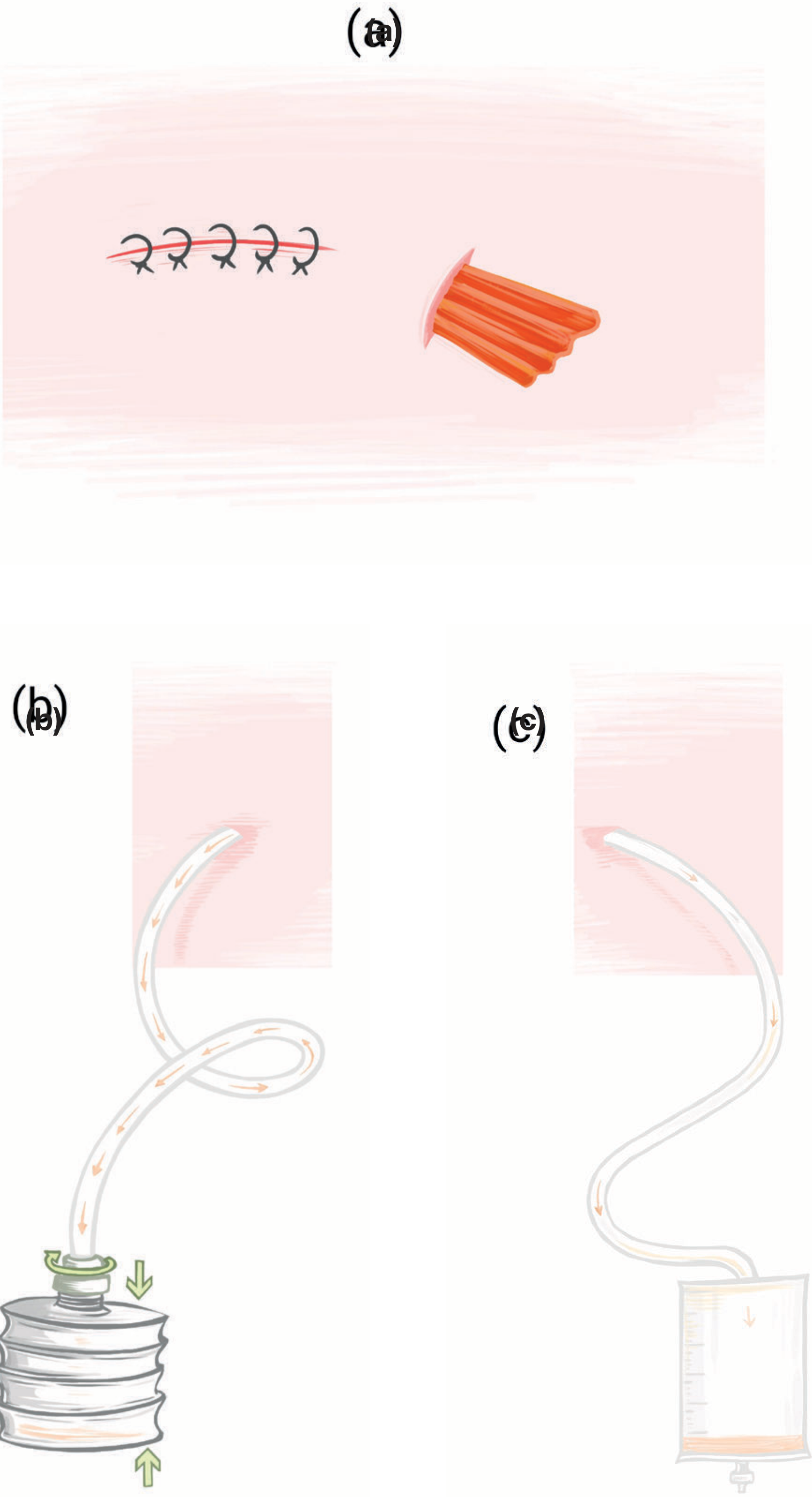
1. By mechanism - Open vs Closed
Open drains
Passive drainage of a cavity by gravity, forming a channel between the body and the outside. They are unsightly, need frequent dressing changes, and can act as a conduit for bacterial colonization.
- Examples: Penrose drain, corrugated rubber drain - used in debrided/contaminated wounds and abscess cavities.
Closed drains - subdivided into:
-
Suctioned (active) drains - maintain negative pressure, actively pulling out fluid and obliterating dead space. Used with caution near vital structures (e.g., after ventral hernia repair, axillary dissection, head and neck surgery).
- Examples: Jackson-Pratt drain, Redivac, Hemovac (bulb/spring suction reservoirs), fine perforated suction catheters (3-6 mm) attached to a collapsible bag or evacuated jar.
-
Non-suctioned (passive) closed drains - rely on capillary action and gravity rather than suction, draining into a closed collection system without directly sucking on viscera or omentum.
- Examples: Robinson's drain (intra-abdominal), urinary (Foley) catheters, nasogastric drainage tubes.
(Bailey and Love's Short Practice of Surgery, p. 135)
2. By purpose
- Prophylactic - placed to prevent fluid/blood collection or to obliterate dead space (e.g., after mastectomy, thyroidectomy, joint replacement).
- Therapeutic - placed to evacuate an existing collection (abscess, hematoma) or to act as a "sentinel" that gives early warning of a leak (bile, pancreatic, bowel, urine, blood) or to control an established fistula. (Schwartz's Principles of Surgery, p. 452)
3. Specific named/site-specific drains you'll encounter clinically
| Drain | Typical use |
|---|---|
| Penrose / corrugated | Open drainage of abscess cavities, perianal/perirectal fistulas |
| Jackson-Pratt (JP) | Closed active suction - abdominal, breast, neck, renal bed |
| Hemovac / Redivac | Closed active suction - orthopedic (joint replacement blood salvage), large wound beds |
| Robinson's drain | Closed passive - intraperitoneal, avoids sucking omentum/bowel into the tube |
| Pigtail (percutaneous) drain | Closed suction - image-guided (CT/US) drainage of abscesses, loculated fluid collections, urinary tract |
| Sump drain (e.g., Silastic sump) | Double-lumen, allows air entry to prevent tissue occlusion - used in GI/pancreatic surgery |
| Chest drain / intercostal catheter (ICD) | Pleural space - pneumothorax, hemothorax, pleural effusion, post-thoracotomy |
| T-tube | Common bile duct drainage after choledochotomy |
| Lumbar drain | CSF diversion (e.g., after skull base/ENT surgery, to reduce ICP or manage CSF leak) |
| Nephrostomy / biliary percutaneous drains | Urinary or biliary diversion |
Key clinical points
- Drains should be removed as soon as safely possible - duration depends on volume/character of output (e.g., left longer for a pancreatic leak, removed earlier for simple serous fluid).
- Complications include tissue trauma, retrograde infection, and (with high-negative-pressure closed suction) possible suction injury contributing to anastomotic breakdown - closed suction drains do not reliably "protect an anastomosis."
- In clean surgery like joint replacement, blood collected via specially designed drain/filter systems can sometimes be autotransfused.
(Sources: Bailey and Love's Short Practice of Surgery 28th Ed., p. 135; Schwartz's Principles of Surgery 11th Ed., p. 452; Hinman's Atlas of Urologic Surgery; Pye's Surgical Handicraft 22nd Ed.)
A quick check of recent systematic reviews/meta-analyses did not surface anything overturning this classification - the open vs. closed and active vs. passive framework remains the current standard teaching. Let me know if you want this narrowed to a specific surgical specialty (e.g., chest drains, biliary drains, or drains in a particular operation).
This is a shared conversation. Sign in to Orris to start your own chat.