
How big placenta causes pih
I'll check the medical library skill first as this is a medical question.
Searching sources...
Reading File
Now let me search the medical library for placenta size and PIH (Pregnancy-Induced Hypertension).
Finding Sources
Finding Sources
Let me search more specifically for the mechanism by which a large placenta (as seen in multiple pregnancies, hydatidiform mole, etc.) causes PIH/preeclampsia.
Finding Sources
Finding Sources
Excellent - I found a key passage in Brenner and Rector's The Kidney about twin pregnancies and increased placental mass causing sFlt1. Let me read those sections in detail.
Reading File
Reading File
I found a great diagram in Robbins. Let me also get the sFlt1 passage about twin pregnancies and large placenta, and fetch the diagram.
Reading File
Loading Image
I now have all the information needed to give a thorough, well-sourced answer. Let me compile it.
How a Large Placenta Causes PIH (Pregnancy-Induced Hypertension / Preeclampsia)
The short answer: a large placenta produces excess anti-angiogenic factors - particularly sFlt-1 (soluble fms-like tyrosine kinase-1) - that spill into the maternal circulation, cause systemic endothelial dysfunction, and trigger the hypertension + proteinuria of preeclampsia/PIH.
1. When Is the Placenta Abnormally Large?
A "large placenta" scenario arises in:
- Multiple gestations (twins, triplets) - each extra fetus adds placental mass
- Hydatidiform mole - trophoblastic proliferation without a viable fetus
- Fetal hydrops or diabetes - where placentomegaly occurs
- Erythroblastosis fetalis
All these conditions carry a well-known, significantly elevated risk of PIH/preeclampsia.
2. The Core Mechanism: sFlt-1 Overproduction from Excess Placental Mass
The key insight comes from twin versus singleton pregnancy studies. As Brenner and Rector's The Kidney explains:
"In the case of twin pregnancies, the increased sFlt1 production appears to be due to increased placental mass, rather than placental ischemia."
- A larger placenta = more syncytiotrophoblast tissue = more sFlt-1 secreted
- sFlt-1 is a truncated, soluble decoy receptor that binds and neutralizes circulating VEGF (vascular endothelial growth factor) and PlGF (placental growth factor)
- Loss of free VEGF/PlGF activity causes widespread endothelial dysfunction
3. Step-by-Step Pathophysiology
Large placenta
     ↓
Excess syncytiotrophoblast mass
     ↓
↑↑ Secretion of sFlt-1 + Soluble Endoglin (sEng)
     ↓
sFlt-1 neutralizes VEGF & PlGF → endothelial injury
sEng inhibits TGF-β → ↓ NO production → vasoconstriction
     ↓
Systemic maternal endothelial dysfunction
     ↓
• Hypertension (vasoconstriction, ↓ NO, ↑ endothelin-1)
• Proteinuria (glomerular endotheliosis, podocyte injury, ↓ nephrin)
• Coagulopathy (↓ PGI₂ → procoagulant state)
• HELLP syndrome (in severe cases)
As Robbins Pathologic Basis of Disease summarizes:
"High levels of sFLT1 and soluble endoglin bring about a decrease in angiogenesis, resulting in defective placental vascular development... sFLT1 and soluble endoglin are key mediators that link the placenta to the characteristic maternal endothelial dysfunction of preeclampsia."
4. The Spiral Artery Remodeling Failure (Underlying Substrate)
The diagram below shows why the placenta becomes ischemic in most cases of preeclampsia - and why a large placenta can induce it even without frank ischemia:
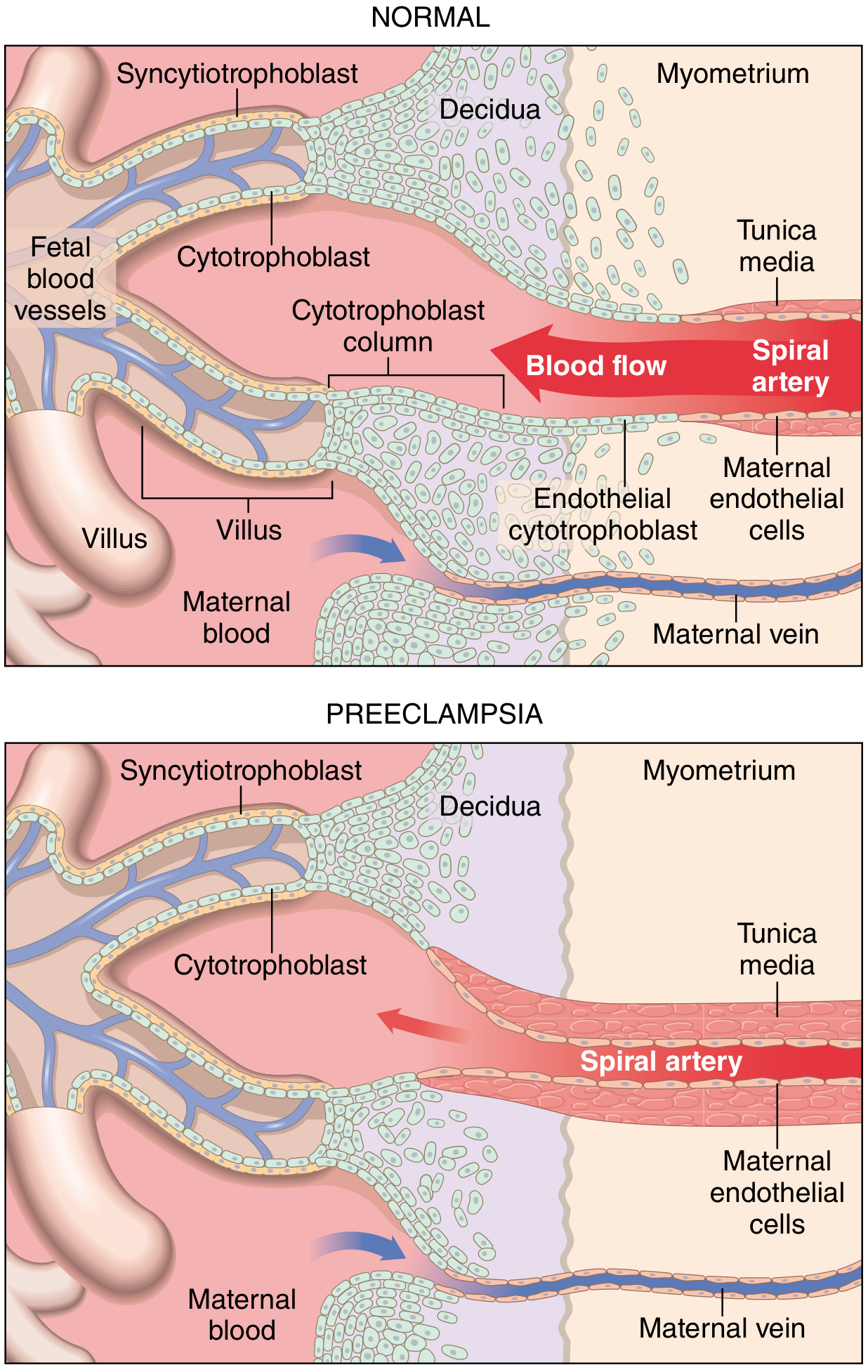
Fig. 22.51 - Physiologic remodeling of uterine spiral arteries (normal, top) vs. failure of remodeling in preeclampsia (bottom). From Robbins Pathologic Basis of Disease.
- In normal pregnancy: cytotrophoblasts invade spiral arteries, replace smooth muscle, convert them to wide, low-resistance vessels
- In preeclampsia: this remodeling is incomplete; arteries remain narrow; the placenta is under-perfused
- With a large placenta, even if spiral artery remodeling is partially adequate, the demand exceeds supply - plus the sheer trophoblast mass secretes excess sFlt-1 regardless
5. Clinical Examples Linking Placental Size to PIH Risk
| Condition | Placenta Size | PIH Risk |
|---|---|---|
| Twin/triplet pregnancy | Large (multiple) | 2-4x higher |
| Hydatidiform mole | Very large (no fetus) | Very high - classic |
| Gestational diabetes | Large (placentomegaly) | Increased |
| Hydrops fetalis | Large | Increased |
| First pregnancy | Relatively smaller | Baseline risk |
Note the hydatidiform mole example: the disease requires a placenta, not necessarily a fetus - confirming placental mass itself drives PIH, not just fetal demand.
"Preeclampsia requires the presence of a placenta - though not necessarily a fetus, as in the case of hydatidiform mole - and almost always remits after its delivery." - Brenner & Rector's The Kidney
Summary
A large placenta causes PIH by producing excess sFlt-1 and soluble endoglin proportional to its mass. These anti-angiogenic proteins neutralize VEGF/PlGF, disrupt endothelial nitric oxide production, and trigger the triad of hypertension, proteinuria, and end-organ damage that defines preeclampsia. This mechanism explains why conditions with excessive placental tissue (twins, moles) carry disproportionately high PIH risk even without classical spiral artery failure.
Sources:
- Robbins & Cotran Pathologic Basis of Disease - Pathogenesis of preeclampsia, Fig. 22.51
- Brenner & Rector's The Kidney - The Role of the Placenta; Angiogenic Imbalance sections
This is a shared conversation. Sign in to Orris to start your own chat.