
What is pilonidal sinus
Reading File
Now let me search the medical library and web in parallel.
Finding Sources
Searching the Web
pilonidal sinus definition causes treatment
Searching PubMed
"pilonidal sinus" treatment
Good - found multiple textbook sections. Let me read the most detailed ones in parallel.
Reading File
Reading File
Reading File
Excellent - I have very rich content. Let me also fetch the clinical image from Sabiston.
Loading Image
I now have comprehensive information from multiple authoritative textbooks. Here is the full answer:
Pilonidal Sinus
Definition
A pilonidal sinus is a small hole or tunnel in the skin located in the natal cleft (the crease between the buttocks), overlying the sacrococcygeal region. The name comes from Latin: pilus (hair) and nidus (nest) - essentially a "nest of hair." It consists of one or more midline openings that communicate with a fibrous track lined by granulation tissue, with hair lying loosely within the lumen.
- Bailey and Love's Short Practice of Surgery, 28th Ed.
Clinical Photo
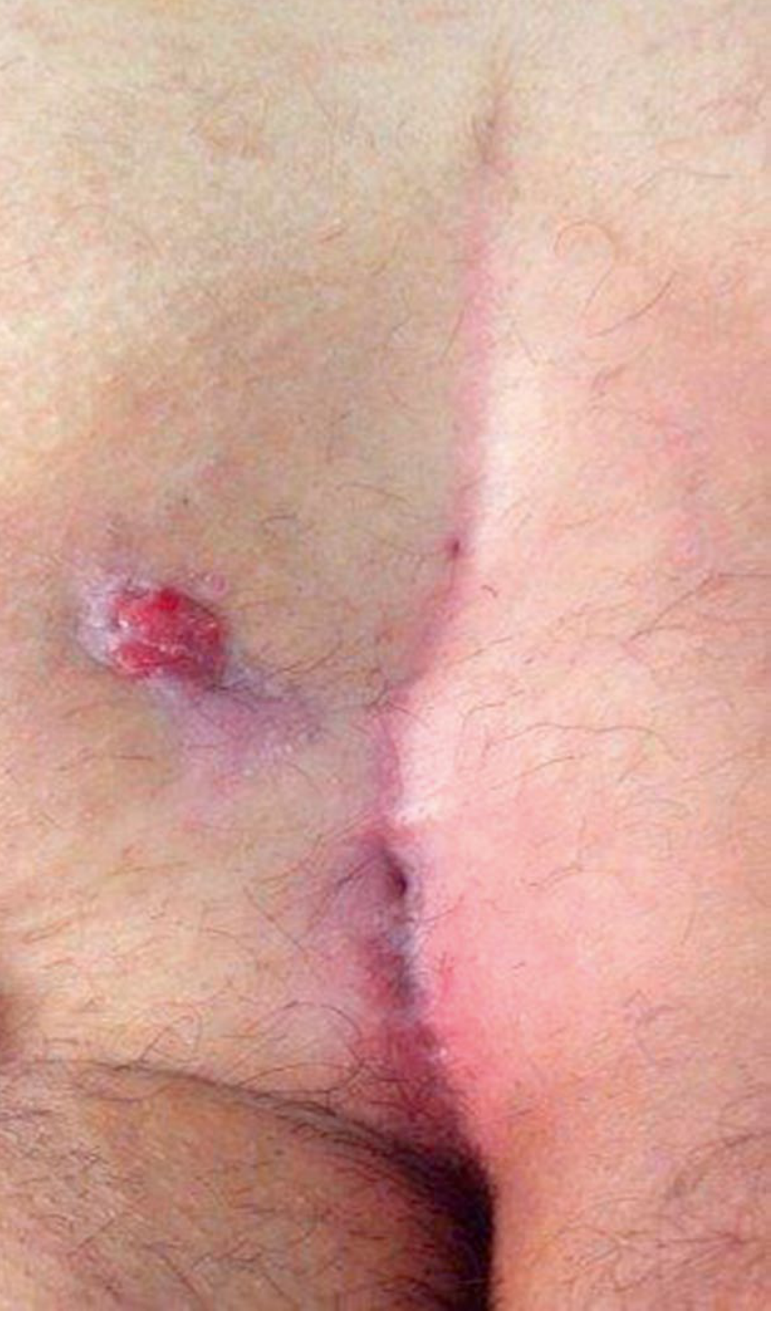
Pilonidal sinus showing the midline pit and a lateral sinus tract with granulation tissue. (Sabiston Textbook of Surgery)
Pathophysiology / How It Forms
The condition is acquired, not congenital. Evidence supporting the acquired origin:
- Interdigital pilonidal sinus is an occupational disease of hairdressers (hair puncturing the skin between fingers)
- The age of appearance is older than expected for a congenital lesion
- Hair follicles are rarely present in the walls of the sinus
- The pointed ends of hairs are directed toward the blind end of the sinus (indicating external penetration)
- The disease mostly affects hirsute men
Mechanism: Buttock friction and shearing forces allow shed or broken hairs that collect in the natal cleft to drill through the midline skin. Movement of the buttocks creates a vacuum effect, forcing loose hair into the skin through small cutaneous pits. The trapped hair triggers a foreign body reaction, causing local inflammation. This may become superinfected, forming a hair-filled abscess cavity. Secondary tracks may spread laterally, emerging at the skin as discharging openings.
- Sabiston Textbook of Surgery; Bailey and Love's
Who Gets It?
- Predominantly young people (typically late teens to mid-20s); rarely after age 40
- Males much more commonly than females (more hirsute)
- Dark-haired individuals more than blond
- Associated with: obesity, sedentary occupation (truck drivers, office workers), local irritation or trauma
- Affects approximately 70,000 patients annually in the United States
Clinical Presentations
Pilonidal disease exists on a spectrum:
| Presentation | Features |
|---|---|
| Asymptomatic pit | Incidental midline pit found without inflammation |
| Acute abscess | Painful, swollen, fluctuant swelling in the natal cleft; may have pus |
| Chronic sinus | Intermittent pain, swelling, and purulent or bloody discharge; history of recurrent abscesses |
All primary sinus openings are strictly in the midline, between the level of the sacrococcygeal joint and the tip of the coccyx. Lateral openings suggest secondary tracks from a midline primary pit.
Differential diagnosis if no midline pits: hidradenitis suppurativa, complex anal fistula, osteomyelitis, tuberculosis, actinomycosis.
Histology
The cyst/sinus is lined by stratified squamous epithelium (like normal epidermis or follicular infundibulum). Some pilonidal cysts are composed of epithelium that keratinizes without a granular cell layer - analogous to the outer root sheath.
- Andrews' Diseases of the Skin
Treatment
Treatment is tailored to severity:
1. Conservative (Minimal/No Symptoms)
- Regular cleaning of the tracks and removal of all hair
- Strict hygiene; regular hair exfoliation of the area
- Laser or depilatory hair removal reduces recurrence rates
- Silver nitrate or laser coagulation to cauterize simple tracks
2. Acute Abscess
- Incision and drainage (I&D) - the standard of care
- A lateral incision (avoiding the midline) should be made over the most fluctuant area
- The cavity is thoroughly curetted - all embedded hair and devitalized tissue removed
- Antibiotics as adjunct (bacterial colonization 50-70%; common isolates: Staphylococcus aureus, Bacteroides)
3. Recurrent or Chronic Disease (Surgical Excision)
Several techniques exist:
| Procedure | Description |
|---|---|
| Gips procedure | Excision of midline pits + debridement of abscess cavity and sinus tracts (minimally invasive) |
| Bascom procedure | Lateral incision over sinus cavity + excision of midline pits; avoids midline closure |
| Wide excision + open healing | Complete excision left to heal by secondary intention |
| Excision + flap closure | Bascom cleft lift, Limberg flap, Z-plasty, V-to-Y advancement flap for complex disease |
| Phenol injection | Chemical ablation of tracts; useful for both chronic and post-I&D cases |
| EPSiT / SiLaC | Newer minimally invasive endoscopic/laser techniques (recent 2026 meta-analysis comparing these) |
Key principle: avoid midline wound closure - midline scars in the natal cleft have higher breakdown and recurrence rates.
- Sabiston Textbook of Surgery; Bailey and Love's
Complications
- Recurrence - the most common problem; even after adequate excision
- Chronic wound healing problems
- Squamous cell carcinoma (SCC) - rare but reported in longstanding, neglected pilonidal disease
Association with Other Conditions
Pilonidal sinus may occur alongside the acne tetrad: nodulocystic acne, dissecting cellulitis of the scalp, hidradenitis suppurativa, and pilonidal sinus - all sharing a follicular occlusion mechanism.
Recent evidence note: A 2026 systematic review and meta-analysis (PMID: 41964736) compared newer minimally invasive techniques - Sinus Laser Closure (SiLaC) vs. Endoscopic Pilonidal Sinus Treatment (EPSiT) - suggesting these are effective alternatives to traditional open surgery, particularly for recurrence rates and healing time.
This is a shared conversation. Sign in to Orris to start your own chat.