
MCH
MCH stands for Mean Corpuscular Hemoglobin - it's the average amount of hemoglobin per red blood cell, measured in picograms (pg). Normal range is roughly 27-33 pg. Low MCH = hypochromic RBCs (e.g., iron deficiency anemia); high MCH = hyperchromic states (e.g., megaloblastic anemia).
Searching sources...
Reading File
"MCH" is quite brief - it could refer to several things. Let me clarify before diving deep.
Asking for Preferences
What aspect of MCH are you asking about?
Maternal child health
Maternal and Child Health (MCH) is a broad field. Let me narrow down what you need.
Asking for Preferences
What specifically do you want to know about Maternal and Child Health?
Antenatal care covers a wide range - from initial booking visits to risk assessment, investigations, and specific interventions.
Searching sources...
Finding Sources
Finding Sources
Reading File
Reading File
Reading File
Reading File
Reading File
I now have comprehensive content. Let me compile the full answer.
Antenatal Care (ANC) - A Complete Overview
Source: Park's Textbook of Preventive and Social Medicine
Definition
Antenatal care (ANC) is the care provided by skilled health-care professionals to pregnant women and pregnant adolescent girls to ensure the best health conditions for both mother and baby during pregnancy. It encompasses:
- Risk identification
- Prevention and management of pregnancy-related or concurrent diseases
- Health education and promotion
ANC reduces maternal and perinatal morbidity and mortality both directly (through detection) and indirectly (by identifying women at increased risk of delivery complications and ensuring referral).
Objectives of ANC
- Promote, protect, and maintain the health of the mother during pregnancy
- Detect "high-risk" cases and give them special attention
- Foresee complications and prevent them
- Remove anxiety and dread associated with delivery
- Reduce maternal and infant mortality and morbidity
- Teach the mother elements of child care, nutrition, personal hygiene, and environmental sanitation
- Sensitize the mother to the need for family planning
- Attend to the under-fives accompanying the mother
(1) Antenatal Visits
Recommended Schedule (Minimum 4 Visits)
| Visit | Timing |
|---|---|
| 1st | Within 12 weeks - registration + first check-up |
| 2nd | 14-26 weeks |
| 3rd | 28-34 weeks (medical officer at PHC) |
| 4th | 36 weeks to term |
- Ideally: monthly during first 7 months; fortnightly during 8th month; weekly thereafter
- The 3rd visit (28-34 weeks) is most important and should be with a medical officer
- Early registration within 12 weeks is the primary responsibility of the ANM (Auxiliary Nurse Midwife)
Importance of Early Registration
- Allows proper planning and adequate care for mother and foetus
- Records LMP and calculates Expected Date of Delivery (EDD)
- Assesses baseline: BP, weight, haemoglobin
- Enables timely detection and referral of complications
- Confirms if pregnancy is wanted; refers for safe abortion services if not
(2) Physical Examination at Each Visit
At Every Visit:
- History taking
- Weight and blood pressure measurement
- Check for pallor and oedema
- Abdominal examination: symphysis-fundal height, foetal lie, presentation, engagement, foetal heart sounds
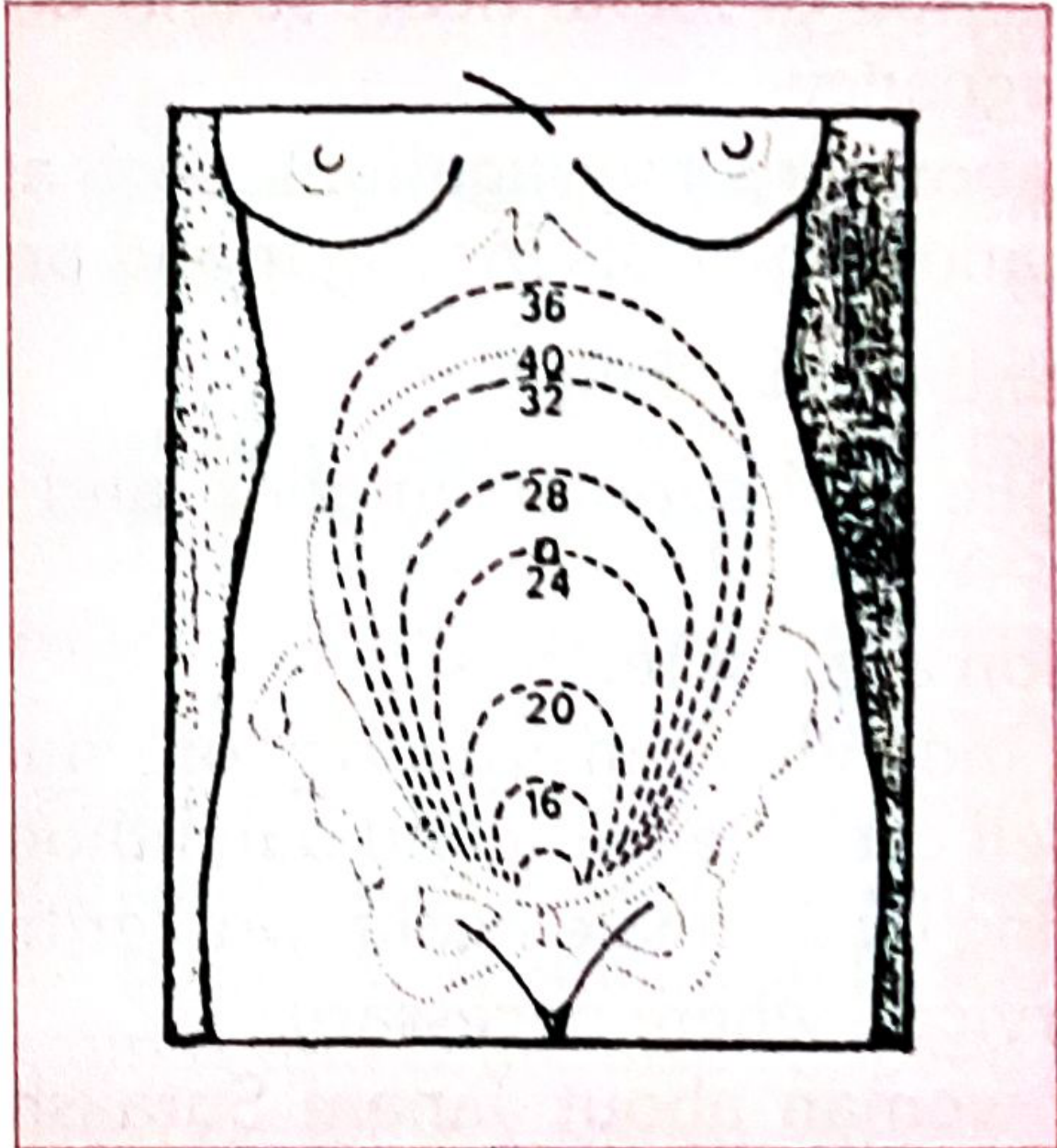
Uterine Fundal Height as Gestational Age Indicator
The fundal height rises progressively through pregnancy and is a key bedside tool for tracking foetal growth:
(3) Laboratory Investigations
At Sub-Centre Level:
- Pregnancy detection test
- Haemoglobin estimation
- Urine for albumin and sugar
- Rapid malaria test
At PHC/CHC/FRU Level:
- Blood group and Rh factor
- VDRL/RPR (syphilis)
- HIV testing
- Blood sugar
- HBsAg (Hepatitis B)
- TB skin test (if available)
(4) Specific Health Protection Measures
(i) Anaemia
- ~50% of pregnant women in India are anaemic (NFHS IV)
- Caused mainly by iron and folic acid deficiency
- Complications: premature birth, postpartum haemorrhage, puerperal sepsis, thromboembolism
- GOI Programme: 100 mg elemental iron + 500 mcg folic acid daily for 100 days, distributed through ANCs, PHCs, and sub-centres
(ii) Other Nutritional Deficiencies
- Protein, Vitamin A, Vitamin D, and iodine deficiencies need attention
- Some MCH centres provide free milk; Vitamin A and D capsules supplied free of cost
(iii) Asymptomatic Bacteriuria (ASB)
- Pregnant women are more prone to UTI due to physiological changes
- Risks: pyelonephritis, preterm birth, low birth weight, increased perinatal mortality
- Diagnosis: midstream urine culture (gold standard); gram staining if culture unavailable
- Treat all confirmed cases
(iv) Gestational Diabetes
- Hyperglycaemia first detected during pregnancy
- More common in the second half of pregnancy
- Family history should be recorded at the first visit
- Symptoms: excessive thirst/hunger, polyuria, fatigue, blurred vision
- Risks: preeclampsia, miscarriage/stillbirth, birth defects, macrosomia (>4.5 kg)
(v) Toxaemia of Pregnancy (Pre-eclampsia)
- Detected by: proteinuria (albumin in urine) + raised blood pressure
- Early detection and management via efficient ANC minimizes risk
(vi) Tetanus Immunization
| Situation | Schedule |
|---|---|
| Unimmunized mother | 2 doses TT: 1st at 16-20 weeks, 2nd at 20-24 weeks (min 1 month apart) |
| Previously immunized | 1 booster dose (covers subsequent pregnancies too) |
| Seen late in pregnancy | No woman should be denied even a single dose |
(5) Health Education During ANC
Topics covered:
- Nutrition: adequate diet during pregnancy
- Rest and exercise: importance of balanced activity
- Personal hygiene: bathing, dental care, breast care
- Danger signs: bleeding, severe headache, visual disturbances, oedema, reduced foetal movements - seek immediate care
- Birth preparedness: choosing the delivery site, arranging transport and finances, identifying a blood donor
- Breastfeeding: importance and technique
- Family planning: post-delivery contraception counselling
(6) High-Risk Identification
Factors placing a pregnancy in the high-risk category:
- Age <18 or >35 years
- Grand multipara (4+ previous pregnancies)
- Height <145 cm (risk of contracted pelvis)
- Previous history of stillbirth, neonatal death, cesarean section, or obstetric complications
- Anaemia (Hb <7 g/dL)
- Hypertension, diabetes, heart disease
- Multiple pregnancy
- Malpresentation after 34 weeks
- Inadequate foetal growth (SFH lagging)
High-risk women are referred to higher facilities (FRU/CHC/District Hospital) for specialist management.
MCH Continuum of Care (Life Cycle Approach)
ANC is one component of the broader MCH continuum:
| Stage | Key Interventions |
|---|---|
| Adolescence/Pre-pregnancy | ARSH programme, weekly IFA, reproductive health counselling |
| Pregnancy (ANC) | Full ANC package, PPTCT, nutrition, immunization |
| Birth | Skilled attendance, emergency obstetric care |
| Newborn/Postnatal | HBNC (Home-Based Newborn Care), immunization |
| Childhood | IYCF, growth monitoring, child immunization, RBSK screening |
Key government schemes supporting ANC in India include JSY (Janani Suraksha Yojana) and JSSK (Janani Shishu Suraksha Karyakram), which provide free institutional deliveries and entitlements.
- Park's Textbook of Preventive and Social Medicine
This is a shared conversation. Sign in to Orris to start your own chat.