
IMNCI intro categories and latest updates
IMNCI integrated management neonatal childhood illness
IMNCI latest updates 2024 2025 WHO categories revisions
https://moh.gov.bt/wp-content/uploads/2025/01/Hospital-Based…
IMNCI - Introduction, Categories, and Latest Updates
What is IMNCI?
- It is the Indian adaptation of the global IMCI (Integrated Management of Childhood Illness) strategy, renamed to IMNCI because it extends coverage to include 0-7 days of age (neonates), which the original IMCI did not.
- It is the central pillar of child health interventions under RCH II / NRHM (National Rural Health Mission).
- Covers children from birth to 5 years of age, in two groups:
- Birth to 2 months (sick young infant)
- 2 months to 5 years (sick child)
Why IMNCI? - Rationale
Three Components of IMNCI
| Component | Description |
|---|---|
| Improving case management skills | Training health workers at first-level facilities |
| Improving health systems | Drugs, supplies, referral, supervision |
| Improving family and community practices | Home care, care-seeking behavior, feeding |
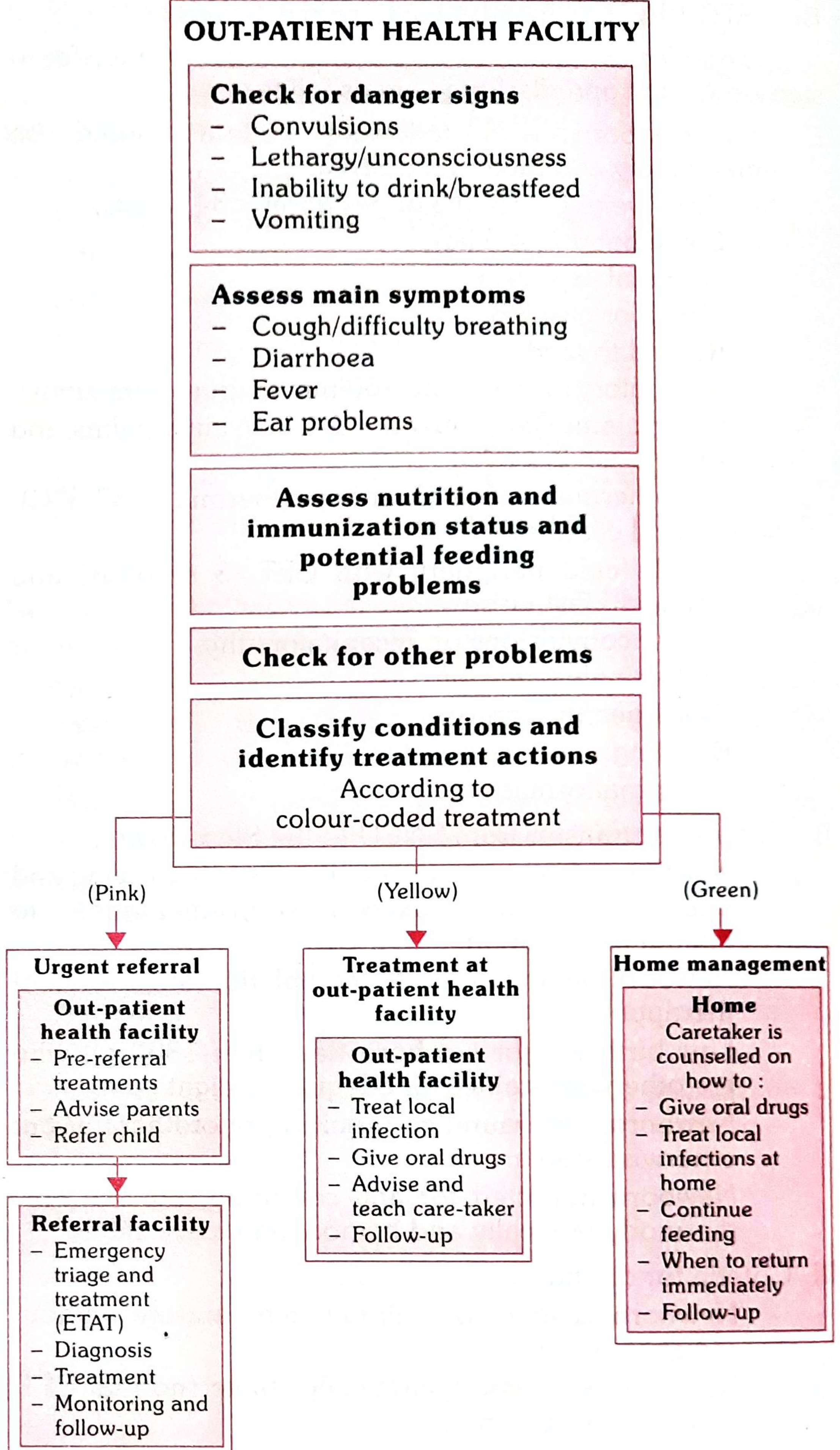
The Case Management Process (Steps)
- Assess - History taking, checking danger signs, assessing main symptoms
- Classify - Using color-coded triage (Pink/Yellow/Green)
- Identify treatment - Based on classification
- Treat - Pre-referral treatment or outpatient treatment or home management
- Counsel - Feeding, fluids, when to return
- Follow-up - Reassess child on return visit
Color-Coded Classification System
| Color | Action | Examples |
|---|---|---|
| Pink | Urgent referral + pre-referral treatment | Very severe febrile disease, severe pneumonia, severe dehydration |
| Yellow | Specific treatment at outpatient facility | Pneumonia, some dehydration, uncomplicated malaria, measles |
| Green | Home management with counseling | No pneumonia (cough/cold), no dehydration, no malaria |
IMNCI Classification Categories
For Children 2 Months to 5 Years
- Convulsions
- Lethargy / unconsciousness
- Inability to drink or breastfeed
- Vomiting everything
- Severe pneumonia or very severe disease (Pink - refer)
- Pneumonia (Yellow - oral amoxicillin)
- No pneumonia: cough or cold (Green - home care)
- Breathing rate thresholds: ≥50/min for 2 months-1 year; ≥40/min for 1-5 years = fast breathing
- Severe dehydration (Pink)
- Some dehydration (Yellow - ORS Plan B)
- No dehydration (Green - Plan A)
- Persistent diarrhea: severe vs. non-severe
- Dysentery (bloody diarrhea - cotrimoxazole)
- Very severe febrile disease / cerebral malaria (Pink)
- Malaria (Yellow - antimalarials)
- Fever: malaria unlikely (Yellow - evaluate)
- Measles with complications (Pink or Yellow)
- Measles (Yellow)
- Mastoiditis (Pink - refer)
- Acute ear infection (Yellow)
- Chronic ear infection (Yellow - local treatment)
- No ear problem (Green)
- Severe malnutrition or severe anemia (Pink)
- Very low weight / anemia (Yellow)
- Not low weight (Green)
For Sick Young Infant (Birth to 2 Months)
- Possible serious bacterial infection / very severe disease (Pink)
- Local bacterial infection (Yellow - topical)
- Unlikely serious bacterial infection (Green)
- Severe jaundice (Pink)
- Jaundice (Yellow)
- No jaundice (Green)
- Not able to feed / severe malnutrition (Pink)
- Feeding problem / low weight (Yellow)
- No feeding problem (Green)
Key Indian Adaptations (IMNCI vs. IMCI)
| Feature | Global IMCI | Indian IMNCI |
|---|---|---|
| Age range | 1 week to 5 years | 0-7 days to 5 years |
| Malaria guidelines | Generic | National guidelines incorporated |
| Anaemia | Standard | National guidelines incorporated |
| Vitamin A | Standard | India's national supplementation schedule |
| Immunization | Standard | India's national immunization schedule |
| Training focus | Mainly sick child | Equal time on sick young infant and sick child |
IMNCI Variants / Program Levels
1. Community-Based IMNCI
2. Pre-service IMNCI
3. Facility-Based IMNCI (F-IMNCI)
- Birth asphyxia
- Neonatal sepsis
- Low birth weight
- Pneumonia
- Diarrhea
- Malaria
- Meningitis
- Severe acute malnutrition
Facility-Level Newborn Care (linked to IMNCI)
| Level | Facility | Sick Newborn Care |
|---|---|---|
| MCH Level I | PHC / Sub-centre | Newborn Care Corner (NBCC) - prompt referral |
| MCH Level II | CHC / FRU | Newborn Stabilization Unit (NBSU) - 4 beds |
| MCH Level III | District Hospital | Special Newborn Care Unit (SNCU) |
Latest Updates (2024-2026)
- Hospital-Based IMNCI 3rd Edition (October 2024) was released in Bhutan, incorporating updated triage protocols for emergency danger signs: poisoning, severe pain, respiratory distress, restlessness/irritability/lethargy, visible severe wasting, bilateral foot edema, and major burns. The hospital module emphasizes Emergency Triage, Assessment and Treatment (ETAT) as the first step for all arriving sick children, followed by IMNCI module-based care.
- Neonatal mortality contributing >70% of infant deaths, with >2/3 occurring in the first week of life, continues to drive expansion of the birth-to-7-days component.
- Facility-based IMNCI continues to evolve with greater integration into SNCU/NBSU networks and linkage to the Rashtriya Bal Swasthya Karyakram (RBSK) for 4D conditions (defects at birth, diseases, deficiencies, developmental delays).
- The injectable gentamicin by ANMs for neonatal sepsis (as pre-referral or completion of antibiotic course) is an important community-level IMNCI update under India's National Health Mission.
make a case scnerio for 0 to 2 months imnci for ug student diagnosis treatment and prevention
IMNCI Case Scenario: Sick Young Infant (0-2 Months)
For Undergraduate Medical Students
CASE PRESENTATION
Baby Aryan, a 25-day-old male infant, is brought by his mother to the health worker with the complaints of not feeding well for 2 days and fever since yesterday.
History
| Parameter | Details |
|---|---|
| Age | 25 days |
| Sex | Male |
| Birth weight | 2.4 kg (low birth weight) |
| Delivery | Home delivery, conducted by a dai |
| Birth history | No cord asepsis - thread used to tie cord, unclean instrument to cut cord |
| Immunization | BCG and OPV-0 not given |
| Feeding | Breastfeeding started late (day 2); currently poor feeding |
| Mother's history | No antenatal care; history of fever during labor |
Presenting Complaints
- Not feeding well / stopped breastfeeding since 2 days
- Fever since yesterday (felt hot to touch)
- Baby is "different" - not as active as before, cries less
- Mother noticed pus discharge from the umbilical stump
STEP 1 - ASSESS (IMNCI Assessment Protocol for 0-2 Months)
A. Check for General Danger Signs First
| Sign | Present? |
|---|---|
| Convulsions (now or history) | No |
| Lethargy / unconsciousness | Yes - reduced activity, poor responsiveness |
| Unable to feed | Yes - stopped feeding |
B. Ask and Look for Symptoms
- Respiratory rate: 62 breaths/minute (normal <60 for this age)
- Mild chest indrawing present
- Grunting noted
STEP 2 - CLASSIFY (IMNCI Color-Coded Classification)
Category 1: Bacterial Infection
| Classification | Signs Present | Color |
|---|---|---|
| Possible Serious Bacterial Infection (PSBI) | Not feeding well + Fever + Lethargy + Fast breathing + Umbilical infection (omphalitis) | 🔴 PINK |
| Local bacterial infection | Skin pustules / umbilical redness only, no systemic signs | 🟡 YELLOW |
| Unlikely serious bacterial infection | None of the above | 🟢 GREEN |
Baby Aryan's Classification: PINK - Possible Serious Bacterial Infection
- Not feeding well (unable to breastfeed)
- Lethargy (reduced activity)
- Fever (>37.5°C axillary or >38°C rectal)
- Fast breathing (>60/min)
- Umbilical infection with surrounding redness extending to skin
Category 2: Jaundice
| Classification | Signs | Color |
|---|---|---|
| Severe jaundice | Jaundice appearing after day 14, deep/yellow palms-soles | 🔴 PINK |
| Jaundice | Jaundice, but not severe | 🟡 YELLOW |
| No jaundice | - | 🟢 GREEN |
Baby has mild jaundice at day 25 - pathological, classify as Yellow at minimum (assess severity clinically)
Category 3: Feeding Problem / Low Birth Weight
| Classification | Signs | Color |
|---|---|---|
| Not able to feed / severe weight loss | - | 🔴 PINK |
| Low weight + feeding problem | Weight < 2.5 kg, not feeding well | 🟡 YELLOW |
| No feeding problem | Normal weight, feeds well | 🟢 GREEN |
Baby Aryan = 2.35 kg + not feeding well = YELLOW (but this is overridden by PINK from PSBI)
Category 4: Diarrhea - Not present in this case
STEP 3 - IDENTIFY TREATMENT
STEP 4 - TREAT (Pre-referral Treatment Before Transfer)
Immediate Pre-referral Treatment at Health Centre
| Treatment | Details |
|---|---|
| Injection Ampicillin | 50 mg/kg IM - first dose before referral |
| Injection Gentamicin | 5 mg/kg IM - first dose before referral |
| Treat local umbilical infection | Clean with antiseptic; apply gentian violet |
| Treat hypoglycemia | If blood glucose <2.2 mmol/L - give expressed breast milk / 10% dextrose |
| Keep warm | Kangaroo Mother Care (KMC) if temperature low; prevent hypothermia |
| Do NOT give oral feeds if baby is lethargic and cannot swallow - risk of aspiration | |
| Vitamin K | Give if not already given at birth (prevents hemorrhagic disease) |
Note for UG exam: The ANM can administer the first dose of IM gentamicin as a pre-referral intervention. If the family refuses referral or referral is not possible, a 7-day course of gentamicin can be completed at the sub-centre as per updated IMNCI India guidelines.
STEP 5 - AT REFERRAL HOSPITAL (F-IMNCI)
Investigations
| Investigation | Purpose |
|---|---|
| Blood culture | Identify organism (GBS, E. coli, Klebsiella, Listeria) |
| CBC with differential | Neutropenia / leukocytosis (sepsis markers) |
| CRP / Procalcitonin | Inflammatory markers |
| Blood glucose | Rule out hypoglycemia |
| CSF analysis (LP) | Rule out meningitis (especially in late-onset sepsis) |
| Urine culture | Rule out UTI as source |
| Serum bilirubin | Quantify jaundice |
| Blood gas | Metabolic acidosis in sepsis |
Definitive Treatment
| Drug | Dose | Route | Duration |
|---|---|---|---|
| Ampicillin | 50-100 mg/kg/dose q8h (meningitis: q6h) | IV | 10-14 days |
| Gentamicin | 5 mg/kg/dose q24h | IV/IM | 7-10 days |
| Add Cefotaxime if meningitis suspected | 50 mg/kg/dose q8h | IV | 21 days (meningitis) |
- Supportive care: IV fluids (maintenance), thermal care, oxygen if SpO2 <90%
- Breastfeeding: Resume as soon as infant can swallow safely
- Phototherapy: For pathological jaundice
- Monitor: Temperature, heart rate, respiratory rate, oxygen saturation, blood glucose 4-hourly
STEP 6 - COUNSEL THE MOTHER
- Explain the diagnosis - Baby has a serious infection, needs hospital care
- Danger signs to watch for and return immediately:
- Baby cannot feed at all
- Convulsions
- Becomes more lethargic
- Develops fast breathing or stops breathing
- Becomes very cold or very hot
- Continue breastfeeding - reassure that breast milk is safe and protective
- Cord care - keep cord clean and dry; never apply cow dung, ash, or oil
- KMC (Kangaroo Mother Care) - skin-to-skin contact keeps baby warm and promotes feeding
STEP 7 - PREVENTION (IMNCI Framework)
At the Household Level
| Intervention | Action |
|---|---|
| Antenatal care | At least 4 ANC visits, tetanus toxoid 2 doses |
| Institutional delivery | Prevents unclean cord practices |
| Clean cord care | Dry cord care (WHO 2014); clean cutting instrument; no dung/ash |
| Early and exclusive breastfeeding | Within 1 hour of birth; colostrum is protective (IgA) |
| Thermal protection | Immediate drying, skin-to-skin, KMC for LBW babies |
| Hand hygiene | For all caregivers before touching baby |
At Community/Health Worker Level
| Intervention | Action |
|---|---|
| ASHA home visits | Day 1, 3, 7, 14, 28 after birth - to detect PSBI early |
| HBNC (Home-Based Newborn Care) | ASHAs trained to identify danger signs and refer |
| JSSK / JSNY | Janani Shishu Suraksha Karyakram - free treatment for neonates |
| Immunization | BCG at birth; OPV-0 at birth - prevents TB and polio |
At Facility Level
| Intervention | Action |
|---|---|
| Intrapartum GBS prophylaxis | IV Penicillin G to mother in labor with GBS-positive swab |
| Vitamin K at birth | 1 mg IM - prevents hemorrhagic disease of newborn |
| Eye prophylaxis | 1% tetracycline ointment - prevents ophthalmia neonatorum |
| SNCU / NBSU setup | Referral care for sick neonates per F-IMNCI |
IMNCI Summary Table for 0-2 Months (Exam Quick Reference)
| Category | Pink (Refer Urgently) | Yellow (Treat at Facility) | Green (Home Care) |
|---|---|---|---|
| Bacterial Infection | PSBI: fever/hypothermia, lethargy, fast breathing, not feeding, omphalitis | Local bacterial infection (pustules, umbilical redness without systemic signs) | Unlikely serious bacterial infection |
| Jaundice | Severe jaundice (palms + soles yellow, or age >14 days with deep jaundice) | Jaundice (not severe) | No jaundice |
| Diarrhea | Severe dehydration | Some dehydration | No dehydration |
| Feeding/LBW | Unable to feed at all | Low birth weight / feeding problem | No feeding problem |
Key Exam Points
- IMNCI for 0-2 months covers birth to 59 days - India extended to 0 days (vs. WHO IMCI which started at 1 week)
- PSBI = Possible Serious Bacterial Infection - the single most important classification in this age group
- Fast breathing threshold for <2 months = ≥60 breaths/minute
- Antibiotic of choice in PSBI = IM Ampicillin + IM Gentamicin before referral
- Hypothermia (<35.5°C axillary) is equally dangerous as fever in neonates - both classify as PSBI
- Umbilical infection (omphalitis) extending to surrounding skin = always PINK
- Jaundice at >14 days of age is always pathological until proven otherwise
- ASHA makes 6 home visits post-delivery (days 1, 3, 7, 14, 21, 28) as part of HBNC under IMNCI
- If referral refused: ANM can complete a 7-day gentamicin course at sub-centre level
- Weight gain check: Healthy neonate regains birth weight by day 10-14; failure to do so = flag
imnci severe pneumoniia case scenerio
Karim is a 21-day-old baby boy brought to the health centre due to watery stools over the past 2 days. This is his first visit for this issue. • He weighs 2.7 kg and has an axillary temperature of 37.2°C. • Karim shows mild chest indrawing and a respiratory rate of 55 breaths per minute. • He has not experienced convulsions and is feeding without difficulty. • Upon examination, there is no jaundice. • Signs of dehydration include sunken eyes and a slowly returning skin pinch.