
Congenital diaphragmatic hernia
Reading File
Finding Sources
Finding Sources
Searching PubMed
"congenital diaphragmatic hernia" AND management
Searching the Web
congenital diaphragmatic hernia management guidelines 2025
Reading File
Reading File
Reading File
Congenital Diaphragmatic Hernia (CDH)
Overview
Congenital diaphragmatic hernia is a developmental defect of the diaphragm that allows abdominal viscera (stomach, bowel, and sometimes liver/spleen) to herniate into the thoracic cavity during fetal development, disrupting lung and pulmonary vascular growth (Sabiston Textbook of Surgery, p. 2675). Defects range from a small posterior muscle-rim opening to complete diaphragmatic agenesis. CDH occurs in roughly 1 in 2,000-3,000 live births, is unilateral in the vast majority of cases (bilateral is rare), and carries an estimated survival of 65-90% with modern management (Sabiston Textbook of Surgery; Mulholland and Greenfield's Surgery).
Anatomy and Types
- Bochdalek hernia - posterolateral defect; the most common type, and most are left-sided (Tintinalli's Emergency Medicine, p. 3956).
- Morgagni hernia - retrosternal/anteromedial defect; much less common.
- Complete absence (agenesis) of the hemidiaphragm is the most severe end of the spectrum.
Pathophysiology
The two processes that drive morbidity and mortality are:
- Pulmonary hypoplasia - the lung ipsilateral to the defect is hypoplastic (reduced airway branching, alveolar number, and vascular bed), and the contralateral lung can also be hypoplastic to a variable degree from mediastinal compression (Tintinalli's Emergency Medicine, p. 3956; Sleisenger and Fordtran's Gastrointestinal and Liver Disease, p. 2212).
- Persistent pulmonary hypertension of the newborn (PPHN) - the pulmonary vascular bed is remodeled with medial/adventitial hypertrophy and is exquisitely reactive, predisposing to pulmonary vasospasm and right-to-left shunting (Morgan and Mikhail's Clinical Anesthesiology, p. 331; Rosen's Emergency Medicine, p. 1464).
Total lung volume >45% of normal predicts survival, and liver herniation into the chest along with lower lung volumes portends worse outcome (Tintinalli's Emergency Medicine, p. 3960). Associated anomalies - especially congenital heart disease and chromosomal abnormalities - occur in 25-50% of cases and significantly affect prognosis.
Prenatal Diagnosis and Prediction
CDH is now frequently diagnosed on prenatal ultrasound, which allows delivery planning at a specialized center (Tintinalli's Emergency Medicine, p. 3956). Prognostic tools used in utero include:
- Lung-to-head ratio (LHR): contralateral lung area divided by head circumference. LHR <1.0 predicts poor prognosis; LHR >1.4 predicts near-100% survival.
- Observed-to-expected LHR (O/E LHR): survival falls below 20% when O/E LHR is under 25% (Mulholland and Greenfield's Surgery - Scientific Principles and Practice, p. 252).
- Presence of intrathoracic liver ("liver-up") worsens prognosis.
Interestingly, prenatal diagnosis itself is associated with worse survival, largely because defects detected antenatally tend to be the larger, more severe ones (Mulholland and Greenfield's Surgery, p. 252).
Fetal intervention
Fetoscopic Endoluminal Tracheal Occlusion (FETO) - a balloon placed in the fetal trachea to promote lung growth by preventing egress of lung fluid - has shown benefit in severe left-sided CDH. In the international TOTAL trial, the severe-CDH arm was stopped early for efficacy: 40% survival to discharge with FETO versus 15% with expectant care, a benefit sustained to 6 months of age. The moderate-severity FETO trial did not show the same benefit (Mulholland and Greenfield's Surgery, p. 258).
Clinical Presentation at Birth
- Persistent respiratory distress immediately after birth
- Characteristic "seesaw" (paradoxical) respiratory pattern from the hypoplastic ipsilateral lung
- Persistent cyanosis, gasping respirations
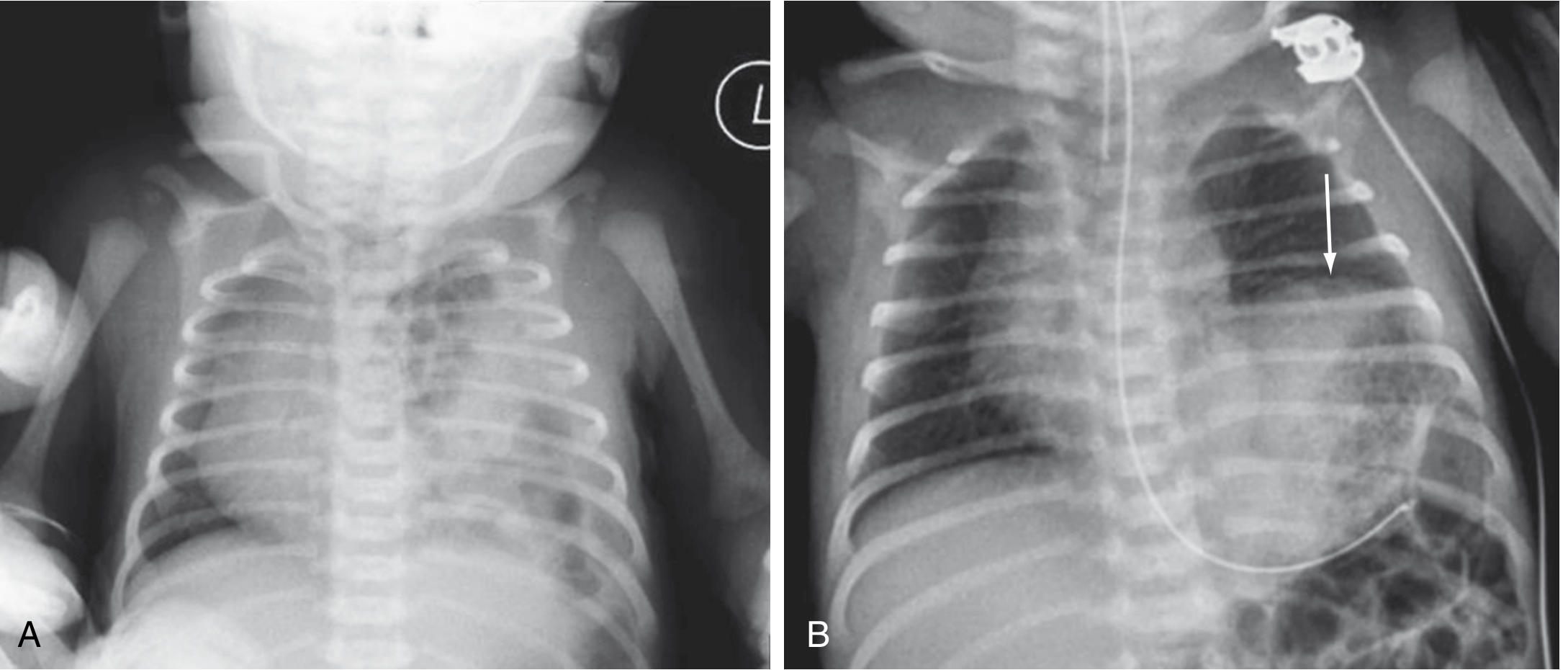
- Scaphoid abdomen (viscera displaced into the chest)
- Bowel sounds audible in the chest, displaced heart sounds
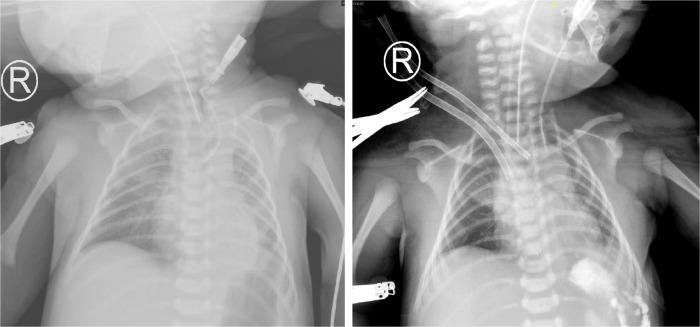
- Confirmed on chest/abdominal radiograph showing gas-filled bowel loops in the hemithorax with mediastinal shift (Tintinalli's Emergency Medicine, p. 3962)
Immediate Neonatal Management
- Avoid bag-mask ventilation - it insufflates air into the herniated GI tract, worsening thoracic compression. Rapid endotracheal intubation is the treatment of choice.
- Gentle ventilation strategy: rate ~40-50/min, lowest peak inspiratory pressures that achieve adequate chest rise, to minimize barotrauma to hypoplastic lungs.
- Permissive/gentle hypercapnia (PaCO2 30-35 mm Hg) to help lower pulmonary vascular resistance.
- Large-bore orogastric/nasogastric tube on continuous suction to decompress the stomach and bowel and reduce thoracic compression.
- Management of PPHN: inhaled nitric oxide, sildenafil, prostacyclins, or milrinone as needed; ECMO is used for refractory cardiopulmonary failure in select centers.
- Surgical repair of the diaphragmatic defect is performed after physiologic stabilization (not as an emergency), typically once pulmonary hypertension and oxygenation have improved; timing relative to ECMO weaning is itself an area of active study (see below).

Surgical Repair
Repair involves reduction of herniated viscera and closure of the diaphragmatic defect, primarily or with a prosthetic patch for larger defects. Patch repair carries a higher recurrence rate than primary closure but is often necessary when the defect is too large to close without tension.
Recent Evidence (last 2 years - systematic reviews/meta-analyses)
To keep this current, I checked recent high-quality evidence that may refine or update the above:
- Patches in CDH: Systematic Review (Saxena & Hayward, Annals of Surgery, 2024, PMID 38450531) - synthesizes outcomes and recurrence rates with different patch materials for large defects.
- Timing of surgery relative to ECMO weaning - a 2024 meta-analysis (PMID 38092047) found data relevant to whether repair should occur on or after weaning from ECMO, an area where practice varies.
- Long-term outcomes beyond childhood in CDH - a 2025 systematic review (PMID 40100453) highlights that survivors can have persistent pulmonary, gastrointestinal, and neurodevelopmental morbidity well into adulthood, reinforcing the need for long-term multidisciplinary follow-up beyond the neonatal period.
None of these contradict the core textbook management principles above, but they underscore two evolving points worth flagging: (1) optimal timing of surgical repair relative to ECMO course is still being refined, and (2) CDH survivors need structured long-term follow-up given persistent morbidity into adulthood. Also relevant: the 2023 Canadian CDH Collaborative practice guideline update (ADC Fetal & Neonatal Edition) provides a current, consensus-based framework spanning prenatal counseling through long-term follow-up, if you want guideline-level detail rather than textbook-level detail.
If you want, I can go deeper into any specific aspect - fetal surgery/FETO technique, ECMO criteria, ventilator strategies, associated syndromes/genetics, or long-term neurodevelopmental outcomes.
This is a shared conversation. Sign in to Orris to start your own chat.