
Blood supply and innervation of scapular and deltoid region
Reading File
Now let me search the library database in parallel for relevant content on scapular and deltoid region blood supply and innervation.
Finding Sources
Finding Sources
Searching Images
scapular region blood supply arteries nerves anatomy
Let me search more specifically in the library for anatomy content:
Finding Sources
Finding Sources
Finding Sources
Excellent! I found the key references. Let me read the most relevant sections — Gray's Anatomy "POSTERIOR SCAPULAR REGION" and "Deltoid", plus relevant paragraphs on blood supply and innervation:
Reading File
Finding Sources
Finding Sources
Excellent! Now let me read the key detailed sections - the posterior scapular region from Gray's Anatomy and the THIEME Atlas, plus the blood vessels and nerves section from Rockwood:
Reading File
Reading File
Reading File
Now let me read the remainder of the Gray's Anatomy posterior scapular region section (neurovascular supply) and fetch the key diagrams:
Reading File
Loading Image
Loading Image
Now let me get the neurovascular diagram and read the remainder of Gray's nerve/artery description:
Reading File
Loading Image
Loading Image
I now have comprehensive information from multiple authoritative anatomy textbooks with excellent diagrams. Let me compile a detailed, well-structured answer.
Blood Supply and Innervation of the Scapular and Deltoid Regions
Sources: Gray's Anatomy for Students; THIEME Atlas of Anatomy — General Anatomy and Musculoskeletal System; Rockwood & Green's Fractures in Adults
I. DELTOID REGION
Muscle Overview
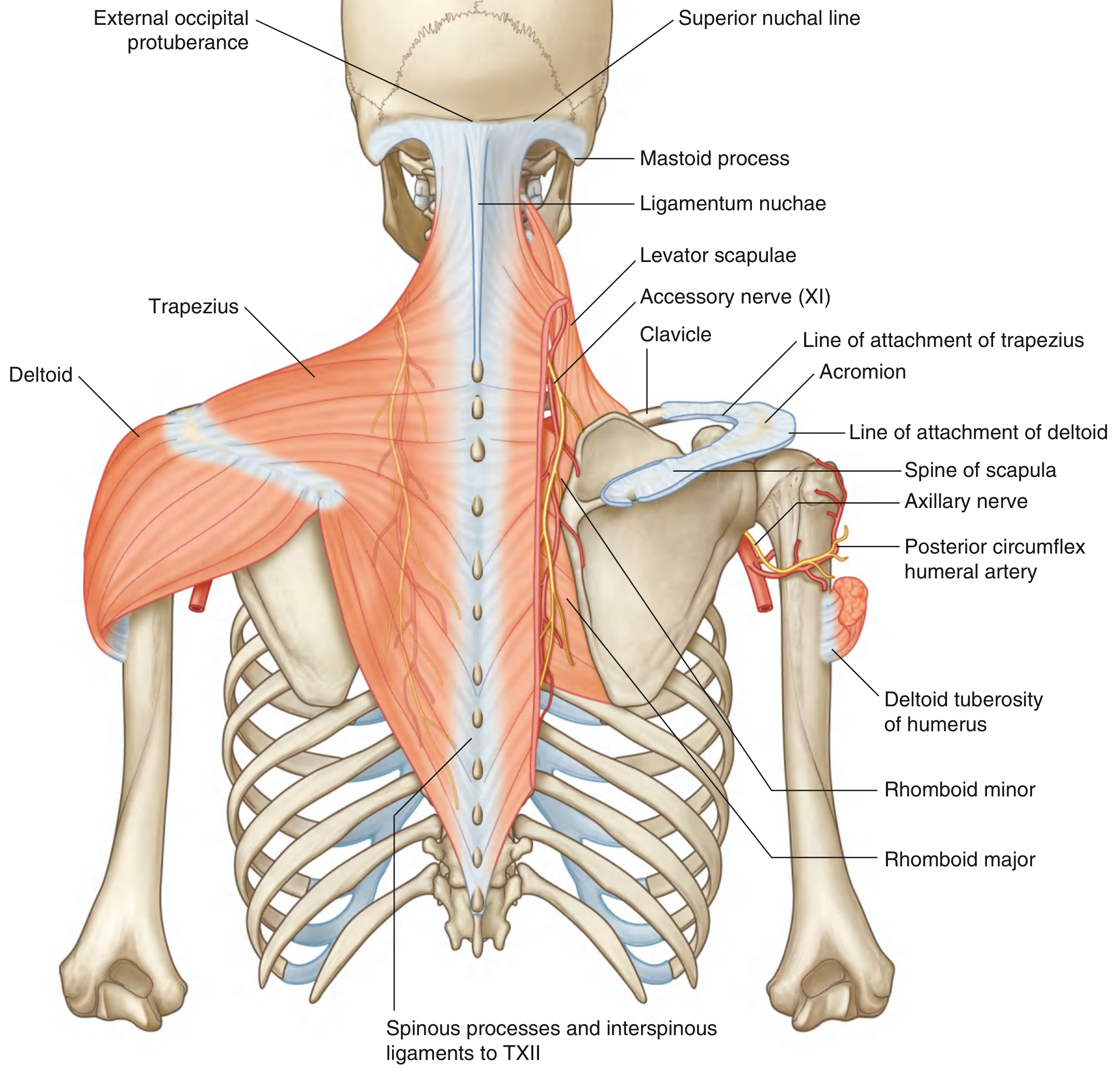
The deltoid is a large, triangular muscle originating along a continuous U-shaped line from the clavicle (anterior 1/3) and scapula (acromion and spine), inserting into the deltoid tuberosity on the lateral humeral shaft. Its three parts — clavicular, acromial, and spinal — allow flexion, abduction, and extension of the arm, respectively.
Innervation of the Deltoid
| Structure | Details |
|---|---|
| Nerve | Axillary nerve (C5, C6) |
| Origin | Posterior cord of the brachial plexus |
| Entry route | Exits axilla via the quadrangular space → wraps posteriorly around the surgical neck of the humerus → enters deep surface of deltoid |
| Branches | Branch to teres minor; branch to posterior deltoid; branch to anterior deltoid; superior lateral cutaneous nerve of the arm (sensory — skin over inferior deltoid) |
The axillary nerve crosses the anterior deltoid raphe between the anterior and middle deltoid as a single terminal branch, which is important surgically because the anterior deltoid innervation can be preserved during shoulder approaches by protecting this branch. Clinically, the nerve lies approximately 5–7 cm distal to the acromion.
Blood Supply of the Deltoid
The deltoid receives its arterial supply primarily via the posterior circumflex humeral artery (PCHA), which enters the muscle together with the axillary nerve through the quadrangular space. Additional supply comes from the anterior circumflex humeral artery and small acromial branches of the thoracoacromial artery.
II. POSTERIOR SCAPULAR REGION
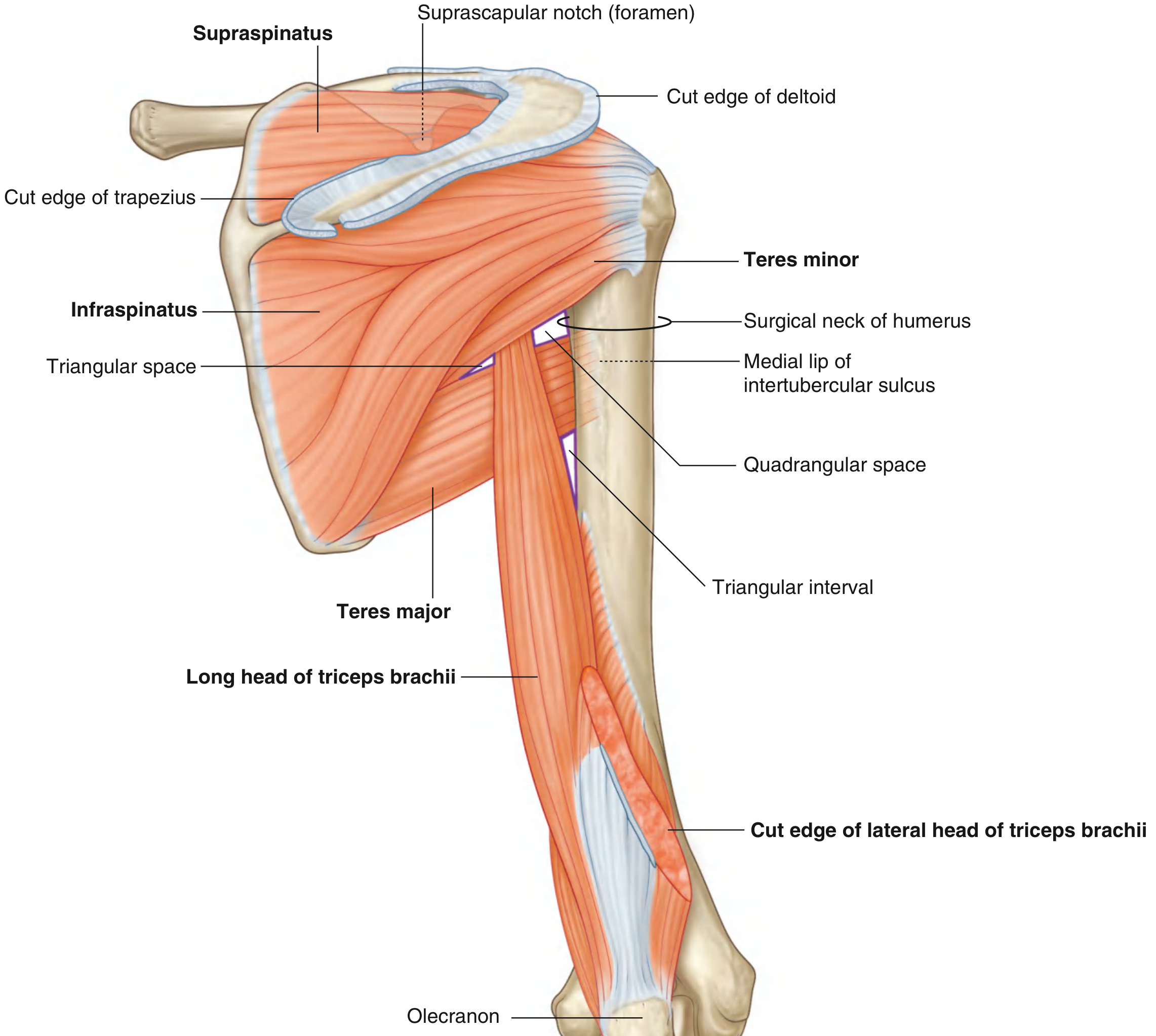
The posterior scapular region lies deep to the trapezius and deltoid and contains the supraspinatus, infraspinatus, teres minor, and teres major muscles, plus the long head of triceps brachii.
Muscles and Their Innervation
| Muscle | Nerve | Spinal Segments |
|---|---|---|
| Supraspinatus | Suprascapular nerve | C5, C6 |
| Infraspinatus | Suprascapular nerve | C5, C6 |
| Teres minor | Axillary nerve | C5, C6 |
| Teres major | Inferior subscapular nerve | C6, C7 |
| Long head triceps | Radial nerve | C6, C7, C8 |
| Rhomboid minor & major | Dorsal scapular nerve | C4, C5 |
| Levator scapulae | Dorsal scapular nerve + C3, C4 directly | C3–C5 |
Nerves of the Posterior Scapular Region
1. Suprascapular Nerve (C5, C6)
- Arises from the superior trunk of the brachial plexus in the base of the neck
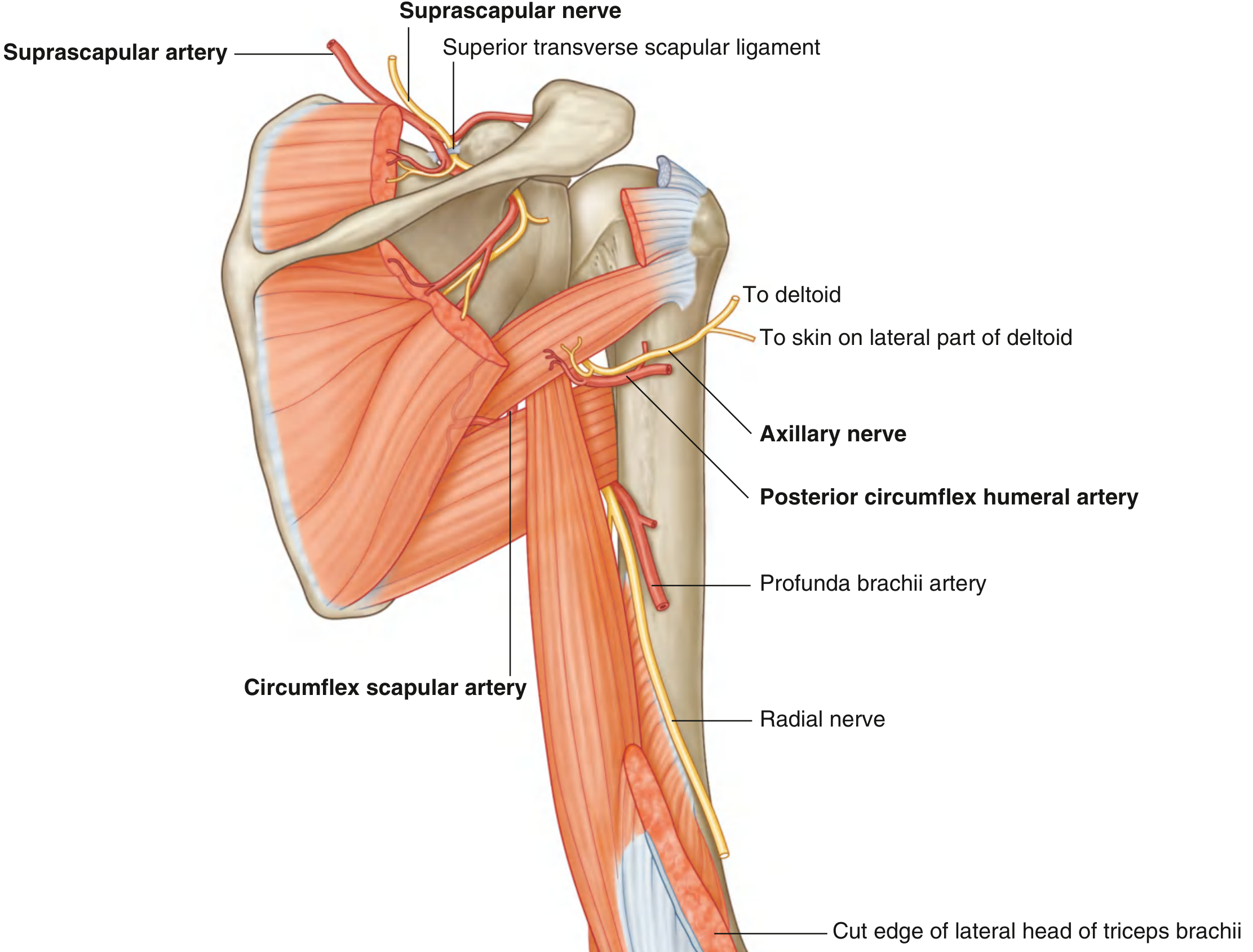
- Passes posterolaterally through the suprascapular foramen (under the superior transverse scapular ligament) — the suprascapular artery passes above the ligament, the nerve passes through the foramen
- Innervates supraspinatus, then winds through the spinoglenoid notch to innervate infraspinatus
- No cutaneous branches
- Contributes to sensory supply of the glenohumeral and acromioclavicular joints
2. Axillary Nerve (C5, C6)
- Arises from the posterior cord of the brachial plexus
- Exits the axilla through the quadrangular space (bounded by teres minor superiorly, teres major inferiorly, long head of triceps medially, surgical neck of humerus laterally)
- Innervates teres minor and all three parts of the deltoid
- Cutaneous branch: superior lateral cutaneous nerve of the arm (skin over the lower deltoid)
3. Dorsal Scapular Nerve (C5)
- Branch of the brachial plexus (root of C5)
- Innervates rhomboid minor, rhomboid major, and contributes to levator scapulae
Arterial Supply of the Scapular Region
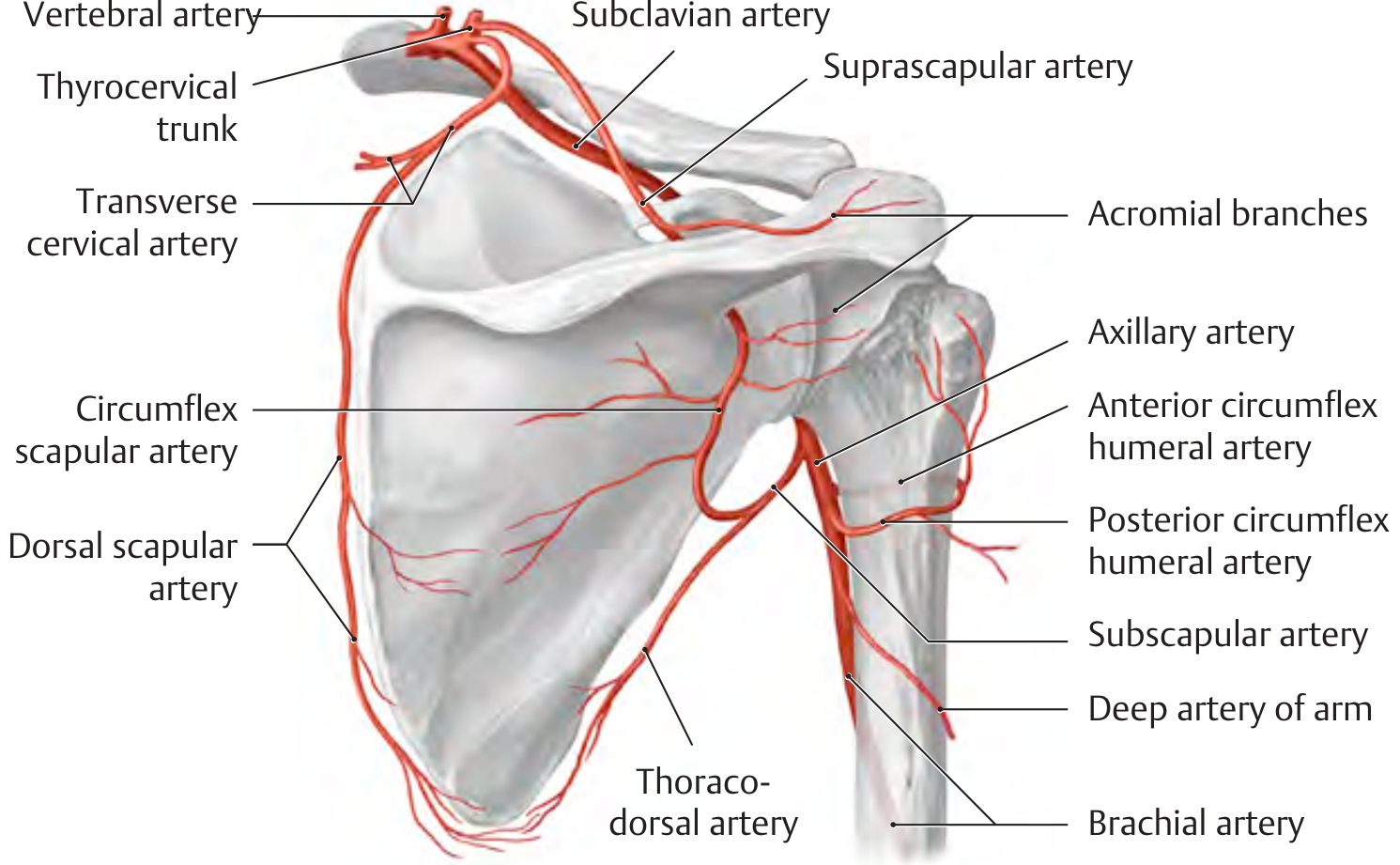
Three major arteries supply the posterior scapular region and anastomose to form the scapular arterial arcade:
1. Suprascapular Artery
- Origin: Thyrocervical trunk (branch of subclavian artery); occasionally directly from the 3rd part of subclavian
- Course: Passes posterolaterally across the base of the neck → enters posterior scapular region above the superior transverse scapular ligament (superior to the suprascapular foramen, unlike the nerve)
- Supplies: Supraspinatus and infraspinatus muscles, glenohumeral joint, clavicle, acromioclavicular joint
- Anastomosis: With circumflex scapular artery (scapular arcade)
2. Posterior Circumflex Humeral Artery (PCHA)
- Origin: 3rd part of the axillary artery
- Course: Passes with the axillary nerve through the quadrangular space → wraps around the surgical neck of the humerus
- Supplies: Deltoid, teres minor, glenohumeral joint, and proximal humerus
3. Circumflex Scapular Artery
- Origin: Branch of the subscapular artery (itself from the 3rd part of the axillary artery)
- Course: Leaves the axilla through the triangular space (bounded by teres minor superiorly, teres major inferiorly, long head of triceps laterally) → passes through the origin of teres minor → reaches infraspinous fossa
- Supplies: Muscles of the infraspinous fossa, teres muscles
- Anastomosis: With suprascapular artery and descending branch of transverse cervical artery (forming the scapular arcade)
4. Dorsal Scapular Artery (descending branch of transverse cervical artery)
- Runs along the medial border of the scapula
- Supplies rhomboids and levator scapulae
- Participates in the scapular arcade
The Three Key Spaces (Neurovascular Gateways)
| Space | Boundaries | Contents |
|---|---|---|
| Quadrangular space | Teres minor (sup), teres major (inf), long head triceps (med), surgical neck of humerus (lat) | Axillary nerve + posterior circumflex humeral artery & vein |
| Triangular space | Teres minor (sup), teres major (inf), long head triceps (lat) | Circumflex scapular artery & vein |
| Triangular interval (triceps hiatus) | Long head triceps (med), shaft of humerus (lat), teres major (sup) | Radial nerve + profunda brachii (deep artery of arm) |
The Scapular Arterial Arcade
The anastomosis between the suprascapular artery (from the thyrocervical trunk / subclavian) and the circumflex scapular artery (from the subscapular / axillary) creates a rich collateral network. This is clinically critical: it can maintain blood flow to the shoulder and upper limb even when the axillary artery is ligated or occluded, provided the collateral vessels are intact.
Clinical Correlates
- Quadrangular space syndrome: Compression of the axillary nerve and PCHA causes teres minor atrophy and deltoid weakness; compression by fibrous bands typically produces posterior shoulder pain worsened with overhead activity.
- Suprascapular nerve entrapment: At the suprascapular notch (affects both supraspinatus + infraspinatus) or at the spinoglenoid notch (affects infraspinatus only — as in volleyball players with ganglion cysts).
- Axillary nerve injury: Commonly occurs with shoulder dislocation or proximal humerus fractures due to its close relationship with the surgical neck; presents with deltoid weakness and loss of sensation over the "regimental badge" area.
— Gray's Anatomy for Students, pp. 834–840; THIEME Atlas: General Anatomy and Musculoskeletal System, pp. 409–411; Rockwood & Green's Fractures in Adults, pp. 1150–1155
This is a shared conversation. Sign in to Orris to start your own chat.