
Discuss risk factors for abdominal aortic aneurysm and its rupture. Describe management of this condition. [
Reading File
Finding Sources
Searching PubMed
"abdominal aortic aneurysm"[MeSH Terms] AND management
Finding Sources
Reading File
Reading File
Reading File
Searching PubMed
"abdominal aortic aneurysm"[MeSH Terms] AND "rupture"[MeSH Terms]
Reading File
Reading File
Finding Sources
Searching PubMed
"abdominal aortic aneurysm"[MeSH Terms] AND "endovascular procedures"[MeSH Terms]
Finding Sources
Reading File
Finding Sources
Finding Sources
Reading File
Reading File
Reading File
Reading File
Loading Image
I now have comprehensive information from multiple authoritative sources. Let me compile the complete answer.
Abdominal Aortic Aneurysm (AAA): Risk Factors, Rupture, and Management
Definition and Epidemiology
An abdominal aortic aneurysm (AAA) is defined as a pathological focal dilation of the aorta greater than 30 mm, or 1.5 times the diameter of the adjacent normal aorta. AAA is by far the most common type of large-vessel aneurysm, found in approximately 2% of the population at autopsy. Ninety percent are infrarenal in location (between the renal arteries and aortic bifurcation) with a fusiform morphology. Concomitant iliac artery aneurysms occur in 20-25% of cases. - Schwartz's Principles of Surgery, p. 948; Bailey and Love's Short Practice of Surgery, p. 1038
Risk Factors for AAA
Non-Modifiable Risk Factors
| Factor | Detail |
|---|---|
| Age | Very uncommon before age 50-60; prevalence rises to ~6% at age 55-64 and 18.5% at age 75-84 |
| Male sex | Significantly higher prevalence in men; ~75% of AAAs found in women are small (3.0-3.9 cm) |
| Family history | First-degree relative with AAA confers a 3-5x increased risk; GWAS have identified multiple susceptibility loci and a polygenic risk score |
Modifiable / Acquired Risk Factors
| Factor | Detail |
|---|---|
| Cigarette smoking | The single most powerful modifiable risk factor - increases overall aneurysm risk 2.7-fold, and large AAA risk 5.6-fold; risk is ~2.5x higher in current vs. former smokers |
| Hypertension | Modestly increases risk; also the most powerful predictor of rupture once aneurysm has formed |
| Dyslipidemia | Contributes independently, albeit more modestly than smoking |
| Atherosclerosis | Present in 95% of AAAs; however, not the sole cause since AAA incidence is < 5% in men >60 despite near-universal aortic atherosclerosis |
Goldman-Cecil Medicine, p. 729; Robbins & Kumar Basic Pathology, p. 333
Note: Interestingly, diabetes mellitus is not a risk factor for AAA and may actually be mildly protective against aneurysm formation - a paradox explained by the pro-fibrotic effects of hyperglycemia on aortic wall remodeling.
Special Subtypes and Their Risk Factors
- Inflammatory AAA (5-10% of AAAs): Dense periaortic fibrosis with lymphocytes, plasma cells, macrophages, and giant cells; occurs in younger individuals
- IgG4-related AAA: Tissue fibrosis with IgG4+ plasma cell infiltrate; responds to steroids and anti-B cell therapies; may cause retroperitoneal fibrosis and bilateral hydronephrosis
- Mycotic AAA: Circulating microorganisms (e.g., from infective endocarditis) seed the aneurysm wall, causing suppurative destruction and rapid dilation
Robbins & Kumar Basic Pathology, p. 333
Pathobiology
The aortic wall normally depends on a dense extracellular matrix (ECM) of elastin, collagen, and glycosaminoglycans, maintained by medial smooth muscle cells. In AAA, four major interconnected pathological processes occur:
- Matrix metalloproteinase (MMP) dysregulation - MMP-1, -3, -9, and -13 are elevated in aortic tissue and blood, causing ECM degradation
- Inflammation - Neutrophils, T cells, B cells, and macrophages all contribute; inflammatory cells serve as additional MMP sources
- Renin-angiotensin pathway activation
- Reactive oxygen species overproduction
The result is medial smooth muscle apoptosis and thinning, with focal destruction of the wall and replacement by poorly organized mural thrombus. - Goldman-Cecil Medicine, p. 729
Risk Factors for Rupture
Rupture risk is primarily determined by aneurysm size but is also influenced by several other factors.
Size-Based Annual Rupture Risk (Schwartz's Table 23-8)
| AAA Size | Annual Rupture Risk | 5-Year Rupture Risk |
|---|---|---|
| 4-5 cm (Small) | ~1% | 5-10% |
| 5-6 cm (Moderate) | 2-5% | 30-40% |
| 6-7 cm (Large) | 3-10% | >50% |
| >7 cm (Very large) | >10% | Approaching 100% |
Schwartz's Principles of Surgery, p. 948
An AAA below 5.5 cm diameter has a ≤1% annual rupture risk. The exponential rise above 55 mm forms the basis for the repair threshold. Bailey & Love further specifies: ≤1% annual rupture for <55 mm; 5-10% for 55-60 mm; ~25% for ≥70 mm.
Other Risk Factors for Rupture
- Uncontrolled hypertension - raises transmural wall stress (Laplace's law: wall tension = pressure × radius)
- Continued cigarette smoking - independently accelerates aneurysmal growth (~2-3 mm/year faster)
- Female sex - associated with higher rupture risk per cm diameter than men
- Rapid expansion - >0.5 cm per year is a warning sign warranting urgent repair regardless of size
- Symptomatic aneurysm - new-onset pain (abdominal, back, or flank) signals expansion or impending rupture; these patients require expeditious evaluation
- Saccular morphology - higher wall stress than fusiform
- COPD/emphysema - may be an independent risk factor for rupture through MMP-mediated mechanisms
Schwartz's Principles of Surgery, p. 920; Goldman-Cecil Medicine, p. 730
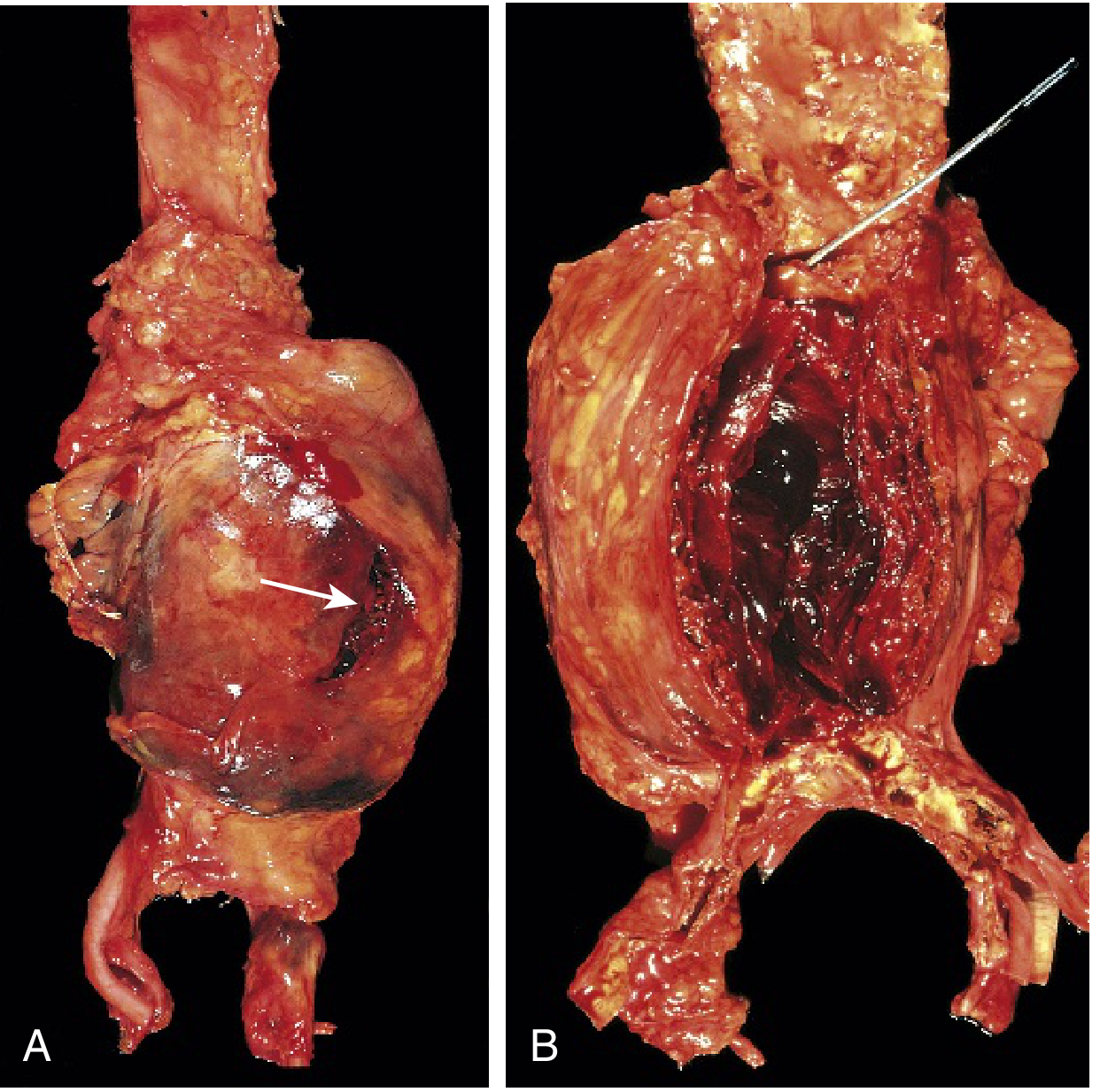
Pathological Consequences of Rupture/Complications
Even without frank rupture, AAA can cause:
- Branch vessel obstruction (renal, mesenteric, iliac arteries) → ischemia
- Thromboembolic events from mural thrombus
- Compression of surrounding structures (ureter, vertebrae)
- Aortoenteric fistula
Clinical Presentation
- Asymptomatic (most common): Incidental finding on physical examination (pulsatile epigastric mass) or imaging
- Symptomatic (unruptured): Back/abdominal discomfort, often a warning of impending rupture
- Ruptured AAA (classic triad): Sudden severe back/abdominal pain + pulsatile abdominal mass + hypotension/shock
Rarely: ureteric obstruction, erosion of adjacent structures, aortoenteric fistula (manifesting as massive hematemesis).
Investigations
- Ultrasound: First-line; reliable for diagnosis and size monitoring; used in screening (UK National AAA Screening Programme offers ultrasound to all men at age 65)
- CT Angiography: Gold standard for pre-operative planning; aorta scanned from arch to pubic symphysis in arterial phase; defines extent, morphology, iliac involvement, and neck anatomy for EVAR planning
- Non-contrast CT: Useful in suspected rupture to detect retroperitoneal haematoma (high attenuation vs. intraluminal blood)
- MR Angiography: Alternative when iodinated contrast is contraindicated
- Bloods: FBC, U&E, LFTs, coagulation studies, lipid profile, cross-match (pre-operatively)
Management
Management is guided by a balance between rupture risk and operative risk.
1. Medical / Conservative Management (All Patients)
- Smoking cessation: The most impactful intervention - reduces both rupture risk and aneurysm growth rate
- Antihypertensive therapy: Target aggressive BP control; beta-blockers (e.g., atenolol) and ACE inhibitors/ARBs preferred
- High-intensity statins: Associated with reduced aneurysm growth and rupture in observational studies; also treat dyslipidemia
- No pharmacological therapy has been proven in RCTs to reduce AAA expansion
Goldman-Cecil Medicine, p. 730
2. Surveillance (Small AAAs)
Asymptomatic AAAs below the repair threshold are managed with regular ultrasound surveillance:
| Aortic Diameter | Surveillance Interval |
|---|---|
| <3.0 cm (normal) | Discharge / re-screen at 65 |
| 3.0-4.4 cm | Annual ultrasound |
| 4.5-5.4 cm | Every 3-6 months |
| ≥5.5 cm (or symptomatic) | Refer for repair |
3. Indications for Repair
Repair is indicated when rupture risk exceeds operative mortality:
- Diameter ≥5.5 cm in men (fit for surgery)
- Diameter ≥5.0 cm in women (rupture risk per size is higher)
- Rapid expansion ≥0.5 cm/year regardless of size
- Symptomatic aneurysm at any size (expansion, contained leak, tenderness)
- Ruptured AAA - emergency intervention
Bailey and Love's, p. 1039; Schwartz's, p. 922
4. Elective Repair: Open vs. Endovascular
Open Surgical Repair (OSR)
- Transabdominal or retroperitoneal approach
- Aortic cross-clamping above and below the aneurysm
- Resection and replacement with a prosthetic tube graft or bifurcated aorto-iliac graft
- Operative mortality: ~5% electively (higher in emergency)
Advantages:
- Permanent cure - aneurysm sac permanently excluded
- No need for long-term imaging surveillance
- Allows assessment of colonic circulation and exploration of other abdominal pathology
Complications:
- Cardiac (MI, arrhythmia): 2-6% - most common complication
- Renal failure: <2% elective; >20% after ruptured AAA repair
- Ischemic colitis: Devastating if full-thickness; mortality up to 90%; highest risk after ruptured AAA repair
- Prosthetic graft infection: 1-4%
- Aortoenteric fistula: Years later; presents with massive hematemesis
Endovascular Aneurysm Repair (EVAR)
- Percutaneous/femoral approach; stent graft deployed under fluoroscopic guidance
- Requires suitable anatomy: adequate infrarenal neck length/diameter, non-tortuous iliac access
- Operative mortality: Lower than OSR in the short term
EVAR vs. Open - Key Evidence (EVAR Trial 1):
- EVAR has significantly lower perioperative morbidity and mortality
- Beyond ~2 years, overall survival is similar between EVAR and open repair
- Long-term efficacy of EVAR requires ongoing surveillance (lifelong)
- Risk of late aortic rupture after EVAR: >5% over 8 years
Post-EVAR surveillance protocol:
- CT angiogram at 1 month (assess for endoleaks, stent position)
- 12-month CT
- Annual thereafter (duplex ultrasound if 1-month CT is clean)
Endoleaks (continued pressurization of the aneurysm sac):
- Type I (inadequate seal at graft end) - most dangerous, requires re-intervention
- Type II (retrograde filling via branch vessel e.g., lumbar, IMA) - commonest; may self-resolve; treat if sac enlarges
- Types III-V - less common; Type III (graft defect) requires re-intervention
Goldman-Cecil Medicine, p. 730; Schwartz's Principles of Surgery, p. 922-925
5. Emergency Management of Ruptured AAA
Ruptured AAA carries approximately 75% overall mortality, with ~35% mortality even after emergency intervention.
Immediate management:
- Large-bore IV access, blood cross-match, activate massive transfusion protocol
- Permissive hypotension (target systolic BP ~70-90 mmHg) to minimize further hemorrhage while awaiting repair
- CT angiography urgently if patient is haemodynamically stable enough; reveals retroperitoneal haematoma
- Inform surgical, anaesthetic, and theatre teams simultaneously
Definitive treatment:
- Emergency EVAR (if anatomy suitable and available): Increasingly preferred for stable-enough patients; reduces operative mortality compared to open
- Emergency open repair: Required when EVAR is not anatomically feasible or in extremis
- The key determinant of outcome is the patient's condition on arrival, speed of diagnosis, and operative precision
Schwartz's Principles of Surgery, p. 922; Goldman-Cecil Medicine, p. 730
6. Special Situations
- Inflammatory AAA: Same repair thresholds; periaortic fibrosis makes open dissection more difficult - EVAR preferred if anatomy allows; corticosteroids for IgG4-related subtype
- Mycotic AAA: Either OSR or EVAR acceptable; long-term antibiotic therapy mandatory if EVAR chosen to prevent recrudescence
- High surgical risk / unfit patients: EVAR in the EVAR-2 trial showed that it is not beneficial in patients unfit for open repair, as all-cause mortality offsets aneurysm-related benefit
Summary Table
| Domain | Key Points |
|---|---|
| Risk factors for AAA | Age, male sex, smoking (most powerful), family history, HTN, dyslipidaemia |
| Risk factors for rupture | Size (primary), hypertension, smoking, female sex, rapid expansion, symptomatic aneurysm |
| Repair threshold | ≥5.5 cm (men), ≥5.0 cm (women), rapid growth, or symptomatic |
| Elective repair | EVAR preferred if suitable anatomy; OSR if not; similar long-term survival |
| Post-EVAR surveillance | CT at 1 month, 12 months, then annually |
| Ruptured AAA mortality | ~75% overall; ~35% after emergency surgery |
| Medical therapy | Smoking cessation, BP control, statins - no agent proven to halt expansion |
References: Goldman-Cecil Medicine 25e, pp. 728-730; Schwartz's Principles of Surgery 11e, pp. 919-925; Bailey & Love's Short Practice of Surgery 28e, p. 1038-1039; Robbins & Kumar Basic Pathology 10e, p. 333.
A 50-year-old male, known case of NIDDM and with BMI of 31 Kg/m2 complains of calf pain after walking for approx. 1 km. Discuss the evaluation and management of this patient.
Finding Sources
Finding Sources
Finding Sources
Reading File
Finding Sources
Finding Sources
Reading File
Reading File
Reading File
Finding Sources
Finding Sources
Reading File
Reading File
Reading File
Reading File
Reading File
I now have comprehensive information from multiple authoritative sources. Let me compile the complete, well-structured answer.
Evaluation and Management of Calf Pain on Walking in a 50-Year-Old Diabetic, Obese Male
Clinical Diagnosis: Intermittent Claudication (IC) Due to Peripheral Artery Disease (PAD)
This patient's presentation - calf pain after walking approximately 1 km that presumably resolves with rest - is the textbook description of intermittent claudication, the hallmark of chronic lower extremity peripheral artery disease. His profile (age 50, male, NIDDM, BMI 31 kg/m² indicating obesity) places him squarely in the high-risk population for PAD. Claudication is defined as reproducible ischemic muscle pain precipitated by exercise and relieved by rest, caused by inadequate blood flow to meet the metabolic demands of working muscle.
"At 32%, 5-year mortality in PAD is higher than that for many cancers." - Sabiston Textbook of Surgery
Pathophysiology
Atherosclerosis is the underlying cause. Plaques form preferentially at arterial bifurcations and areas of fixation; the distal superficial femoral artery (SFA) at the adductor hiatus is the single most common location in the lower limb. As stenosis progresses, compensatory collateral vessels form - when native disease outpaces collateral formation, ischemic symptoms emerge. During exercise, increased metabolic demand in calf muscles cannot be met by the restricted arterial supply, producing anaerobic ischemic pain. With rest, demand falls and pain resolves. - Sabiston Textbook of Surgery, p. 2299
Why this patient is at especially high risk:
- Diabetes mellitus: Accelerates atherosclerosis, promotes distal/tibial vessel disease, and causes peripheral neuropathy that can mask symptoms, making clinical assessment unreliable. Diabetic patients often present at more advanced stages.
- Obesity (BMI 31): Contributes to insulin resistance, dyslipidaemia, hypertension, and systemic inflammation - all driving atherosclerosis
- Male sex + age >50: Classic high-risk demographic
Classification (Staging)
The two standard classification systems are:
| Fontaine Stage | Clinical Picture | Rutherford Grade/Category |
|---|---|---|
| I | Asymptomatic | 0/0 |
| IIa | Mild claudication (>200 m) | I/1 |
| IIb | Moderate-severe claudication (<200 m) | I/2-3 |
| III | Ischaemic rest pain | II/4 |
| IV | Ulceration or gangrene | III/5-6 |
This patient is Fontaine IIa-IIb (claudication at ~1 km = 1000 m, suggesting mild-to-moderate disease).
Schwartz's Principles of Surgery, p. 982
EVALUATION
1. History
A thorough history must establish:
Characterising claudication:
- Exact walking distance before onset (claudication distance)
- Location of pain (calf = SFA/popliteal disease; thigh/buttock = aorto-iliac disease; Leriche syndrome)
- Time to resolution after rest (typically <5 minutes in vascular claudication)
- Progression over time
Differentiating from "pseudo-claudication" (neurogenic claudication):
| Feature | Vascular Claudication | Neurogenic Claudication (Spinal Stenosis) |
|---|---|---|
| Trigger | Walking (distance-dependent) | Walking AND standing |
| Relief | Rest (within minutes, standing acceptable) | Sitting or lumbar flexion |
| Character | Cramping, aching | Numbness, weakness, burning |
| Pulses | Reduced/absent | Normal |
| Reproducibility | Consistent walking distance | Variable |
Other mimics to exclude: musculoskeletal pain, venous claudication, compartment syndrome, arthritic pain.
Cardiovascular risk factor assessment:
- Duration and control of diabetes (HbA1c, medications)
- Smoking history (most powerful modifiable risk factor)
- Hypertension duration/control
- Dyslipidaemia
- Family history of premature cardiovascular disease
- Prior MI, stroke, TIA
PAD-specific symptoms:
- Rest pain (forefoot, worse with elevation, relieved by dependency - suggests critical limb ischaemia)
- Non-healing wounds/ulcers
- Erectile dysfunction (suggests aorto-iliac/Leriche syndrome)
2. Physical Examination
Vascular examination (with shoes and socks removed):
- Pulse palpation at all levels: carotid, brachial, radial, femoral, popliteal, dorsalis pedis (DP), posterior tibial (PT) - bilaterally compared; diminished or absent pulses at any level guides localisation of disease
- Auscultation for bruits: neck (carotid), abdomen (renal/mesenteric), femoral region - suggests turbulent flow across a stenosis
- Capillary refill time and skin temperature
- Buerger's test: Legs elevated 45° → pallor in ischaemia; placed dependent → reactive hyperaemia (Buerger's angle <20° is severe)
- Skin changes: Pallor, dependent rubor, elevation pallor, loss of hair growth, dry/shiny skin, apocrine gland dysfunction, muscle atrophy
- Ulcers or gangrene: Ischaemic ulcers are typically painful, punched-out, over pressure points, with pale sloughy base (vs. neuropathic ulcers = painless, plantar surface)
Neurological assessment (given DM):
- Semmes-Weinstein monofilament test (10g) for protective sensation
- Vibration sense (128 Hz tuning fork), proprioception
- Tendon reflexes
General examination:
- BP both arms (>15 mmHg difference suggests subclavian/aortic disease)
- BMI, waist circumference
- Fundoscopy (diabetic retinopathy as marker of microvascular disease)
- Cardiac examination (concurrent CAD is common)
3. Investigations
First-Line / Non-Invasive
Ankle-Brachial Index (ABI) - the cornerstone diagnostic test:
| ABI Value | Interpretation |
|---|---|
| >1.40 | Non-compressible vessels (calcification - common in DM); unreliable; proceed to Toe-Brachial Index (TBI) |
| 1.00-1.40 | Normal |
| 0.91-0.99 | Borderline |
| ≤0.90 | Abnormal = PAD confirmed |
| 0.41-0.70 | Moderate PAD (claudication) |
| ≤0.40 | Severe PAD (rest pain/critical ischaemia) |
"ABI results should be uniformly reported, with noncompressible values defined as >1.40, normal 1.00-1.40, borderline 0.91-0.99, and abnormal ≤0.90." - Goldman-Cecil Medicine, p. 770
Note for diabetics: Medial calcinosis of vessel walls causes falsely elevated ABI (non-compressible vessels). In these patients, use the Toe-Brachial Index (TBI) - normal >0.70; <0.70 = PAD.
Exercise ABI: Performed if resting ABI is borderline (0.91-1.00) but clinical suspicion is high; ABI fall of >20% after treadmill exercise confirms PAD.
Segmental limb pressures + Pulse Volume Recordings (PVRs): Localise the level of stenosis (aortoiliac, femoropopliteal, tibial)
Doppler waveform analysis: Normal = triphasic; mild-moderate disease = biphasic; severe = monophasic
Duplex Ultrasonography: Sensitivity and specificity >90% for >50% stenosis; localises lesions and guides intervention planning. First-line imaging before revascularisation.
Second-Line / Anatomical Imaging (When Planning Intervention)
- CT Angiography (CTA): Excellent for aortoiliac and femoropopliteal segments; calcification creates artefact in distal tibial vessels (problematic in diabetes)
- MR Angiography (MRA): Most accurate for detecting >50% stenosis; better for infrapopliteal vessels in diabetics; avoids iodinated contrast; contraindicated with ferromagnetic implants; gadolinium risk if GFR <60 mL/min
- Digital Subtraction Angiography (DSA): Invasive gold standard; reserved for when intervention is planned concurrently
Sabiston Textbook of Surgery, p. 2302; Goldman-Cecil Medicine, p. 770
Laboratory Investigations
| Test | Reason |
|---|---|
| FBC | Anaemia (worsens ischaemia), polycythaemia |
| Fasting glucose, HbA1c | Diabetes control |
| Lipid profile (TC, LDL, HDL, TG) | Dyslipidaemia assessment |
| Renal function (eGFR, creatinine) | CKD risk (common in DM); pre-contrast assessment |
| Urine ACR | Microalbuminuria (diabetic nephropathy) |
| ECG / cardiac assessment | Concurrent CAD (very common in PAD) |
| CRP / inflammatory markers | If vasculitis considered |
MANAGEMENT
Management has three pillars: (1) Cardiovascular risk reduction (systemic), (2) Limb-specific treatment (symptom relief/revascularisation), and (3) Diabetic foot surveillance.
1. Risk Factor Modification (Most Important Intervention)
Smoking Cessation
If this patient smokes, cessation is the single most impactful intervention - reduces PAD progression, lowers MACEs, and improves patency after revascularisation. Pharmacotherapy (varenicline, bupropion, NRT) should be offered.
Glycaemic Control
Tight control (target HbA1c ~53 mmol/mol / 7%) reduces microvascular disease. Metformin first-line; consider SGLT-2 inhibitors (empagliflozin, canagliflozin) - these have evidence for cardiovascular and renal benefit in T2DM. Poor glycaemic control accelerates atherosclerosis and impairs wound healing.
Hypertension Management
Target BP <130/80 mmHg. ACE inhibitors or ARBs are preferred (also nephroprotective in DM). Note: Beta-blockers were previously avoided in PAD but are not contraindicated and are important if coexistent CAD/heart failure exists.
Dyslipidaemia / Statin Therapy
High-intensity statin therapy is mandatory in all PAD patients:
- Atorvastatin 40-80 mg or Rosuvastatin 20-40 mg daily
- Target LDL <1.4 mmol/L (<55 mg/dL) in very high cardiovascular risk
- If target not achieved, add ezetimibe; PCSK9 inhibitors (evolocumab) have demonstrated reduced limb events in PAD (FOURIER trial)
Weight Reduction
BMI 31 → target BMI <25; dietary modification and increased physical activity (which also directly benefits claudication)
2. Antiplatelet / Antithrombotic Therapy
Single antiplatelet therapy (aspirin 75-100 mg/day OR clopidogrel 75 mg/day) is standard for all symptomatic PAD patients as secondary prevention - reduces MACE (MI, stroke, cardiovascular death).
- Clopidogrel is preferred over aspirin in established PAD (CAPRIE trial data)
- Dual pathway inhibition with rivaroxaban 2.5 mg BD + aspirin 100 mg has demonstrated reduced major adverse limb events in PAD (COMPASS trial) but increases bleeding risk - suitable in selected high-risk patients
3. Exercise Therapy
Supervised exercise therapy (SET) is the most effective first-line treatment for IC:
- Programs typically involve 30-60 minutes of treadmill walking, 3 sessions/week for 12 weeks
- Mechanism: improved collateral formation, skeletal muscle adaptation, enhanced oxygen extraction, improved endothelial function, and metabolic efficiency
- Increases pain-free walking distance significantly
- Evidence grade A (multiple RCTs)
- Home-based walking programs (using wearables + telephone coaching) are an effective alternative (HONOR trial, LITE trial)
"Supervised exercise therapy is of benefit in reducing claudication and increasing pain-free walking distance." - Katzung's Basic and Clinical Pharmacology, p. 324
4. Pharmacotherapy for Claudication
Cilostazol (First-Line)
- Phosphodiesterase III inhibitor; vasodilator + antiplatelet
- 100 mg twice daily for 3-month trial
- Based on Cochrane review of 16 RCTs: significantly improves pain-free and maximum walking distance
- Contraindicated in heart failure (all PDEI3 drugs increase mortality in CHF)
- Side effects: headache, diarrhoea, dizziness, palpitations
Naftidrofuryl (available in UK/Europe)
- 5-HT₂ antagonist; similar efficacy to cilostazol
- 200 mg three times daily
Not Recommended:
- Conventional vasodilators: Of no benefit because distal vessels are already maximally dilated at rest
- Pentoxifylline: Not recommended (insufficient efficacy evidence); previously used as a rheological agent
5. Management Algorithm: When to Consider Revascularisation
Revascularisation is indicated when:
- IC is lifestyle-limiting despite ≥3 months of optimal medical therapy + supervised exercise
- Critical limb-threatening ischaemia (CLTI) - rest pain (Fontaine III), ulceration, or gangrene (Fontaine IV) - these are urgent indications
- Short-distance claudication causing significant disability
"Abdominal aortic aneurysms should be repaired when the risk exceeds the risk of perioperative complications. Endovascular repair is preferred in patients with suitable anatomic morphology." - Schwartz's
This patient (1 km claudication) does not yet meet revascularisation criteria - he should receive medical therapy + supervised exercise first for at least 3 months.
If Revascularisation Becomes Necessary:
Selection by anatomical level (TASC II Classification):
| TASC Class | Lesion | Preferred Approach |
|---|---|---|
| A | Single short stenosis ≤10 cm | Endovascular (PTA ± stent) |
| B | Multiple lesions or single 5-10 cm occlusion | Endovascular preferred |
| C | Multiple stenoses >15 cm total | Surgery preferred, endovascular acceptable |
| D | CTO, diffuse disease | Open surgery preferred |
Endovascular Techniques:
- Percutaneous transluminal angioplasty (PTA) with or without stenting
- Drug-eluting balloons/stents (paclitaxel/limus-coated) reduce restenosis
- Atherectomy for calcified lesions
- Less invasive, lower procedural risk, shorter recovery
Open Surgical Techniques:
- Aorto-femoral bypass (prosthetic Dacron/ePTFE graft) for aortoiliac disease
- Femoro-popliteal bypass with autologous reversed saphenous vein (preferred conduit) or prosthetic graft
- Femoro-distal (tibial) bypass for infrapopliteal disease (common in diabetics)
- Endarterectomy for common femoral artery disease
Post-revascularisation antithrombotic therapy (rivaroxaban 2.5 mg BD + aspirin, VOYAGER PAD) reduces acute limb ischaemia and reinterventions.
6. Diabetic Foot Care (Specific to This Patient)
Given NIDDM, foot surveillance is mandatory at every visit:
- Regular podiatry review
- Patient education: daily foot inspection, appropriate footwear, moisture management
- Screen for neuropathy (monofilament + vibration)
- Prompt referral for any foot wound or ulcer
- Multidisciplinary diabetic foot team if complications develop
Summary Flowchart
50M, DM, BMI 31, Calf Pain @ 1 km
          ↓
DIAGNOSIS: Intermittent Claudication (Fontaine IIa-IIb)
          ↓
INVESTIGATIONS:
• ABI (if >1.4 → Toe-Brachial Index)
• Segmental pressures + PVR
• Labs: HbA1c, lipids, eGFR, ECG
          ↓
STAGING CONFIRMED (ABI likely 0.5-0.7)
          ↓
MANAGEMENT (IMMEDIATE):
1. Risk factor modification
   - Smoking cessation
   - Glycaemic control (HbA1c <7%)
   - High-intensity statin (atorvastatin 80 mg)
   - BP control (<130/80 mmHg; ACEi/ARB)
   - Weight loss
2. Antiplatelet: Clopidogrel 75 mg/day
3. Supervised Exercise Therapy (12 weeks)
4. Cilostazol 100 mg BD (if no CHF)
5. Diabetic foot care
          ↓
REASSESS AT 3 MONTHS:
Symptoms improved? → Continue medical Rx
Symptoms limiting lifestyle? → Consider revascularisation
(Duplex ultrasound → CTA/MRA → DSA + intervention)
Key References: Sabiston Textbook of Surgery (The Biological Basis of Modern Surgical Practice), pp. 2299-2307; Goldman-Cecil Medicine 25e, pp. 769-771; Schwartz's Principles of Surgery 11e, p. 982; Katzung's Basic and Clinical Pharmacology 16e, p. 324.
This is a shared conversation. Sign in to Orris to start your own chat.