
Can you help me understand - flexion and extension, abduction and abduction, medial and lateral rotation, supination and pronation
Reading File
Now let me search the medical library for content on body movements and planes of motion.
Finding Sources
Finding Sources
Finding Sources
Finding Sources
Good, I found relevant sources. Let me read the key sections from Gray's Anatomy for Students (body movements fundamentals) and the THIEME Atlas.
Reading File
Finding Sources
Reading File
Reading File
Now let me read the core body movements section from Gray's Anatomy for Students and the pronation/supination section.
Finding Sources
Reading File
Now let me fetch the key diagrams to display them visually.
Loading Image
Loading Image
Loading Image
I now have excellent diagrams and textbook content to give a comprehensive answer. Let me compile everything.
Body Movements: A Complete Guide
All body movements are described relative to the anatomical position — standing upright, palms facing forward. Each movement occurs around a specific axis through a specific plane.
1. Flexion & Extension
Axis: Transverse (side-to-side)
Plane: Sagittal (divides body into left/right)
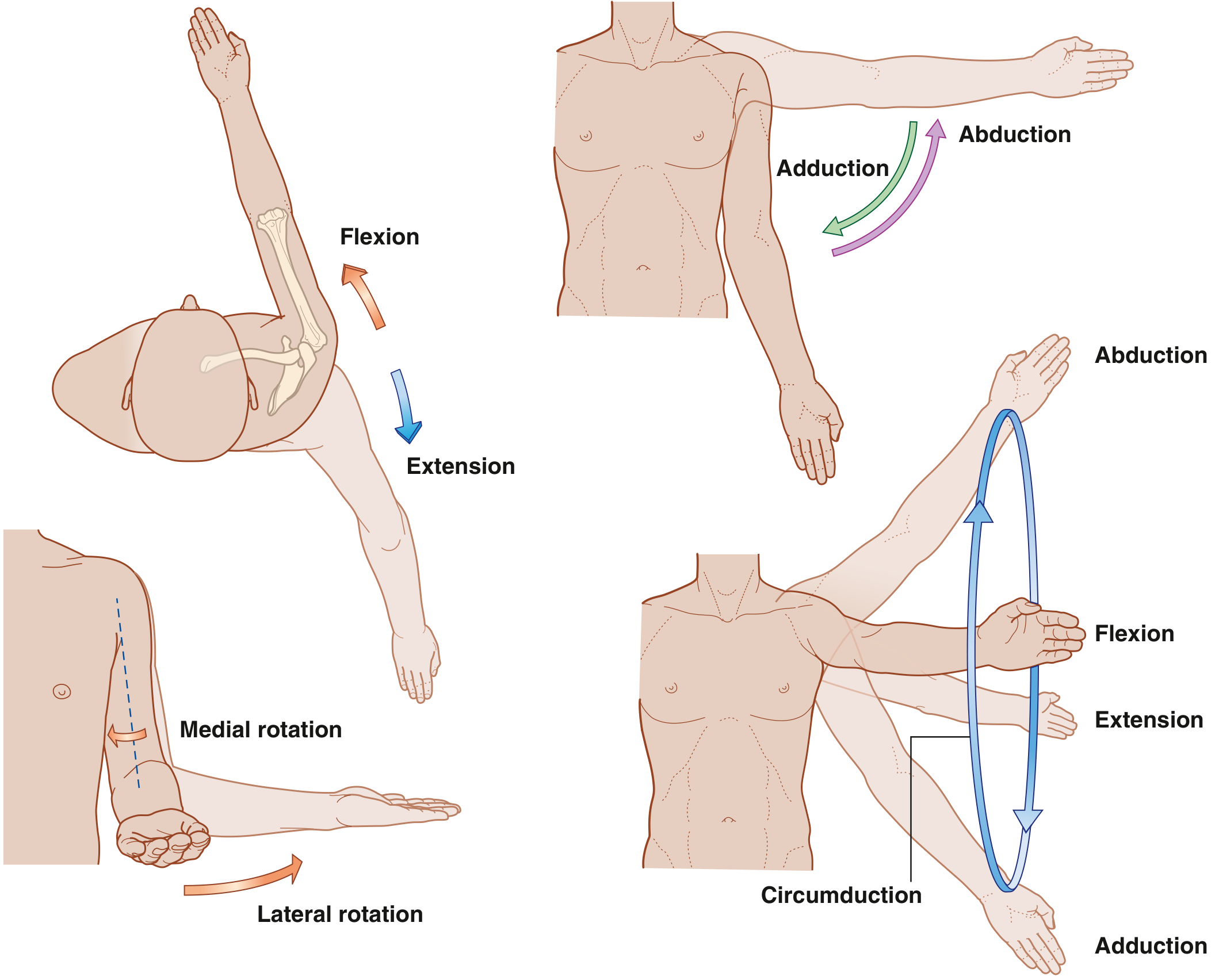
| Term | Definition | Examples |
|---|---|---|
| Flexion | Decreases the angle between two body parts; bending | Bending elbow, bending knee, bowing head forward |
| Extension | Increases the angle; straightening | Straightening elbow/knee, tilting head back |
| Hyperextension | Extension beyond anatomical position | Bending the neck backward past neutral |
Key points:
- At most joints, flexion moves anteriorly (e.g., arm forward at shoulder, leg forward at hip)
- The knee is an exception — flexion moves the leg posteriorly
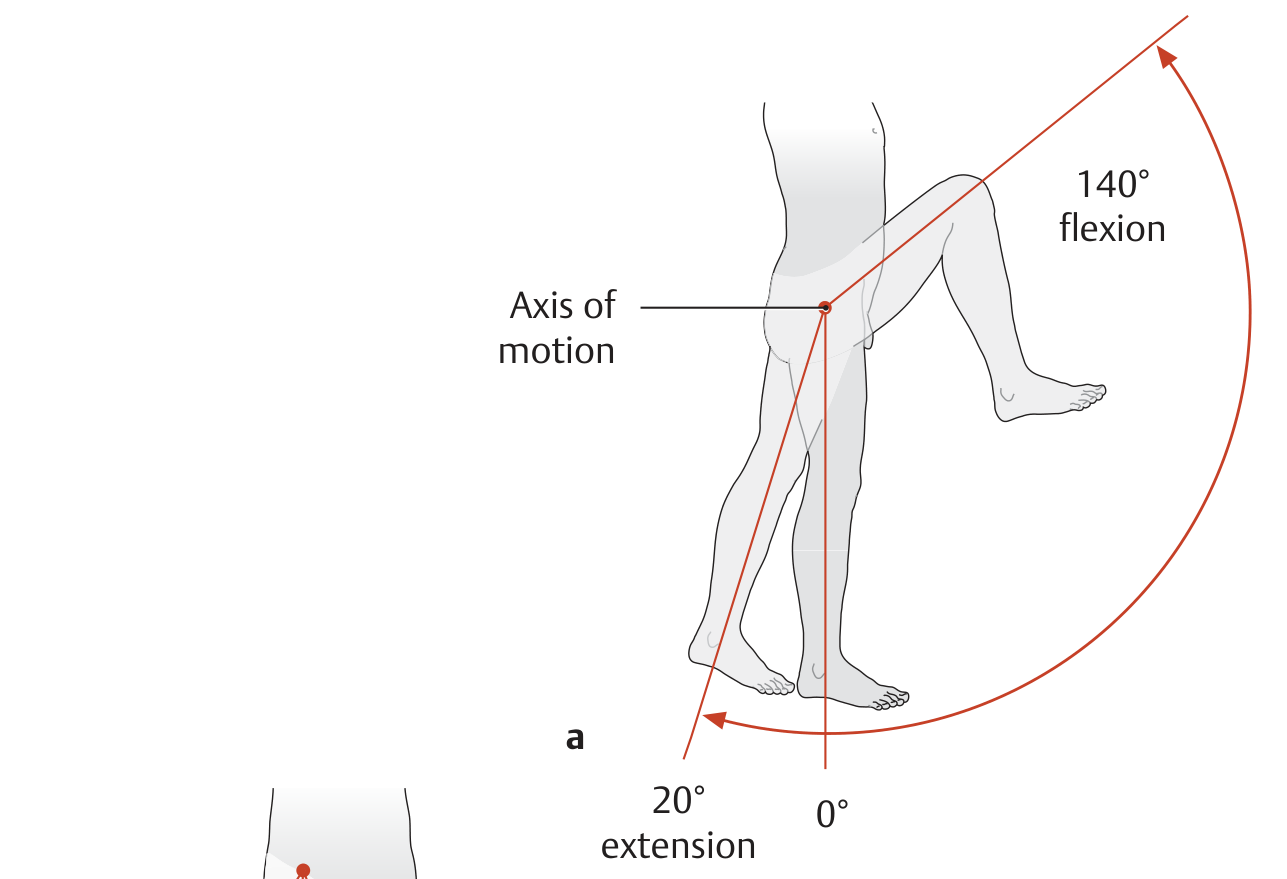
- Flexion of the hip (with knee extended) is limited to ~90°; with knee flexed, ~140°
2. Abduction & Adduction
Axis: Sagittal (front-to-back)
Plane: Frontal/coronal (divides body into front/back)
| Term | Definition | Memory trick |
|---|---|---|
| Abduction | Moves the limb away from the midline | "Ab" = away |
| Adduction | Moves the limb toward the midline | "Ad" = toward |
Examples:
- Raising your arm out to the side = shoulder abduction
- Bringing a raised arm back to your side = shoulder adduction
- Spreading fingers apart = abduction of fingers (at MCP joint, relative to the middle finger as reference)
- Closing fingers together = adduction
At the hip: abduction with the hip extended has a smaller range (~45°) versus abduction with the hip flexed 90° (~60°), because the capsule and ligaments are more relaxed in flexion. — THIEME Atlas of Anatomy
3. Medial & Lateral Rotation
Axis: Longitudinal (vertical, runs along the long axis of the bone)
Plane: Transverse (divides body into top/bottom)
| Term | Also called | Definition | Example |
|---|---|---|---|
| Medial rotation | Internal rotation | Rotates the anterior surface toward the midline | Turning your arm so thumb points inward |
| Lateral rotation | External rotation | Rotates the anterior surface away from the midline | Turning your arm so thumb points outward |
These movements occur at ball-and-socket joints (shoulder, hip) and some condylar joints.
At the hip: Medial rotation ~40°, lateral rotation ~50°
At the shoulder: Wide range enabled by the multiaxial glenohumeral joint
The diagram below (THIEME Atlas) shows all three axes of hip motion clearly:
4. Supination & Pronation
These are unique rotational movements of the forearm (radioulnar joints). They do not occur at the shoulder or hip.
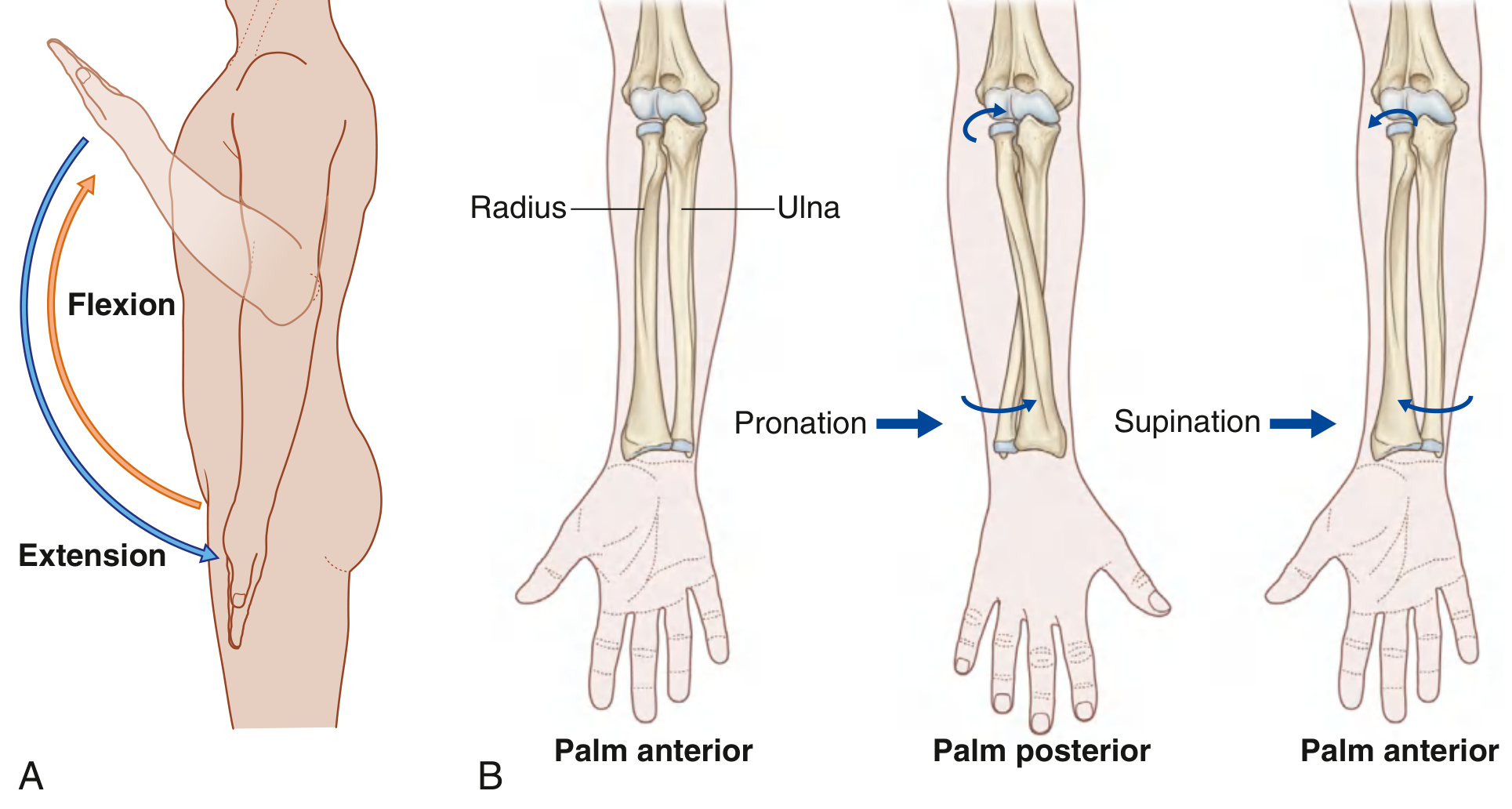
| Term | What happens | Result |
|---|---|---|
| Supination | Radius and ulna are parallel | Palm faces anteriorly (anatomical position) — "holding a bowl of soup" |
| Pronation | Radius crosses over the ulna | Palm faces posteriorly — "pouring soup out" |
Mechanism: The radius rotates around the ulna at both the proximal and distal radioulnar joints, which act together as a functional unit. The ulna is the primary load-bearing bone of the forearm and remains relatively fixed while the radius pivots around it.
"Supination returns the hand to the anatomical position." — Gray's Anatomy for Students
Memory trick: Supination = palm up (like a super-hero holding their hand out to receive); Pronation = palm down (like pressing/prone position).
Summary Table
| Movement Pair | Axis | Plane | Joints Involved |
|---|---|---|---|
| Flexion / Extension | Transverse | Sagittal | All major joints |
| Abduction / Adduction | Sagittal | Frontal (coronal) | Shoulder, hip, wrist, fingers |
| Medial / Lateral rotation | Longitudinal | Transverse | Shoulder, hip (ball-and-socket) |
| Supination / Pronation | Longitudinal | Transverse | Radioulnar joints only |
Bonus — Circumduction (not a separate movement, but worth knowing): A combination of flexion → abduction → extension → adduction in sequence, tracing a cone shape. Occurs at ball-and-socket and condylar joints.
Sources: Gray's Anatomy for Students; THIEME Atlas of General Anatomy and Musculoskeletal System
This is a shared conversation. Sign in to Orris to start your own chat.