
Hypothalamus
Reading File
The query is broad - "Hypothalamus" could mean anatomy, physiology, hormones, clinical disorders, or all of the above. Let me clarify before diving in.
Asking for Preferences
What aspect of the hypothalamus are you interested in?
Hypothalamus physiology
Reading File
Searching sources...
Finding Sources
Finding Sources
Good results. Let me read the most relevant sections - Neuroscience textbook and Berek & Novak's Gynecology (hormones), plus Kaplan & Sadock's (comprehensive), in parallel.
Reading File
Reading File
Reading File
Excellent content. Now let me read more of the Berek & Novak section (hormones/releasing factors) and search for hypothalamic nuclei and thermoregulation/osmolarity content.
Reading File
Finding Sources
Finding Sources
Now let me read the Neuroanatomy section on hypothalamic nuclei and the section on osmoreceptors/thermoregulation.
Reading File
Reading File
Excellent. Let me read more about the nuclei details and fetch the key diagram images.
Reading File
Loading Image
Loading Image
I now have comprehensive content. Let me also fetch the nuclei diagram and the ARC network diagram for visual support.
Loading Image
Loading Image
I now have rich, comprehensive content from multiple authoritative textbooks with excellent diagrams. Let me compile the full response.
Hypothalamus: Physiology
Overview
The hypothalamus is a small but remarkably powerful neural structure at the base of the brain, sitting above the optic chiasm and below the third ventricle. Despite its tiny size, it coordinates two fundamental biological imperatives: homeostasis and the organization of coordinated visceral and somatic motor responses (including emotional expression). It is the master link between the nervous system and the endocrine system.
- Neuroanatomy through Clinical Cases, 3rd Ed.
- Berek & Novak's Gynecology
1. Anatomical Organisation
The hypothalamus is divided into three zones mediolaterally and four regions anteroposteriorly.
Zones (mediolateral)
| Zone | Content |
|---|---|
| Periventricular | Thin layer adjacent to the 3rd ventricle |
| Medial | Primarily cell bodies (most nuclei lie here) |
| Lateral | Primarily axonal; contains the medial forebrain bundle (MFB) |
Regions and Key Nuclei (anteroposterior)
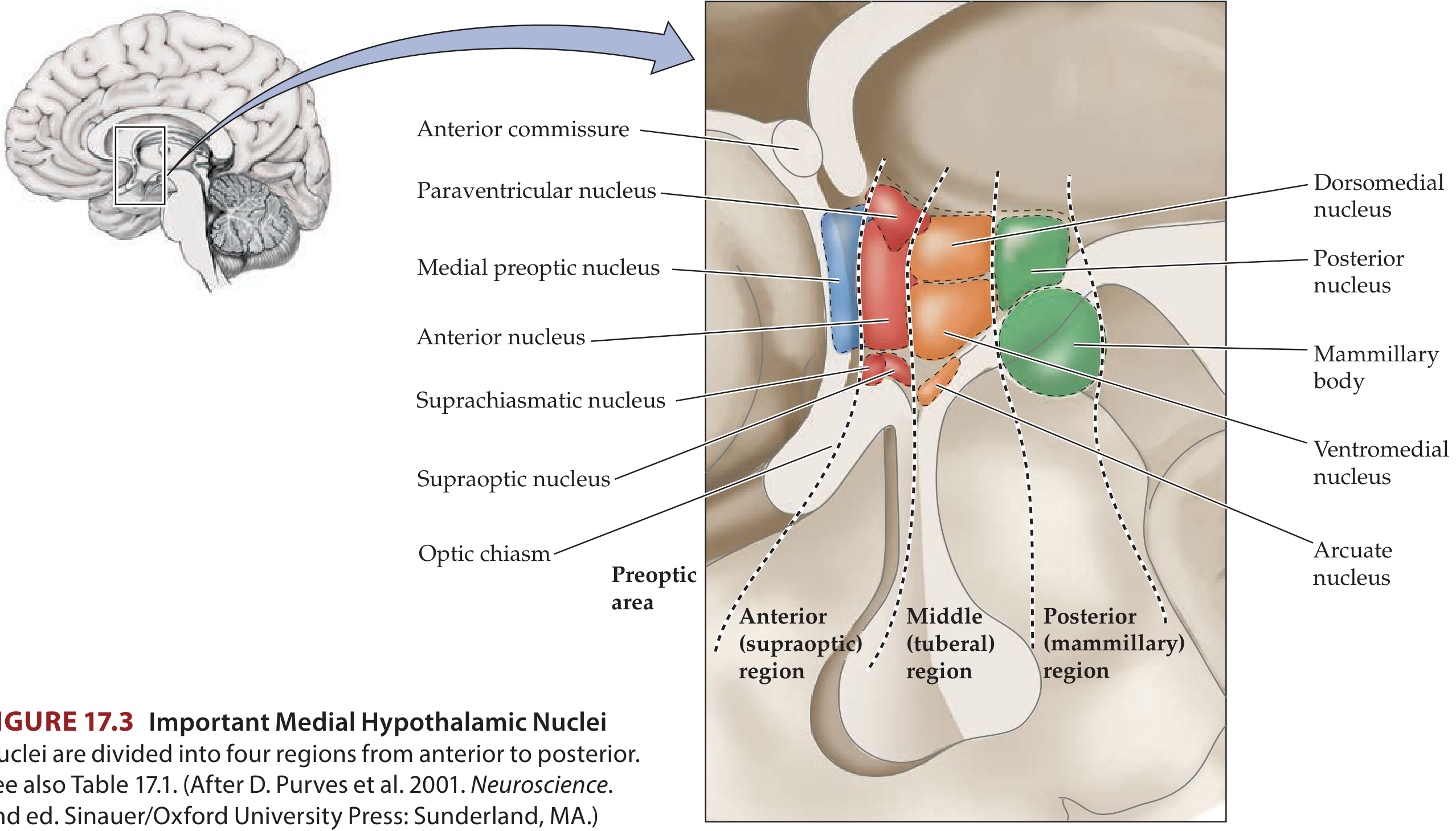
| Region | Key Nuclei |
|---|---|
| Preoptic area (telencephalic origin) | Medial preoptic nucleus, lateral preoptic nucleus |
| Anterior (supraoptic) region | Anterior hypothalamic nucleus, supraoptic nucleus (SON), paraventricular nucleus (PVN), suprachiasmatic nucleus (SCN) |
| Middle (tuberal) region | Arcuate nucleus, ventromedial nucleus (VMN), dorsomedial nucleus |
| Posterior (mammillary) region | Medial/lateral/intermediate mammillary nuclei, posterior hypothalamic nucleus |
The fornix passes through the hypothalamus dividing medial from lateral areas. The medial forebrain bundle runs rostrocaudally through the lateral hypothalamic area, carrying reciprocal connections.
2. Neuroendocrine Function: Hypothalamic-Pituitary Axis
The hypothalamus controls the anterior pituitary via releasing and inhibiting hormones secreted into the hypophyseal portal system at the median eminence (which lies outside the blood-brain barrier, allowing direct hormone access to fenestrated capillaries).
Hypothalamic-Pituitary-End Organ Axes
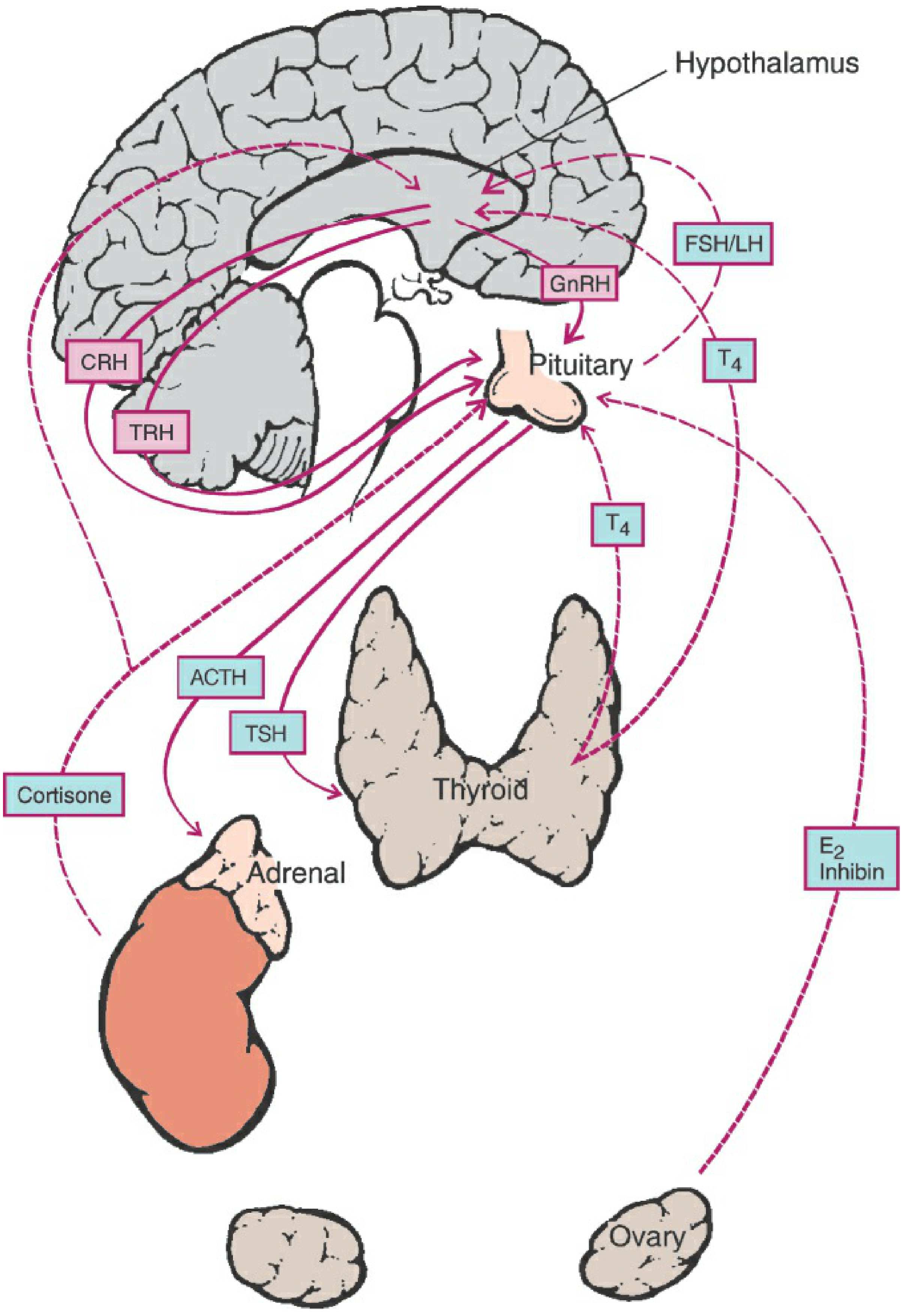
| Hypothalamic Hormone | Abbreviation | Pituitary Effect | End Organ Effect |
|---|---|---|---|
| Gonadotropin-releasing hormone | GnRH | Releases LH + FSH | Gonads (E2, testosterone, inhibin) |
| Corticotropin-releasing hormone | CRH | Releases ACTH | Adrenals (cortisol) |
| Growth hormone-releasing hormone | GHRH | Releases GH | Liver (IGF-1), growth |
| Thyrotropin-releasing hormone | TRH | Releases TSH | Thyroid (T3, T4) |
| Somatostatin | SS | Inhibits GH, TSH | - |
| Dopamine | DA | Inhibits prolactin | - |
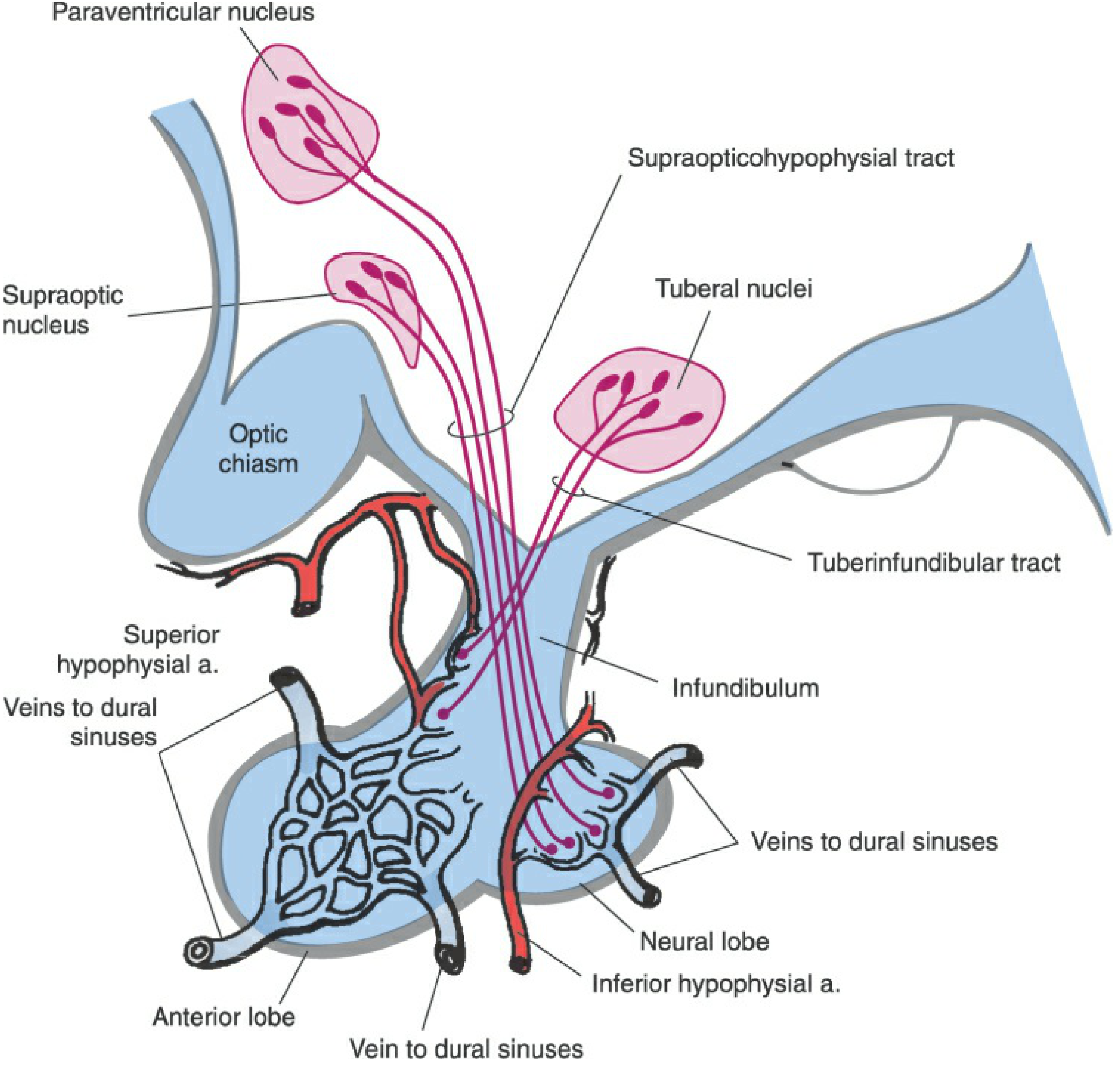
Posterior Pituitary Hormones
The posterior pituitary is a direct extension of the hypothalamus. Oxytocin and vasopressin (ADH) are synthesized in the supraoptic nucleus (SON) and paraventricular nucleus (PVN), then transported down the supraopticohypophysial tract to be released from nerve terminals in the neurohypophysis.
Feedback Loops
Three levels of feedback regulate this axis:
-
Long-loop feedback: Peripheral hormones (e.g., cortisol, estradiol) act on hypothalamic steroid receptors
-
Short-loop feedback: Pituitary hormones (e.g., ACTH) feed back to the hypothalamus
-
Ultrashort feedback: Hypothalamic peptides feed back on the hypothalamus itself
-
Berek & Novak's Gynecology, pp. 265-268
3. Osmolarity and Water Balance
Hypothalamic osmoreceptors are located in or near the supraoptic and paraventricular nuclei. Two stimuli trigger ADH release:
- Intracellular dehydration: increased intracellular sodium concentration
- Extracellular dehydration: elevated angiotensin II in hypothalamic blood
When plasma osmolarity rises, SON and PVN large neurons secrete ADH (vasopressin) into the posterior pituitary, promoting renal water reabsorption. Conversely, increased intravascular volume activates peripheral volume receptors (large veins, left atrium), inhibiting ADH secretion.
The lateral hypothalamus acts as a drinking center - lesions here cause adipsia (reduced water intake), while lesions of the ventromedial nucleus may cause hyperdipsia.
Central (hypothalamic) diabetes insipidus results when at least 90% of SON and PVN neurons are destroyed.
- Localization in Clinical Neurology, 8e, pp. 1015-1016
4. Energy Balance and Appetite Regulation
The arcuate nucleus (ARC) is the key hub for energy homeostasis. Two opposing neuronal populations receive leptin and ghrelin signals:
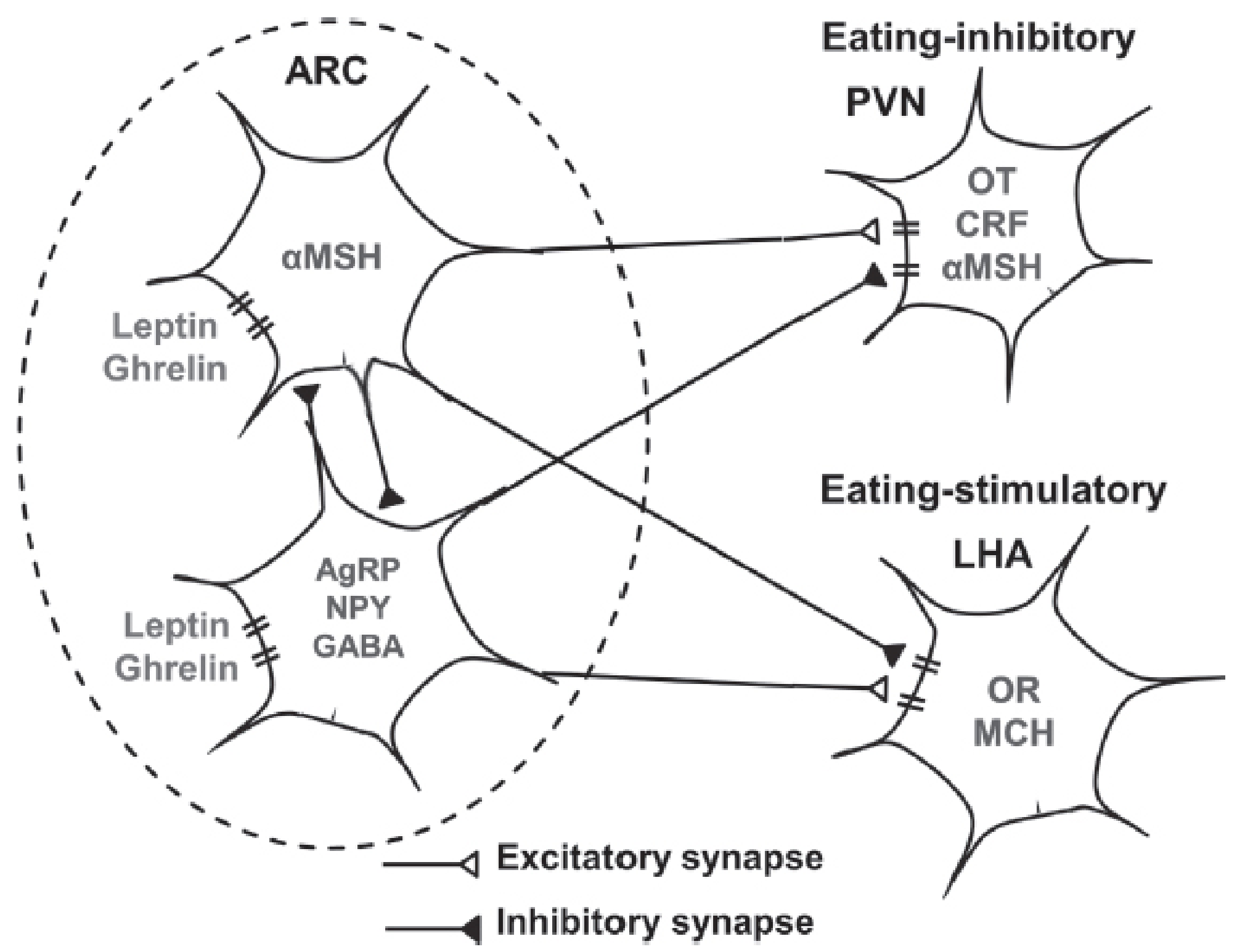
| Population | Neurotransmitters | Leptin Effect | Ghrelin Effect | Net Effect |
|---|---|---|---|---|
| POMC neurons | α-MSH | Stimulated | Inhibited | Anorexigenic (suppress eating) |
| AgRP/NPY neurons | AgRP, NPY, GABA | Inhibited | Stimulated | Orexigenic (promote eating) |
- ARC → PVN pathway: αMSH stimulates PVN (oxytocin, CRF, αMSH neurons) → eating inhibited
- ARC → LHA pathway: AgRP/NPY neurons activate lateral hypothalamic area (orexin, MCH neurons) → eating stimulated
Classic lesion studies: destruction of the ventromedial hypothalamus (VMH) causes hyperphagia; destruction of the lateral hypothalamic area (LHA) causes aphagia.
- Kaplan & Sadock's Comprehensive Textbook of Psychiatry, pp. 802-803
5. Thermoregulation
The preoptic area and anterior hypothalamus (POAH) serve as the body's thermostat:
- Contains warm-sensitive neurons that respond to rising core temperature
- Triggers heat-dissipating responses: vasodilation, sweating
- The posterior hypothalamus integrates cold signals and coordinates heat-conservation/generation responses (vasoconstriction, shivering)
Destruction of the posterior hypothalamus abolishes temperature regulation in cold environments.
6. Circadian Rhythm
The suprachiasmatic nucleus (SCN) is the brain's "master clock." It receives direct photic input from the retina via the retinohypothalamic tract and entrains circadian rhythms in the rest of the body. The SCN projects to the paraventricular nucleus and other hypothalamic regions to synchronize endocrine, autonomic, and behavioral cycles.
- Neuroanatomy through Clinical Cases, 3rd Ed., pp. 823-824
7. Autonomic and Emotional Integration
Early experiments (Cannon and Bard) showed that the posterior hypothalamus is critical for expressing anger and aggression ("sham rage"). W.R. Hess demonstrated that electrical stimulation of slightly different hypothalamic subregions could produce a remarkable variety of behaviors: sniffing, panting, eating, fear, or anger - all coordinated with appropriate autonomic responses (heart rate change, pupillary dilation, GI motility).
The hypothalamus has extensive reciprocal connections with:
- Limbic system (amygdala, hippocampus)
- Thalamus
- Pons and brainstem
These connections allow it to translate emotional states into coordinated visceral, hormonal, and behavioral responses.
- Neuroscience: Exploring the Brain, 5th Ed., pp. 1664-1665
Summary Table: Key Hypothalamic Nuclei and Functions
| Nucleus | Primary Function(s) |
|---|---|
| Supraoptic (SON) | ADH and oxytocin synthesis/release |
| Paraventricular (PVN) | ADH, oxytocin; stress axis (CRH); anorexigenic signaling |
| Suprachiasmatic (SCN) | Circadian rhythm master clock |
| Arcuate | Anterior pituitary control (via median eminence); appetite regulation |
| Ventromedial (VMN) | Satiety center; destruction → hyperphagia |
| Lateral hypothalamic area (LHA) | Feeding and drinking center; destruction → aphagia/adipsia |
| Preoptic area (POAH) | Thermoregulation (heat dissipation); sexual behavior |
| Posterior hypothalamus | Heat conservation; aggression/emotional expression |
| Mammillary bodies | Memory (part of Papez circuit) |
This is a shared conversation. Sign in to Orris to start your own chat.