
11. Define Carbohydrates and classify them. 12. Write the structure of glucose, maltose, galactose and glycogen. 13. Discuss the general properties of amino acids. 14. Write a note on fatty acids. 15. Define allosteric enzymes and feedback inhibition2 marks
11. Definition and Classification of Carbohydrates
Definition
Harper's Illustrated Biochemistry, 32nd Ed
Classification
1. Monosaccharides (Simple Sugars)
- Number of carbons: trioses (3C), tetroses (4C), pentoses (5C), hexoses (6C), heptoses (7C)
- Functional group: aldoses (aldehyde group, e.g., glucose, galactose) and ketoses (keto group, e.g., fructose)
| Sugar | Type | Carbons | Significance |
|---|---|---|---|
| Glucose | Aldohexose | 6 | Most important; primary energy source |
| Fructose | Ketohexose | 6 | Fruit sugar |
| Galactose | Aldohexose | 6 | Component of lactose |
| Ribose | Aldopentose | 5 | Component of RNA |
| Deoxyribose | Aldopentose | 5 | Component of DNA |
2. Disaccharides
- Maltose - glucose + glucose (α1→4 bond); from starch hydrolysis
- Sucrose - glucose + fructose; table sugar
- Lactose - galactose + glucose; milk sugar
3. Oligosaccharides
4. Polysaccharides
- Storage polysaccharides: Starch (plants), Glycogen (animals)
- Structural polysaccharides: Cellulose (plant cell walls), Chitin (insect exoskeletons)
- Hexosans: polymers of hexoses (e.g., starch, cellulose, glycogen)
- Pentosans: polymers of pentoses (e.g., xylans)
- Homopolysaccharides: one type of monosaccharide unit (e.g., glycogen = glucose only)
- Heteropolysaccharides: more than one type (e.g., hyaluronic acid = glucuronic acid + glucosamine)
12. Structures of Glucose, Maltose, Galactose, and Glycogen
Glucose
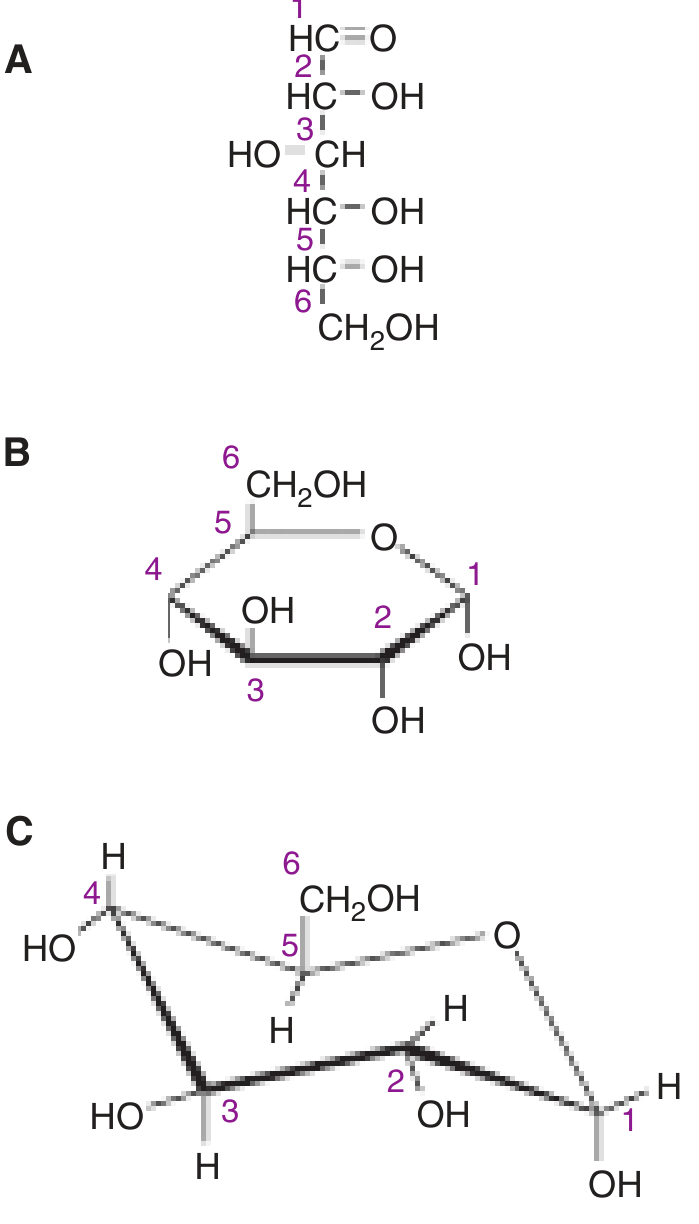
- (A) Open-chain (Fischer projection): Shows the aldehyde at C1 and hydroxyl groups at C2-C5, with CH₂OH at C6.
- (B) Haworth projection: A cyclic hemiacetal (pyranose ring) formed when the C1 aldehyde reacts with the C5 hydroxyl. The -OH at C1 can be α (below the ring) or β (above the ring).
- (C) Chair form: The most accurate 3D representation, showing the ring in a chair conformation.
Galactose
- Lactose (β-galactose + glucose)
- Gangliosides and glycoproteins in the brain and cell membranes
Maltose
- Ring 1 (non-reducing end): α-D-glucopyranose, C1 involved in the glycosidic bond
- Ring 2 (reducing end): α-D-glucopyranose, C1 free (reducing end, can mutarotate)
- The two rings are connected through an oxygen bridge between C1 of the first glucose and C4 of the second
Glycogen
- α(1→4) glycosidic bonds in the linear chains (same as amylose)
- α(1→6) glycosidic bonds at the branch points
- Highly branched -- branching occurs every 8-12 glucose residues (more frequent branching than starch's amylopectin, which branches every 24-30 residues)
- This highly branched structure allows rapid mobilization of glucose (many non-reducing ends available for phosphorylase action simultaneously)
13. General Properties of Amino Acids
Harper's Illustrated Biochemistry, 32nd Ed
1. Ionization and Zwitterionic Nature
- At pH 7.4: -COOH → -COO⁻ (deprotonated), -NH₂ → -NH₃⁺ (protonated)
- Zwitterions cannot be extracted into nonpolar solvents; they are highly water-soluble
2. Amphoteric Nature
3. pKa Values and Isoelectric Point (pI)
- α-COOH: pKa ~2.0 (stronger acid)
- α-NH₃⁺: pKa ~9.0-10.0 (weaker acid)
- R group (if ionizable): additional pKa values
4. Optical Activity
5. Classification Based on R Groups
| Class | Examples | Property |
|---|---|---|
| Non-polar aliphatic | Glycine, Alanine, Valine, Leucine, Isoleucine | Hydrophobic; found in protein interior |
| Aromatic | Phenylalanine, Tyrosine, Tryptophan | Hydrophobic; absorb UV light |
| Polar uncharged | Serine, Threonine, Asparagine, Glutamine | Hydrophilic |
| Positively charged (basic) | Lysine, Arginine, Histidine | +ve charge at pH 7 |
| Negatively charged (acidic) | Aspartate, Glutamate | -ve charge at pH 7 |
| Sulfur-containing | Cysteine, Methionine | Cysteine forms disulfide bonds |
6. Reactions of Functional Groups
- Carboxyl groups: esterification, amide formation, acid anhydride formation
- Amino groups: acylation, amidation
- -OH and -SH groups: oxidation and esterification
- Imidazole of histidine: acts as acid or base catalyst at neutral pH (pKa ~6)
- Thiol (-SH) of cysteine: excellent nucleophile; participates in enzymatic catalysis; can form disulfide bonds (-S-S-) stabilizing protein structure
7. Ninhydrin Reaction
8. Essential vs. Non-essential
- Essential (indispensable): cannot be synthesized by the body; must come from diet (e.g., lysine, threonine, methionine, valine, leucine, isoleucine, phenylalanine, tryptophan -- "PVT TIM HaLL")
- Non-essential (dispensable): synthesized by the body (e.g., glycine, alanine, serine, aspartate, glutamate)
- Conditionally essential: normally non-essential but become essential under certain conditions (e.g., arginine during growth, cysteine in premature infants)
14. Note on Fatty Acids
Tietz Textbook of Laboratory Medicine, 7th Ed
Definition
Classification by Chain Length
| Group | Carbon Atoms | Example |
|---|---|---|
| Short-chain fatty acids (SCFA) | 2-4 C | Acetic acid (C2), Butyric acid (C4) |
| Medium-chain fatty acids (MCFA) | 6-12 C | Capric acid (C10) |
| Long-chain fatty acids (LCFA) | 14-26 C | Palmitic (C16), Stearic (C18), Oleic (C18:1) |
| Very long-chain fatty acids (VLCFA) | >26 C | Cerotic acid (C26) |
Classification by Degree of Saturation
- No double bonds between carbon atoms
- Alkyl chain is extended and flexible; carbons rotate freely
- Fully saturated -- each internal carbon is covalently linked to two hydrogen atoms
- Form straight, packed chains → high melting points → solid at room temperature
- Examples: Palmitic acid (16:0), Stearic acid (18:0)
- One double bond in the carbon chain
- Example: Oleic acid (18:1, n-9) -- main fatty acid in olive oil
- More than one double bond; double bonds are usually 3 carbons apart
- Prone to oxidation at the sites of unsaturation
- Marine fish fatty acids (e.g., salmon) can have up to 6 double bonds and are >20 carbons long
- Examples: Linoleic acid (18:2, n-6), Linolenic acid (18:3, n-3), EPA (20:5, n-3), DHA (22:6, n-3)
Cis vs. Trans Configuration
- Cis-unsaturated: Both hydrogens on the same side of the double bond → 30-degree bend in the acyl chain → lower melting point → liquid at room temperature (e.g., olive oil, plant oils)
- Trans-unsaturated: Hydrogens on opposite sides → more linear, resembles saturated FA → solid at room temperature (e.g., margarine). Trans fats are produced by catalytic hydrogenation of plant oils -- this is an artificial process.
- In mammals, all naturally occurring unsaturated fatty acids are of the cis variety.
Essential Fatty Acids (EFAs)
- Linoleic acid (18:2, ω-6): essential; precursor to arachidonic acid
- α-Linolenic acid (18:3, ω-3): essential; precursor to EPA and DHA
Nomenclature
- Oleic acid: 18:1 Δ9 (or 18:1 ω-9)
- Linoleic acid: 18:2 Δ9,12 (or 18:2 ω-6)
15. Allosteric Enzymes and Feedback Inhibition (2 Marks)
Lippincott's Illustrated Reviews: Biochemistry, 8th Ed; Harper's Illustrated Biochemistry, 32nd Ed
Allosteric Enzymes
- Almost always composed of multiple subunits
- The allosteric regulatory site is distinct from the substrate-binding site and may be on a non-catalytic subunit
- Do not follow Michaelis-Menten kinetics; instead show a sigmoidal (S-shaped) v₀ vs [S] curve (due to cooperativity)
- Frequently catalyze the committed step (often the rate-limiting step) in a metabolic pathway
- Positive effectors (activators): increase enzyme activity by increasing substrate affinity (↓K₀.₅) or increasing Vmax
- Negative effectors (inhibitors): decrease enzyme activity
- Homotropic: substrate itself is the effector (cooperative binding -- binding of one substrate molecule enhances binding of subsequent molecules; produces sigmoidal curve)
- Heterotropic: a different molecule (not the substrate) is the effector
Feedback Inhibition
A → B → C → D → E → F → G
           ↑_______________|
         (G inhibits enzyme at D→E)
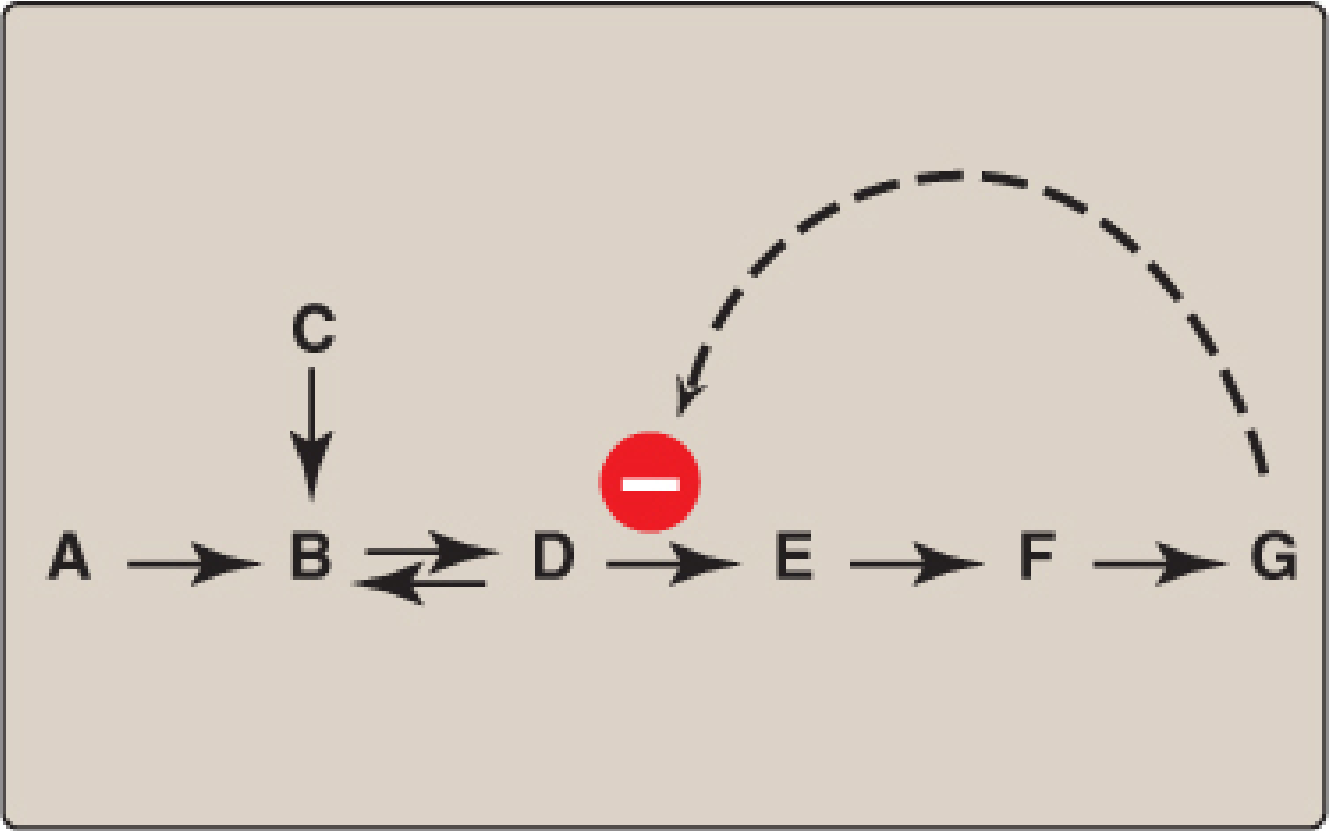
- Provides the cell with appropriate amounts of a product by regulating flux through the biosynthetic pathway
- Acts rapidly (noncovalent, reversible)
- Prevents wasteful overproduction of metabolic intermediates
- Classic example: Serine inhibits 3-phosphoglycerate dehydrogenase, the enzyme catalyzing the first committed step in serine biosynthesis
- Another example: Citrate (end product of the citric acid cycle) allosterically inhibits phosphofructokinase-1 in glycolysis
- Harper's Illustrated Biochemistry, 32nd Ed, Chapters 3, 9, 14, 15
- Lippincott's Illustrated Reviews: Biochemistry, 8th Ed, Chapter 5
- Tietz Textbook of Laboratory Medicine, 7th Ed, Chapter 36
Create a study guide PDF with structures and key points for exam prep
mkdir -p /home/daytona/workspace/biochem-study-guide && ls /home/daytona/workspace/biochem-study-guide
~/biochem-study-guide/generate_pdf.py
from reportlab.lib.pagesizes import A4
from reportlab.lib import colors
from reportlab.lib.styles import getSampleStyleSheet, ParagraphStyle
from reportlab.lib.units import cm, mm
from reportlab.platypus import (
SimpleDocTemplate, Paragraph, Spacer, Table, TableStyle,
HRFlowable, PageBreak, KeepTogether
)
from reportlab.lib.enums import TA_CENTER, TA_LEFT, TA_JUSTIFY
from reportlab.platypus.flowables import BalancedColumns
import urllib.request
import os
# ─── Output path ──────────────────────────────────────────────────────────────
OUTPUT = "/home/daytona/workspace/biochem-study-guide/Biochemistry_Study_Guide.pdf"
# ─── Color palette ────────────────────────────────────────────────────────────
DEEP_BLUE = colors.HexColor("#1a3a5c")
MID_BLUE = colors.HexColor("#2e6da4")
ACCENT = colors.HexColor("#e8732a")
LIGHT_BG = colors.HexColor("#eef4fb")
TABLE_HDR = colors.HexColor("#2e6da4")
TABLE_ALT = colors.HexColor("#f0f6ff")
GREEN_BOX = colors.HexColor("#e6f4ea")
GREEN_BDR = colors.HexColor("#34a853")
YELLOW_BOX = colors.HexColor("#fffbe6")
YELLOW_BDR = colors.HexColor("#f9ab00")
WHITE = colors.white
BLACK = colors.black
# ─── Styles ───────────────────────────────────────────────────────────────────
base = getSampleStyleSheet()
def S(name, **kw):
return ParagraphStyle(name, **kw)
cover_title = S("cover_title",
fontSize=28, textColor=WHITE, alignment=TA_CENTER,
spaceAfter=8, fontName="Helvetica-Bold", leading=34)
cover_sub = S("cover_sub",
fontSize=14, textColor=colors.HexColor("#c9dff5"), alignment=TA_CENTER,
spaceAfter=6, fontName="Helvetica", leading=18)
cover_note = S("cover_note",
fontSize=10, textColor=colors.HexColor("#a0c4e8"), alignment=TA_CENTER,
fontName="Helvetica-Oblique")
h1 = S("h1",
fontSize=18, textColor=WHITE, fontName="Helvetica-Bold",
leading=22, spaceAfter=2, spaceBefore=0, backColor=DEEP_BLUE,
leftIndent=-12, rightIndent=-12)
h2 = S("h2",
fontSize=13, textColor=DEEP_BLUE, fontName="Helvetica-Bold",
leading=17, spaceBefore=10, spaceAfter=4,
borderPadding=(0,0,2,0))
h3 = S("h3",
fontSize=11, textColor=MID_BLUE, fontName="Helvetica-Bold",
leading=14, spaceBefore=6, spaceAfter=2)
body = S("body",
fontSize=10, textColor=colors.HexColor("#1e1e2e"), fontName="Helvetica",
leading=15, spaceAfter=4, alignment=TA_JUSTIFY)
bullet = S("bullet",
fontSize=10, textColor=colors.HexColor("#1e1e2e"), fontName="Helvetica",
leading=14, spaceAfter=3, leftIndent=14, bulletIndent=4,
bulletFontName="Helvetica", bulletFontSize=10, bulletText="\u2022")
sub_bullet = S("sub_bullet",
fontSize=9.5, textColor=colors.HexColor("#333"), fontName="Helvetica",
leading=13, spaceAfter=2, leftIndent=26, bulletIndent=16,
bulletFontName="Helvetica", bulletFontSize=9, bulletText="\u25e6")
code = S("code",
fontSize=9, fontName="Courier", textColor=colors.HexColor("#1e2a1e"),
backColor=colors.HexColor("#f4fdf4"), leading=13,
leftIndent=10, spaceAfter=4, spaceBefore=2)
caption = S("caption",
fontSize=8.5, textColor=colors.HexColor("#555"), fontName="Helvetica-Oblique",
alignment=TA_CENTER, leading=12, spaceAfter=6)
tip_style = S("tip",
fontSize=9.5, textColor=colors.HexColor("#1a3a1a"), fontName="Helvetica",
leading=14, leftIndent=8, rightIndent=8, spaceAfter=4)
warn_style = S("warn",
fontSize=9.5, textColor=colors.HexColor("#5a3200"), fontName="Helvetica",
leading=14, leftIndent=8, rightIndent=8, spaceAfter=4)
mnemonic = S("mnemonic",
fontSize=11, textColor=colors.HexColor("#1a4a1a"), fontName="Helvetica-BoldOblique",
alignment=TA_CENTER, leading=16, spaceAfter=4)
page_w, page_h = A4
MARGIN = 2*cm
# ─── Helper flowables ─────────────────────────────────────────────────────────
def section_header(num, title, subtitle=""):
data = [[
Paragraph(f"<b>{num}</b>", S("sn", fontSize=22, textColor=ACCENT,
fontName="Helvetica-Bold", leading=26, alignment=TA_CENTER)),
Paragraph(f"<b>{title}</b>" + (f"<br/><font size=10 color='#c9dff5'>{subtitle}</font>" if subtitle else ""),
S("sh", fontSize=16, textColor=WHITE, fontName="Helvetica-Bold",
leading=20, alignment=TA_LEFT, leftIndent=4))
]]
t = Table(data, colWidths=[1.4*cm, None])
t.setStyle(TableStyle([
("BACKGROUND", (0,0),(-1,-1), DEEP_BLUE),
("VALIGN", (0,0),(-1,-1), "MIDDLE"),
("LEFTPADDING", (0,0),(0,0), 8),
("RIGHTPADDING",(0,0),(-1,-1), 10),
("TOPPADDING", (0,0),(-1,-1), 8),
("BOTTOMPADDING",(0,0),(-1,-1), 8),
("ROUNDEDCORNERS", [4,4,4,4]),
]))
return t
def tip_box(text, color=GREEN_BOX, border=GREEN_BDR, label="KEY POINT"):
inner = Paragraph(f"<b><font color='#{border.hexval()[2:]}'>▶ {label}:</font></b> {text}", tip_style)
t = Table([[inner]], colWidths=[page_w - 2*MARGIN])
t.setStyle(TableStyle([
("BACKGROUND", (0,0),(-1,-1), color),
("BOX", (0,0),(-1,-1), 1.2, border),
("LEFTPADDING", (0,0),(-1,-1), 8),
("RIGHTPADDING", (0,0),(-1,-1), 8),
("TOPPADDING", (0,0),(-1,-1), 5),
("BOTTOMPADDING",(0,0),(-1,-1), 5),
("ROUNDEDCORNERS", [4,4,4,4]),
]))
return t
def mnemonic_box(text, title="MNEMONIC"):
inner = [
Paragraph(f"<b>{title}</b>", S("mt", fontSize=9, textColor=colors.HexColor("#5a3200"),
fontName="Helvetica-Bold", alignment=TA_CENTER)),
Paragraph(text, mnemonic)
]
t = Table([inner], colWidths=[page_w - 2*MARGIN])
t.setStyle(TableStyle([
("BACKGROUND", (0,0),(-1,-1), YELLOW_BOX),
("BOX", (0,0),(-1,-1), 1.5, YELLOW_BDR),
("LEFTPADDING", (0,0),(-1,-1), 10),
("RIGHTPADDING", (0,0),(-1,-1), 10),
("TOPPADDING", (0,0),(-1,-1), 6),
("BOTTOMPADDING",(0,0),(-1,-1), 6),
("ROUNDEDCORNERS", [4,4,4,4]),
]))
return t
def styled_table(headers, rows, col_widths=None):
data = [[Paragraph(f"<b>{h}</b>", S("th", fontSize=9.5, textColor=WHITE,
fontName="Helvetica-Bold", alignment=TA_CENTER)) for h in headers]]
for i, row in enumerate(rows):
data.append([Paragraph(str(c), S("td", fontSize=9.5,
textColor=BLACK, fontName="Helvetica",
leading=13, alignment=TA_LEFT)) for c in row])
avail = page_w - 2*MARGIN
if col_widths is None:
col_widths = [avail / len(headers)] * len(headers)
t = Table(data, colWidths=col_widths, repeatRows=1)
style = [
("BACKGROUND", (0,0),(-1,0), TABLE_HDR),
("TEXTCOLOR", (0,0),(-1,0), WHITE),
("ALIGN", (0,0),(-1,0), "CENTER"),
("ROWBACKGROUNDS",(0,1),(-1,-1), [WHITE, TABLE_ALT]),
("GRID", (0,0),(-1,-1), 0.4, colors.HexColor("#c0d0e8")),
("TOPPADDING", (0,0),(-1,-1), 4),
("BOTTOMPADDING",(0,0),(-1,-1), 4),
("LEFTPADDING", (0,0),(-1,-1), 6),
("RIGHTPADDING", (0,0),(-1,-1), 6),
]
t.setStyle(TableStyle(style))
return t
def divider():
return HRFlowable(width="100%", thickness=0.5,
color=colors.HexColor("#c0d0e8"), spaceAfter=6, spaceBefore=2)
def sp(n=6):
return Spacer(1, n)
# ─── Download structural images ───────────────────────────────────────────────
IMG_DIR = "/home/daytona/workspace/biochem-study-guide/img"
os.makedirs(IMG_DIR, exist_ok=True)
IMAGES = {
"glucose": "https://cdn.orris.care/cdss_images/de892984738f32daa09bd2a953cfdcff258049e7921e4ff406ab9aab06611cc6.png",
"epimers": "https://cdn.orris.care/cdss_images/eb8b120a8cc9ffa7beace8f583d9e7a97aaa402b69ca2dba76e8819d8f3d52f9.png",
"disacc": "https://cdn.orris.care/cdss_images/18f38a58116d58f6676fdae674b635af7cd21a2588109112de5e5be5a48f86a1.png",
"feedback": "https://cdn.orris.care/cdss_images/cb502295cc8ba6cf5745deaa9d789705c0ef503227d0376ec0bbaae611015665.png",
"zwitterion":"https://cdn.orris.care/cdss_images/f978843e8ecc8bd64dbd1cefa0d23b79b28ea7d4d3b6d23aba9ac2167f51b2f1.png",
}
def download_images():
paths = {}
headers = {"User-Agent": "Mozilla/5.0"}
for key, url in IMAGES.items():
dest = os.path.join(IMG_DIR, f"{key}.png")
if not os.path.exists(dest):
try:
req = urllib.request.Request(url, headers=headers)
with urllib.request.urlopen(req, timeout=15) as r, open(dest, "wb") as f:
f.write(r.read())
print(f" Downloaded {key}")
except Exception as e:
print(f" WARN: could not download {key}: {e}")
dest = None
paths[key] = dest if os.path.exists(dest or "") else None
return paths
# ─── Page template callbacks ──────────────────────────────────────────────────
def on_page(canvas, doc):
canvas.saveState()
# Footer bar
canvas.setFillColor(DEEP_BLUE)
canvas.rect(0, 0, page_w, 1.1*cm, fill=1, stroke=0)
canvas.setFillColor(WHITE)
canvas.setFont("Helvetica", 8)
canvas.drawString(MARGIN, 0.4*cm, "Biochemistry Study Guide | Questions 11-15")
canvas.drawRightString(page_w - MARGIN, 0.4*cm, f"Page {doc.page}")
# Top accent line
canvas.setFillColor(ACCENT)
canvas.rect(0, page_h - 3*mm, page_w, 3*mm, fill=1, stroke=0)
canvas.restoreState()
# ─── COVER PAGE ───────────────────────────────────────────────────────────────
def cover_page():
story = []
# Blue background via table
cover_data = [[
Paragraph("BIOCHEMISTRY", S("ct1", fontSize=11, textColor=colors.HexColor("#a0c4e8"),
fontName="Helvetica-Bold", alignment=TA_CENTER, leading=14, spaceAfter=4)),
],[
Paragraph("STUDY GUIDE", S("ct2", fontSize=34, textColor=WHITE,
fontName="Helvetica-Bold", alignment=TA_CENTER, leading=40, spaceAfter=8)),
],[
Paragraph("Questions 11-15: Biomolecules & Enzymes", S("ct3", fontSize=14,
textColor=colors.HexColor("#c9dff5"), fontName="Helvetica",
alignment=TA_CENTER, leading=18, spaceAfter=6)),
],[
Paragraph("Carbohydrates • Amino Acids • Fatty Acids • Allosteric Enzymes",
S("ct4", fontSize=10, textColor=colors.HexColor("#8ab8db"),
fontName="Helvetica-Oblique", alignment=TA_CENTER, leading=14)),
],[
Spacer(1, 0.5*cm),
],[
Paragraph("Sources: Harper's Illustrated Biochemistry 32e | Lippincott's Biochemistry 8e | Tietz Lab Medicine 7e",
S("ct5", fontSize=8, textColor=colors.HexColor("#6090b0"),
fontName="Helvetica-Oblique", alignment=TA_CENTER, leading=12)),
]]
tbl = Table(cover_data, colWidths=[page_w - 2*MARGIN])
tbl.setStyle(TableStyle([
("BACKGROUND", (0,0),(-1,-1), DEEP_BLUE),
("TOPPADDING", (0,0),(-1,-1), 10),
("BOTTOMPADDING",(0,0),(-1,-1), 10),
("LEFTPADDING", (0,0),(-1,-1), 20),
("RIGHTPADDING", (0,0),(-1,-1), 20),
("ROUNDEDCORNERS", [8,8,8,8]),
]))
story.append(sp(1.5*cm))
story.append(tbl)
story.append(sp(0.8*cm))
# Topics index
topics = [
("Q.11", "Carbohydrates: Definition & Classification"),
("Q.12", "Structures of Glucose, Maltose, Galactose & Glycogen"),
("Q.13", "General Properties of Amino Acids"),
("Q.14", "Fatty Acids: Classification & Properties"),
("Q.15", "Allosteric Enzymes & Feedback Inhibition (2 marks)"),
]
idx_data = [[
Paragraph(f"<b><font color='#e8732a'>{q}</font></b>", S("iq",
fontSize=10, fontName="Helvetica-Bold", leading=14)),
Paragraph(t, S("it", fontSize=10, fontName="Helvetica", leading=14))
] for q, t in topics]
idx_tbl = Table(idx_data, colWidths=[1.5*cm, page_w - 2*MARGIN - 1.8*cm])
idx_tbl.setStyle(TableStyle([
("ROWBACKGROUNDS", (0,0),(-1,-1), [WHITE, LIGHT_BG]),
("GRID", (0,0),(-1,-1), 0.3, colors.HexColor("#d0dff0")),
("TOPPADDING", (0,0),(-1,-1), 5),
("BOTTOMPADDING", (0,0),(-1,-1), 5),
("LEFTPADDING", (0,0),(-1,-1), 8),
]))
story.append(Paragraph("<b>Contents</b>", S("idx_hdr", fontSize=12, textColor=DEEP_BLUE,
fontName="Helvetica-Bold", spaceAfter=4)))
story.append(idx_tbl)
story.append(PageBreak())
return story
# ─── BUILD FULL STORY ─────────────────────────────────────────────────────────
def build_story(img_paths):
from reportlab.platypus import Image as RLImage
def img(key, w=None, h=None, caption_text=""):
path = img_paths.get(key)
if not path:
return []
ri = RLImage(path)
aspect = ri.imageWidth / ri.imageHeight
if w and not h:
h = w / aspect
elif h and not w:
w = h * aspect
else:
w = 9*cm
h = w / aspect
ri._restrictSize(w, h)
items = [ri]
if caption_text:
items.append(Paragraph(caption_text, caption))
return items
story = []
story += cover_page()
# ══════════════════════════════════════════════
# Q11: CARBOHYDRATES
# ══════════════════════════════════════════════
story.append(section_header("11", "Carbohydrates", "Definition & Classification"))
story.append(sp(6))
story.append(Paragraph("<b>Definition</b>", h2))
story.append(Paragraph(
"Carbohydrates (saccharides) are extremely polar biomolecules composed of carbon, "
"hydrogen, and oxygen. The general formula is <b>(CH\u2082O)\u2099</b>, though not all carbohydrates "
"fit this formula. They serve as the primary energy source, structural components, and "
"play key roles in cell signaling and recognition.",
body))
story.append(tip_box(
"The word carbohydrate means 'carbon hydrate'. Saccharide is the preferred biochemical term. "
"Glucose is the MOST important carbohydrate - all dietary polysaccharides are ultimately "
"absorbed as monosaccharides.", label="DEFINITION TIP"))
story.append(sp(4))
story.append(Paragraph("<b>Classification</b>", h2))
story.append(Paragraph("<b>1. Monosaccharides</b> (Simple sugars)", h3))
story.append(Paragraph("Cannot be hydrolyzed further. Classified by:", body))
story.append(Paragraph("Number of carbons: triose (3C), tetrose (4C), pentose (5C), hexose (6C)", bullet))
story.append(Paragraph("Functional group: aldoses (CHO group) vs ketoses (C=O group)", bullet))
story.append(sp(4))
story.append(styled_table(
["Sugar", "Type", "Carbons", "Significance"],
[
["Glucose", "Aldohexose", "6", "Primary energy source; most important monosaccharide"],
["Galactose", "Aldohexose", "6", "Component of lactose; brain glycolipids"],
["Fructose", "Ketohexose", "6", "Fruit sugar; component of sucrose"],
["Ribose", "Aldopentose","5", "Component of RNA, ATP, coenzymes"],
["Deoxyribose","Aldopentose","5", "Component of DNA"],
],
col_widths=[3.2*cm, 3*cm, 2.2*cm, None]
))
story.append(sp(6))
story.append(Paragraph("<b>2. Disaccharides</b>", h3))
story.append(Paragraph("Two monosaccharide units joined by a <b>glycosidic bond</b>.", body))
story.append(styled_table(
["Disaccharide", "Components", "Bond", "Source"],
[
["Maltose", "Glc + Glc", "α(1→4)", "Starch hydrolysis, malt"],
["Lactose", "Gal + Glc", "β(1→4)", "Milk; deficiency → lactose intolerance"],
["Sucrose", "Glc + Fru", "α(1→2)β", "Table sugar; non-reducing sugar"],
["Trehalose","Glc + Glc", "α(1→1)α", "Insect hemolymph, fungi"],
],
col_widths=[2.8*cm, 2.8*cm, 2.2*cm, None]
))
story.append(sp(6))
story.append(Paragraph("<b>3. Oligosaccharides</b>", h3))
story.append(Paragraph(
"3-10 monosaccharide units. Often linked to proteins (glycoproteins) or lipids (glycolipids). "
"Important in cell recognition, immune function, and blood group antigens.", body))
story.append(Paragraph("<b>4. Polysaccharides</b>", h3))
story.append(styled_table(
["Polysaccharide", "Monomer", "Linkage", "Function / Location"],
[
["Starch (amylose)", "Glucose", "α(1→4)", "Plant energy storage; non-branching helix"],
["Starch (amylopectin)","Glucose", "α(1→4) + α(1→6)", "Plant storage; branched every 24-30 residues"],
["Glycogen", "Glucose", "α(1→4) + α(1→6)", "Animal storage (liver, muscle); branch every 8-12"],
["Cellulose", "Glucose", "β(1→4)", "Plant structural; indigestible dietary fiber"],
["Chitin", "GlcNAc", "β(1→4)", "Insect exoskeleton, fungal cell wall"],
["Hyaluronic acid", "GlcUA + GlcNAc", "β(1→3)/(1→4)", "Connective tissue, synovial fluid"],
],
col_widths=[3.8*cm, 2.5*cm, 3.5*cm, None]
))
story.append(sp(4))
story.append(tip_box(
"Homopolysaccharides contain ONE type of monosaccharide (e.g., glycogen = glucose only). "
"Heteropolysaccharides contain MORE than one type (e.g., hyaluronic acid = glucuronic acid + GlcNAc). "
"Starch + Glycogen = hexosans (hexose polymers). Inulin = fructosan (pentosan).", label="EXAM KEY"))
story.append(PageBreak())
# ══════════════════════════════════════════════
# Q12: STRUCTURES
# ══════════════════════════════════════════════
story.append(section_header("12", "Structures", "Glucose, Maltose, Galactose & Glycogen"))
story.append(sp(6))
story.append(Paragraph("<b>Glucose</b>", h2))
story.append(Paragraph(
"Glucose (C\u2086H\u2081\u2082O\u2086) is an <b>aldohexose</b>. It has 4 asymmetric carbon atoms "
"and can be represented in three forms:", body))
story.append(Paragraph("<b>A. Open-chain (Fischer)</b>: Aldehyde at C1, hydroxyl groups at C2-C5, CH\u2082OH at C6.", bullet))
story.append(Paragraph("<b>B. Haworth projection</b>: Cyclic hemiacetal (pyranose ring); -OH at C1 is \u03b1 (below) or \u03b2 (above).", bullet))
story.append(Paragraph("<b>C. Chair form</b>: Most stable 3D representation; \u03b2-D-glucopyranose predominates (~64%) at equilibrium.", bullet))
story.append(sp(4))
glucose_imgs = img("glucose", w=10*cm, caption_text="Figure: D-Glucose structural representations (A) Fischer/open-chain, (B) Haworth projection, (C) Chair form. Source: Harper's Illustrated Biochemistry 32e")
if glucose_imgs:
story += glucose_imgs
story.append(sp(4))
story.append(styled_table(
["Feature", "Detail"],
[
["Molecular formula", "C\u2086H\u2081\u2082O\u2086 (MW = 180 g/mol)"],
["Class", "Aldohexose"],
["Anomers", "\u03b1-D-glucose (36%) and \u03b2-D-glucose (64%) at equilibrium (mutarotation)"],
["Ring type", "Pyranose (6-membered ring involving C1 and C5-oxygen)"],
["Configuration", "D-series (OH at C5 is on the RIGHT in Fischer projection)"],
],
col_widths=[4.5*cm, None]
))
story.append(sp(8))
story.append(Paragraph("<b>Galactose</b>", h2))
story.append(Paragraph(
"Galactose is an <b>aldohexose</b> and the <b>C4 epimer of glucose</b> - identical to glucose "
"except the -OH at C4 is oriented upward (above the ring) in the Haworth projection instead of downward.", body))
story.append(Paragraph(
"It forms a pyranose ring and exists as \u03b1 and \u03b2 anomers. At physiologic pH, "
"galactose participates in galactose metabolism via the Leloir pathway (galactose \u2192 "
"glucose-1-phosphate via galactokinase, GALT, phosphoglucomutase).", body))
epimer_imgs = img("epimers", w=10*cm, caption_text="Figure: Epimers of glucose - note C4-OH orientation differs in galactose. Source: Harper's Illustrated Biochemistry 32e")
if epimer_imgs:
story += epimer_imgs
story.append(tip_box(
"EPIMER = differs at only ONE carbon. Galactose is C4 epimer of glucose. "
"Mannose is C2 epimer of glucose. Galactosemia results from deficiency of GALT enzyme.", label="EXAM KEY"))
story.append(sp(6))
story.append(Paragraph("<b>Maltose</b>", h2))
story.append(Paragraph(
"Maltose is a <b>disaccharide</b> made of <b>two \u03b1-D-glucose units</b> linked by an "
"<b>\u03b1(1\u21924) glycosidic bond</b>:", body))
story.append(Paragraph("Full name: O-\u03b1-D-glucopyranosyl-(1\u21924)-\u03b1-D-glucopyranose", bullet))
story.append(Paragraph("C1 of the first glucose (non-reducing end) is linked to C4 of the second glucose (reducing end)", bullet))
story.append(Paragraph("The reducing end (C1 of the second glucose) is free and can mutarotate - so maltose IS a reducing sugar", bullet))
story.append(Paragraph("Produced by amylase hydrolysis of starch; found in germinating cereals and malt", bullet))
disacc_imgs = img("disacc", w=9*cm, caption_text="Figure: Maltose (glucosyl-glucose) with \u03b1(1\u21924) linkage. Source: Harper's Illustrated Biochemistry 32e")
if disacc_imgs:
story += disacc_imgs
story.append(sp(6))
story.append(Paragraph("<b>Glycogen</b>", h2))
story.append(Paragraph(
"Glycogen is the <b>storage polysaccharide of animals</b> - a highly branched homopolymer "
"of \u03b1-D-glucose:", body))
story.append(styled_table(
["Feature", "Glycogen", "Starch (Amylopectin)"],
[
["Backbone linkage", "\u03b1(1\u21924)", "\u03b1(1\u21924)"],
["Branch linkage", "\u03b1(1\u21926)", "\u03b1(1\u21926)"],
["Branch frequency", "Every 8-12 glucose residues", "Every 24-30 glucose residues"],
["Degree of branching","Very high (more non-reducing ends)", "Moderate"],
["Location", "Liver (~100g) + Muscle (~400g)", "Plants"],
["Synthesis enzyme", "Glycogen synthase", "Starch synthase"],
["Degradation enzyme", "Glycogen phosphorylase", "Amylase"],
],
col_widths=[4.5*cm, 5*cm, None]
))
story.append(sp(4))
story.append(tip_box(
"Glycogen has MORE branch points than starch. This provides MORE non-reducing ends, "
"allowing RAPID glucose mobilization (many phosphorylase molecules act simultaneously). "
"Glycogen is built on a protein core called GLYCOGENIN.", label="WHY IT'S BRANCHED"))
story.append(PageBreak())
# ══════════════════════════════════════════════
# Q13: AMINO ACIDS
# ══════════════════════════════════════════════
story.append(section_header("13", "Amino Acids", "General Properties"))
story.append(sp(6))
story.append(Paragraph(
"Amino acids are the <b>building blocks of proteins</b>. All 20 standard amino acids used "
"in protein synthesis are <b>L-\u03b1-amino acids</b>: each has an \u03b1-carbon bearing an "
"<b>amino group (-NH\u2082)</b>, a <b>carboxyl group (-COOH)</b>, a <b>hydrogen atom</b>, "
"and a distinctive <b>R group (side chain)</b>.", body))
story.append(sp(4))
story.append(Paragraph("<b>1. Zwitterionic Nature</b>", h3))
story.append(Paragraph(
"In aqueous solution at physiologic pH (7.4), amino acids exist as <b>zwitterions</b>: "
"the \u03b1-COOH loses a proton (\u2192 COO\u207b) and the \u03b1-NH\u2082 gains a proton (\u2192 NH\u2083\u207a). "
"The molecule has BOTH positive and negative charges but is electrically NEUTRAL overall.",
body))
zwit_imgs = img("zwitterion", w=8*cm, caption_text="Figure: Zwitterion form of an amino acid (A) vs uncharged form (B). Source: Harper's Illustrated Biochemistry 32e")
if zwit_imgs:
story += zwit_imgs
story.append(Paragraph("<b>2. Amphoteric Nature</b>", h3))
story.append(Paragraph(
"Amino acids can act as both <b>acids</b> (proton donors) and <b>bases</b> (proton acceptors). "
"This is because they possess a weakly acidic -COOH (pKa ~2.0) AND a weakly basic -NH\u2083\u207a (pKa ~9-10).",
body))
story.append(Paragraph("<b>3. Isoelectric Point (pI)</b>", h3))
story.append(Paragraph(
"The pH at which an amino acid carries <b>no net charge</b> (exists as zwitterion). "
"At pI, the amino acid has minimum solubility and does not migrate in an electric field.", body))
story.append(Paragraph("For simple amino acids: pI = (pKa\u2081 + pKa\u2082) / 2", code))
story.append(Paragraph("Acidic amino acids have low pI (~3); basic amino acids have high pI (~10); neutral amino acids pI ~6", bullet))
story.append(sp(4))
story.append(Paragraph("<b>4. Optical Activity</b>", h3))
story.append(Paragraph(
"All amino acids except <b>glycine</b> are optically active (have a chiral \u03b1-carbon). "
"They exist as L and D stereoisomers. Only <b>L-amino acids</b> are found in proteins. "
"L-form = amino group on the LEFT in Fischer projection.", body))
story.append(Paragraph("<b>5. Classification by R Group</b>", h3))
story.append(styled_table(
["Class", "Examples", "Properties"],
[
["Non-polar aliphatic", "Gly, Ala, Val, Leu, Ile, Pro, Met", "Hydrophobic; protein interior"],
["Aromatic", "Phe, Tyr, Trp", "Hydrophobic; absorb UV at 280 nm"],
["Polar uncharged", "Ser, Thr, Cys, Asn, Gln", "Hydrophilic; H-bond formation"],
["Positively charged", "Lys, Arg, His", "+ve at pH 7; basic side chains"],
["Negatively charged", "Asp, Glu", "\u2212ve at pH 7; acidic side chains"],
],
col_widths=[4*cm, 5.5*cm, None]
))
story.append(sp(6))
story.append(Paragraph("<b>6. Reactions of Functional Groups</b>", h3))
story.append(styled_table(
["Group", "Location", "Key Reactions / Role"],
[
["-COOH (carboxyl)", "\u03b1-carbon", "Ester, amide, anhydride formation; peptide bond"],
["-NH\u2082 (amino)", "\u03b1-carbon", "Acylation, amidation; peptide bond"],
["-SH (thiol)", "Cysteine", "Nucleophile; disulfide bonds (-S-S-); pKa 8.3"],
["-OH (hydroxyl)", "Ser, Thr, Tyr", "Phosphorylation sites; nucleophile in serine proteases"],
["Imidazole", "Histidine", "Acid/base catalyst at neutral pH; pKa ~6"],
["Guanidino", "Arginine", "Strongly basic; stabilizes protein conformation"],
],
col_widths=[3.5*cm, 3*cm, None]
))
story.append(sp(6))
story.append(Paragraph("<b>7. Ninhydrin Reaction</b>", h3))
story.append(Paragraph(
"Most amino acids react with <b>ninhydrin</b> to produce a <b>purple color</b> (Ruhemann's purple). "
"Used for detection and quantification. Exception: proline and hydroxyproline (imino acids) give a "
"<b>yellow color</b>.", body))
story.append(Paragraph("<b>8. Essential vs. Non-essential Amino Acids</b>", h3))
story.append(styled_table(
["Type", "Definition", "Examples"],
[
["Essential (Indispensable)", "Cannot be synthesized by the body; must come from diet", "Lys, Thr, Met, Val, Leu, Ile, Phe, Trp (+ His for infants)"],
["Non-essential (Dispensable)", "Synthesized in adequate amounts by the body", "Gly, Ala, Ser, Asp, Glu, Asn, Gln"],
["Conditionally essential", "Non-essential normally but become essential in certain states", "Arg (growth), Cys (premature infants), Tyr (PKU)"],
],
col_widths=[3.5*cm, 5.5*cm, None]
))
story.append(sp(4))
story.append(mnemonic_box(
'"PVT TIM HaLL" = Phe, Val, Thr, Trp, Ile, Met, His, Arg(cond.), Leu, Lys',
title="MNEMONIC: 8 Essential Amino Acids"
))
story.append(PageBreak())
# ══════════════════════════════════════════════
# Q14: FATTY ACIDS
# ══════════════════════════════════════════════
story.append(section_header("14", "Fatty Acids", "Classification & Properties"))
story.append(sp(6))
story.append(Paragraph("<b>Definition</b>", h2))
story.append(Paragraph(
"Fatty acids are the simplest lipid-type molecules. General formula: <b>R-COOH</b>, "
"where R is a long alkyl (hydrocarbon) chain. They are carboxylic acids and are "
"the building blocks of triglycerides, phospholipids, sphingolipids, and waxes. "
"Most biologically important fatty acids contain an <b>even number of carbon atoms</b> "
"(built by 2-carbon additions from acetyl-CoA).", body))
story.append(sp(4))
story.append(Paragraph("<b>Classification by Chain Length</b>", h2))
story.append(styled_table(
["Class", "Carbon Atoms", "Example", "Notes"],
[
["Short-chain (SCFA)", "2-4 C", "Acetic (C2), Butyric (C4)", "Produced by gut bacteria; energy for colonocytes"],
["Medium-chain (MCFA)", "6-12 C", "Capric (C10), Lauric (C12)", "Absorbed directly into portal blood"],
["Long-chain (LCFA)", "14-26 C","Palmitic (C16), Stearic (C18), Oleic (C18:1)", "Most important in human metabolism"],
["Very long-chain (VLCFA)",">26 C","Cerotic acid (C26)", "Found in brain; involved in adrenoleukodystrophy"],
],
col_widths=[3.5*cm, 2.5*cm, 4.5*cm, None]
))
story.append(sp(6))
story.append(Paragraph("<b>Classification by Degree of Saturation</b>", h2))
story.append(Paragraph("<b>1. Saturated Fatty Acids (SFA)</b>", h3))
story.append(Paragraph("No double bonds. Fully saturated carbons. Linear, packed chains.", bullet))
story.append(Paragraph("High melting point \u2192 solid at room temperature (e.g., lard, butter)", bullet))
story.append(Paragraph("Examples: Palmitic acid (16:0), Stearic acid (18:0)", bullet))
story.append(Paragraph("<b>2. Monounsaturated Fatty Acids (MUFA)</b>", h3))
story.append(Paragraph("One double bond. Slight bend in chain. Lower melting point.", bullet))
story.append(Paragraph("Example: Oleic acid (18:1 \u039412 or 18:1 \u03c9-9) - main FA in olive oil", bullet))
story.append(Paragraph("<b>3. Polyunsaturated Fatty Acids (PUFA)</b>", h3))
story.append(Paragraph("More than one double bond. Double bonds usually 3 carbons apart.", bullet))
story.append(Paragraph("Prone to oxidation at sites of unsaturation (lipid peroxidation)", bullet))
story.append(Paragraph("Deep-sea fish (salmon) have up to 6 double bonds, >20 carbons", bullet))
story.append(Paragraph("Examples: Linoleic (18:2, \u03c9-6), \u03b1-Linolenic (18:3, \u03c9-3), Arachidonic (20:4), EPA (20:5), DHA (22:6)", bullet))
story.append(sp(4))
story.append(Paragraph("<b>Cis vs. Trans Configuration</b>", h2))
story.append(styled_table(
["Property", "Cis Fatty Acids", "Trans Fatty Acids"],
[
["H position at double bond", "Same side (cis)", "Opposite sides (trans)"],
["Chain shape", "30\u00b0 fixed bend at each double bond", "More linear, resembles saturated FA"],
["Melting point", "Lower", "Higher (like saturated)"],
["Physical state", "Liquid at room temp (e.g., olive oil)", "Solid at room temp (e.g., margarine)"],
["Occurrence", "All natural mammalian unsaturated FAs", "Artificial (catalytic hydrogenation) or small amount in ruminants"],
["Health effect", "Protective (especially \u03c9-3)", "Increases LDL, decreases HDL; atherogenic"],
],
col_widths=[4*cm, None, None]
))
story.append(sp(6))
story.append(Paragraph("<b>Essential Fatty Acids (EFA)</b>", h2))
story.append(Paragraph(
"Humans lack \u03949 desaturase (cannot form double bonds beyond C9). Therefore these "
"CANNOT be synthesized and MUST come from the diet:", body))
story.append(styled_table(
["EFA", "Symbol", "Family", "Precursor to"],
[
["Linoleic acid", "18:2 \u039412,15 or 18:2n-6", "\u03c9-6 (n-6)", "Arachidonic acid (20:4) \u2192 PGs, TXs, LTs"],
["α-Linolenic acid", "18:3 \u039412,15,18 or 18:3n-3", "\u03c9-3 (n-3)", "EPA (20:5) and DHA (22:6) \u2192 anti-inflammatory eicosanoids"],
],
col_widths=[3.5*cm, 3.5*cm, 2*cm, None]
))
story.append(sp(4))
story.append(tip_box(
"EFA DEFICIENCY: dermatitis (scaly skin), poor wound healing, growth retardation, "
"increased susceptibility to infection. Linoleic acid is most commonly deficient.", label="CLINICAL NOTE"))
story.append(Paragraph("<b>Fatty Acid Nomenclature</b>", h2))
story.append(Paragraph("Format: <b>C:D \u03944,7</b> where C = carbons, D = double bonds, numbers = position from carboxyl end (\u0394) or from methyl end (\u03c9/n)", body))
story.append(styled_table(
["Common Name", "Systematic Name", "Symbol", "Source"],
[
["Palmitic", "n-Hexadecanoic", "16:0", "Most abundant SFA; palm oil"],
["Stearic", "n-Octadecanoic", "18:0", "Animal fat, cocoa butter"],
["Oleic", "cis-\u039449-Octadecenoic", "18:1 \u03c9-9", "Olive oil; most abundant MUFA"],
["Linoleic", "cis,cis-\u03949,12-Octadecadienoic", "18:2 \u03c9-6", "Vegetable oils; essential"],
["Arachidonic","5,8,11,14-Eicosatetraenoic", "20:4 \u03c9-6", "Cell membranes; prostaglandin precursor"],
["EPA", "5,8,11,14,17-Eicosapentaenoic", "20:5 \u03c9-3", "Fish oil; anti-inflammatory"],
["DHA", "Docosahexaenoic", "22:6 \u03c9-3", "Brain, retina; fish oil"],
],
col_widths=[2.5*cm, 5*cm, 2.2*cm, None]
))
story.append(PageBreak())
# ══════════════════════════════════════════════
# Q15: ALLOSTERIC ENZYMES & FEEDBACK INHIBITION
# ══════════════════════════════════════════════
story.append(section_header("15", "Allosteric Enzymes & Feedback Inhibition", "2 Marks"))
story.append(sp(6))
story.append(Paragraph("<b>Allosteric Enzymes - Definition</b>", h2))
story.append(Paragraph(
"Allosteric enzymes are enzymes whose catalytic activity is regulated by the "
"<b>noncovalent binding of small molecules called effectors (modulators)</b> at a site "
"other than the active site - called the <b>allosteric site</b>. The term 'allosteric' "
"means 'to occupy another space' (coined by Jacques Monod).", body))
story.append(sp(4))
story.append(Paragraph("<b>Key Features</b>", h3))
story.append(styled_table(
["Feature", "Detail"],
[
["Structure", "Almost always multi-subunit (oligomeric) proteins"],
["Allosteric site", "Distinct from active site; may be on non-catalytic subunit"],
["Kinetics", "Do NOT follow Michaelis-Menten; show SIGMOIDAL v\u2080 vs [S] curve"],
["Cooperativity", "Binding of substrate at one site enhances binding at other sites (positive cooperativity)"],
["Location in pathway", "Typically catalyze the FIRST COMMITTED (rate-limiting) step"],
["Regulation speed", "RAPID (noncovalent, reversible) - milliseconds"],
],
col_widths=[4.5*cm, None]
))
story.append(sp(6))
story.append(Paragraph("<b>Types of Effectors</b>", h2))
story.append(styled_table(
["Type", "Effect", "Mechanism", "Example"],
[
["Positive effector (activator)", "Increases enzyme activity", "Increases substrate affinity (\u2193K\u2080.\u2085) or \u2191Vmax", "AMP activates phosphofructokinase-1"],
["Negative effector (inhibitor)", "Decreases enzyme activity", "Decreases substrate affinity (\u2191K\u2080.\u2085) or \u2193Vmax", "Citrate inhibits phosphofructokinase-1"],
],
col_widths=[4*cm, 3*cm, 4.5*cm, None]
))
story.append(sp(4))
story.append(Paragraph("<b>Homotropic vs. Heterotropic</b>", h3))
story.append(Paragraph("<b>Homotropic</b>: Substrate itself is the effector \u2192 cooperative binding \u2192 sigmoidal curve", bullet))
story.append(Paragraph("<b>Heterotropic</b>: A DIFFERENT molecule (not the substrate) is the effector", bullet))
story.append(sp(6))
story.append(Paragraph("<b>Feedback Inhibition</b>", h2))
story.append(Paragraph(
"A type of <b>heterotropic negative allosteric regulation</b> where the <b>end product</b> "
"of a biosynthetic pathway <b>inhibits the enzyme catalyzing the first committed (irreversible) "
"step</b> of that same pathway:", body))
story.append(Paragraph("A \u2192 B \u2192 C \u2192 D \u2192 E \u2192 F \u2192 G", code))
story.append(Paragraph(" \u2191_____________________________|", code))
story.append(Paragraph(" (G inhibits enzyme at D\u2192E, the first committed step)", code))
story.append(sp(4))
fb_imgs = img("feedback", w=11*cm, caption_text="Figure: Feedback inhibition - end product G loops back to inhibit the first committed step (D\u2192E). Source: Lippincott's Illustrated Reviews: Biochemistry 8e")
if fb_imgs:
story += fb_imgs
story.append(sp(4))
story.append(Paragraph("<b>Key Points about Feedback Inhibition</b>", h3))
story.append(styled_table(
["Aspect", "Detail"],
[
["Mechanism", "End product binds allosteric site of first committed enzyme"],
["Result", "Slows/stops entire biosynthetic pathway"],
["Reversibility","Fully reversible - when end product is consumed, inhibition lifts"],
["Purpose", "Prevents wasteful overproduction; provides precise regulation"],
["Speed", "Rapid (seconds to minutes)"],
["Classic example", "Serine \u2192 inhibits 3-phosphoglycerate dehydrogenase (first committed step in serine synthesis)"],
["Another example", "Citrate \u2192 inhibits phosphofructokinase-1 in glycolysis (cross-pathway regulation)"],
["Vs. Feedforward","Feedforward = upstream metabolite ACTIVATES downstream enzyme (e.g., AMP activates PFK-1)"],
],
col_widths=[4*cm, None]
))
story.append(sp(6))
story.append(tip_box(
"For 2-mark answers: Define allosteric enzyme (noncovalent effector at allosteric site, "
"multi-subunit, sigmoidal kinetics). Define feedback inhibition (end product inhibits "
"first committed step enzyme). Give ONE example each.", label="2-MARK ANSWER GUIDE"))
story.append(sp(8))
story.append(divider())
story.append(Paragraph(
"<b>Sources:</b> Harper's Illustrated Biochemistry 32e (Chapters 3, 9, 14, 15) | "
"Lippincott's Illustrated Reviews: Biochemistry 8e (Chapter 5) | "
"Tietz Textbook of Laboratory Medicine 7e (Chapter 36)",
S("src", fontSize=8, textColor=colors.HexColor("#666"), fontName="Helvetica-Oblique",
alignment=TA_CENTER, leading=12)))
return story
# ─── MAIN ─────────────────────────────────────────────────────────────────────
if __name__ == "__main__":
print("Downloading images...")
img_paths = download_images()
print("Building PDF story...")
story = build_story(img_paths)
doc = SimpleDocTemplate(
OUTPUT,
pagesize=A4,
leftMargin=MARGIN, rightMargin=MARGIN,
topMargin=2.2*cm, bottomMargin=1.8*cm,
title="Biochemistry Study Guide Q11-15",
author="Orris AI",
subject="Carbohydrates, Amino Acids, Fatty Acids, Allosteric Enzymes"
)
doc.build(story, onFirstPage=on_page, onLaterPages=on_page)
print(f"PDF saved: {OUTPUT}")
cd /home/daytona/workspace/biochem-study-guide && python generate_pdf.py 2>&1
ls -lh /home/daytona/workspace/biochem-study-guide/Biochemistry_Study_Guide.pdf
Biochemistry Study Guide
PDF Document · PDF
| Section | Contents |
|---|---|
| Cover page | Indexed table of contents with all 5 questions |
| Q.11 - Carbohydrates | Definition, classification table (mono/di/oligo/poly), full polysaccharide comparison table |
| Q.12 - Structures | Glucose (Fischer + Haworth + Chair form diagrams), Galactose (epimer diagram), Maltose (disaccharide structure image), Glycogen vs Starch comparison table |
| Q.13 - Amino Acids | Zwitterion diagram, ionization/pI, optical activity, R-group classification table, functional group reactions table, ninhydrin test, essential vs non-essential table + mnemonic "PVT TIM HaLL" |
| Q.14 - Fatty Acids | Chain length classification, saturation types, cis vs trans comparison table, EFA table, common fatty acids nomenclature table |
| Q.15 - Allosteric Enzymes | Definition, key features table, effector types, feedback inhibition diagram with pathway illustration, 2-mark answer guide box |
- Blue exam-tip boxes for critical exam points
- Yellow mnemonic boxes
- Color-coded tables with alternating rows
- Textbook diagrams pulled directly from Harper's and Lippincott's
- Page numbers and source citations in the footer
Create a study guide PDF with structures and key points for exam prep
Biochemistry Study Guide
PDF Document · PDF
ls -lh /home/daytona/workspace/biochem-study-guide/Biochemistry_Study_Guide.pdf
Biochemistry Study Guide
PDF Document · PDF
- Q.11 - Carbohydrates: definition + full classification table (mono/di/oligo/polysaccharides)
- Q.12 - Structures of Glucose (Fischer, Haworth, Chair form diagrams), Galactose (epimer diagram), Maltose (glycosidic bond), Glycogen vs Starch table
- Q.13 - Amino acid properties: zwitterion, amphoteric nature, pI, optical activity, R-group classes, reactions, ninhydrin, essential/non-essential + "PVT TIM HaLL" mnemonic
- Q.14 - Fatty acids: chain length classes, saturation types, cis vs trans table, essential fatty acids, nomenclature of common FAs
- Q.15 - Allosteric enzymes + feedback inhibition: definition, effector types, feedback pathway diagram, 2-mark answer guide box