
Dark adaptation
Reading File
Finding Sources
Searching PubMed
"dark adaptation"
Searching the Web
dark adaptation physiology rods rhodopsin visual cycle
Reading File
Reading File
Searching Images
dark adaptation curve rods cones retinal sensitivity minutes darkness
Dark adaptation is the gradual increase in retinal sensitivity when moving from bright light to darkness. It lowers the visual threshold, allowing progressively dimmer light to be detected.
Mechanism
- In bright light, visual pigments are bleached, especially rhodopsin in rods.
- In darkness, 11-cis-retinal recombines with opsin to regenerate rhodopsin.
- The pupil dilates rapidly and retinal/central visual pathways also contribute modest neural adaptation.
- The major, slower component is recovery of rod photopigment and rod-mediated signaling.
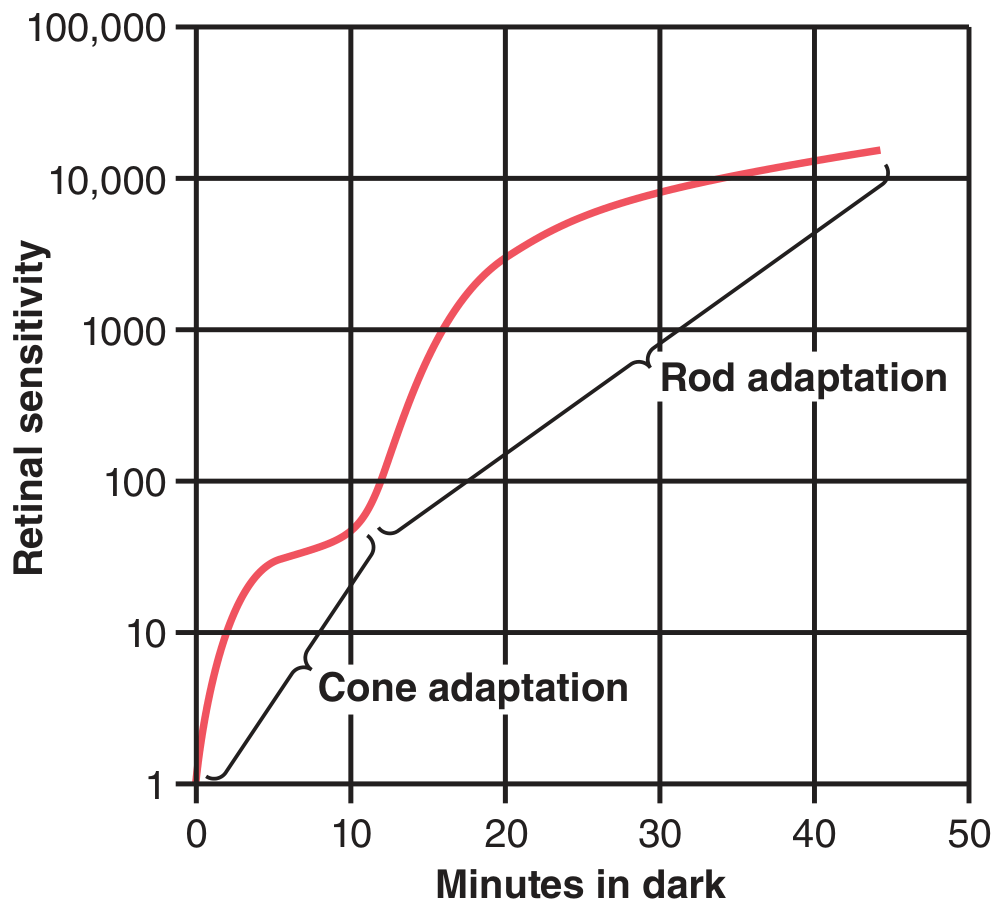
Dark-adaptation curve
It has two phases:
-
Cone phase
- Rapid, small improvement in sensitivity.
- Predominates during the first few minutes.
- Cones adapt about four times faster than rods but never attain rod sensitivity.
-
Rod phase
- Starts to predominate after the rod-cone break, usually about 7-10 minutes.
- Slow but much larger increase in sensitivity.
- Near maximal adaptation occurs at around 20-30 minutes, with some additional improvement possible later.
- Rod convergence onto ganglion cells further improves low-light sensitivity.
Retinal sensitivity rises roughly 10-fold in the first minute, about 6,000-fold by 20 minutes, and approximately 25,000-fold by 40 minutes in the cited physiology text. The full operating range from light-adapted to dark-adapted vision is around 500,000 to 1,000,000-fold. - Guyton and Hall Textbook of Medical Physiology, p. 637
Clinical relevance
- Impaired dark adaptation causes nyctalopia (night blindness).
- Causes include vitamin A deficiency and retinal disorders affecting rods or the retinoid cycle, such as retinitis pigmentosa and fundus albipunctatus.
- Red illumination or red goggles preserve rod dark adaptation because red wavelengths stimulate rods relatively little. - Ganong’s Review of Medical Physiology, p. 205
The visual-pigment recovery process is closely tied to delivery of 11-cis-retinal and rhodopsin regeneration, as summarized in this retinoid-cycle review.
This is a shared conversation. Sign in to Orris to start your own chat.