
from Guyton and Hall textbook of medical physiology, 4th South Asia edition write a 5 mark short note on Fick Principle
Reading File
Finding Sources
Finding Sources
Reading File
Finding Sources
Loading Image
I have everything needed. Here is the complete 5-mark short note:
Fick Principle
(Guyton and Hall Textbook of Medical Physiology, 4th South Asia Edition - p. 262)
Definition
The Fick Principle is a method for measuring cardiac output based on the principle of conservation of mass. It states that the total uptake or release of a substance by an organ equals the product of blood flow through that organ and the arteriovenous difference in concentration of that substance.
Principle
The method uses oxygen as the indicator substance. The lungs absorb oxygen from inhaled air into the pulmonary circulation. Therefore, the amount of oxygen taken up per minute by the lungs must equal the cardiac output multiplied by the difference in oxygen content between arterial and venous blood.
Formula
$$\text{Cardiac Output (L/min)} = \frac{\text{O}_2 \text{ absorbed per minute by the lungs (mL/min)}}{\text{Arteriovenous O}_2 \text{ difference (mL/L of blood)}}$$
Worked Example (from the textbook)
As illustrated in Fig. 20.19:
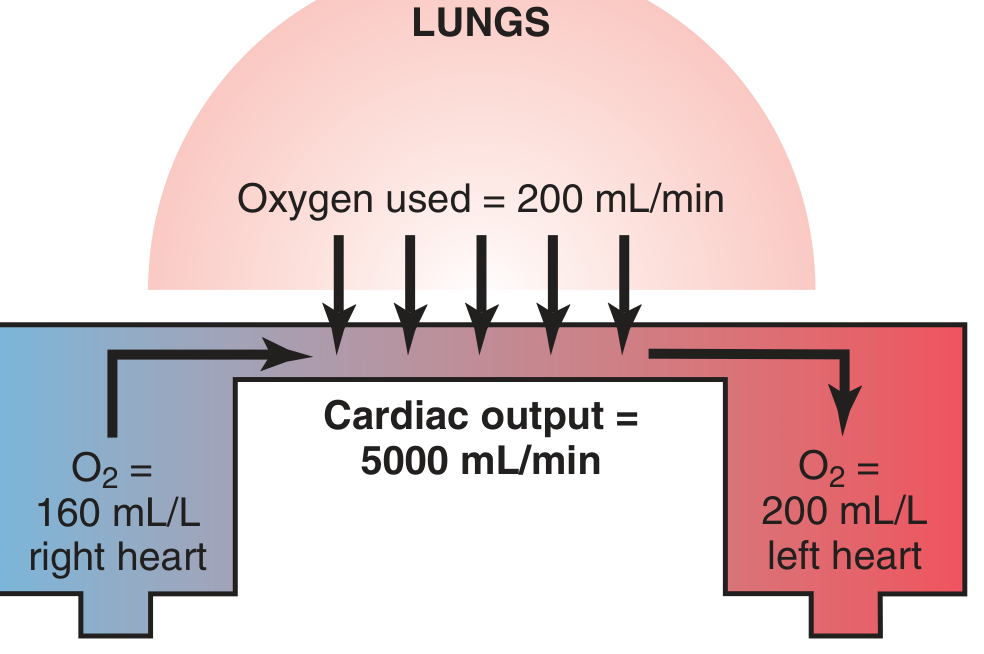
- O2 absorbed by lungs = 200 mL/min
- O2 in blood entering right heart (mixed venous) = 160 mL/L
- O2 in blood leaving left heart (systemic arterial) = 200 mL/L
- Arteriovenous O2 difference = 200 - 160 = 40 mL/L
$$\text{Cardiac Output} = \frac{200 \text{ mL/min}}{40 \text{ mL/L}} = \mathbf{5 \text{ L/min}}$$
Practical Application (Measurement Technique)
To apply the Fick method in humans:
- Mixed venous blood is obtained by inserting a catheter through the brachial vein → subclavian vein → right atrium → right ventricle or pulmonary artery.
- Systemic arterial blood is sampled from any peripheral systemic artery.
- Rate of O2 absorption by the lungs is measured by tracking the rate of disappearance of oxygen from respired air using an oxygen meter.
Significance
- The Fick method is considered the gold standard for cardiac output measurement because it is based on a fundamental conservation law rather than a dye or tracer assumption.
- It is used clinically during right heart catheterization to determine cardiac output in patients with heart failure, valvular disease, and pulmonary hypertension.
- The same principle can be applied using CO2 or other substances instead of oxygen.
Source: Guyton and Hall Textbook of Medical Physiology, 4th South Asia Edition, Chapter 20, p. 262
This is a shared conversation. Sign in to Orris to start your own chat.