
covid
Asking for Preferences
What would you like to know about COVID-19?
COVID-19 symptoms typically include fever, cough, fatigue, and shortness of breath, with loss of taste/smell being a more distinctive feature. Treatment depends on severity - mild cases are managed at home, while severe cases may need antivirals (like Paxlovid), oxygen, and hospitalization. Current variants tend to cause milder illness in vaccinated individuals.
Searching sources...
Reading File
Searching PubMed
"COVID-19"[MeSH Terms] AND "treatment"[MeSH Terms]
Searching the Web
COVID-19 symptoms treatment 2025 2026 current guidelines
Finding Sources
Searching PubMed
"COVID-19" AND ("nirmatrelvir" OR "antiviral" OR "treatment")
Reading Web Page
https://prioritycareclinics.com/new-covid-variant-symptoms
Reading File
Finding Sources
Finding Sources
Reading File
Reading File
Reading File
Reading File
Reading File
I now have thorough information from Goldman-Cecil Medicine (2 Vol Set), Robbins Pathology, and Harrison's to give a complete, well-sourced answer.
Loading Image
Here is a thorough overview of COVID-19 symptoms and treatment, drawn from major medical textbooks and current guidelines.
COVID-19: Symptoms & Treatment
Transmission
SARS-CoV-2 spreads primarily via respiratory droplets and aerosols. Transmission peaks during the first 7-10 days of infection, especially in indoor, poorly ventilated spaces. The incubation period is 2-14 days, with a median of ~5 days. Asymptomatic people can still transmit the virus (accounting for ~20% of transmissions). - Goldman-Cecil Medicine, p. 3547
Symptoms
Most common:
- Fever
- Dry cough
- Fatigue and myalgias
- Anosmia (loss of smell) and ageusia (loss of taste) - hallmark features, though less common with Omicron/newer variants
- Sore throat, headache, nasal congestion
- Shortness of breath (more common in moderate/severe illness)
- Nausea, vomiting, diarrhea (GI symptoms more prominent with Omicron-lineage variants)
2026 variants (e.g., NB.1.8.1): symptoms tend to be upper-respiratory dominant - congestion, runny nose, dry cough, fatigue, headache, body aches. Loss of taste/smell is less frequent than with earlier strains.
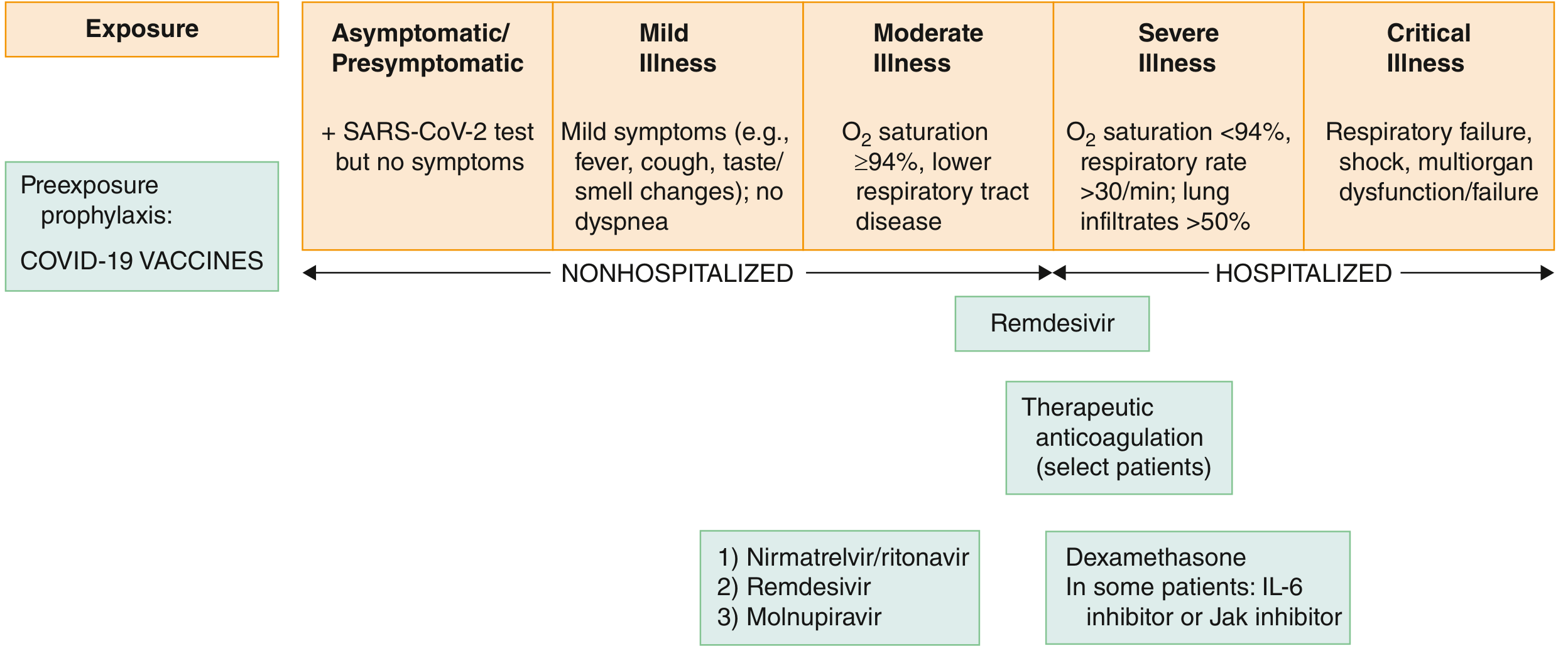
Severity Classification
Patients are classified into four groups:
| Severity | Definition |
|---|---|
| Mild | Symptoms present, no hypoxia (SpO2 >94%), no pneumonia |
| Moderate | SpO2 ≥94%, lower respiratory tract disease on imaging |
| Severe | SpO2 <94%, respiratory rate >30/min, lung infiltrates >50% |
| Critical | Respiratory failure, shock, or multiorgan dysfunction |
Among unvaccinated adults: ~40% mild, ~40% moderate, ~15% severe, ~5% critical. - Goldman-Cecil Medicine, p. 3546
Risk factors for severe disease: Age >65, diabetes, obesity, cardiovascular disease, chronic lung disease, renal disease, immunosuppression, pregnancy, and being unvaccinated.
Treatment by Severity
Mild illness (outpatient, low risk)
- Supportive care: rest, hydration, acetaminophen/ibuprofen for fever and aches
- No COVID-specific antivirals needed for low-risk individuals
- Isolation to prevent transmission
Mild-to-moderate illness (outpatient, high risk of progression)
Antivirals should be started within 5 days of symptom onset. Priority order:
- Nirmatrelvir/ritonavir (Paxlovid) - first choice for most high-risk patients
- Remdesivir (IV, 3-day course) - used if Paxlovid is contraindicated due to drug-drug interactions
- Molnupiravir - when the above are not feasible (FDA EUA for adults)
Hospitalized / Severe illness
- Remdesivir (200 mg IV day 1, then 100 mg daily) - speeds recovery, especially if given within 10 days of symptom onset before mechanical ventilation
- Dexamethasone - mainstay anti-inflammatory for patients requiring oxygen
- IL-6 inhibitors (e.g., tocilizumab) or JAK inhibitors (e.g., baricitinib) - for select patients
- Therapeutic anticoagulation - for some patients with severe disease (thrombotic risk)
- Careful oxygenation management and organ support in the ICU
Not recommended: Ivermectin (no proven benefit), prophylactic aspirin/anticoagulation in outpatients without other indications. - Goldman-Cecil Medicine, p. 3551
Extrapulmonary Complications
COVID-19 can affect nearly every organ:
- Cardiac: myocarditis, myocardial infarction, arrhythmias, thrombosis
- Neurologic: delirium, encephalitis, seizures, myoclonus
- Renal: AKI (about 1/3 of ventilated patients need dialysis)
- Skin: maculopapular eruptions, urticaria, vesicles
- Of hospitalized patients: ~15% need ICU, ~12% need mechanical ventilation, ~3-4% need dialysis. - Goldman-Cecil Medicine, p. 3547
Long COVID
Symptoms persisting at least 1 month after acute infection and lasting 2+ months = long COVID (also called PASC - post-acute sequelae of SARS-CoV-2). Estimated prevalence: ~6% of people who had COVID-19. Common features:
- Physical: fatigue, weakness, dyspnea, chest pain, cough
- Cognitive/psychological: "brain fog," memory/concentration problems, anxiety, depression, PTSD
Risk factors: female sex, severe acute illness, age >20, unvaccinated status. Most recover within a year. - Robbins Pathology, p. 331
When to Seek Medical Care
- Symptoms worsen after several days
- Persistent high fever (>3 days)
- Chest pain or breathing difficulty
- Any high-risk group (elderly, immunocompromised, pregnant, chronic illness)
For current treatment guidelines, see the NIH COVID-19 Treatment Guidelines and IDSA COVID-19 guidelines.
Recent evidence: A 2024 systematic review and meta-analysis (PMID: 39288386) confirmed that Paxlovid (nirmatrelvir/ritonavir) significantly reduces hospitalization and death in high-risk patients with mild-to-moderate COVID-19, supporting its continued use as first-line outpatient antiviral therapy.
This is a shared conversation. Sign in to Orris to start your own chat.