
from Guyton and Hall textbook of medical physiology, 4th South Asia edition write a 5 mark short note on .Mean Arterial Blood Pressure-define,enumerate mechanisms regulating;Baroreceptor Mechanism-describe
Reading File
Finding Sources
Finding Sources
Finding Sources
Finding Sources
Reading File
Reading File
Reading File
Reading File
Finding Sources
Reading File
Reading File
Loading Image
Loading Image
I now have all the necessary content from Guyton and Hall. Here is the complete 5-mark short note:
Short Note: Mean Arterial Blood Pressure and the Baroreceptor Mechanism
(Source: Guyton and Hall Textbook of Medical Physiology, 9780443111013)
I. Definition of Mean Arterial Pressure (MAP)
Mean arterial pressure is the average of the arterial pressures measured millisecond by millisecond over a period of time. It is not equal to the simple average of systolic and diastolic pressures, because at normal heart rates a greater fraction of the cardiac cycle is spent in diastole than in systole. Therefore:
- MAP is determined approximately 60% by diastolic pressure and 40% by systolic pressure
- At the usual resting heart rate, MAP ~ 100 mm Hg (normal range 90-100 mm Hg)
- Formula (at normal heart rates): MAP = Diastolic BP + 1/3 (Pulse Pressure)
At very high heart rates, diastole comprises a smaller fraction of the cycle, and MAP approaches the simple average of systolic and diastolic pressures more closely.
(Guyton & Hall, p. 192 - Chapter 15)
II. Mechanisms Regulating Arterial Blood Pressure (Enumeration)
Blood pressure is regulated by three main categories of mechanisms:
A. Rapid-acting mechanisms (seconds to minutes)
- Baroreceptor (pressoreceptor) reflex
- Chemoreceptor reflex
- CNS ischemic response
- Sympathetic vasoconstrictor system (vasomotor center)
B. Intermediate-acting mechanisms (minutes to hours)
5. Renin-angiotensin vasoconstriction
6. Stress-relaxation of blood vessels
7. Capillary fluid shift mechanism
C. Long-term (slow) mechanisms (hours to days)
8. Renal-body fluid pressure control system (the dominant long-term regulator)
9. Aldosterone-volume mechanism
10. Vasopressin (ADH) mechanism
(Guyton & Hall, Chapter 18)
III. Baroreceptor Mechanism - Description
1. Nature and Location of Baroreceptors
Baroreceptors (also called pressoreceptors) are spray-type nerve endings located in the walls of large systemic arteries that are stimulated when stretched by increased pressure. They are found in small numbers in nearly every large artery of the thoracic and neck region, but are especially abundant in:
- Carotid sinus - the wall of each internal carotid artery, slightly above the carotid bifurcation
- Aortic arch - the wall of the aortic arch
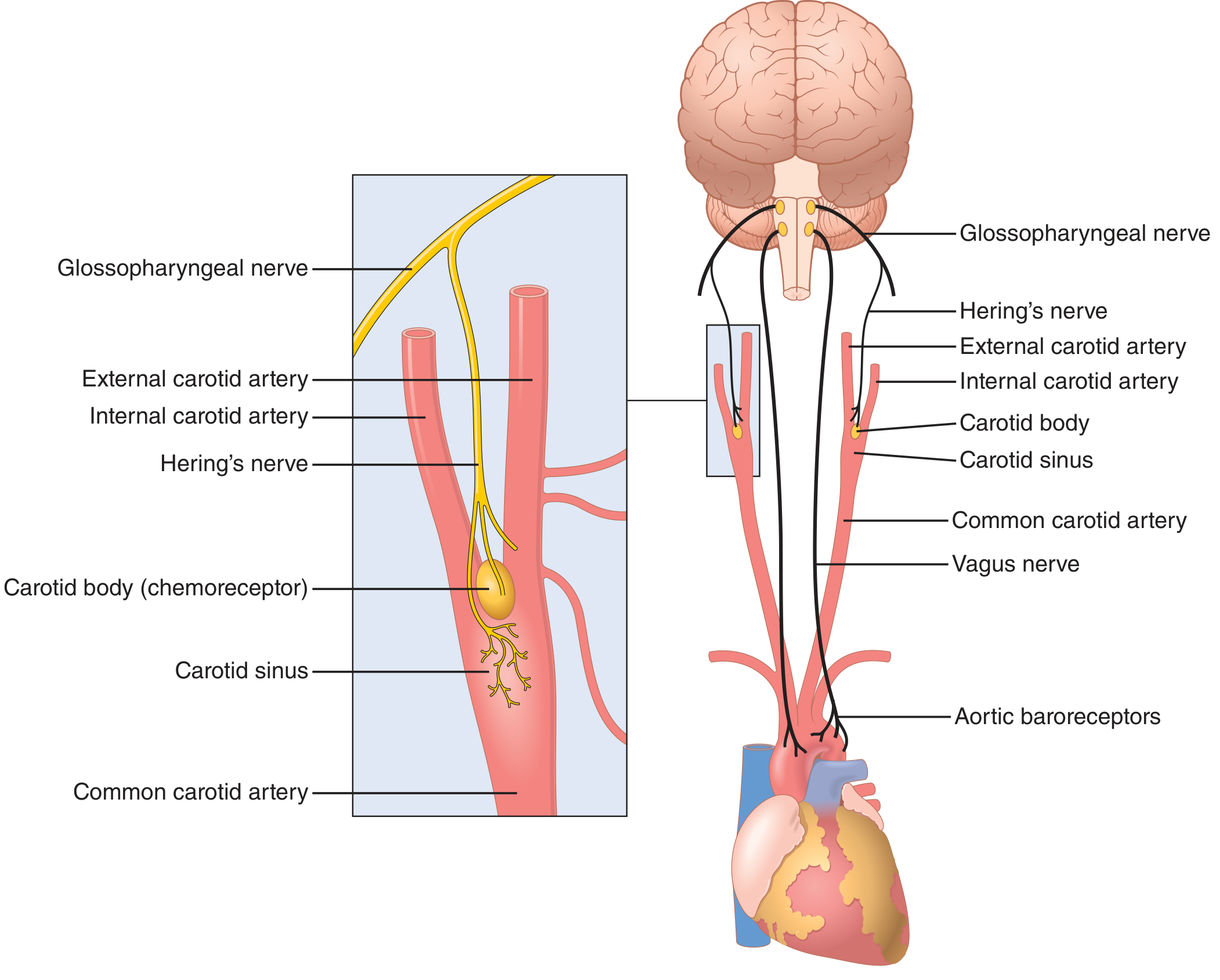
Fig. 18.5: Baroreceptor system for controlling arterial pressure (Guyton & Hall, p. 227)
2. Afferent Innervation
- Carotid sinus baroreceptors - signals travel via Hering's nerve to the glossopharyngeal nerve, then to the nucleus tractus solitarius (NTS) in the medullary brainstem
- Aortic arch baroreceptors - signals travel via the vagus nerve to the same NTS in the medulla
3. Response to Pressure Changes
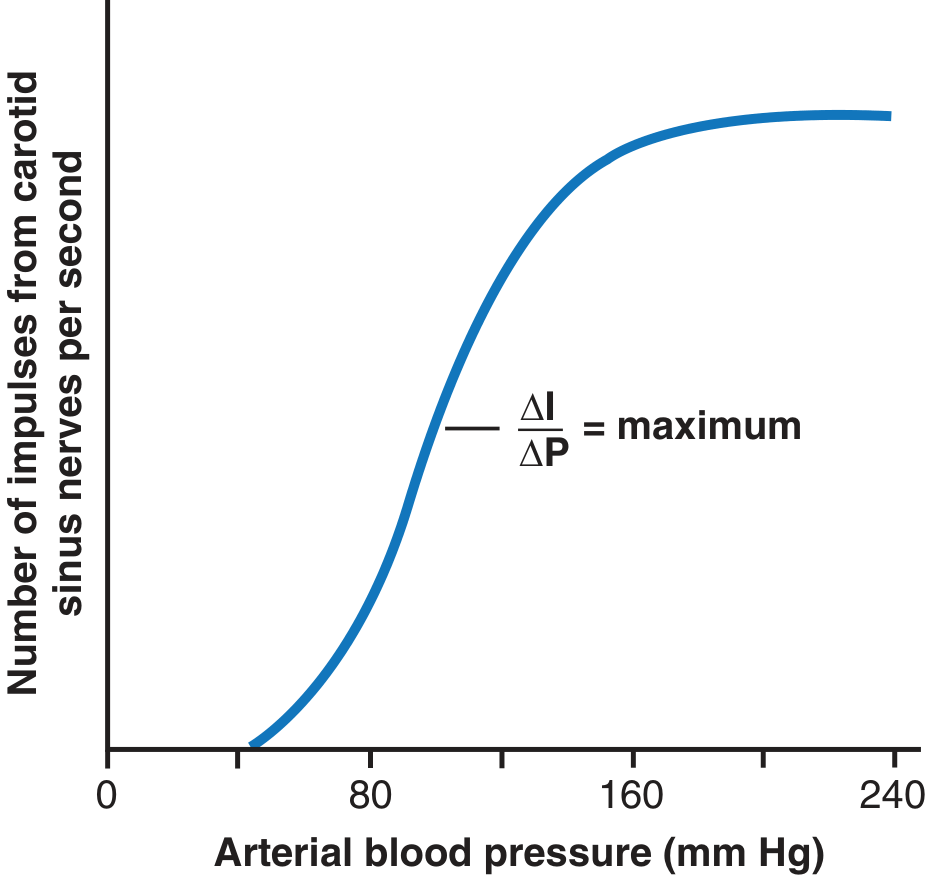
Fig. 18.6: Baroreceptor firing rate vs. arterial blood pressure (Guyton & Hall, p. 227)
- Carotid sinus baroreceptors are not stimulated below 50-60 mm Hg
- They respond progressively more rapidly above 60 mm Hg and reach a maximum at about 180 mm Hg
- Aortic baroreceptors respond similarly but operate about 30 mm Hg higher
- In the normal operating range (~100 mm Hg), even a slight change in pressure causes a strong change in the baroreflex signal - this is where the system is most effective
- The baroreceptors respond more to a rapidly changing pressure than to a stationary one
4. Circulatory Reflex Initiated
After signals enter the NTS, secondary signals:
- Inhibit the vasoconstrictor center of the medulla
- Excite the vagal parasympathetic center
The net cardiovascular effects are:
- Vasodilation of veins and arterioles throughout the peripheral circulation (decreased TPR)
- Decreased heart rate (chronotropic effect via vagus)
- Decreased strength of heart contraction (inotropic effect)
- High arterial pressure → baroreceptors fire → decreased peripheral resistance + decreased cardiac output → pressure falls toward normal
- Low arterial pressure → reduced baroreceptor firing → decreased inhibition of vasomotor center → vasoconstriction + increased heart rate → pressure rises toward normal
5. Buffer Function
Because the baroreceptor system opposes both increases and decreases in arterial pressure, it is called a pressure buffer system, and the nerves from the baroreceptors are called buffer nerves.
- When baroreceptors function normally, MAP is maintained between 85-115 mm Hg throughout the day (mostly at ~100 mm Hg)
- After baroreceptor denervation, the pressure range increases 2.5-fold, frequently falling to 50 mm Hg or rising above 160 mm Hg
- The primary purpose is to reduce minute-by-minute variation in arterial pressure to about one-third of what would occur without the system
6. Additional Roles
Postural hypotension prevention: On standing up after lying down, arterial pressure in the head tends to fall; the baroreceptor reflex elicits immediate sympathetic discharge that minimizes this drop and prevents loss of consciousness.
7. Limitation: Baroreceptor Resetting
Baroreceptors are important for moment-to-moment (short-term) control but have limited role in long-term blood pressure regulation because they tend to reset within 1-2 days to whatever pressure level they are chronically exposed to. For example, if MAP rises to 160 mm Hg, firing rate initially increases sharply but then returns to nearly normal over 1-2 days even though the pressure remains elevated. Long-term regulation of blood pressure is therefore primarily handled by the renal-body fluid pressure control system.
(Guyton & Hall, p. 228-229 - Chapter 18)
Summary Table
| Feature | Detail |
|---|---|
| MAP (normal) | ~100 mm Hg |
| Receptor type | Spray-type nerve endings (stretch receptors) |
| Locations | Carotid sinus, Aortic arch |
| Afferent nerve | Hering's nerve / Glossopharyngeal (carotid); Vagus (aortic) |
| CNS relay | Nucleus tractus solitarius, medulla |
| Response to high BP | Vasodilation + bradycardia + reduced contractility |
| Response to low BP | Vasoconstriction + tachycardia + increased contractility |
| Operating range | 60-180 mm Hg (most sensitive near 100 mm Hg) |
| Main function | Short-term (moment-to-moment) pressure buffering |
| Limitation | Resets in 1-2 days; not effective for long-term control |
This is a shared conversation. Sign in to Orris to start your own chat.