
What is new in post partum Haemorrage
"postpartum hemorrhage" management
new updates postpartum hemorrhage management guidelines 2024 2025
https://www.ncbi.nlm.nih.gov/books/NBK619233
PMID: 40237648
PMID: 40743526
PMID: 41056961
What's New in Postpartum Haemorrhage (PPH) - 2025 Updates
Major Development: WHO Consolidated Guidelines (October 2025)
1. Revised Definition of PPH
Blood loss ≥ 1,000 mL accompanied by signs of hypovolemia (rather than the older ≥500 mL cutoff)
- The conventional 500 mL threshold has only 75.7% sensitivity for predicting mortality or severe morbidity
- Sensitivity improves to 87-88% when combining blood loss of 300-450 mL plus any abnormal haemodynamic sign (pulse >100, SBP <100, DBP <60, or shock index >1.0)
- This supports a combined clinical marker approach over volume alone for earlier diagnosis
2. New Guidance on Tranexamic Acid (TXA) - KEY UPDATE
- Rec. 14 (NEW): TXA is NOT recommended for prevention of PPH at vaginal birth
- Rec. 15 (NEW): TXA is NOT recommended for prevention of PPH at caesarean birth
3. Uterotonic Rankings - Updated Cochrane Network Meta-Analysis (2025)
| Rank | Agent | PPH ≥500 mL vs Oxytocin |
|---|---|---|
| 1st (tied) | Ergometrine + Oxytocin | RR 0.76 (high certainty) |
| 1st (tied) | Misoprostol + Oxytocin | RR 0.70 (moderate certainty) |
| Equivalent | Carbetocin | Similar (high certainty) |
- Combination agents outperform oxytocin alone, though with more side effects
- WHO still recommends oxytocin 10 IU (IM/IV) as the first-line standard (Rec. 24, revalidated), but combination therapy is preferred where feasible
- Carbetocin (heat-stable formulation) continues to be supported especially in low-resource settings without cold chains
4. Updated Diagnostic Approach
- Universal objective blood loss measurement (calibrated drapes, weighing) is now recommended - not visual estimation
- Standardized risk assessment tool before and after every delivery
- Early action at combined threshold of ≥300 mL + any haemodynamic sign, rather than waiting for 500 mL
5. ACOG Update: Nonsurgical Hemorrhage-Control Devices (October 2025)
- Uterine balloon tamponade remains a core second-line intervention
- Newer devices (e.g. Jada system - intrauterine vacuum-induced hemorrhage control) are now addressed with revised guidance
- Devices should be used as part of a structured bundle, not in isolation
6. Structured Treatment Bundle (Revalidated & Reinforced)
- Objective assessment of blood loss
- Rapid uterine massage
- Uterotonic agent (oxytocin IV/IM)
- Tranexamic acid 1g IV (for treatment, within 3 hours of delivery)
- IV fluids
- Genital tract examination
- Clear escalation to second-line (balloon tamponade → surgical repair → embolization → hysterectomy)
7. Aetiology Confirmed by Global Data
- Uterine atony: 70.6% of cases
- Genital tract trauma: 16.9%
- Retained placenta: 16.4%
- Coagulation disorders: less common
8. Health Systems & Global Implementation
- Supply chain strengthening for heat-stable uterotonics in low-resource settings
- Training modules and simulation-based emergency drills for frontline workers
- National implementation guides, developed with UNFPA
- Equity lens - most of the 70,000 annual deaths occur in low- and middle-income countries
Summary Table: What Changed in 2025
| Area | Old Guidance | New/Updated 2025 |
|---|---|---|
| Definition | ≥500 mL | ≥1,000 mL with haemodynamic signs OR ≥300-450 mL + abnormal vitals |
| TXA prophylaxis | Debated/used by some | NOT recommended (vaginal or C-section) |
| TXA treatment | Recommended | Confirmed - within 3 hours |
| Best uterotonic | Oxytocin alone | Oxytocin + ergometrine OR oxytocin + misoprostol superior |
| Diagnosis threshold | Volume-only | Volume + haemodynamic signs combined |
| Nonsurgical devices | ACOG 2017 guidance | Updated 2025 (includes Jada system) |
- WHO Consolidated PPH Guidelines 2025, executive summary
- Gallos et al., Lancet 2025 - prognostic markers meta-analysis (PMID: 41056961)
- Gallos et al., Cochrane 2025 - uterotonic network meta-analysis (PMID: 40237648)
- ACOG Clinical Practice Update 2025 on nonsurgical hemorrhage-control devices
Massive transfusion b protocol what is it
"massive transfusion protocol" hemorrhage ratio
massive transfusion protocol MTP blood product ratios 1:1:1 definition activation criteria 2024 2025
Massive Transfusion Protocol (MTP) - Complete Overview
What Is It?
- Rosen's Emergency Medicine, p. 2429
- Henry's Clinical Diagnosis, p. 881
Definition of Massive Transfusion (Trigger Volume)
| Setting | Definition |
|---|---|
| Adults | > 10 units PRBCs in 24 hours OR ≥3 units in 1 hour OR ≥150 mL/min blood loss |
| Adults (volume) | Loss of 1 complete blood volume (~5L/70 mL/kg) in 24h |
| Children | ≥80 mL/kg in 24h OR ≥40 mL/kg in 3 hours |
Activation Criteria - The ABC Score
| Criterion | Score |
|---|---|
| Penetrating mechanism | 1 |
| SBP ≤ 90 mmHg | 1 |
| Heart rate > 120 bpm | 1 |
| Positive FAST exam | 1 |
- Blood loss > 150 mL/min
- Blood loss > 50% of blood volume within 3 hours
- Anticipated need for ≥3 units in 1 hour
The Core Concept: Damage Control Resuscitation (DCR)
- Massive hemorrhage depletes all blood components - red cells, plasma, platelets, and clotting factors
- Replacing only red cells (old strategy) worsens the lethal triad: coagulopathy + hypothermia + acidosis
- Reconstituting whole blood by giving components in a ratio approximating whole blood is the solution
The 1:1:1 Ratio - The Standard of Care
| Ratio (PRBCs : FFP : Platelets) | Outcome |
|---|---|
| 1:1:1 | Fewer deaths from exsanguination at 24h |
| 2:1:1 | No difference in overall 30-day mortality |
- Rosen's Emergency Medicine, p. 2430
- Bailey & Love's Surgery, 28th Ed.
MTP Protocol - Step-by-Step (Denver Health/Schwartz's Surgery Model)
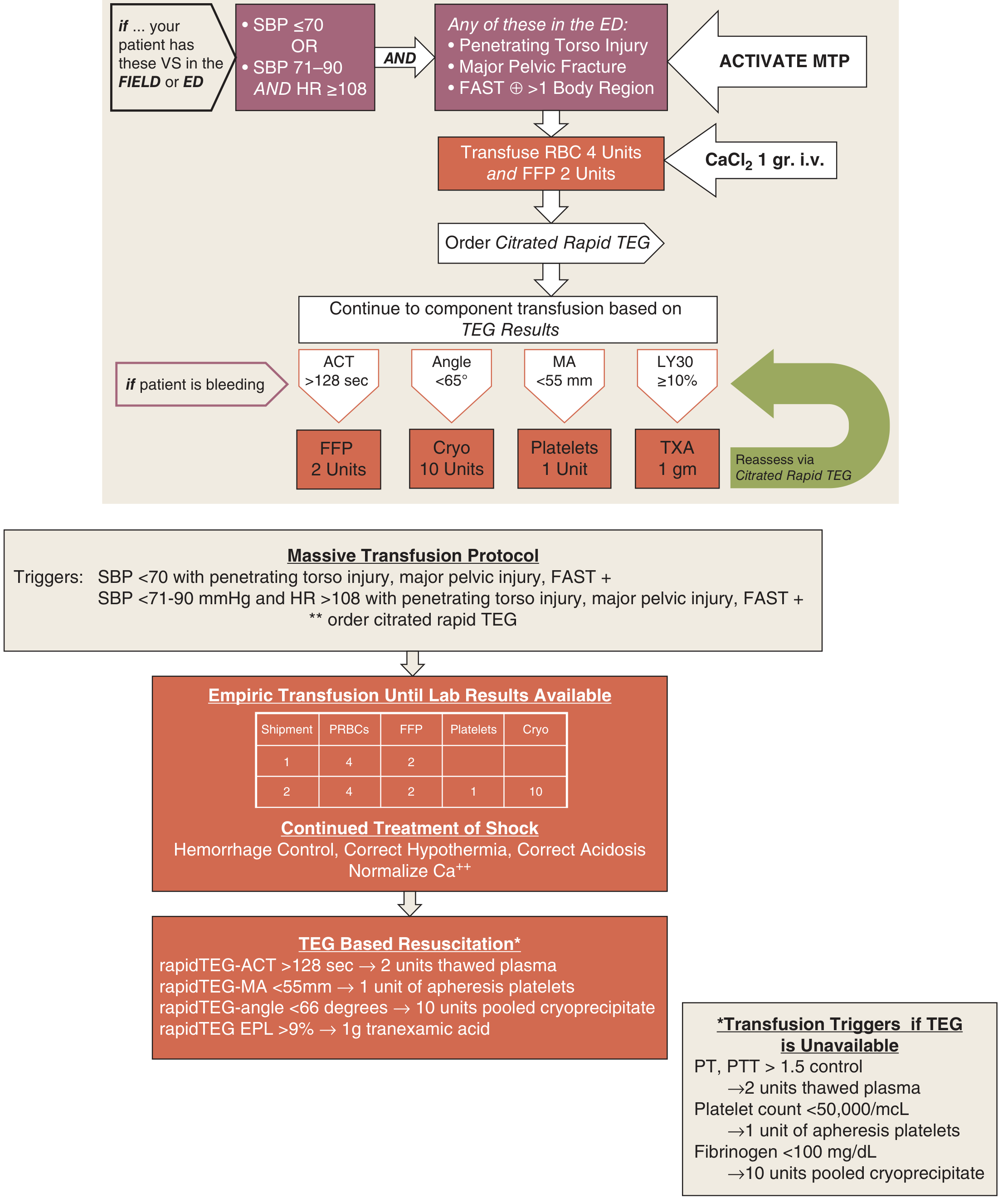
Phase 1 - Trigger & Activate
- SBP ≤70 OR (SBP 71-90 AND HR ≥108) PLUS any of: penetrating torso injury / major pelvic fracture / FAST+ in >1 region
- ACTIVATE MTP - call blood bank, notify OR, anaesthesia, lab
- Give CaCl₂ 1g IV immediately (combat citrate-induced hypocalcaemia)
Phase 2 - Empiric (Pre-Lab) Transfusion
| Shipment | PRBCs | FFP | Platelets | Cryo |
|---|---|---|---|---|
| Pack 1 | 4 units | 2 units | - | - |
| Pack 2 | 4 units | 2 units | 1 unit | 10 units |
Phase 3 - Goal-Directed (TEG/ROTEM-Guided)
| TEG Parameter | Threshold | Give |
|---|---|---|
| ACT (clotting time) | > 128 sec | FFP 2 units |
| Angle (fibrin kinetics) | < 65° | Cryoprecipitate 10 units |
| MA (platelet function) | < 55 mm | Platelets 1 unit (apheresis) |
| LY30 (fibrinolysis) | ≥ 10% | TXA 1g |
- PT/PTT > 1.5x control → FFP 2 units
- Platelets < 50,000/µL → 1 unit apheresis platelets
- Fibrinogen < 100 mg/dL → 10 units pooled cryoprecipitate
The "Lethal Triad" MTP Targets
         COAGULOPATHY
              △
             /|\
            / | \
           /  |  \
    ACIDOSIS──────HYPOTHERMIA
- Clotting factors/FFP → treat coagulopathy
- Warming all blood products → prevent/treat hypothermia
- Restoring perfusion (not crystalloid overload) → treat acidosis
Blood Products in MTP - At a Glance
| Product | Role | Key Points |
|---|---|---|
| PRBCs | Oxygen-carrying capacity | Start with Group O uncrossmatched if urgent; Rh-negative preferred for females of childbearing age |
| FFP (Fresh Frozen Plasma) | Replaces all clotting factors | Given when PT/APTT >1.5x normal |
| Platelets | Haemostatic plug | Give if count <50,000; use apheresis units |
| Cryoprecipitate | Fibrinogen + Factor VIII + vWF + XIII | Give if fibrinogen <100 mg/dL |
| Whole Blood (Low-Titer Type O) | All components in one unit | Re-emerging as preferred option especially in pre-hospital/military settings |
| Tranexamic Acid (TXA) | Antifibrinolytic | 1g IV within 3 hours of injury/bleeding onset; do NOT give after 3 hours |
| Calcium | Reverses citrate toxicity | Give CaCl₂ or calcium gluconate with every pack |
Whole Blood - The Emerging Trend
- Provides all components in physiological ratios in a single unit
- Reduces logistical burden in pre-hospital care
- Reduces donor exposures
- ACS TQIP now includes guidance on LTOWB in MTP frameworks
When to Stop (MTP Termination Criteria)
- Bleeding is controlled surgically
- Haemodynamics are stable
- Labs normalize (Hb, PT/INR, fibrinogen, platelets in acceptable range)
- Clinical decision by senior physician
Complications of Massive Transfusion
| Complication | Mechanism | Management |
|---|---|---|
| Hypothermia | Cold blood products | Fluid warmers, warm blankets, Bair Hugger |
| Hypocalcaemia | Citrate chelates calcium | CaCl₂ 1g IV per pack |
| Hyperkalaemia | Stored blood releases K⁺ | Monitor, ECG |
| Metabolic acidosis | Hypoperfusion + citrate | Optimize O₂ delivery; NOT bicarbonate |
| TRALI | Immune reaction to donor plasma | Supportive; use male donor or pathogen-reduced plasma |
| Dilutional coagulopathy | Volume replacing coagulation factors | Guided by TEG/ROTEM |
| Hypothermic coagulopathy | Cold reduces clotting factor activity | Warming |
Key Evidence Base
- The PROPPR trial (Holcomb et al.): 1:1:1 reduces exsanguination deaths at 24h vs 2:1:1
- Williams et al., Cochrane 2025 - transfusion of blood products for PPH management (PMID: 39911088)
- ACS TQIP MTP Guidelines - standardization across trauma systems, 2025
- TEG/ROTEM-guided resuscitation associated with lower mortality vs conventional coag parameters in trauma (Rosen's EM, p. 2430)
What is new in Endomeetriosis
endometriosis diagnosis treatment guidelines
endometriosis new developments 2024 2025 diagnosis biomarkers treatment guidelines
PMID: 38555044
PMID: 39488350
PMID: 40312882
https://www.emjreviews.com/reproductive-health/congress-revi…
endometriosis linzagolix elagolix relugolix new drug treatment 2024 2025
endometriosis 2025 new drugs GnRH antagonist linzagolix ACOG clinical diagnosis laparoscopy not required
What's New in Endometriosis - 2024/2025 Updates
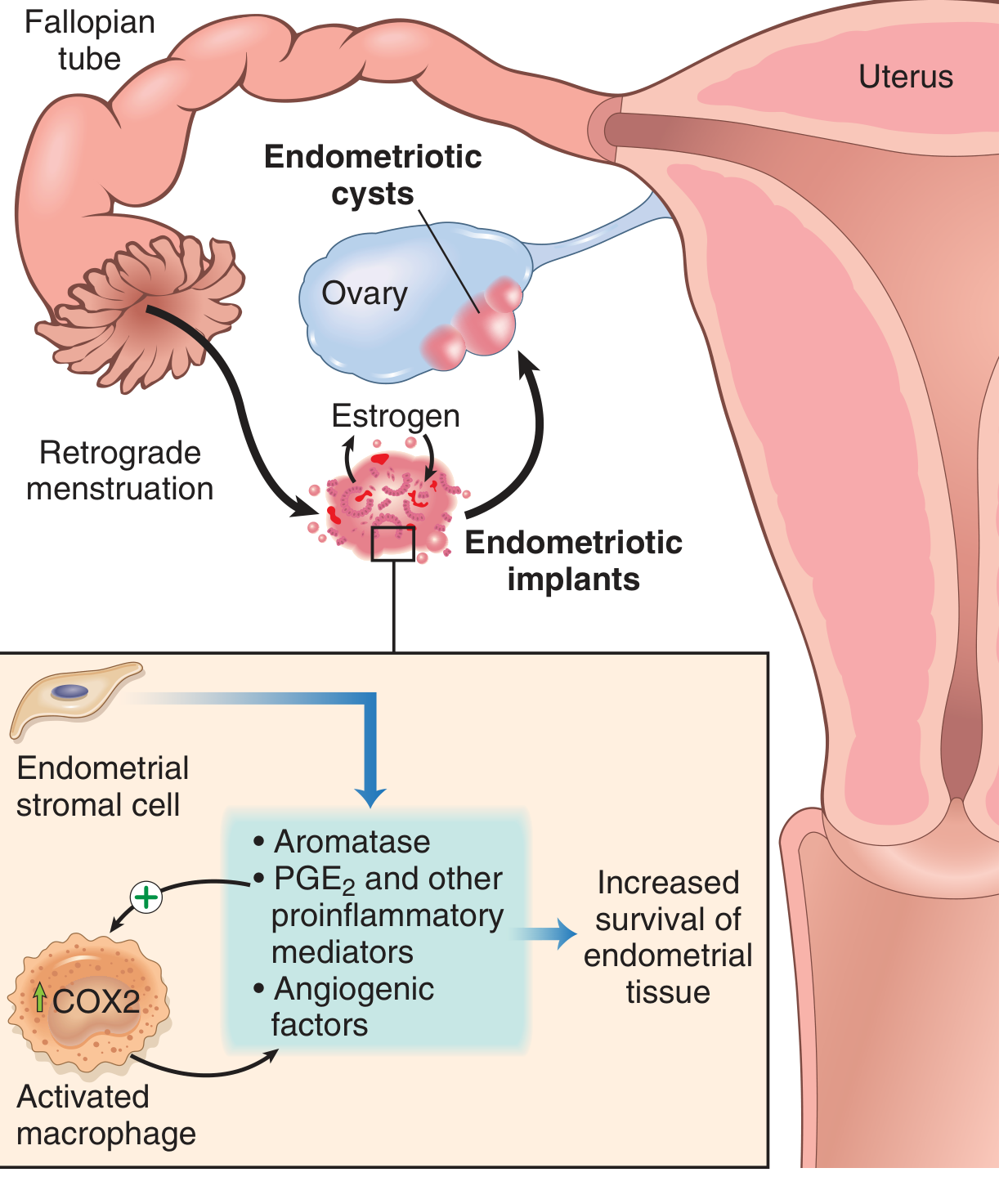
Quick Pathogenesis Recap
1. BIGGEST CHANGE: End of the "Laparoscopy First" Dogma
Old Standard
New Approach (ACOG 2025, ESHRE 2022, NICE 2024, Canadian Guideline 2024)
- Characteristic symptoms (dysmenorrhoea, deep dyspareunia, dyschezia, chronic pelvic pain, infertility)
- Physical examination (fixed retroverted uterus, tender uterosacral ligaments, deeply infiltrating nodules in POD)
- Imaging (TVUS, MRI) - especially for endometriomas and DIE
Laparoscopy is still needed when: imaging is negative but symptoms are convincing, surgical intervention is planned, or cancer needs to be excluded.
2. Imaging Advances - "Imaging First"
Transvaginal Ultrasound (TVUS) - Now Standardized
- The IDEA (International Deep Endometriosis Analysis) group in 2024 expanded its consensus guidelines to include routine evaluation of the parametrium for lateral compartment disease
- Standardized TVUS protocols now reliably detect DIE, endometriomas, and bowel involvement
- Pelveoneurosonography - a new technique that visualises sacral nerve roots and plexus, structures implicated in chronic pelvic pain that were previously invisible on standard imaging
MRI - Harmonised Protocols
- MRI protocols are being standardised internationally for greater consistency in preoperative assessment
- MRI detects haemosiderin deposits in abdominal organs suggesting DIE; role is strongest for complex or extragenital disease
Molecular Imaging - DETECT Study (Oxford)
- Non-invasive, functional imaging of active endometriotic lesions
- Detection of early-stage and superficial peritoneal disease (the one type current imaging still misses)
New ACR Appropriateness Criteria (2024)
3. Biomarkers - Approaching Clinical Readiness
Why Biomarkers Matter
| Biomarker Type | Candidates | Status |
|---|---|---|
| Blood-based microRNAs (miRNAs) | Specific miRNA panels | Validation studies published (Nature 2025) |
| Salivary signature | 109-miRNA panel | High sensitivity and specificity in validation studies |
| Menstrual effluent | Neutrophil morphology changes | 2025 findings - neutrophils signal incorrectly in endometriosis |
| Serum proteins | VEGF, IL-6, MMP panels | Research stage |
Current Reality Check (ESHRE 2025)
4. New Drugs - Oral GnRH Antagonists
Traditional Medical Options (Still Used)
| Drug Class | Agents | Role |
|---|---|---|
| NSAIDs | Ibuprofen, mefenamic acid | First-line analgesia |
| Combined OCP | Any COC | First-line hormonal suppression |
| Progestogens | Dienogest, DMPA, LNG-IUS | First/second line |
| GnRH agonists | Leuprolide, goserelin | Second-line (injectable, with add-back) |
NEW: Oral GnRH Antagonists - Second-Line Standard
| Drug | Brand | Status | Key Feature |
|---|---|---|---|
| Elagolix | Orilissa | FDA approved (US); CDSCO approved India (March 2024) | Daily oral; dose-dependent hypoestrogenism; ACOG 2025 meta-analysis confirms efficacy |
| Relugolix + estradiol/norethisterone | Ryeqo | EMA approved (Europe); MHRA approved (UK) | Combined with add-back therapy in a single tablet; prevents bone loss |
| Linzagolix | Yselty | EMA approved | Once daily; flexible dosing |
- Immediate suppression (no initial "flare" of estrogen/LH seen with agonists)
- Oral formulation (vs injectable agonists)
- Rapid reversibility on stopping
- Titratable dosing - can balance symptom control vs. side effects (hot flushes, bone loss)
- All used with add-back hormone therapy to mitigate hypoestrogenic side effects and bone loss
5. Aromatase Inhibitors - Confirmed Role in Refractory Cases
- Medical castration failures
- Postmenopausal patients with recurrent disease
- Deep infiltrating endometriosis refractory to standard therapy
6. Artificial Intelligence in Diagnosis
- Triage role - identifying patients who need specialist imaging or referral
- Adolescent and fertility patient pathways - accelerating diagnosis in high-risk groups
- MRI pattern recognition - deep learning models being trained on pelvic MRI datasets
- TVS analysis - though highly operator-dependent images make AI development harder
7. Endometriosis and Fertility - New Evidence
- Endometriosis independently increases risks of placenta praevia, preterm birth, and SGA neonates
- IVF outcomes are affected - but less than previously thought when confounders are separated
Endometrioma Surgery Before IVF
- Ovarian cystectomy (not drainage) still preferred for definitive treatment
- Preoperative oocyte cryopreservation should be considered for bilateral disease
8. New Classification Needs
9. Psychosocial Recognition - A Formal Update
10. Global Prevalence - Updated Estimates
Summary Table: Key 2024-2025 Changes
| Domain | Old Practice | New in 2024-2025 |
|---|---|---|
| Diagnosis | Laparoscopy required | Clinical diagnosis sufficient; imaging first |
| Imaging | TVUS for endometriomas only | Standardised TVUS/MRI; parametrium assessment; pelveoneurosonography |
| Molecular imaging | None | DETECT study: ⁹⁹ᵐTc-maraciclatide tracer in trials |
| Biomarkers | CA-125 (poor) | miRNA panels, salivary 109-miRNA signature; menstrual effluent neutrophils |
| New drugs | GnRH agonist injections | Oral GnRH antagonists: elagolix, relugolix, linzagolix approved |
| AI | Not in use | Triage, imaging analysis - research stage |
| Pain: non-pharma | Physiotherapy, psychology | VR immersive therapy - promising new evidence |
| Fertility | Empiric risk | Independent risks quantified from ART data |
| Psychosocial | Rarely addressed formally | Formal guideline recommendation for psychological support |
All tests for checking ovarian reserve
"ovarian reserve" AMH antral follicle count testing
ovarian reserve tests AMH AFC FSH inhibin B complete list clinical use 2024 2025