
Most dangerous position of appendix ?
Retrocecal position is the most dangerous position of the appendix.
Reading File
Searching sources...
Finding Sources
Finding Sources
Good results found. Let me read the key sections for full detail.
Reading File
Reading File
Reading File
Let me also fetch the positions diagram and get the Sleisenger content for a complete picture.
Loading Image
Reading File
Excellent - I now have all the information needed for a thorough answer. Here is the full response:
Most Dangerous Position of the Appendix: Retrocecal
The retrocecal position is universally regarded as the most dangerous position of the appendix for clinical purposes. Here is why, broken down systematically.
Positions of the Appendix (Frequency)
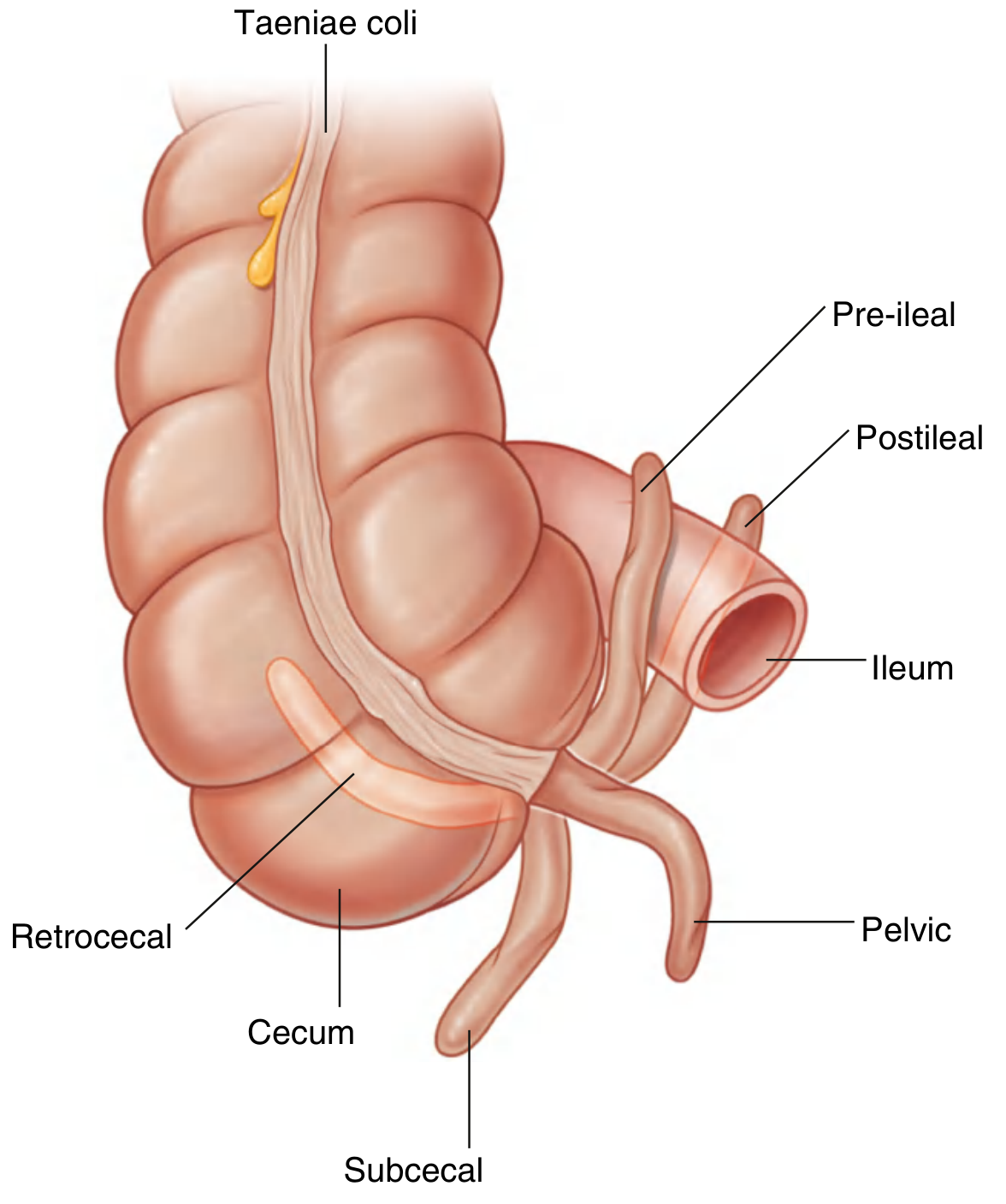
| Position | Approximate Frequency |
|---|---|
| Retrocecal / retrocolic | ~60-70% (most common) |
| Pelvic / descending | ~30% |
| Retroperitoneal | ~7-10% |
| Subcecal | Uncommon |
| Pre-ileal / post-ileal | Uncommon |
The appendix may assume "any position of a clock hand," with the appendiceal origin at the centre - Sleisenger and Fordtran's GI and Liver Disease.
Why Retrocecal is the Most Dangerous
1. Atypical / Absent Classic Signs of Appendicitis
In a standard (non-retrocecal) inflamed appendix, the organ contacts the parietal peritoneum of the right iliac fossa, producing the hallmark somatic pain at McBurney's point and rebound tenderness. However:
"The appendix is situated in a retrocecal position in approximately 70% of patients; therefore it may never contact the parietal peritoneum anteriorly in the right iliac fossa."
- Gray's Anatomy for Students
Without parietal peritoneal irritation:
- There is no classical shift of pain from the umbilicus to the right iliac fossa
- Guarding and rigidity are absent or minimal
- McBurney's tenderness may be absent
- The patient (and clinician) may not recognize appendicitis until perforation has already occurred
2. Delayed Diagnosis - the Core Danger
Because the classic triad (periumbilical pain shifting to RIF + nausea/vomiting + fever) is incomplete or absent, diagnosis is delayed. By the time the appendix perforates in this position, the infection spreads retroperitoneally, which is far harder to drain and control than intraperitoneal pus.
3. Psoas Sign May Be the Only Clue
When the retrocecal appendix lies against the psoas major, an inflamed appendix irritates the muscle. The positive psoas sign (pain on passive extension of the right hip) may be the only localizing clinical finding.
4. Can Mimic Other Conditions
The retrocecal appendix can contact:
- The right ureter - causing urological symptoms (hematuria, flank pain), mimicking renal colic
- The right kidney - mimicking pyelonephritis
- The psoas muscle - causing a psoas abscess
This diagnostic confusion further delays surgical intervention.
5. Retroperitoneal Spread of Infection
If the appendix is fully retroperitoneal (7-10%), perforation leads to retroperitoneal abscess, which is a more serious and difficult-to-treat complication compared to intraperitoneal abscess.
Summary Table
| Feature | Retrocecal Appendix |
|---|---|
| Frequency | Most common position (~65-70%) |
| Classic McBurney's tenderness | Absent or atypical |
| Rebound tenderness / guarding | Absent (no parietal peritoneal contact) |
| Key sign | Psoas sign (positive) |
| Mimic | Renal colic, pyelonephritis |
| Danger | Delayed diagnosis, retroperitoneal spread |
Bottom line: Retrocecal appendix is the most dangerous because it is the most common position AND produces an atypical clinical picture - the classic signs of appendicitis are absent or masked. This leads to delayed diagnosis, higher perforation rates, and retroperitoneal spread of infection when perforation occurs.
Sources: Gray's Anatomy for Students; Sabiston Textbook of Surgery; Sleisenger and Fordtran's Gastrointestinal and Liver Disease
This is a shared conversation. Sign in to Orris to start your own chat.