
from Guyton and Hall textbook of medical physiology, 4th South Asia edition, write a 5-mark short note on Peptic Ulcer-etiology, physiological basis
Reading File
Finding Sources
Finding Sources
Reading File
Reading File
Loading Image
Reading File
I now have all the required content directly from Guyton and Hall. Here is the complete 5-mark short note:
Short Note: Peptic Ulcer - Etiology and Physiological Basis
(Guyton and Hall Textbook of Medical Physiology, 4th South Asia Edition - Chapter 67)
Definition
A peptic ulcer is an excoriated area of stomach or intestinal mucosa caused principally by the digestive action of gastric juice or upper small intestinal secretions.
Common Sites
The most frequent sites are within a few centimeters of the pylorus. Ulcers also occur along the lesser curvature of the antral end of the stomach and, more rarely, in the lower esophagus where stomach juice refluxes. A marginal ulcer occurs where a surgical gastrojejunostomy has been made.
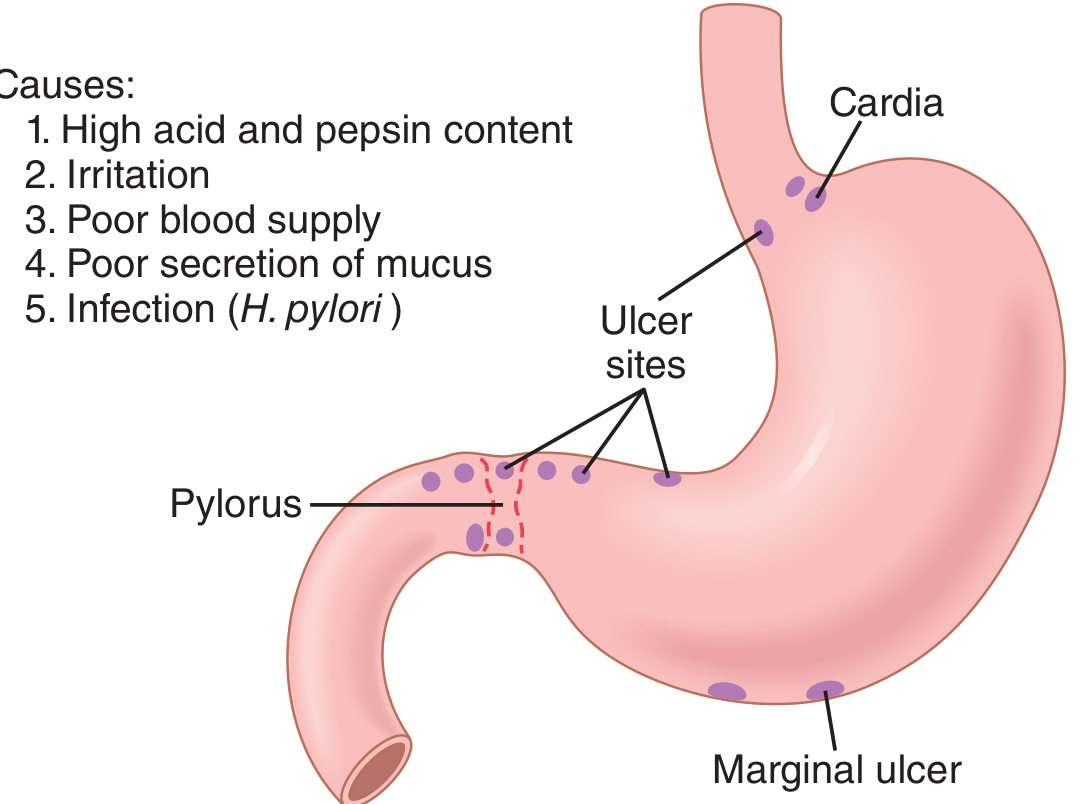
Basic Physiological Basis (Pathogenesis)
Peptic ulceration results from an imbalance between:
- Aggressive factors - rate of gastric acid and pepsin secretion
- Defensive factors - the gastroduodenal mucosal barrier and neutralization of acid
Defensive Mechanisms Normally Present:
- Mucus layer - compound mucous glands of the esophagus, mucous cell coating of stomach, mucous neck cells of gastric glands, pyloric glands, and Brunner's glands of the upper duodenum (which secrete a highly alkaline mucus)
- Bicarbonate neutralization - pancreatic secretion (rich in NaHCO₃) neutralizes HCl and inactivates pepsin; bile and Brunner's gland secretions also contribute
- Two feedback control mechanisms:
- Excess acid in duodenum inhibits gastric secretion and peristalsis via nervous reflexes and hormonal feedback, reducing gastric emptying rate
- Acid in the small intestine liberates secretin from intestinal mucosa, which stimulates pancreatic juice secretion (high NaHCO₃ content) for acid neutralization
A peptic ulcer forms when either: (1) excess secretion of acid and pepsin occurs, or (2) the mucosal barrier is diminished.
Etiology - Specific Causes
1. Helicobacter pylori Infection (Most Important - >75% of cases)
- Chronic infection of the terminal gastric mucosa and initial duodenal mucosa
- H. pylori penetrates the mucosal barrier by burrowing physically through it and by releasing ammonium, which:
- Liquefies the mucus barrier
- Stimulates HCl secretion
- Strongly acidic gastric secretions then penetrate the exposed epithelium, causing digestion of the GI wall - leading to ulceration
- Infection lasts a lifetime unless eradicated by antibacterial therapy
2. Excess Acid Secretion
- Many duodenal ulcer patients have gastric acid secretion up to twice normal
- Can be triggered by H. pylori infection, psychic disturbances (psychological stress), or other stimulants of gastric glands
3. Other Predisposing Factors
| Factor | Mechanism |
|---|---|
| Smoking | Increased nervous stimulation of gastric secretory glands |
| Excess alcohol | Breaks down the mucosal barrier directly |
| Aspirin/NSAIDs | Strong propensity to break down the mucosal barrier |
| Poor blood supply | Reduces mucosal resistance to digestion |
| Poor mucus secretion | Impairs the protective mucus layer |
Summary
Peptic ulceration occurs when protective mucosal defenses are overwhelmed by aggressive acid-pepsin activity. The single most common cause is H. pylori infection (>75%), which both breaches the barrier and amplifies acid secretion. Excess acid from any etiology (psychological stress, smoking, alcohol, NSAIDs) further tips this balance toward ulceration.
(Guyton and Hall Textbook of Medical Physiology, 4th South Asia Edition, Chapter 67, pp. 824-825)
from Guyton and Hall textbook of medical physiology, 4th South Asia edition, write a 5-mark short note on Peptic Ulcer-etiology, physiological basis of treatment
I already have the full Guyton and Hall content on Peptic Ulcer from the previous turn, including etiology and treatment. Let me compose the short note directly.
Short Note: Peptic Ulcer - Etiology and Physiological Basis of Treatment
(Guyton and Hall Textbook of Medical Physiology, 4th South Asia Edition - Chapter 67)
Definition
A peptic ulcer is an excoriated area of stomach or intestinal mucosa caused principally by the digestive action of gastric juice or upper small intestinal secretions.
Common Sites
Most frequent sites: within a few centimeters of the pylorus, along the lesser curvature of the antral stomach, lower esophagus (due to reflux), and at a surgical gastrojejunostomy (marginal ulcer).
Etiology
Peptic ulceration results from an imbalance between aggressive factors (acid/pepsin secretion) and defensive factors (mucosal barrier + neutralization). A peptic ulcer forms when either (1) excess acid and pepsin are secreted or (2) the mucosal barrier is broken down.
Specific Causes:
1. Helicobacter pylori Infection (>75% of cases)
- Chronic infection of the terminal gastric and initial duodenal mucosa
- H. pylori penetrates the mucosal barrier by physically burrowing through it and by releasing ammonium, which:
- Liquefies the protective mucus barrier
- Stimulates excess HCl secretion
- Exposed epithelium is then digested by gastric acid-pepsin, causing ulceration
- Infection persists lifelong unless eradicated by antibacterial therapy
2. Excess Acid Secretion
- Duodenal ulcer patients may have acid secretion up to twice normal
- Triggers: H. pylori, psychological/psychic disturbances (stress stimulates vagal and gastric gland activity)
3. Other Predisposing Factors
| Factor | Mechanism |
|---|---|
| Smoking | Increased nervous stimulation of gastric secretory glands |
| Excess alcohol | Directly breaks down the mucosal barrier |
| Aspirin/NSAIDs | Break down the mucosal barrier (inhibit prostaglandin-mediated protection) |
| Poor blood supply | Reduces mucosal resistance to digestion |
| Poor mucus secretion | Impairs the protective mucus coating |
Physiological Basis of Treatment
Since the discovery that most peptic ulcers have a bacterial infectious basis, treatment is directed at two targets:
1. Eradication of H. pylori - Antibacterial Therapy
- Rationale: H. pylori is the root cause in >75% of cases. Eliminating the infection removes the primary source of mucosal barrier breakdown and excess acid stimulation.
- Antibiotics (e.g., amoxicillin, clarithromycin) are used in combination regimens to eradicate the organism permanently.
2. Suppression of Acid Secretion
Three classes of acid-suppressants are described in Guyton and Hall:
(a) H₂-Receptor Blockers (e.g., Ranitidine)
- Physiological basis: Histamine acts on gastric gland H₂ receptors to stimulate HCl secretion by parietal cells
- Ranitidine blocks H₂ receptors, reducing gastric acid secretion by 70-80%
- This allows the mucosal barrier to recover and ulcer healing to proceed
(b) Proton Pump Inhibitors (PPIs)
- Physiological basis: Parietal cells secrete H⁺ into the gastric lumen via H⁺-K⁺ ATPase (the proton pump)
- PPIs block H⁺-K⁺ ATPase, directly and potently reducing acid secretion by parietal cells
- Most effective class of acid suppressants currently available
(c) Potassium-Competitive Acid Blockers (e.g., Vonoprazan)
- Physiological basis: Bind to the potassium-binding region of the proton pump (H⁺-K⁺ ATPase), competitively inhibiting it
- Suppress acid secretion effectively and are used in recent years as an alternative to classical PPIs
3. Surgical Treatment (Severe/Refractory Cases)
When conservative therapy fails or complications arise (e.g., massive bleeding from ulcer), surgical measures include:
- Partial gastrectomy - removal of part of the stomach to reduce acid-secreting parietal cell mass
- Vagotomy - cutting the two vagus nerves that supply parasympathetic stimulation to gastric glands, thereby reducing the cephalic phase of gastric acid secretion
Summary Table
| Treatment | Physiological Target | Mechanism |
|---|---|---|
| Antibiotics | H. pylori infection | Eradicate bacteria; restore mucosal barrier |
| H₂-blockers (ranitidine) | H₂ receptors on parietal cells | Block histamine-driven HCl secretion (↓70-80%) |
| PPIs | H⁺-K⁺ ATPase (proton pump) | Block the final step of H⁺ secretion |
| Potassium-competitive acid blockers (vonoprazan) | K⁺-binding site of proton pump | Competitive inhibition of acid secretion |
| Vagotomy | Vagus nerve (parasympathetic) | Reduce cephalic phase stimulation of gastric glands |
| Partial gastrectomy | Parietal cell mass | Reduce total acid-secreting capacity |
(Guyton and Hall Textbook of Medical Physiology, 4th South Asia Edition, Chapter 67, pp. 824-825)
This is a shared conversation. Sign in to Orris to start your own chat.