
Frontal fibrosing alopecia
Reading File
Finding Sources
Searching PubMed
frontal fibrosing alopecia
Reading File
Reading File
Reading File
Reading File
Reading File
Reading File
Reading File
Loading Image
I now have comprehensive data from multiple authoritative sources. Here is the full structured answer:
Frontal Fibrosing Alopecia (FFA)
Definition and Classification
Frontal fibrosing alopecia is a primary lymphocytic cicatricial (scarring) alopecia that is widely accepted as a variant of lichen planopilaris (LPP). It was first described by Kossard and colleagues in 1994 in Australia, though a similar condition was described by Swedish physician Axel Munthe in 1929. The condition is becoming increasingly common worldwide.
- Dermatology 2-Volume Set 5e, p. 1404
- Andrews' Diseases of the Skin, p. (block 9)
Epidemiology
- Occurs primarily in perimenopausal and postmenopausal women, but younger women and men can also be affected
- A hormonal influence is suspected - concurrent androgenetic alopecia (AGA) is present in ~40% of affected women and ~67% of men
- Environmental triggers in genetically predisposed individuals are under investigation (cosmetics, sunscreens, fragrances, contact allergens, diet)
Pathogenesis
The infundibulo-isthmic (bulge) region of the hair follicle is targeted by an immune-mediated inflammatory infiltrate with a predominance of CD8+ T lymphocytes. This leads to destruction of the follicular bulge and permanent scarring. Proposed mechanisms include:
- Deficiency of PPAR-γ (peroxisome proliferator-activated receptor gamma), leading to loss of immune privilege and scarring
- Loss of follicular immune privilege (similar to alopecia areata)
- Hormonal influences, suggested by the clinical similarity of the kinky hairs in FFA to those in progressive acquired kinking of the hair (a manifestation of early male-pattern alopecia)
Clinical Features
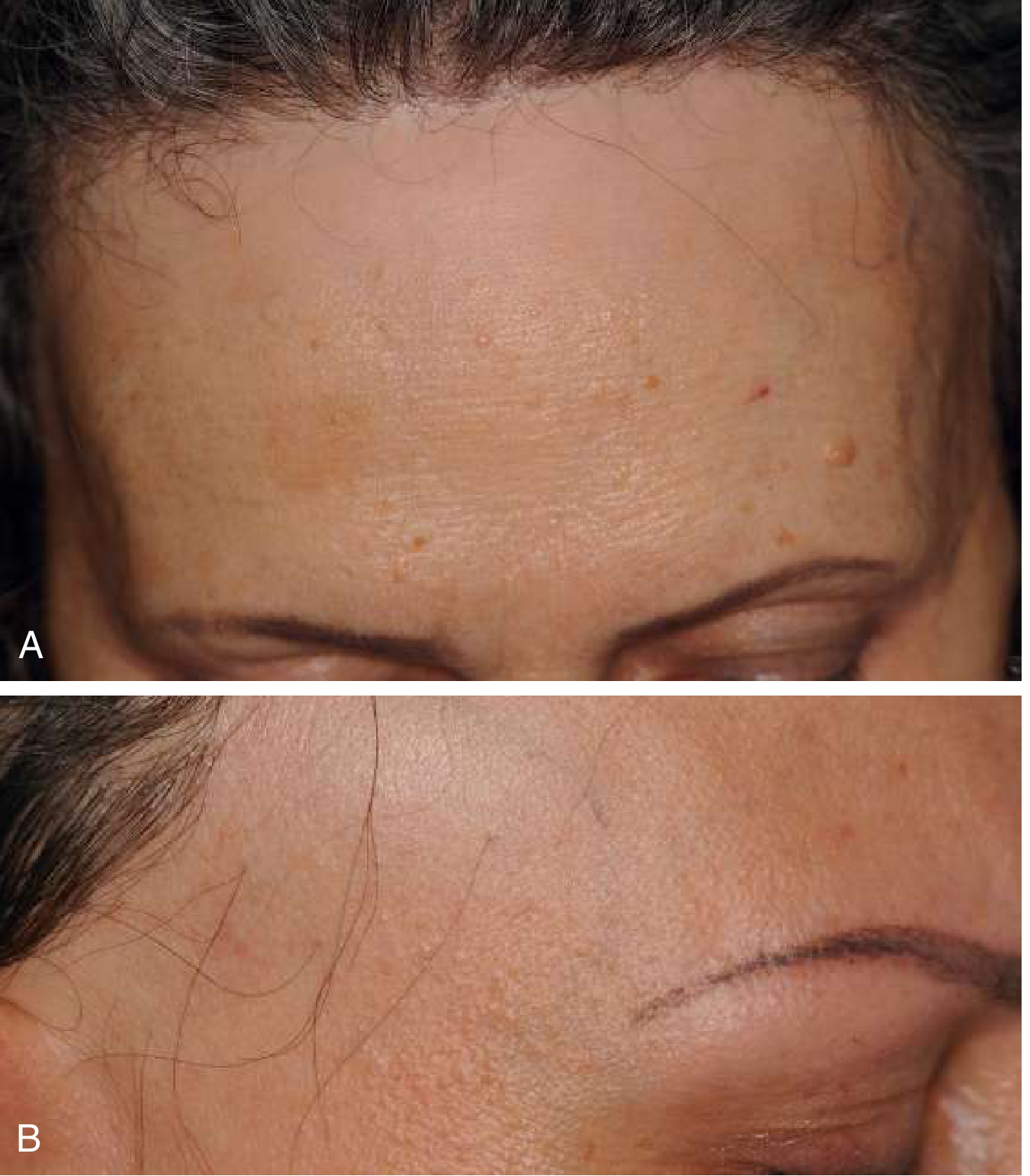
Figure: Frontal fibrosing alopecia. (A) Scarring recession of the frontal hairline - the alopecic area shows no photoaging, distinguishing it from the normal forehead. (B) Eyebrow alopecia and facial papules. (Goldman-Cecil Medicine)
Cardinal Signs
| Feature | Description |
|---|---|
| Band-like hairline recession | Frontotemporal, typically progressing at ~0.3-1.5 mm/month |
| Perifollicular erythema and hyperkeratosis | Around remaining hairs at the active margin |
| Eyebrow loss | Lateral > complete; very common |
| "Lonely hairs" | Isolated terminal hairs persisting within the alopecic band |
| Skin changes | Smooth, slightly atrophic, hypopigmented skin in the alopecic zone - notably devoid of solar lentigines |
Three Clinical Patterns of Hairline Recession
- Linear - clearly demarcated, band-like hairline recession
- Diffuse - decreased hair density in the frontal hairline without a sharp edge
- Pseudo-fringe - a fringe of frontal hairs is isolated from the main hairline by a hairless band
Additional Features
- Partial eyelash loss
- Prominent or depressed forehead veins
- Facial papules (glabellar follicular red dots) - due to involvement of facial vellus hairs
- In late-stage disease: thinning of axillary, pubic, limb, and truncal hair
- Co-occurrence of classic lichen planus, lichen planus pigmentosus (especially in darker skin phototypes), or even cutaneous lupus
Key distinction from traction alopecia: vellus hairs are absent in the alopecic band of FFA (they are the first to disappear), whereas in traction alopecia the "fringe" contains vellus hairs.
Trichoscopy (Dermoscopy) Findings
- Perifollicular scaling around remaining hairs at the hairline ("beige areas")
- Loss of follicular ostia (confirming cicatricial process)
- "Lonely hairs" - single terminal hairs isolated in the alopecic band
- Absence of vellus hairs in the alopecic zone
Histopathology
- Lichenoid (lymphocytic) interface dermatitis of the follicular unit, targeting the infundibulo-isthmic region
- Perifollicular concentric lamellar fibrosis
- Cytoid bodies may fill the fibrous tract remnant
- Perifollicular mucinous fibrosis
- Focal perifollicular lymphoid infiltrates (predominantly CD8+) involving the infundibulum
- Late stages: replacement of follicles by fibrous streaks ("fibrous tracts")
- DIF may be negative or show cytoid bodies and shaggy linear fibrin at the DEJ
Diagnosis
Diagnosis is primarily clinical, supported by dermoscopy and confirmed by biopsy when needed. Key diagnostic clues:
- Band-like frontotemporal recession in a perimenopausal woman
- Eyebrow loss
- Perifollicular erythema/scaling at the active margin
- Absence of solar lentigines in the alopecic zone (the receded skin is "younger-looking" than surrounding photoaged forehead skin)
- Histology showing lymphocytic scarring alopecia
Treatment
No single therapy is consistently effective. The goal is to arrest progression rather than regrow hair (scarring is permanent).
FFA-Specific Treatment Approach (Fitzpatrick's, Dermatology 5e)
First-line:
- Oral 5α-reductase inhibitors (most effective): finasteride 2-5 mg/day OR dutasteride 0.5 mg every 1-7 days, for 12-18 months - good response in ~45-47% of cases
- Intralesional corticosteroids: 10-20 mg/mL injected every 3-6 months - partial improvement in ~60%
- Topical minoxidil (adjunct)
A 2024 meta-analysis (PMID: 38357767) specifically evaluated dutasteride in FFA, providing updated evidence for 5α-reductase inhibitor use.
Second-line:
- Hydroxychloroquine - effective in ~30% (typically combined with topical immune modulators)
- PPAR-γ agonist: pioglitazone 15 mg for 3 months, escalating to 30-45 mg if no response (monitor for edema, heart failure)
Third-line / severe or rapidly progressive disease:
- Oral corticosteroids + mycophenolate mofetil (MMF) or methotrexate
- Cyclosporine monotherapy (limited by side-effect profile)
Note: Topical corticosteroids alone are ineffective in FFA (93% failure rate), in contrast to classic LPP where they have ~53% response. This is a clinically important distinction.
Differential Diagnosis
| Condition | Key Distinguishing Features |
|---|---|
| Traction alopecia | History of tight braiding; vellus hairs present in fringe; potentially reversible |
| Alopecia areata | Non-scarring; exclamation-mark hairs; no perifollicular fibrosis |
| Androgenetic alopecia | Miniaturization pattern; no scarring; affects vertex > frontal band |
| Discoid lupus | Erythema, edema, follicular plugging, dyspigmentation, scale; DIF positive |
| Classic LPP | Vertex/diffuse involvement rather than frontal band; overlaps significantly |
| Graham Little-Piccardi-Lasseur syndrome | Triad: LPP of scalp + non-cicatricial alopecia of axilla/groin + follicular LP of body |
Prognosis
FFA is a progressive condition without spontaneous remission. Scarring is permanent and irreversible. The aims of treatment are to halt progression and prevent further hairline recession. Regular follow-up measuring the hairline position and tracking trichoscopic activity markers (perifollicular erythema, easily extractable anagen hairs) is important.
Recent Evidence (2024-2026)
- Dutasteride meta-analysis (2024) in JEADV (PMID: 38357767) supports dutasteride as effective in FFA with a systematic review and meta-analysis
- A 2025 meta-analysis on primary cicatricial alopecia comorbidities (PMID: 40948796) highlights associated systemic conditions that should be screened for
- A 2026 systematic review on menopause and dermatoses (PMID: 41331233) reinforces the hormonal dimension of FFA
Sources: Dermatology 2-Volume Set 5e | Fitzpatrick's Dermatology | Goldman-Cecil Medicine | Andrews' Diseases of the Skin | PubMed (2024-2026)
This is a shared conversation. Sign in to Orris to start your own chat.