
Interpretation of tuning fork tests
I'll start with a quick answer while I look up detailed textbook content.
Tuning fork tests (Rinne and Weber) help differentiate conductive hearing loss (CHL) from sensorineural hearing loss (SNHL). In Rinne's test, bone conduction > air conduction suggests CHL; in Weber's test, sound lateralizes to the affected ear in CHL and to the better ear in SNHL.
Searching sources...
Reading File
Now let me search the library for tuning fork test content in parallel:
Finding Sources
Finding Sources
Searching Images
tuning fork test Rinne Weber hearing loss interpretation
Excellent results. Now let me read the key textbook sections in parallel:
Reading File
Reading File
Reading File
Good content from Scott-Brown's. Let me now read more of that section plus other tests (Bing, Stenger, Schwabach, absolute bone conduction):
Reading File
Reading File
I have very rich content. Let me also read more of the Scott-Brown's section on the Weber test, Bing test, and the "overall role" section, and the KJ Lee table content:
Reading File
Reading File
I now have comprehensive content from multiple authoritative ENT textbooks. Let me compile the full, well-structured answer.
Loading Image
I now have all the information needed to write a comprehensive, well-structured answer.
Interpretation of Tuning Fork Tests
Tuning fork tests are a standard component of the otologic examination. They provide bedside information about the type and laterality of hearing loss, and are particularly important for confirming audiometric findings before surgery (e.g., stapedectomy). They do not replace formal audiometry, but complement it.
Which Fork to Use
- 512 Hz is the standard frequency for most tests - it strikes the best balance between tactile vibration (which distorts results at lower frequencies) and inaudibility (which affects higher frequencies).
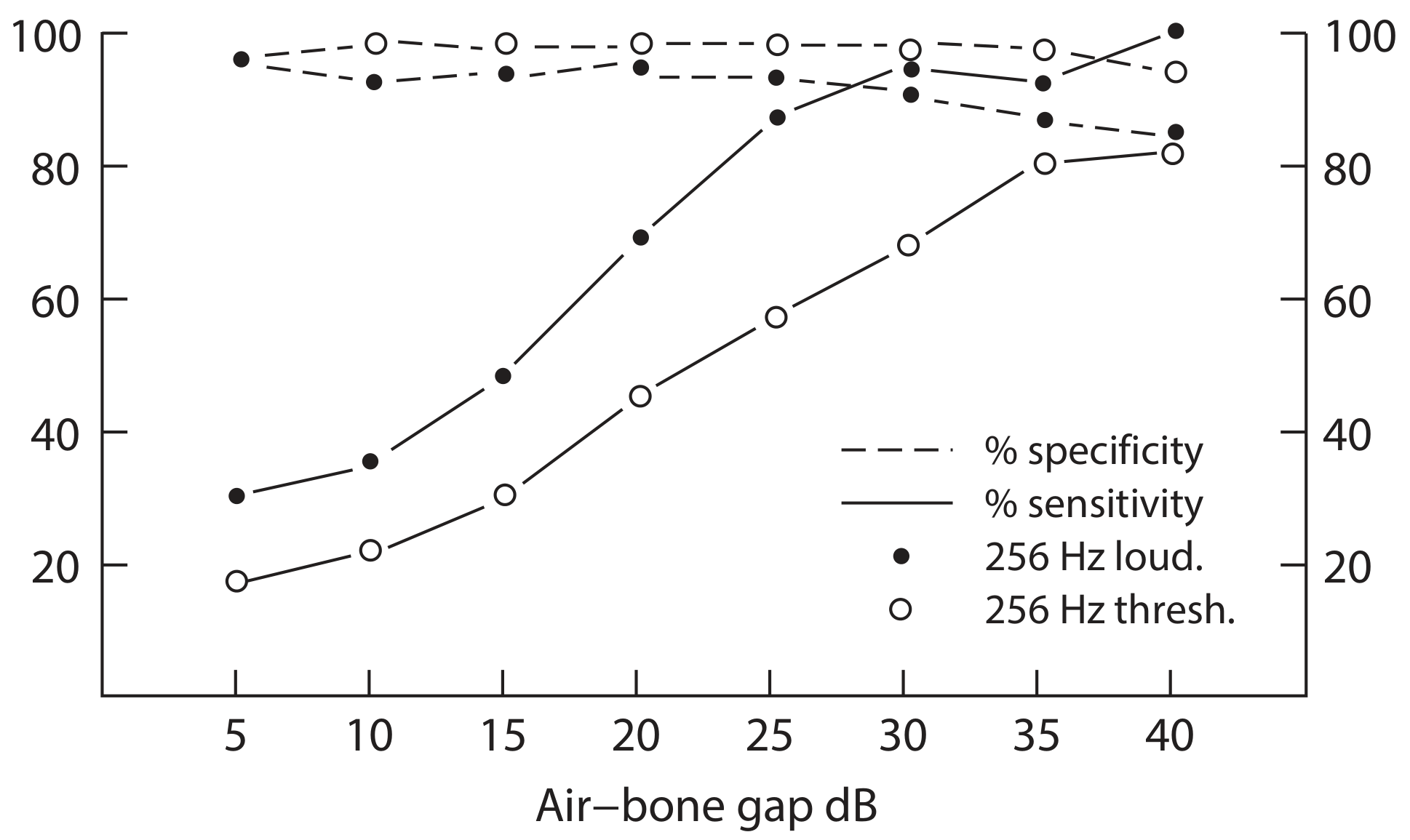
- 256 Hz actually gives superior sensitivity and specificity for the Rinne test in some studies (Scott-Brown's).
- Forks below 256 Hz (e.g., 128 Hz) should be avoided - low-frequency vibrations may be felt rather than heard, confusing the patient's response (KJ Lee's Essential Otolaryngology).
- Always strike the fork gently against a soft surface (e.g., elbow) to prevent harmonic overtones, which distort the pure tone.
1. Weber Test
Purpose: Tests lateralization - distinguishes which ear has the problem.
Technique: Strike the fork and place its base firmly on the midline of the skull - forehead, bridge of the nose, vertex, or upper central incisors. Ask the patient: "In which ear do you hear the sound louder, or is it equal?"
Interpretation:
| Weber Result | Interpretation |
|---|---|
| Midline (heard equally) | Normal hearing or equal loss bilaterally |
| Lateralizes to the poorer ear | Conductive hearing loss (CHL) in that ear |
| Lateralizes to the better ear | Sensorineural hearing loss (SNHL) in the opposite ear |
Why it lateralizes in CHL: The conductive barrier (e.g., fluid, ossicular fixation) reduces ambient noise reaching the cochlea on the affected side, making the bone-conducted signal appear relatively louder there.
Why it lateralizes in SNHL: The cochlea on the better side picks up the bone-conducted signal more efficiently.
Important: The Weber test is only informative in unilateral or asymmetric hearing loss. A 512 Hz fork detects lateralization with a conductive loss of approximately 3-5 dB.
2. Rinne Test
Purpose: Compares air conduction (AC) with bone conduction (BC) to identify a conductive component.
Technique (Loudness Comparison Method - preferred):
Place the vibrating fork 2 cm outside the external auditory canal (AC), then firmly on the mastoid tip (BC). Ask: "Which sounds louder?"
Threshold Comparison Method (less reliable):
Hold fork at canal until no longer heard, then move to mastoid. If heard again, BC > AC.
Interpretation:
| Result | Meaning |
|---|---|
| AC > BC (Positive Rinne) | Normal hearing or SNHL |
| BC > AC (Negative Rinne) | Conductive hearing loss (CHL) |
| AC = BC | Borderline - uninterpretable in up to 10% of ears with 11-40 dB air-bone gap |
Sensitivity by air-bone gap size (256 Hz fork, loudness comparison):
- Air-bone gap > 30 dB: ~90% sensitivity
- Air-bone gap 20-30 dB: ~70% sensitivity
- Air-bone gap 10-20 dB: < 50% sensitivity
The 512 Hz fork BC > AC implies a conductive loss of 20 dB or greater.
False-positive Rinne (BC > AC in a normal ear or SNHL): Can occur when the non-tested ear has much better hearing and picks up the bone-conducted sound - masking with a Barany box noise-maker is required in this situation. This is why a "negative Rinne" in a deaf ear (anacusis) could be falsely negative - the sound is heard by the contralateral ear via transcranial BC.
3. Combined Weber + Rinne Interpretation
This table from Cummings Otolaryngology summarizes combined results:
| Rinne Result | Weber Lateralizes Left | Weber Lateralizes Right |
|---|---|---|
| Rinne positive bilaterally (AC > BC both ears) | SNHL right ear (or mild CHL left) | SNHL left ear (or mild CHL right) |
| Rinne negative left only | CHL left | Mixed HL left |
| Rinne negative right only | Mixed HL right | CHL right |
| Rinne negative bilaterally | CHL left + Mixed HL right | CHL right + Mixed HL left |
AD = right ear; AS = left ear; AU = bilateral; CHL = conductive HL; SNHL = sensorineural HL
4. Bing Test
Purpose: Tests for the occlusion effect - confirms or excludes a conductive component.
Technique: Place the vibrating fork on the mastoid. Alternately occlude and open the external auditory canal with a finger.
| Result | Interpretation |
|---|---|
| Positive Bing - sound becomes louder when canal is occluded | Normal hearing or SNHL (occlusion effect present) |
| Negative Bing - no change in loudness with occlusion | Conductive hearing loss (occlusion effect absent) |
Physiology: In a normal or SNHL ear, occluding the canal traps low-frequency bone-conducted energy and amplifies the perceived sound. In CHL, this pathway is already partially blocked, so occlusion adds no further gain.
Note: The Bing test has low sensitivity and specificity - its reliability for correctly identifying CHL is only slightly better than chance (57-66%). It is now used less often than the Rinne (Scott-Brown's).
5. Schwabach Test
Purpose: Compares the patient's bone conduction to that of a normal-hearing examiner.
Technique: Place vibrating fork alternately on the patient's mastoid and the examiner's mastoid. Compare duration of hearing.
| Result | Interpretation |
|---|---|
| Normal Schwabach - heard for the same duration as examiner | Normal hearing |
| Prolonged Schwabach - patient hears longer than examiner | Conductive hearing loss (BC enhanced) |
| Diminished Schwabach - patient stops hearing before examiner | Sensorineural hearing loss (cochlear damage reduces BC) |
This test requires the examiner to have confirmed normal hearing, which limits its practical utility.
Summary Table (All Four Tests)
| Test | Fork Placement | Normal | CHL | SNHL |
|---|---|---|---|---|
| Weber | Midline skull | Midline | Lateralizes to poorer ear | Lateralizes to better ear |
| Rinne | Mastoid vs. ear canal | AC > BC (positive) | BC > AC (negative) | AC > BC (positive) |
| Bing | Mastoid + canal occlusion | Positive (louder when occluded) | Negative (no change) | Positive (louder when occluded) |
| Schwabach | Patient's mastoid vs. examiner's | Equal duration | Prolonged | Diminished |
Clinical Pearls
-
Negative Rinne in a deaf ear: If a patient has anacusis (total deafness) in one ear, BC stimulates the contralateral cochlea via transcranial transmission. The patient reports BC > AC - a "false-negative Rinne" (also called a "pseudo-negative Rinne"). Always mask the contralateral ear with a Barany box when testing the worse ear.
-
Weber before Rinne: Always perform the Weber test first to determine lateralization, then use Rinne on each ear to characterize the loss.
-
Pre-surgical confirmation: Tuning fork tests are especially recommended before stapedectomy to confirm audiometric findings of conductive loss. A discrepancy between audiogram and tuning fork result warrants re-evaluation.
-
Limited value in OME/CSOM: In ears with obvious middle ear disease (OME, active CSOM), tuning fork tests add little - a conductive component is assumed. Pure-tone audiometry is needed to quantify the air-bone gap.
-
Children: Rinne and Weber tests show poor predictive value for CHL in children under 11 years old with OME (Scott-Brown's).
Sources: Shambaugh Surgery of the Ear, p. 205 | Cummings Otolaryngology Head and Neck Surgery, p. 2638 | KJ Lee's Essential Otolaryngology, p. 293 | Scott-Brown's Otorhinolaryngology Head & Neck Surgery Vol 2, pp. 969-971
This is a shared conversation. Sign in to Orris to start your own chat.