
Human blood
Reading File
Human blood is a connective tissue fluid that makes up about 7-8% of body weight (~5 liters in an adult). It consists of plasma (~55%) and formed elements (~45%): red blood cells (RBCs), white blood cells (WBCs), and platelets.
Searching sources...
Finding Sources
Finding Sources
Finding Sources
Reading File
Finding Sources
Finding Sources
Reading File
Finding Sources
Reading File
Loading Image
Reading File
Here is a thorough overview of human blood, drawing from Guyton & Hall Medical Physiology and Histology: A Text and Atlas.
Human Blood
Blood is a fluid connective tissue that circulates through the cardiovascular system, carrying out transport, regulatory, and protective functions. In adults it totals about 4-6 liters (roughly 7-8% of body weight).
Composition
Blood has two main compartments:
| Component | % of Blood Volume | Contents |
|---|---|---|
| Plasma | ~55% | Water (~91%), proteins, electrolytes, nutrients, hormones, gases, waste |
| Formed elements | ~45% (hematocrit) | RBCs, WBCs, platelets |
Serum is plasma with clotting factors removed. - Histology: A Text and Atlas, p. 766
Red Blood Cells (Erythrocytes)
- Biconcave discs, ~7.8 µm in diameter, 2.5 µm thick at the rim, ~1 µm at the center
- Average volume: 90-95 cubic micrometers
- Anucleate with a lifespan of ~120 days
- Normal count: 5.2 million/mm³ (men), 4.7 million/mm³ (women)
- Hematocrit: normally 40-45%
Functions:
- Oxygen transport - via hemoglobin (Hgb). Each gram of Hgb carries 1.34 mL O₂; each 100 mL of blood carries ~20 mL O₂ at full saturation.
- CO₂ transport - contain carbonic anhydrase, which converts CO₂ + H₂O → HCO₃⁻ (bicarbonate), shuttling CO₂ from tissues to the lungs.
- Acid-base buffering - hemoglobin is an excellent protein buffer and accounts for most of the acid-base buffering power of whole blood.
Hemoglobin types in adults:
-
HbA: ~96% of total
-
HbA₂: ~3%
-
HbF (fetal): <1% in adults but predominant in the fetus
-
Guyton & Hall Textbook of Medical Physiology, p. 440-441; Histology: A Text and Atlas, p. 766
White Blood Cells (Leukocytes)
WBCs are classified by the presence or absence of cytoplasmic granules:
Granulocytes
| Cell | % of WBCs | Key Features |
|---|---|---|
| Neutrophils | 47-67% | Multilobed nuclei; contain lysozyme, lactoferrin; first responders to bacterial infection |
| Eosinophils | 1-4% | Bilobed nuclei; cytotoxic to parasites; involved in allergy |
| Basophils | <0.5% | Irregular lobed nuclei; granules contain heparin, histamine, leukotrienes; role in allergy |
Agranulocytes
| Cell | % of WBCs | Key Features |
|---|---|---|
| Lymphocytes | 26-28% | T cells (cell-mediated immunity), B cells (antibody production), NK cells (anti-tumor/viral) |
| Monocytes | 3-9% | Indented nucleus; differentiate into macrophages in tissues; antigen-presenting cells |
Neutrophils leave the bloodstream via diapedesis (transendothelial migration), mediated by selectins and integrins on postcapillary venules. - Histology: A Text and Atlas, p. 766-767
Platelets (Thrombocytes)
- Small, anucleate cytoplasmic fragments shed from megakaryocytes in the bone marrow
- Organized into four zones: peripheral, structural, organelle, and membrane
- Primary role: hemostasis and repair of small vessel damage (blood clotting)
Plasma Proteins
The main protein fractions in plasma include:
- Albumin - maintains oncotic pressure, transports substances
- Globulins (alpha, beta, gamma) - transport, immune function (IgG, IgM, IgA, etc.)
- Fibrinogen - key clotting factor; converted to fibrin during coagulation
Hematopoiesis (Blood Cell Formation)
All blood cells arise from a single multipotent hematopoietic stem cell (MHSC) in the bone marrow.
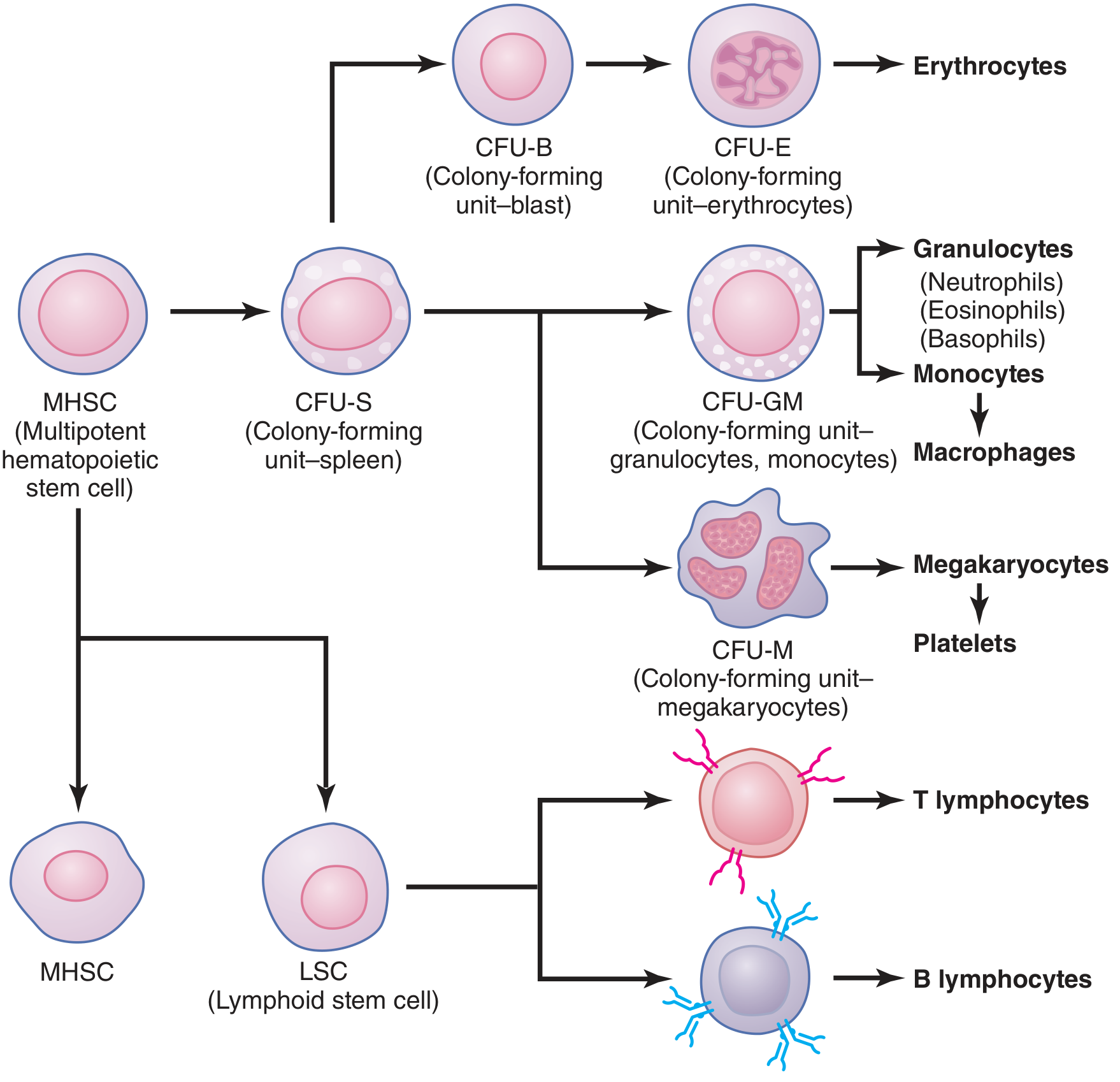
Formation of all blood cells from the multipotent hematopoietic stem cell. - Guyton & Hall, p. 442
The MHSC gives rise to two main progenitor lineages:
- Common Myeloid Progenitor (CMP) → erythrocytes, platelets, granulocytes, monocytes
- Common Lymphoid Progenitor (CLP) → T cells, B cells, NK cells
Sites of production change with age:
- Embryo: yolk sac (early), then liver and spleen (mid-gestation)
- After birth: exclusively red bone marrow
- After age ~20: mainly flat/irregular bones (vertebrae, sternum, ribs, iliac crests), as long bone marrow becomes fatty (yellow marrow)
Key processes:
- Erythropoiesis - stimulated by erythropoietin (EPO), released by the kidney in response to hypoxia
- Thrombopoiesis - megakaryocytes fragment into platelets
- Granulopoiesis - six stages from myeloblast → mature neutrophil
Summary: Key Normal Values
| Parameter | Normal Range |
|---|---|
| Total blood volume | ~5 L (adult) |
| Hematocrit | 40-45% |
| RBC count | 4.7-5.2 million/mm³ |
| Hemoglobin | 12-17 g/dL |
| WBC count | 4,500-11,000/mm³ |
| Platelet count | 150,000-400,000/mm³ |
| Plasma | ~55% of blood volume |
Sources: Guyton & Hall Textbook of Medical Physiology (14th Ed.); Histology: A Text and Atlas With Correlated Cell and Molecular Biology
Mcqs
Here are 20 MCQs on Human Blood, covering composition, cells, hematopoiesis, and physiology:
Human Blood - MCQs
1. What percentage of body weight does blood constitute in an adult?
- A) 3-4%
- B) 5-6%
- C) 7-8%
- D) 10-12%
Answer
**C) 7-8%** - Blood makes up approximately 7-8% of body weight, totaling ~5 liters in an average adult.2. What is the normal hematocrit value in adult males?
- A) 30-35%
- B) 36-39%
- C) 40-45%
- D) 50-55%
Answer
**C) 40-45%** - Hematocrit (packed cell volume) is normally 40-45% in adult males.3. A normal RBC has a mean diameter of:
- A) 4.5 µm
- B) 6.2 µm
- C) 7.8 µm
- D) 10.0 µm
Answer
**C) 7.8 µm** - Normal RBCs are biconcave discs with a mean diameter of ~7.8 µm.4. Which enzyme found in RBCs catalyzes the conversion of CO₂ + H₂O → HCO₃⁻?
- A) Lactate dehydrogenase
- B) Carbonic anhydrase
- C) Alkaline phosphatase
- D) Glucose-6-phosphate dehydrogenase
Answer
**B) Carbonic anhydrase** - This enzyme accelerates CO₂ transport as bicarbonate, increasing reaction rate several thousand-fold.5. The normal RBC count in healthy adult women is:
- A) 3.5 million/mm³
- B) 4.7 million/mm³
- C) 5.2 million/mm³
- D) 6.0 million/mm³
Answer
**B) 4.7 million/mm³** - Women average 4.7 million (±300,000)/mm³; men average 5.2 million/mm³.6. Each gram of hemoglobin can carry how much oxygen at 100% saturation?
- A) 0.34 mL
- B) 0.67 mL
- C) 1.34 mL
- D) 2.68 mL
Answer
**C) 1.34 mL** - Each gram of hemoglobin binds 1.34 mL O₂ when fully saturated, giving ~20 mL O₂ per 100 mL blood.7. Which of the following is the predominant hemoglobin type in normal adults?
- A) HbF
- B) HbA₂
- C) HbA
- D) HbS
Answer
**C) HbA** - HbA constitutes ~96% of total hemoglobin in adult humans; HbA₂ ~3%; HbF <1%.8. What is the normal lifespan of a red blood cell?
- A) 30 days
- B) 60 days
- C) 90 days
- D) 120 days
Answer
**D) 120 days** - RBCs have a normal lifespan of approximately 120 days before being removed by the spleen and liver.9. Which WBC is the MOST abundant in peripheral blood?
- A) Monocytes
- B) Eosinophils
- C) Neutrophils
- D) Lymphocytes
Answer
**C) Neutrophils** - Neutrophils make up 47-67% of all leukocytes and are the predominant WBC in circulation.10. Basophil granules contain which of the following substances?
- A) Lysozyme and lactoferrin
- B) Heparin, histamine, and leukotrienes
- C) Major basic protein
- D) Perforin and granzymes
Answer
**B) Heparin, histamine, and leukotrienes** - Basophil granules are rich in these mediators, which drive allergic reactions and inflammation.11. Which WBC type differentiates into macrophages after leaving the bloodstream?
- A) Neutrophils
- B) Basophils
- C) Monocytes
- D) Lymphocytes
Answer
**C) Monocytes** - Monocytes (3-9% of WBCs) migrate into tissues and transform into macrophages and other mononuclear phagocyte system cells.12. Natural killer (NK) cells are a subtype of which blood cell?
- A) Monocytes
- B) Neutrophils
- C) Eosinophils
- D) Lymphocytes
Answer
**D) Lymphocytes** - The three major lymphocyte subtypes are T cells, B cells, and NK cells. NK cells destroy virus-infected and cancer cells.13. Platelets (thrombocytes) are derived from which bone marrow cell?
- A) Proerythroblast
- B) Myeloblast
- C) Megakaryocyte
- D) Lymphoid stem cell
Answer
**C) Megakaryocyte** - Platelets are anucleate cytoplasmic fragments shed from large polyploid megakaryocytes in the red bone marrow.14. In the embryo, which is the FIRST site of red blood cell production?
- A) Liver
- B) Spleen
- C) Yolk sac
- D) Bone marrow
Answer
**C) Yolk sac** - Primitive nucleated RBCs are first produced in the yolk sac in early embryonic life, then the liver takes over in mid-gestation.15. After approximately what age does the long bone marrow become fatty and stop producing RBCs?
- A) 5 years
- B) 10 years
- C) 20 years
- D) 35 years
Answer
**C) 20 years** - After age ~20, long bone marrow becomes yellow (fatty) and inactive; RBC production continues mainly in flat bones (vertebrae, sternum, ribs, ilium).16. The common myeloid progenitor (CMP) gives rise to ALL of the following EXCEPT:
- A) Erythrocytes
- B) Platelets
- C) T lymphocytes
- D) Neutrophils
Answer
**C) T lymphocytes** - T cells arise from the common lymphoid progenitor (CLP), not CMP. CMP produces erythrocytes, platelets, granulocytes, and monocytes.17. Which hormone primarily stimulates erythropoiesis and is released by the kidney in response to hypoxia?
- A) Thrombopoietin
- B) G-CSF
- C) Erythropoietin (EPO)
- D) Interleukin-3
Answer
**C) Erythropoietin (EPO)** - EPO is produced mainly by peritubular cells of the kidney in response to tissue hypoxia and stimulates RBC production.18. The process by which neutrophils cross the endothelium to enter tissues is called:
- A) Opsonization
- B) Chemotaxis
- C) Diapedesis
- D) Phagocytosis
Answer
**C) Diapedesis** - Also called transendothelial migration, diapedesis involves neutrophil passage through postcapillary venule walls, mediated by selectins and integrins.19. Which plasma protein is primarily responsible for maintaining colloid osmotic (oncotic) pressure?
- A) Fibrinogen
- B) Gamma globulin
- C) Albumin
- D) Alpha-1 antitrypsin
Answer
**C) Albumin** - Albumin is the most abundant plasma protein and the main determinant of plasma oncotic pressure, preventing fluid leakage into tissues.20. Serum differs from plasma in that serum lacks:
- A) Albumin
- B) Clotting factors (including fibrinogen)
- C) Red blood cells
- D) Electrolytes
Answer
**B) Clotting factors (including fibrinogen)** - Serum is plasma from which clotting factors have been removed following coagulation.Score Guide
| Score | Level |
|---|---|
| 18-20 | Excellent |
| 14-17 | Good |
| 10-13 | Average |
| <10 | Needs revision |
This is a shared conversation. Sign in to Orris to start your own chat.