
Define Transformative zone
The transformation zone (also called the transitional zone or T-zone) is a concept that appears in a few different medical/anatomical contexts. The most common usage is in gynecology (cervical anatomy), but it also appears in other fields.
Searching sources...
Reading File
Finding Sources
Finding Sources
Reading File
Reading File
Reading File
Loading Image
Reading File
Transformation Zone (T-Zone) - Cervix
The transformation zone (TZ) is a specific region on the uterine cervix where columnar epithelium is gradually replaced by squamous epithelium through a process called squamous metaplasia. It is the most clinically significant area of the cervix because it is the site where virtually all cervical dysplasia and carcinoma originate.
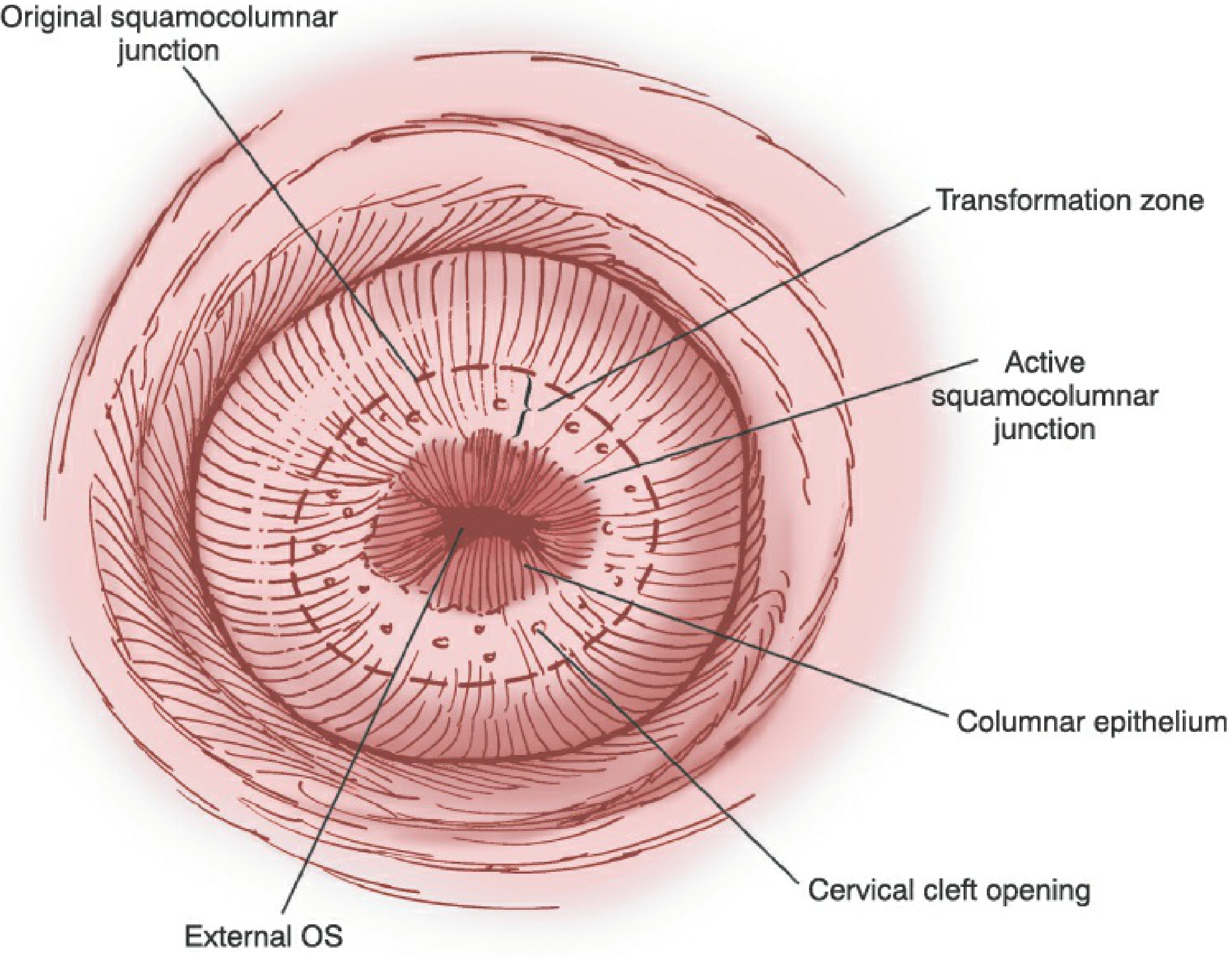
Anatomical Boundaries
The transformation zone is bounded by two landmarks:
| Border | Definition |
|---|---|
| Outer (lateral) border | The original squamocolumnar junction (SCJ) - where native squamous epithelium of the vagina/ectocervix originally ended |
| Inner (medial) border | The physiologically active (new) SCJ - the current advancing edge of columnar epithelium |
The entire area between these two junctions - now occupied by metaplastic epithelium in varying stages of maturity - is the transformation zone.
What Fills the Transformation Zone?
The TZ is occupied by metaplastic squamous epithelium in various degrees of maturity, along with:
- Gland openings (crypts where columnar epithelium retreated inward)
- Nabothian cysts (mucus-filled retention cysts formed when metaplasia occludes gland openings)
- Islands of residual columnar epithelium surrounded by immature squamous metaplasia
"The active TZ contains gland openings, nabothian cysts, and, typically, islands of columnar epithelium surrounded by metaplastic squamous epithelium."
- Pfenninger and Fowler's Procedures for Primary Care
How the TZ Forms (Mechanism)
Under the influence of hormones and the acidic vaginal environment:
- Columnar epithelium (originally found on the ectocervix at birth/puberty) is exposed to the lower vaginal pH.
- Subcolumnar reserve cells proliferate and begin to replace the columnar epithelium.
- Immature metaplastic cells (large nuclei, little cytoplasm, no glycogen) gradually mature.
- Mature metaplastic cells produce glycogen and eventually resemble original squamous epithelium, forming a "healed transformation zone" that becomes relatively resistant to oncogenic stimuli.
Life-Cycle Changes
The location of the TZ shifts throughout a woman's life:
| Stage | TZ Location |
|---|---|
| Neonatal / Prepubertal | TZ resides inside the cervical canal |
| Reproductive age | TZ visible on the ectocervix (exposed by estrogen) |
| Postmenopausal | TZ retreats back into the endocervical canal |
This is why colposcopic visualization of the TZ becomes difficult after menopause.
Clinical Significance
- Site of CIN and cervical cancer: Virtually all cervical intraepithelial neoplasia (CIN) and squamous cell carcinoma originate in the TZ, specifically at the advancing SCJ where immature metaplastic cells are most vulnerable to HPV-induced transformation.
- Pap smear adequacy: A satisfactory cervical cytology (Pap test) requires sampling from the TZ - the report must include evidence that the TZ was sampled (endocervical cells present).
- Colposcopy: Adequate colposcopy requires full visualization of the entire TZ and the new SCJ.
- Treatment targets the TZ: Procedures like LLETZ (large loop excision of the transformation zone), laser ablation, and cryotherapy all aim to destroy or remove the entire TZ.
- CIN extent: CIN can spread horizontally to involve the entire TZ but typically does not replace the original squamous epithelium; severity is worst near the endocervical clefts.
Histology
Under H&E staining at ×240, an abrupt change from stratified squamous epithelium (SSEp) to simple columnar epithelium (CEp) is visible at the external os. This junction is marked by a dense collection of lymphocytes and blood vessels, reflecting the immunological activity at this dynamic interface.
- Histology: A Text and Atlas, Ross & Pawlina
Sources:
- Berek & Novak's Gynecology (16th ed.), Chapter 16
- Pfenninger and Fowler's Procedures for Primary Care, 3rd ed.
- Histology: A Text and Atlas with Correlated Cell and Molecular Biology
- Schwartz's Principles of Surgery, 11th ed.
This is a shared conversation. Sign in to Orris to start your own chat.