
Spine examination in detail orthopedic surgeon
Reading File
Now let me search the medical library for comprehensive spine examination content:
Finding Sources
Finding Sources
Finding Sources
Reading File
Reading File
Reading File
Reading File
Finding Sources
Reading File
Reading File
Now let me get the neurological examination details and the dermatomes/myotomes tables:
Finding Sources
Finding Sources
Reading File
Finding Sources
Reading File
Finding Sources
I now have comprehensive content from the textbooks. Let me fetch some key images and compile the full answer:
Loading Image
Loading Image
Loading Image
I now have all the content needed for a comprehensive, well-illustrated answer. Here is the full spine examination guide:
Spine Examination - Comprehensive Orthopedic Guide
Sources: Bailey and Love's Short Practice of Surgery 28th Ed.; Rockwood and Green's Fractures in Adults 10th Ed. 2025; Textbook of Family Medicine 9th Ed.
Anatomy Overview
The spinal column consists of 33 vertebrae with 23 intervertebral discs, supported by numerous ligaments and paraspinal muscles. The spine has four physiological sagittal curves:
- Cervical lordosis (20-40°)
- Thoracic kyphosis (20-45°)
- Lumbar lordosis (40-60°)
- Sacral kyphosis
General Inspection (Standing Patient)
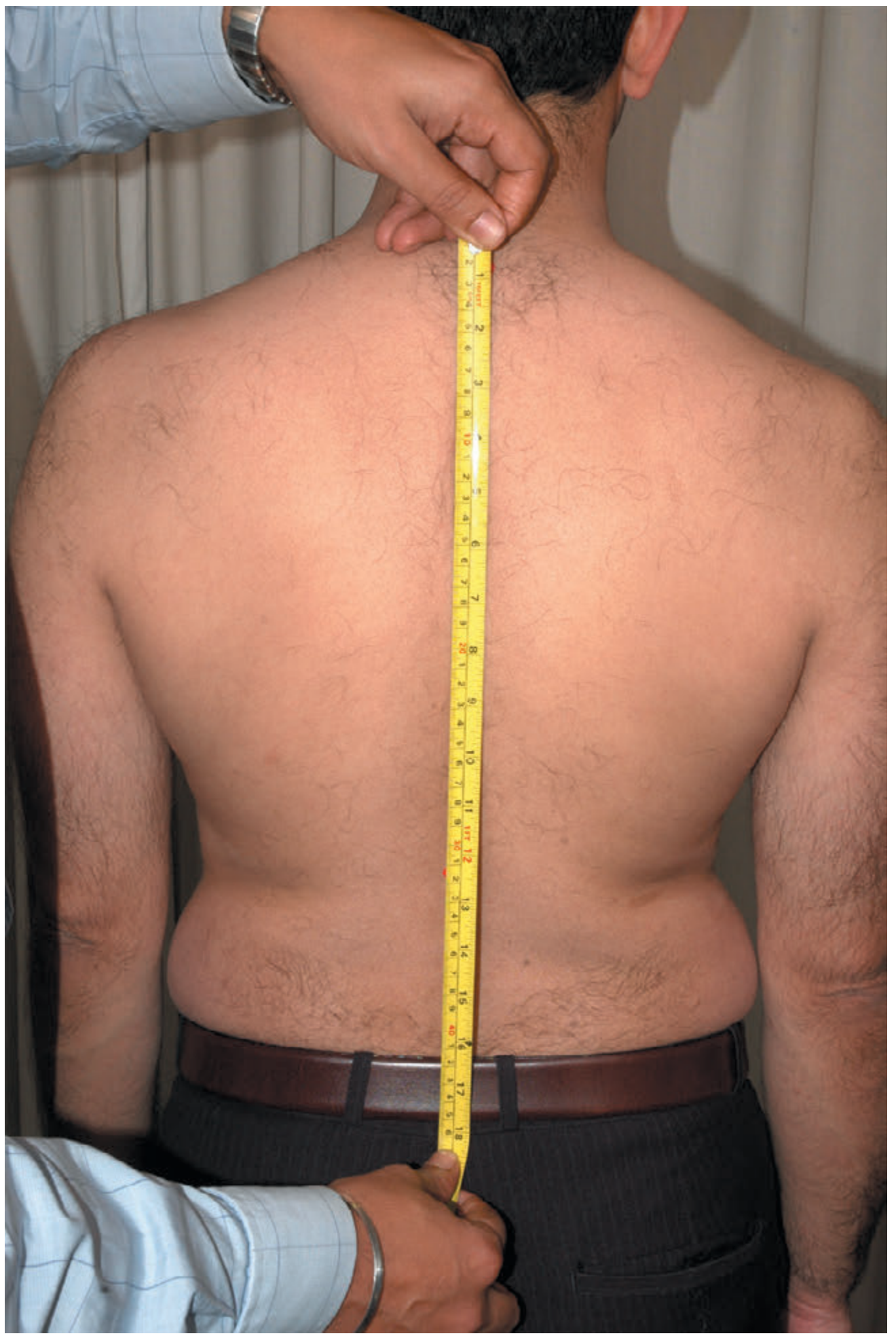
Coronal Plane (from front and back)
- The head should be centered over the sacrum
- A plumb line dropped from the spinous process of C7 should fall through the gluteal crease
- If it falls to either side, lateral tilt is present
- The ear, shoulder, and greater trochanter should lie in the same vertical plane
Sagittal Plane (from the side)
- Assess all four physiological curves
- Loss of lumbar lordosis suggests muscle spasm or ankylosing spondylitis
- Increased thoracic kyphosis (Scheuermann's, osteoporosis, Pott's disease)
1. CERVICAL SPINE EXAMINATION
Look
- Expose the shoulders, back muscles, and scapulae
- Look for: muscle wasting, asymmetry of neck creases, shoulder-level inequality
- Check for normal cervical lordosis (20-40°)
Feel
Stand behind the patient, support the patient's chin.
- Soft tissues: Feel for spasm of paraspinal muscles
- Bone: Palpate spinous processes for tenderness and alignment; C7 (vertebra prominens) and T1 are easily palpable at the base of the neck
Move - Range of Motion
Motion occurs in three planes:
| Movement | Normal Range | Technique |
|---|---|---|
| Flexion | 45° | Chin to chest; measure chin-sternum distance |
| Extension | 55° | Look up at the ceiling |
| Right/Left Rotation | 70° each | Look over each shoulder without moving the chest |
| Right/Left Lateral Bending | 40° each | Lay ear on ipsilateral shoulder |
Neurological Assessment (C5-T1 nerve roots)
| Root | Dermatome | Key Muscle | Reflex |
|---|---|---|---|
| C5 | Lateral arm (regimental badge area) | Deltoid / Biceps | Biceps (C5/C6) |
| C6 | Lateral forearm, thumb, index finger | Wrist extensors / Biceps | Brachioradialis |
| C7 | Middle finger | Triceps / Wrist flexors | Triceps |
| C8 | Medial forearm, ring/little finger | Finger flexors / Intrinsics | - |
| T1 | Medial arm | Intrinsic hand muscles | - |
Special Tests - Cervical Spine
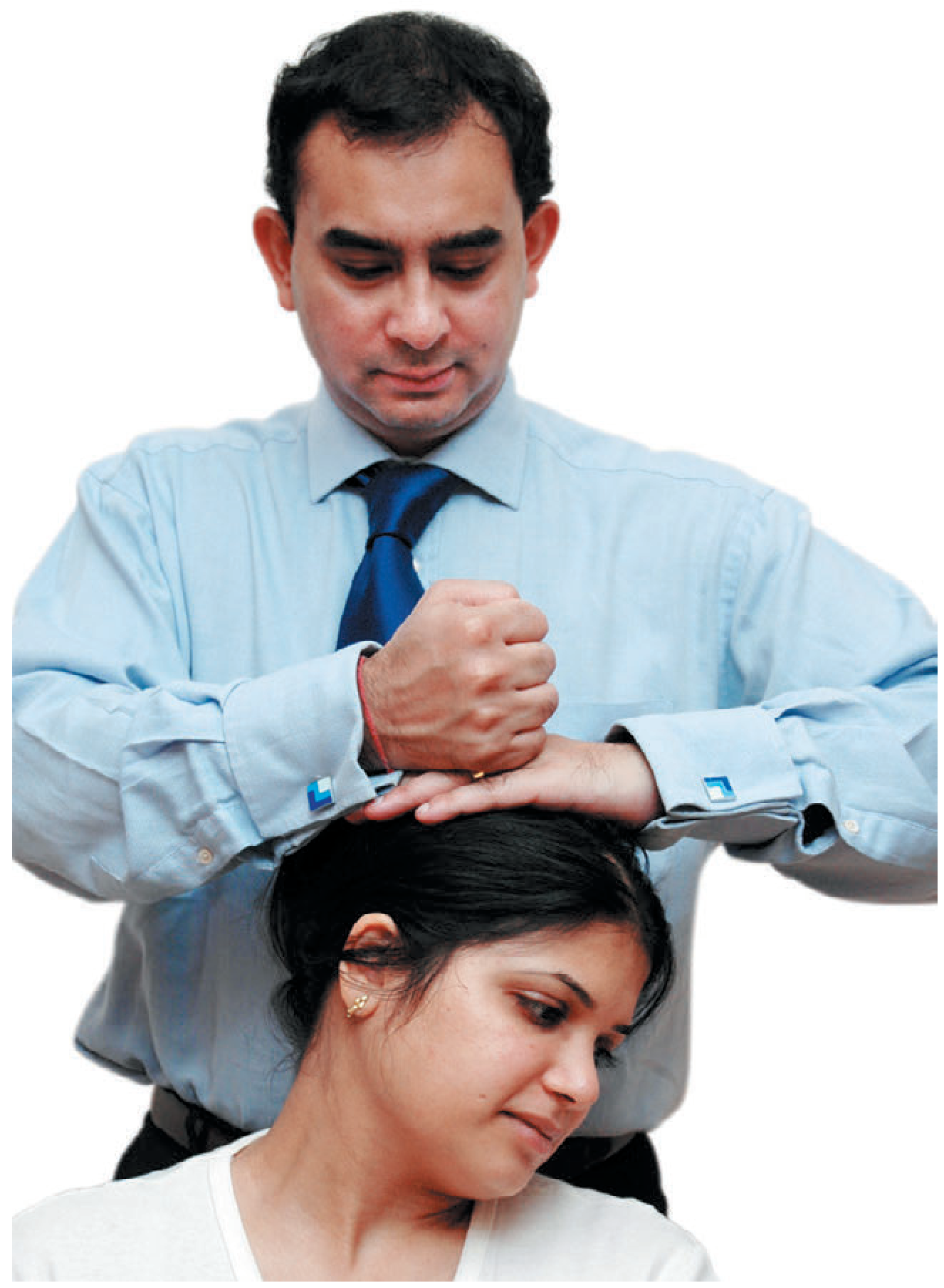
Spurling's Test (for cervical nerve root entrapment)
The examiner extends the patient's neck, rotates and side-bends the head toward the affected side, and applies downward axial compression. A positive test reproduces radicular arm pain. Low sensitivity, high specificity.
Cervical Distraction Test
Patient supine. Examiner places one hand under the chin, another on the occiput, and gently applies traction. Positive: improvement in radicular symptoms. Tests for nerve root compression. Low sensitivity, high specificity.
Upper Limb Tension Test (ULTT)
Patient supine. Examiner depresses the scapula, then places the shoulder in abduction, extends the elbow and wrist, and side-bends the neck contralaterally. Positive: reproduction of radicular symptoms. Sensitivity >90%, low specificity.
2. THORACIC SPINE EXAMINATION
The thoracic spine is normally convex with a gentle kyphosis (20-45°). Pathology commonly presents as pain and deformity.
Look
Expose from neck to gluteal cleft, front and back.
- Skin: Cafe-au-lait spots, hairy patches (suggesting occult neural/bony pathology), scars
- Front: Asymmetry of shoulder and ribcage (scoliosis)
- Back: Difference in iliac crest height (pelvic tilt); coronal plane deformity (scoliosis = lateral curvature with rotation); rib hump
- Side: Sagittal deformity (increased kyphosis)
Feel
Palpate with one hand supporting the patient's pelvis.
- Paraspinal muscles for spasm
- Spinous processes for tenderness, step-off
Move
Forward Bending Test (Adam's Test)
Ask the patient to bend forward and touch their toes:
- Structural scoliosis: Rib hump increases (bulges posteriorly on the thoracic convex side) as the patient bends - diagnostic of idiopathic thoracic scoliosis (rotatory deformity)
- Functional scoliosis: Spine straightens and no rib hump is visible; flexible deformity secondary to leg-length discrepancy or lumbar muscle spasm
Lateral Bending: Used to assess the flexibility of scoliosis; radiographs can be taken in this position.
3. LUMBAR SPINE EXAMINATION
Always include assessment of pelvis, hips, lower limbs, gait, and peripheral vascular system. Irritation of lumbar nerve roots can mimic lower limb problems. Always consider referred pain.
Look
- Back: Check for hairy tufts and dimples at the base of the spine (underlying spina bifida occulta); unilateral paraspinal muscle prominence (spasm secondary to pain)
- Side: Normal lumbar lordosis (40-60°); muscle spasm causes loss of lordosis
Feel
- Palpate spinous processes for any step-off - this may indicate forward slippage (spondylolisthesis)
- Paraspinal muscle tenderness
Move - Range of Motion
| Movement | Normal Range | Technique |
|---|---|---|
| Forward flexion | Variable (Schober's) | Fingertips toward floor; measure lumbar skin stretch using Schober's test |
| Extension | ~25-30° | Lean backwards |
| Lateral bending | ~25° each | Hand slides down outside of thigh |
| Rotation | 3-18° | Hold pelvis fixed; patient twists and looks over shoulder |
Schober's Test (Modified): Place thumb tip over the T12/L1 junction and index finger over L5/S1. As the patient bends forward, the distance between these points should increase by at least 5 cm in normal lumbar flexion. A smaller increase suggests restricted lumbar mobility (ankylosing spondylitis, etc.)
Neurological Assessment (L1-S1 nerve roots)
| Root | Dermatome | Key Muscle (Power Test) | Reflex |
|---|---|---|---|
| L1/L2 | Groin/upper inner thigh | Hip flexors (psoas) | Cremaster |
| L3 | Inner/anterior thigh | Quadriceps (knee extension) | Knee jerk |
| L4 | Medial shin/foot | Tibialis anterior (ankle dorsiflexion) | Knee jerk |
| L5 | Lateral shin, dorsum of foot, great toe | Extensor hallucis longus (great toe extension) | Absent |
| S1 | Lateral foot, sole | Gastrocnemius (ankle plantarflexion) | Ankle jerk |
| S2-S4 | Perineum/perianal | Bladder/bowel/sexual function | Bulbocavernosus/anal reflex |
Note: Always assess perianal sensation and voluntary anal contraction when cauda equina is suspected.
4. SPECIAL TESTS FOR THE LUMBAR SPINE
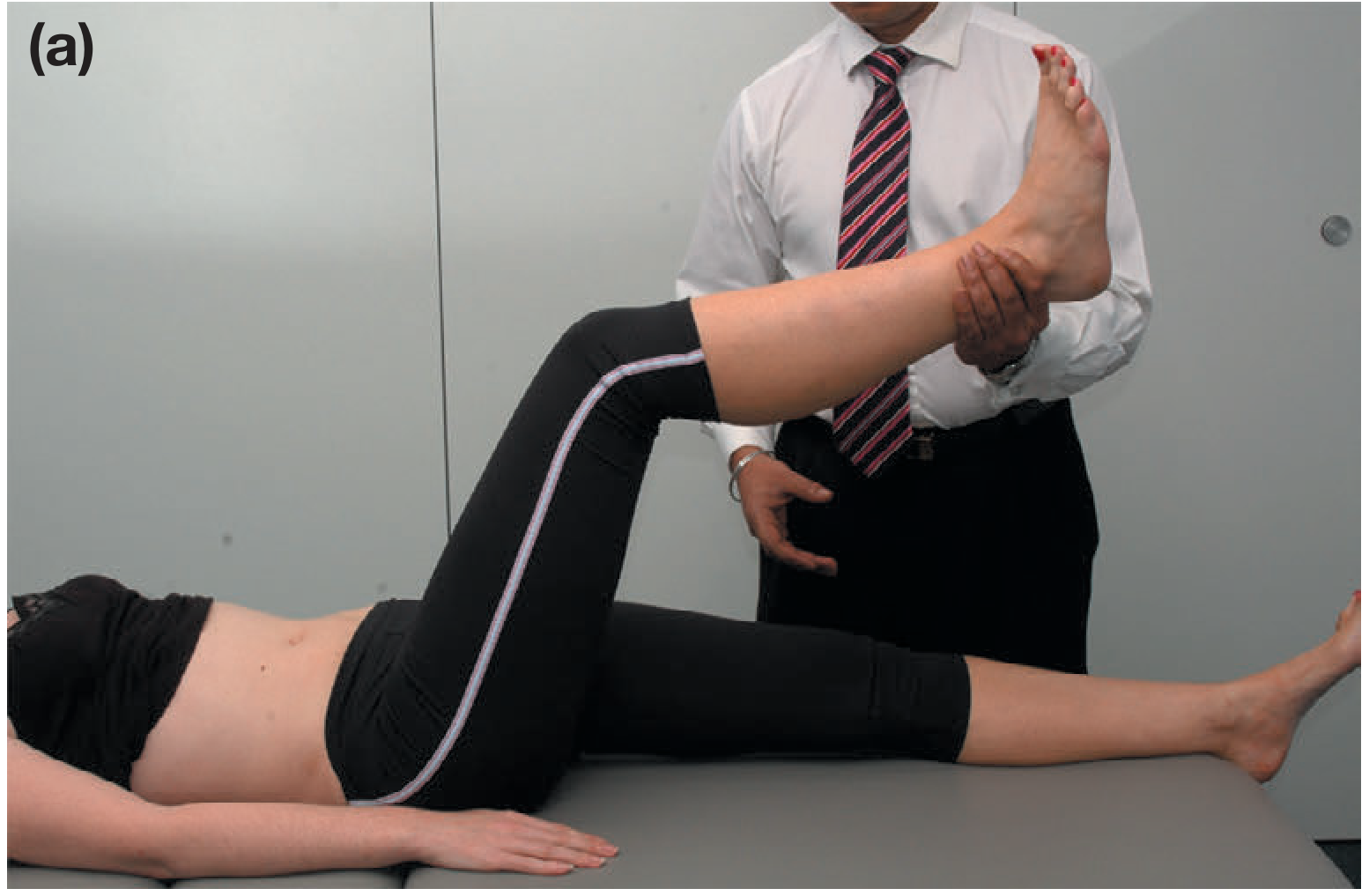
Lasègue's Straight Leg Raise (SLR) Test
Tests tension along the sciatic nerve (L5 and S1 nerve roots)
Technique (three-step method):
- With patient supine, elevate the leg with the knee bent - checks pain-free hip movement
- Straighten the knee - note the angle at which hamstrings allow hip flexion
- Allow hip to extend until hamstring tension is removed, then firmly dorsiflex the ankle - this pulls on the sciatic nerve
Positive test: Pain radiating down the leg (not just the back) between 30-70°.
- Sensitivity: >80% (for disc herniation)
- Specificity: ~40%
Crossed (Contralateral) SLR Test
Elevate the asymptomatic leg; if pain is reproduced in the opposite (symptomatic) leg, this is positive.
- High specificity (~90%) for large central disc herniation
Femoral Stretch Test (Reverse SLR)
Patient prone. Flex the knee to 90°, then extend the hip. Positive test (pain in anterior thigh/groin) suggests upper lumbar (L2, L3, L4) nerve root involvement.
FABER Test (Patrick's Test)
Flexion, Abduction, External Rotation of the hip - helps differentiate hip pathology from sacroiliac joint pathology.
FADIR Test
Flexion, Adduction, Internal Rotation - screens for hip impingement and hip pathology.
5. GAIT ASSESSMENT
Observe walking from front, side, and behind:
- Antalgic gait: Shortened stance phase on the painful side
- Trendelenburg gait: Contralateral pelvis drops (L5 root or gluteus medius weakness)
- Steppage gait: High-stepping to clear foot drop (L4/L5 root palsy)
- Spastic gait: Broad-based with circumduction (upper motor neuron lesion - myelopathy)
- Heel walk: Tests L4/L5 (dorsiflexors)
- Toe walk: Tests S1 (plantarflexors)
6. NEUROLOGICAL EXAMINATION - COMPLETE CORD/CAUDA EQUINA ASSESSMENT
For trauma or suspected cord injury, use the ASIA Impairment Scale (American Spinal Injury Association):
| ASIA Grade | Type | Description |
|---|---|---|
| A | Complete | No motor or sensory function preserved in sacral segments S4-S5 |
| B | Incomplete | Sensory preserved below injury level, no motor function |
| C | Incomplete | Motor preserved below level; most key muscles grade <3 |
| D | Incomplete | Motor preserved below level; most key muscles grade ≥3 |
| E | Intact | Normal motor and sensory function |
MRC Motor Grading Scale:
| Grade | Description |
|---|---|
| 0 | No contraction |
| 1 | Flicker/trace of contraction |
| 2 | Movement with gravity eliminated |
| 3 | Movement against gravity |
| 4 | Movement against some resistance |
| 5 | Normal power |
Upper Motor Neuron vs Lower Motor Neuron Signs:
| Sign | UMN (myelopathy) | LMN (radiculopathy) |
|---|---|---|
| Tone | Increased (spastic) | Decreased (flaccid) |
| Reflexes | Hyperreflexia | Hyporeflexia/absent |
| Plantars | Extensor (Babinski) | Flexor |
| Wasting | Minimal | Present |
| Clonus | Present | Absent |
7. RED FLAGS - REQUIRING URGENT INVESTIGATION
| Red Flag | Concern |
|---|---|
| Fever, weight loss | Infection, malignancy |
| Saddle anesthesia, bowel/bladder incontinence or retention | Cauda equina syndrome |
| Recent trauma | Fracture/instability |
| History of cancer | Metastatic disease |
| Night pain unrelieved by rest | Malignancy |
| History of IV drug use | Discitis/osteomyelitis |
| Immune suppression / chronic steroids | Infection, fracture |
| Progressive neurological deficit | Compressive lesion |
8. CLINICAL EXAMINATION SEQUENCE SUMMARY
Standing patient:
- Coronal inspection (plumb line, scoliosis, pelvic tilt)
- Sagittal inspection (kyphosis, lordosis)
- Gait assessment (heel walk, toe walk, tandem)
Palpation:
4. Spinous processes (tenderness, step-off, crepitus)
5. Paraspinal muscles (spasm)
6. Sacroiliac joints, sciatic notch
Range of motion:
7. All planes for the affected spinal region (record in degrees)
Neurological:
8. Sensation (light touch, pinprick in dermatomes)
9. Power (key muscle groups by myotome)
10. Reflexes (biceps, brachioradialis, triceps, knee jerk, ankle jerk)
11. Plantar response (Babinski)
12. Clonus (ankle/patella)
Special tests:
13. SLR / Crossed SLR (lumbar)
14. Spurling's / Distraction test (cervical)
15. FABER/FADIR (hip differentiation)
16. Forward bending / Adam's test (thoracic scoliosis)
Supine / Prone:
17. Abdominal reflexes
18. Femoral stretch test
19. Perianal sensation and anal tone (if cauda equina suspected)
Bailey and Love's Short Practice of Surgery, 28th Ed., pp. 497-500 | Rockwood and Green's Fractures in Adults, 10th Ed. 2025, pp. 2117-2118 | Textbook of Family Medicine, 9th Ed., pp. 848-849
This is a shared conversation. Sign in to Orris to start your own chat.