
Metabolic equivalent of task for 5 marks anesthesia residency
Reading File
Finding Sources
Finding Sources
Reading File
Reading File
Reading File
Reading File
Reading File
Reading File
Loading Image
I now have comprehensive, textbook-sourced content. Here is a complete 5-mark anesthesia residency answer on MET:
Metabolic Equivalent of Task (MET)
Definition
One MET is defined as the resting metabolic rate in a sitting position - the amount of oxygen consumed by a 70-kg adult at rest: approximately 3.5 mL O₂/kg/min (or ~1.2 kcal/min). It is a standardized unit used to express the energy cost of physical activities as a multiple of the resting metabolic rate.
MET = VO₂ of activity / 3.5 mL O₂/kg/min
- Sabiston Textbook of Surgery, p. 88
- Bailey and Love's Short Practice of Surgery, p. 313
Clinical Importance in Anesthesia
MET assessment provides a simple, non-invasive bedside estimate of a patient's functional capacity (exercise tolerance) prior to surgery. It is central to the ACC/AHA perioperative cardiovascular evaluation algorithm for patients undergoing noncardiac surgery.
- Patients with poor functional capacity (<4 METs) are at significantly increased risk for perioperative major adverse cardiac events (MACE).
- Those with moderate to excellent functional capacity (≥4 METs) may proceed to surgery without further cardiac testing.
- Each additional MET generated correlates with a 13% decrease in all-cause mortality and a 15% decrease in long-term cardiovascular disease events (meta-analysis data).
MET Scale - Activities and Values
(from the Duke Activity Status Index, ACC/AHA guidelines)
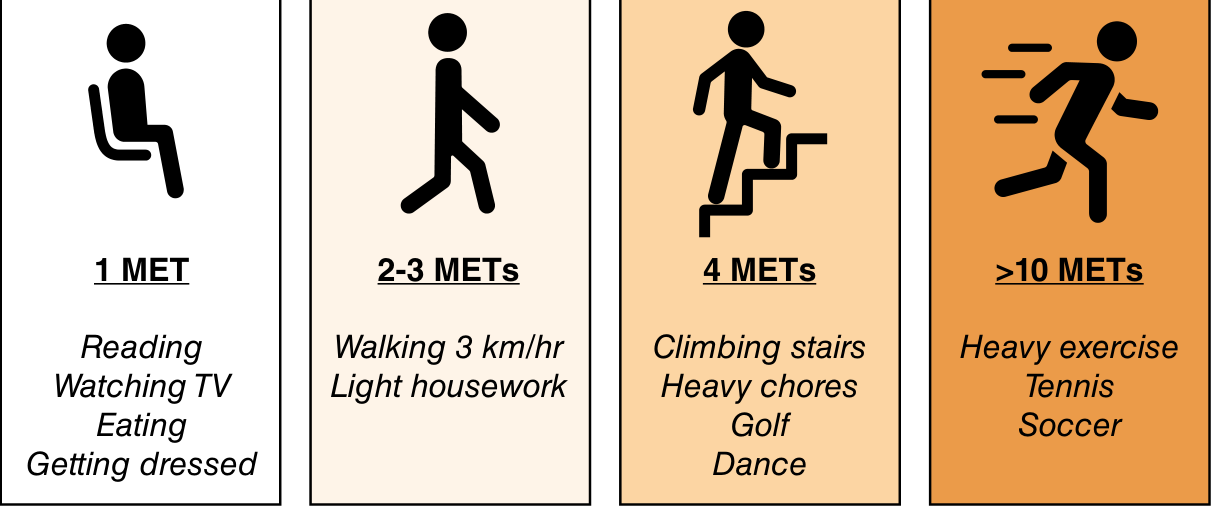
| MET Level | Representative Activities |
|---|---|
| 1 MET | Eating, dressing, using the toilet, reading, watching TV, walking indoors |
| 2-3 METs | Walking at 3-4.8 km/hr on level ground, light housework (dusting, washing dishes) |
| 4 METs | Climbing one flight of stairs or a hill, walking at 6.4 km/hr, short run, heavy housework (scrubbing floors, moving furniture), golf, bowling, dancing |
| 6 METs | Short run, moderate swimming |
| >10 METs | Strenuous sport: singles tennis, football, basketball, swimming, skiing |
- Morgan & Mikhail's Clinical Anesthesiology, 7e, Table 21-1 (based on Duke Activity Status Index)
Perioperative Decision Algorithm (ACC/AHA)
Elevated surgical risk patient
         |
         ▼
   Assess Functional Capacity (MET)
         |
    _____|__________
   |                |
 ≥4 METs          <4 METs or Unknown
(Moderate-        (Poor capacity)
 Excellent)              |
   |                     ▼
Proceed to       Collaborative decision:
surgery         further stress testing
(no further     or cardiac catheterization
cardiac test    IF results will change
needed)         management
- Barash Clinical Anesthesia, 9e, p. 3403-3404
- Morgan & Mikhail's Clinical Anesthesiology, 7e, p. 706
Assessment Methods
- Clinical interview (subjective) - Ask patients to describe their most demanding daily activity. This is the standard bedside method.
- Duke Activity Status Index (DASI) - A structured patient questionnaire giving a less subjective score; correlates with VO₂ peak.
- Cardiopulmonary Exercise Testing (CPET) - Gold standard objective measurement; measures VO₂ and VCO₂ during incremental exercise.
- Anaerobic threshold (AT) < 11 mL/kg/min = high surgical risk
- VO₂ peak < 15 mL/kg/min = high surgical risk
- Incremental Shuttle Walk Test (ISWT) - Patients failing to achieve 350 metres are at elevated risk for major surgery (correlates well with VO₂ peak; less expensive alternative to CPET).
Key Cutoff: Why 4 METs?
4 METs is the perioperative threshold because it represents moderate daily activity (climbing stairs). Patients unable to achieve 4 METs:
- Have poor cardiorespiratory reserve
- Are at documented increased risk of perioperative morbidity and mortality
- May benefit from further specialist evaluation (cardiology, pulmonology) or prehabilitation (supervised exercise 4-6 weeks preoperatively)
"Patients with moderate (4 METs) to excellent (>10 METs) exercise capacity may proceed to surgery with no further cardiac testing." - Barash Clinical Anesthesia, 9e
Summary Table
| MET | Functional Status | Perioperative Implication |
|---|---|---|
| <4 | Poor | Increased MACE risk; consider further testing |
| 4-10 | Moderate-Good | Proceed to surgery |
| >10 | Excellent | Lowest risk; proceed |
Sources: Sabiston Textbook of Surgery (p. 88) | Morgan & Mikhail's Clinical Anesthesiology 7e (p. 706-707) | Barash Clinical Anesthesia 9e (p. 3403) | Bailey & Love's Short Practice of Surgery 28e (p. 313-314)
This is a shared conversation. Sign in to Orris to start your own chat.