
strength vs muscle size
Reading File
Searching the Web
strength vs muscle size hypertrophy neural adaptations exercise science
Finding Sources
Finding Sources
Finding Sources
Finding Sources
Reading File
Reading File
Reading File
Finding Sources
Loading Image
Reading File
Here's a thorough breakdown of strength vs. muscle size — two related but distinct adaptations.
Strength vs. Muscle Size (Hypertrophy)
These are overlapping but separable phenomena. You can get significantly stronger without getting much bigger, and vice versa. The distinction comes down to where the adaptation happens: the nervous system vs. the muscle itself.
1. What Is Strength?
Strength is your nervous system's ability to produce maximal force. It depends on:
- Motor unit recruitment — how many motor units (motor neuron + its muscle fibers) you can activate simultaneously. Motor units are recruited in order of size: small (low-force, fatigue-resistant) first, large (high-force, fast-twitch) last. At ~85% of max effort in muscles like the biceps, all units are being recruited; beyond that, gains come from increased firing rate.
- Rate coding — how fast motor neurons fire action potentials; higher frequency = greater force summation
- Motor pattern efficiency — better inter- and intra-muscular coordination (fewer antagonist muscles fighting each other)
- Muscle size — the physical cross-sectional area of the fiber sets the ceiling for how much force it can produce
— Guyton and Hall, Eric Kandel's Principles of Neural Science
2. What Is Hypertrophy (Muscle Size)?
Hypertrophy is an increase in the cross-sectional area of muscle fibers — primarily by adding more myofibrils inside existing fibers (not usually by creating new fibers). Key features:
- Training can increase muscle size by 30–60% beyond genetic baseline
- Mostly driven by increased myofibril diameter, not fiber splitting (which is rare)
- Inside a hypertrophied fiber: ↑ myofibrils, ↑ mitochondria (up to 120%), ↑ phosphocreatine/ATP (~60–80%), ↑ glycogen (~50%), ↑ triglyceride (~75–100%)
- Hypertrophy is strongly influenced by testosterone (which is why men average larger muscles) and genetics
— Guyton and Hall Textbook of Medical Physiology
3. Why They're Different
| Strength | Muscle Size | |
|---|---|---|
| Primary driver | Neural adaptations | Structural/protein synthesis |
| Timeline | Fast (weeks 1–6) | Slower (weeks 4+) |
| Key mechanism | Motor unit recruitment, rate coding | Myofibril addition, fiber hypertrophy |
| Fiber type targeted | All types; fast-twitch for max strength | Strength training → Type II (fast-twitch); Endurance → Type I (slow-twitch) |
| Training stimulus | High load (>50% 1RM), low reps | Moderate-to-high load, moderate reps, metabolic stress |
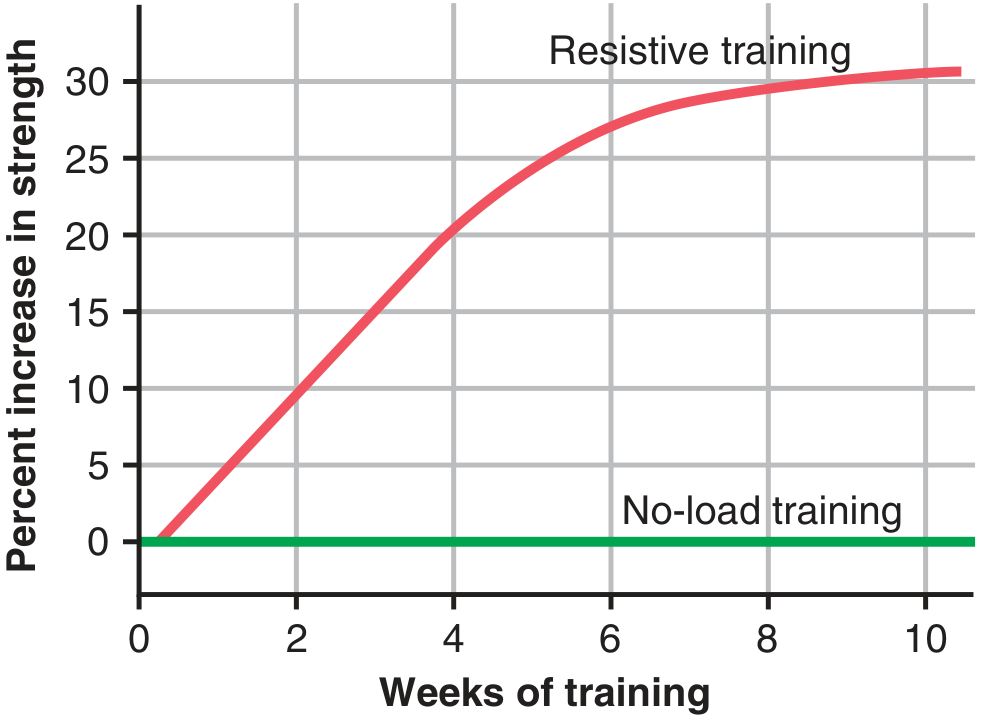
Early training gains are mostly neural. Beginners get strong fast — not because their muscles grew dramatically, but because their nervous system learned to recruit more motor units more efficiently. True hypertrophy follows later.
The graph below (from Guyton & Hall) illustrates this: resistive training yields ~30% strength increase over 10 weeks, with almost zero gain from no-load training regardless of duration.
4. Fiber Types and Training Specificity
Your muscle fiber composition matters:
| Athlete Type | Fast-Twitch (Type II) | Slow-Twitch (Type I) |
|---|---|---|
| Marathoners | 18% | 82% |
| Swimmers | 26% | 74% |
| Average person | 55% | 45% |
| Weight lifters | 55% | 45% |
| Sprinters/Jumpers | 63% | 37% |
- Strength training (high load, low reps) → hypertrophy of fast-twitch (Type II) fibers, improved neural activation, myofibrillar protein synthesis
- Endurance training (low load, high reps) → hypertrophy of slow-twitch (Type I) fibers, ↑ mitochondria, ↑ capillary density, ↑ oxidative capacity
Training can shift fiber proportions by ~10%, but the baseline ratio is largely genetic — which partly explains why some people are naturally built for power vs. endurance.
— Miller's Review of Orthopaedics, Guyton & Hall
5. Practical Implications
- To maximize strength (e.g., powerlifting): heavy loads (>85% 1RM), low reps (1–5), long rest. Prioritizes neural adaptation and fast-twitch recruitment.
- To maximize size (bodybuilding/hypertrophy): moderate loads (~65–80% 1RM), moderate reps (6–15), shorter rest, high metabolic stress and volume.
- Optimal basic protocol (from Guyton & Hall): ~6 near-maximal contractions in 3 sets, 3×/week — produces approximately optimal strength increase without chronic fatigue.
- Strength and size co-occur, but are not the same thing. A bigger muscle is a potentially stronger muscle — but a trained nervous system can outperform a larger untrained one at the same muscle size.
Bottom line: Strength is primarily a skill of the nervous system; muscle size is a structural adaptation of the fibers themselves. Both are built through resistance training, but the specific protocol, load, volume, and rep range shift the balance toward one or the other.
This is a shared conversation. Sign in to Orris to start your own chat.