
Choledocolethiasis 101
Reading File
Now let me search the library for choledocholithiasis content in parallel:
Finding Sources
Finding Sources
Searching PubMed
choledocholithiasis management guidelines
Excellent - rich sources found. Let me read the most comprehensive sections in parallel:
Reading File
Reading File
Reading File
Great content. Let me get the ASGE risk stratification table and the management/treatment sections:
Reading File
Reading File
Reading File
I have rich content. Let me get the treatment/ERCP section and the Sabiston surgical management section:
Reading File
Reading File
I now have comprehensive content from multiple authoritative textbooks. Let me fetch the EUS image for illustration and compile the full response:
Loading Image
Loading Image
Now I have everything needed for a thorough, well-illustrated response.
Choledocholithiasis - A Complete Overview
Choledocholithiasis refers to the presence of stones within the extrahepatic common bile duct (CBD). It affects 5-20% of patients with cholelithiasis and is one of the most common indications for biliary endoscopy and surgery.
1. Classification: Primary vs. Secondary
| Type | Origin | Stone Composition | Common In |
|---|---|---|---|
| Secondary (most common in the West) | Gallbladder stones migrating through cystic duct | Cholesterol or black pigment | United States, Europe |
| Primary | De novo formation within the CBD | Soft brown pigment stones | Asia; post-sphincterotomy patients |
| Retained | Secondary stones found in CBD within 2 years post-cholecystectomy | Mixed | 1-2% of post-cholecystectomy cases |
Primary stone risk factors include IgA deficiency, chronic biliary infection, biliary dyskinesia, and prior sphincterotomy stenosis (allows duodenal reflux to seed stone formation).
- Clinical Gastrointestinal Endoscopy, 3e, p. 804
- Sabiston Textbook of Surgery, p. 1832
2. Presentation
Presentations span a wide spectrum:
Asymptomatic - CBD stones can be clinically silent or pass spontaneously; about 1/3 of incidentally found stones at cholecystectomy resolve on their own.
Biliary colic - Most common symptomatic presentation; intermittent obstruction causes fluctuating bilirubin and LFT abnormalities.
Obstructive jaundice - Painful jaundice (distinguishes it from malignant causes, which tend to be painless). Scleral icterus, dark urine, pale stools.
Ascending cholangitis - Bacterial infection behind an obstructing CBD stone:
- Charcot's triad: Fever/rigors + RUQ pain + Jaundice (42-75% have all three; 95% specific but only 26% sensitive)
- Reynolds' pentad: Charcot's triad + hypotension + altered mental status - indicates severe/suppurative cholangitis
- Bacteremia is found in 74% of patients - antibiotics should be started promptly on clinical suspicion
Gallstone pancreatitis - Second most common complication; CBD stones found in ~50% of patients with gallstone pancreatitis depending on timing of cholangiography.
Chronic/recurrent disease - Can lead to biliary strictures, secondary biliary cirrhosis, and cholangiocarcinoma (via chronic inflammation).
- Mulholland & Greenfield's Surgery, 7e, p. 3071
- Symptom to Diagnosis, 4e, p. 50
3. Diagnosis
Labs
LFTs alone are unreliable but informative:
| Finding | Sensitivity | Specificity | LR+ | LR- |
|---|---|---|---|---|
| Cholangitis | 11% | 99% | 18.3 | 0.93 |
| Jaundice | 36% | 97% | 10.1 | 0.69 |
| Dilated CBD on US | 42% | 96% | 6.9 | 0.77 |
| Elevated ALP | 57% | 86% | 2.6 | 0.65 |
| Elevated amylase | 11% | 95% | 1.5 | 0.99 |
Key points:
- Elevated bilirubin: 69% sensitive, 88% specific
- Normal LFTs have a 97% negative predictive value for CBD stones
- Elevated bilirubin + abnormal US = pretest probability approaches 90%
- Leukocytosis raises concern for cholangitis; lipase >3x ULN is diagnostic for pancreatitis
Imaging
| Modality | Sensitivity | Specificity | Notes |
|---|---|---|---|
| Transabdominal US | 22-60% | ~90% | Poor sensitivity, highly operator-dependent; gold standard for cholelithiasis but poor for CBD stones |
| CT | ~75% | - | Not test of choice; misses small/isodense stones |
| MRCP | 81-100% | 92-100% | Gold standard noninvasive test; 3D duct reconstruction; can miss stones <5 mm |
| EUS | 94-99% | 94-100% | Most sensitive test overall; same-session ERCP possible if positive; reduces ERCP need by 67% |
| ERCP | >90% | 99% | Now reserved as therapeutic, not diagnostic; pancreatitis in 1-5% |
| Intraoperative cholangiogram (IOC) | High | High | Useful during laparoscopic cholecystectomy; ~10-15% positivity rate |
ASGE Risk Stratification (most widely used framework)
| Predictor Strength | Criteria |
|---|---|
| Very strong | CBD stone on US; ascending cholangitis; bilirubin >4 mg/dL |
| Strong | Dilated CBD (>6 mm with GB in situ); bilirubin 1.8-4 mg/dL |
| Moderate | Any other abnormal liver biochemistry; age >55; clinical gallstone pancreatitis |
| Risk Category | Criteria | Pre-test Probability | Next Step |
|---|---|---|---|
| High | Any very strong predictor OR both strong predictors present | >50% | Proceed to ERCP |
| Intermediate | All other patients with some predictors | 10-50% | MRCP or EUS first |
| Low | No predictors | <10% | Cholecystectomy, consider IOC |
Note: A 2025 meta-analysis (PMID: 40569779) found that current diagnostic guidelines have limited performance in acute biliary presentations, reinforcing that clinical judgment must supplement risk stratification.
4. Imaging Examples
EUS identification of a CBD stone - hyperechoic focus with posterior acoustic shadowing:
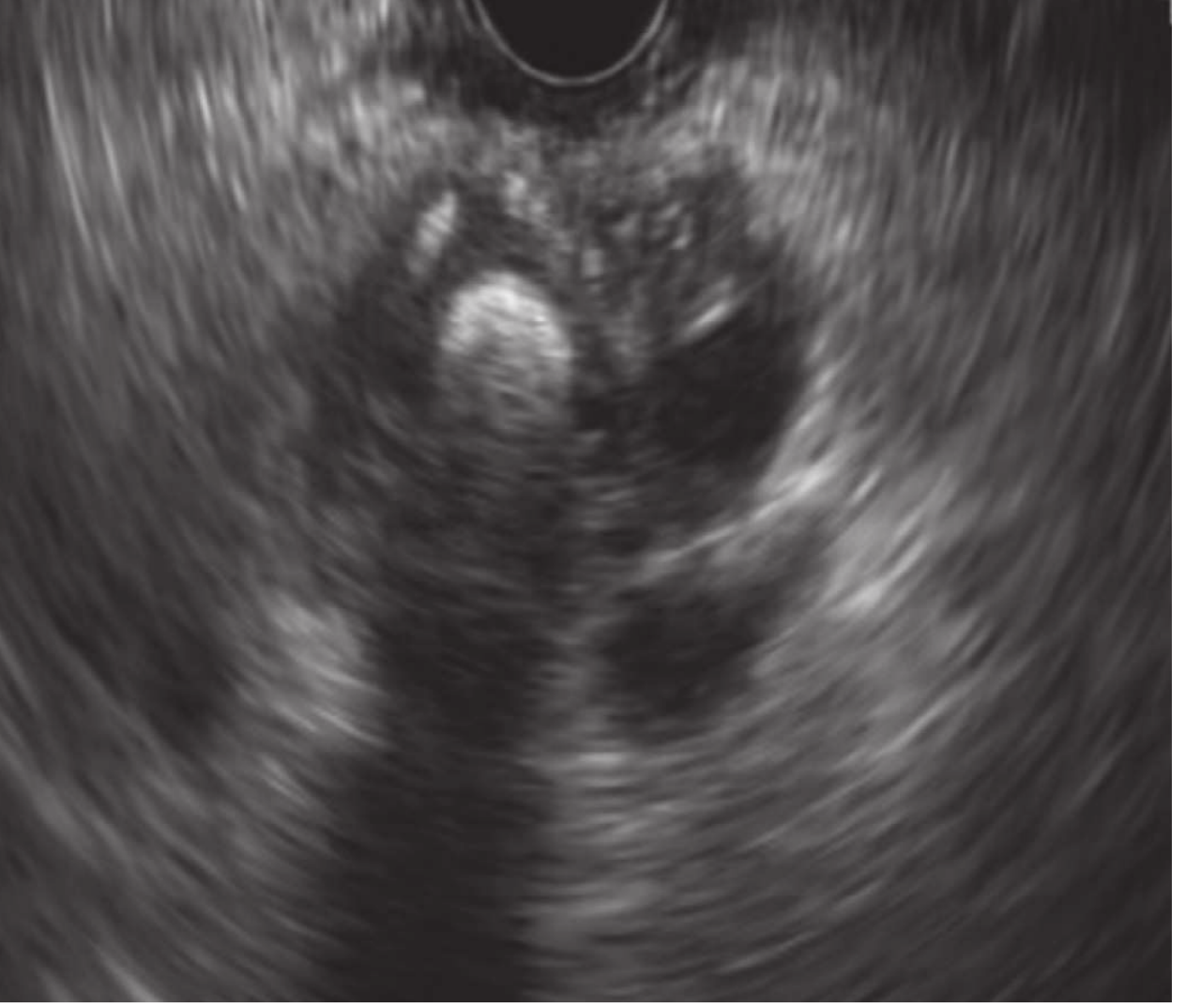
Clinical Gastrointestinal Endoscopy, 3e - Fig. 53.8
Intraoperative cholangiogram showing choledocholithiasis - note the filling defect (arrow) and no dye entering the duodenum:
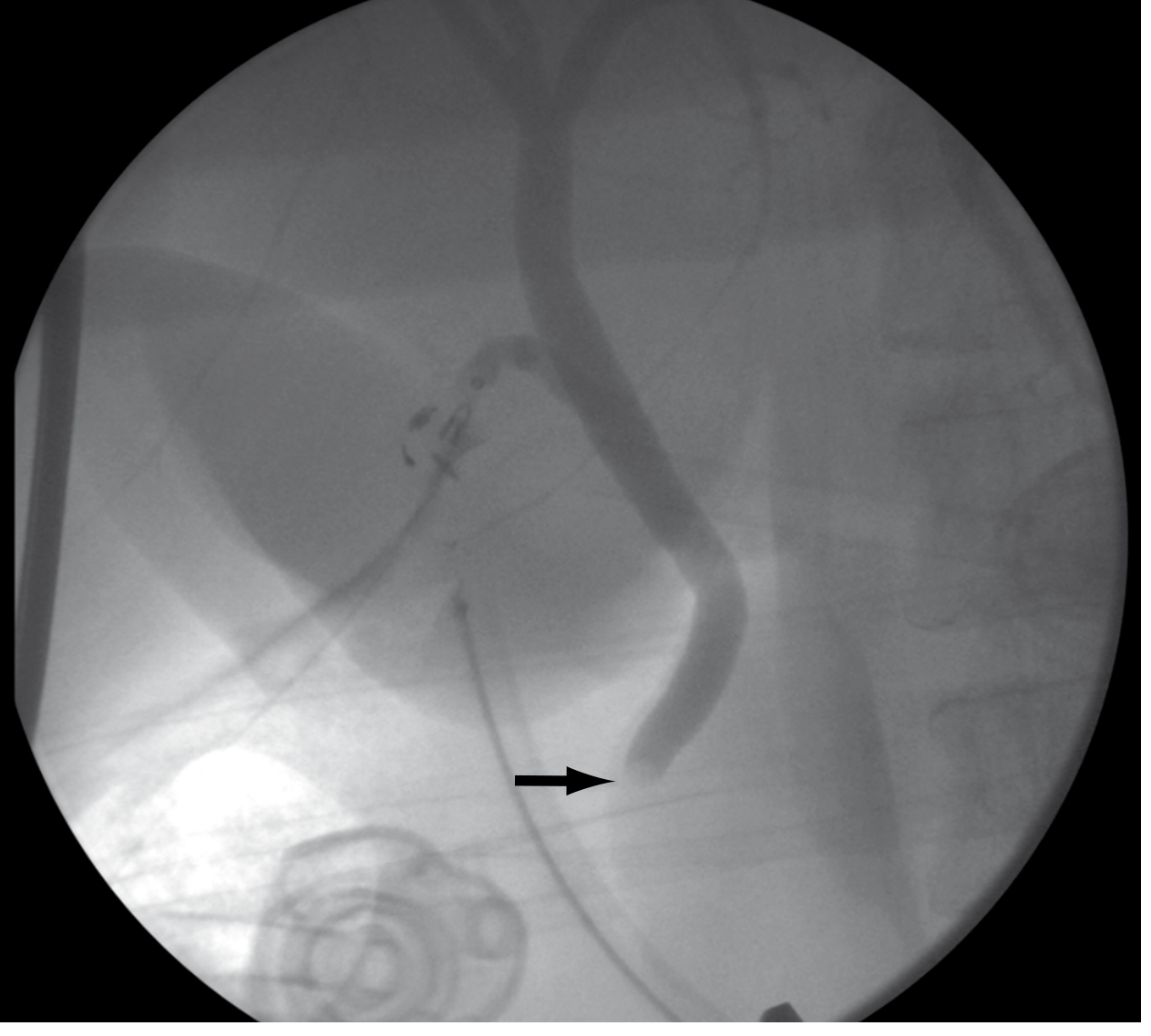
Sabiston Textbook of Surgery - Fig. 88.19
5. Management
Three main approaches exist: endoscopic, surgical, and (less commonly) percutaneous. The ideal approach depends on clinical urgency, gallbladder status, surgical expertise, and stone characteristics.
When to do ERCP first (before cholecystectomy)
- High-risk patients, especially those with ascending cholangitis needing urgent biliary decompression
- Severe gallstone pancreatitis with persistent choledocholithiasis
- Patient unfit for surgery
When to do CBD exploration at surgery
- Large or impacted stones
- Multiple failed endoscopic attempts
- Anatomy precluding endoscopy (e.g., prior Roux-en-Y gastric bypass)
- Intermediate preoperative risk with IOC confirming CBD stones intraoperatively
Endoscopic Approach (ERCP)
- Deep biliary cannulation with cholangiogram to confirm stone(s) and anatomy
- Endoscopic sphincterotomy - first therapeutic step
- Stone extraction using balloon catheters or Dormia baskets
- For large stones: endoscopic balloon dilation, mechanical lithotripsy, laser lithotripsy, or electrohydraulic lithotripsy
- ERCP is successful in ~90% of cases
- Complications: post-ERCP pancreatitis (1-5%), bleeding, perforation, ascending cholangitis
Surgical Approach
- Laparoscopic CBD exploration via transcystic or transcholedochal route - success rate 83-97% in experienced hands
- Open CBD exploration with choledochotomy and T-tube drainage, or primary closure
- Single-stage laparoscopic cholecystectomy + CBD exploration has equivalent duct clearance rates, lower morbidity, and shorter hospital stay compared to two-stage ERCP-then-laparoscopic cholecystectomy - but is highly dependent on surgeon experience
Single-stage vs. Two-stage: What does the evidence say?
A 2025 meta-analysis (PMID: 40101031) of RCTs comparing single-stage laparoscopic management vs. two-stage endoscopic + laparoscopic cholecystectomy found comparable duct clearance and morbidity, supporting single-stage as a valid option when surgical expertise is available.
Timing for Cholecystectomy
- If ERCP was done first for cholangitis or pancreatitis, cholecystectomy should follow during the same admission (or very soon after) to prevent recurrent biliary events
- Delaying cholecystectomy significantly increases the risk of recurrent cholangitis, pancreatitis, and readmission
6. Special Scenarios
Choledocholithiasis identified during cholecystectomy:
Three options: (1) Convert to open with CBD exploration, (2) laparoscopic transcystic CBD exploration, (3) postoperative ERCP. Choice depends on surgeon skill and stone characteristics.
Post-cholecystectomy retained stones (within 2 years): Treat with ERCP and sphincterotomy.
Post-cholecystectomy discovered stones (>2 years): Likely primary CBD stones; treat endoscopically; no further surgical intervention needed if gallbladder already removed.
Intermediate-risk patients: Randomized trial data favor upfront cholecystectomy with IOC over preoperative EUS/ERCP in terms of shorter hospital stay and fewer procedures.
7. Complications Summary
| Complication | Mechanism | Hallmark |
|---|---|---|
| Ascending cholangitis | Bacterial superinfection behind obstruction | Charcot's triad / Reynolds' pentad |
| Obstructive jaundice | Complete biliary obstruction | Painful jaundice, dark urine, pale stools |
| Gallstone pancreatitis | Transient ampullary obstruction | Elevated lipase, epigastric pain |
| Biliary stricture | Chronic inflammation | Recurrent cholestasis, cholangitis |
| Secondary biliary cirrhosis | Prolonged biliary obstruction | Portal hypertension, liver failure |
| Cholangiocarcinoma | Chronic inflammation → neoplasia | Rare long-term complication |
Sources: Clinical Gastrointestinal Endoscopy, 3e | Sleisenger and Fordtran's GI and Liver Disease | Mulholland & Greenfield's Surgery, 7e | Sabiston Textbook of Surgery | Symptom to Diagnosis, 4e | Fischer's Mastery of Surgery, 8e
Recent evidence note: A 2025 systematic review (PMID: 40569779) found that ASGE and other guidelines have limited overall accuracy (~63%) in predicting choledocholithiasis in acute biliary presentations - reinforcing that no guideline should replace individualized clinical assessment.
Differentials
Finding Sources
Finding Sources
Reading File
Reading File
Finding Sources
Reading File
Reading File
Excellent - rich differential content from multiple angles. Here is the complete differential diagnosis breakdown:
Differentials for Choledocholithiasis
The differentials depend on the presenting syndrome - obstructive jaundice, RUQ pain, cholangitis, or incidental biliary dilation. Organized by anatomical level and clinical urgency:
Organized by Anatomical Level of Obstruction
Low / Mid Duct (Most Common Level)
| Diagnosis | Malignant? | Key Distinguishing Features |
|---|---|---|
| Choledocholithiasis | No | Painful jaundice; acute onset; fluctuating LFTs; stone on MRCP/EUS |
| Pancreatic head carcinoma | Yes | Painless progressive jaundice; weight loss; palpable GB (Courvoisier's sign); "double-duct sign" on MRCP |
| Ampullary carcinoma | Yes | Intermittent jaundice (tumor sloughs); occult GI bleeding; periampullary mass on EUS/ERCP |
| Chronic pancreatitis stricture | No | History of alcohol/recurrent pancreatitis; calcifications on CT; gradual onset |
| Acute pancreatitis | No | Elevated lipase; pain radiating to back; peripancreatic edema on CT; may coexist with CBD stone |
| Choledochal cyst | No | Can obstruct distally; cystic dilation of duct on imaging; more common in young/Asian patients |
Hilar / Perihilar
| Diagnosis | Malignant? | Key Distinguishing Features |
|---|---|---|
| Cholangiocarcinoma (Klatskin tumor) | Yes | Hilar stricture on MRCP; intrahepatic duct dilation only; insidious painless jaundice; Bismuth classification I-IV |
| Gallbladder carcinoma | Yes | GB wall thickening or mass; direct hilar invasion; often advanced at diagnosis |
| Hepatocellular carcinoma | Yes | Cirrhotic background; elevated AFP; intrahepatic mass with biliary invasion |
| Mirizzi syndrome | No | Large cystic duct/Hartmann's pouch stone extrinsically compressing the CHD; looks malignant on imaging |
| Primary sclerosing cholangitis (PSC) | No | Beaded/multifocal strictures on cholangiography; associated with IBD (usually UC); progressive |
Either Level
| Diagnosis | Malignant? | Key Distinguishing Features |
|---|---|---|
| Postoperative biliary stricture | No | Prior cholecystectomy history; presents weeks to years later; ERCP/PTC shows smooth narrowing |
| Metastatic lymphadenopathy | Yes | Known primary malignancy; porta hepatis nodes on CT |
| Lymphoma | Yes | Systemic symptoms; lymphadenopathy elsewhere |
| Haemobilia | No | History of trauma or procedure; blood in bile; seen at ERCP |
| Parasites (Ascaris, Clonorchis) | No | Travel history; filling defects in duct; eosinophilia |
| IgG4-related sclerosing cholangitis | No | Mimics PSC or cholangiocarcinoma; responds to steroids; elevated serum IgG4 |
Differentials by Presenting Syndrome
1. Obstructive (Cholestatic) Jaundice
The core question is painful vs. painless:
- Painful jaundice with acute onset → favors choledocholithiasis (rapid distension activates pain fibers)
- Painless, progressive jaundice → strongly suggests malignancy (pancreatic head CA, cholangiocarcinoma, ampullary CA)
- Intermittent jaundice → ampullary carcinoma, Mirizzi syndrome, PSC
Courvoisier's rule: A palpable, non-tender gallbladder in a jaundiced patient suggests malignant (not stone) obstruction, since chronic choledocholithiasis leads to a fibrotic, non-distensible gallbladder.
2. RUQ Pain + Fever (Cholangitis picture)
- Choledocholithiasis (most common cause)
- Biliary stricture (post-op or PSC) with superinfection
- Biliary parasitosis (especially Ascaris or Clonorchis)
- Haemobilia (post-procedure or trauma)
- Mirizzi syndrome with secondary infection
3. Elevated LFTs / Incidental Biliary Dilation
- Choledocholithiasis (silent)
- Early PSC
- IgG4-related cholangiopathy
- Ampullary stenosis / papillary dysfunction (Sphincter of Oddi dysfunction)
- Post-cholecystectomy duct dilation (physiologic; reservoir effect - duct up to 10 mm can be normal)
- Drug-induced cholestasis (no ductal dilation)
4. Gallstone Pancreatitis Overlap
- Choledocholithiasis with pancreatitis (stone at ampulla)
- Idiopathic acute pancreatitis
- Other causes of pancreatitis (alcohol, hypertriglyceridemia, autoimmune) with incidental duct dilation
Key Differentiating Workup
| Feature | Choledocholithiasis | Malignant Obstruction | PSC | Biliary Stricture |
|---|---|---|---|---|
| Pain | Often present | Usually absent | Variable | Variable |
| Onset | Acute/fluctuating | Progressive | Insidious | Gradual (post-op) |
| LFTs | Transaminases first, then cholestatic | Predominantly cholestatic | Mixed | Cholestatic |
| Bilirubin | Fluctuates | Steadily rises | Fluctuates | Steady |
| CA 19-9 | Normal (mildly elevated if cholangitis) | Often markedly elevated | May be elevated | Normal-mildly elevated |
| US | Stone/dilation | Mass, dilation | Beading | Stricture, dilation |
| MRCP | Stone, filling defect | Stricture + mass | Multifocal beading | Smooth tapering |
| Double-duct sign | Absent | Present (pancreatic CA) | Absent | Absent |
| Response to stone removal | Resolution | No change | Partial | Variable |
Radiological Pearl: Level of Obstruction
-
Intrahepatic duct dilation only → hilar obstruction (Klatskin tumor, hilar metastases)
-
Both intra- and extrahepatic duct dilation → low/mid duct obstruction (stone, pancreatic CA, ampullary CA)
-
No duct dilation + jaundice → consider PSC, cholangitis, hepatocellular jaundice (hepatitis, cirrhosis), or drug-induced causes
-
Grainger & Allison's Diagnostic Radiology - Table 24.1
-
Sleisenger & Fordtran's GI and Liver Disease, p. 1268
-
Current Surgical Therapy, 14e, p. 577
This is a shared conversation. Sign in to Orris to start your own chat.