
Larger staging of mucosal injury
The Langer staging system (also called the "Larger" staging - likely referring to Langer's classification) is used for grading mucosal injury. Let me pull the authoritative details from the medical library.
Searching sources...
Reading File
Zarger staging
The Zargar staging (also called Zargar's endoscopic classification) is used to grade caustic/corrosive mucosal injury of the esophagus and stomach after ingestion of corrosive substances. It is an adaptation of burn depth classification applied endoscopically.
Searching sources...
Reading File
Searching the Web
Zargar staging classification caustic esophageal injury endoscopic grading
Now let me search the medical library for more detail:
Finding Sources
Reading File
Reading File
Now let me fetch the endoscopy image for a visual reference:
Loading Image
Here is a complete summary of the Zargar Endoscopic Staging of Caustic Mucosal Injury:
Zargar Endoscopic Classification of Caustic Injury
Zargar's classification is the most widely used endoscopic grading system for assessing the severity of mucosal injury following ingestion of corrosive (acid or alkali) substances. It is performed ideally within 12-24 hours of ingestion. The system is analogous to burn depth classification applied endoscopically.
(Source: Zargar SA et al. Gastrointest Endosc. 1991;37(2):165-169)
| Grade | Endoscopic Findings | Clinical Implication |
|---|---|---|
| 0 | Normal appearance | No injury |
| 1 | Mucosal oedema and hyperaemia (erythema) | Superficial; heals without sequelae |
| 2a | Superficial, non-circumferential ulceration, whitish membranes, shallow ulcers, haemorrhage, friable exudates | Heals well; low stricture risk |
| 2b | Deep or circumferential ulceration with structure formation | Higher stricture risk |
| 3a | Small, scattered areas of focal necrosis | Significant stricture and complication risk |
| 3b | Extensive necrosis | Highest morbidity and mortality |
| 4 | Perforation | Surgical emergency |
(Bailey and Love's Short Practice of Surgery, 28th Ed.; Cummings Otolaryngology, Head and Neck Surgery)
Key Clinical Correlations
- Grade 0 and 1 - conservative management; good prognosis
- Grade 2a - admit, observe; stricture risk is low
- Grade 2b - higher risk of stricture formation; monitor closely
- Grade 3a and 3b - high risk of stricture, perforation, mediastinitis; may need surgery
- Grade 4 - immediate surgical intervention required
Pathophysiology (NaOH/Alkali injury)
- Day 0-2: Intense inflammatory reaction, oedema, haemorrhagic congestion, eosinophilic necrosis
- Day 4: Fibroblast and new blood vessel emergence; necrosis typically complete by day 7
- Week 2+: Granulation tissue predominates → contractile phase → stricture formation
Complications by Grade
- Stricture: Most common with grades 2b and above - often long, resistant to dilation
- Malignancy: Long-term risk in the damaged oesophagus (especially corrosive strictures)
- Perforation/Mediastinitis/Peritonitis: Grades 3b and 4
Endoscopic image - caustic burn to the oesophagus:
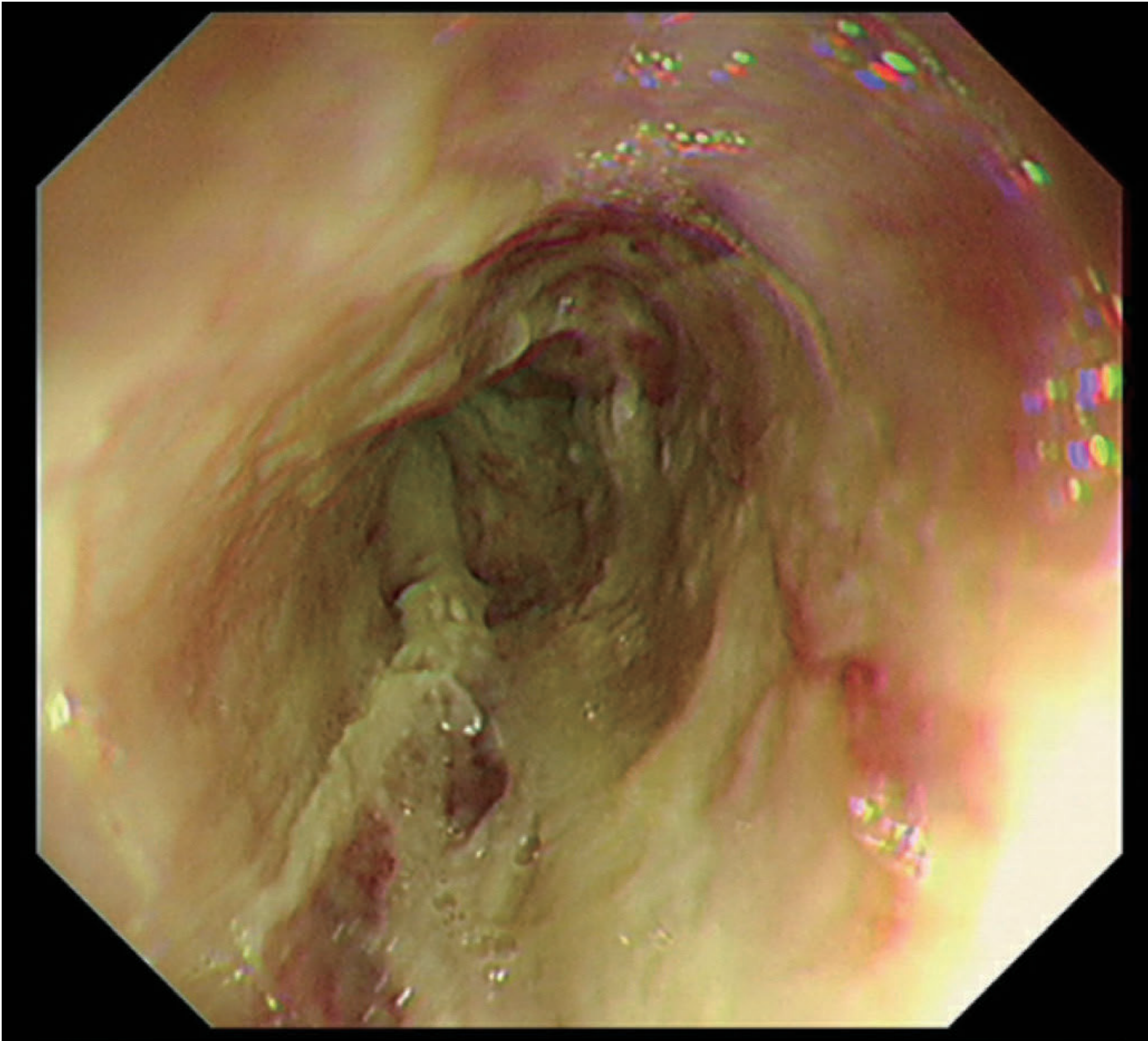
Note: Grade 4 (perforation) was added in the modified Zargar classification (1991) - the original 1989 classification only went to Grade 3b. Endoscopy should be performed with caution in suspected Grade 3b injury, as advancing the scope risks iatrogenic perforation.
This is a shared conversation. Sign in to Orris to start your own chat.