
Prepare a seminar on perioperative care
perioperative care management outcomes
mkdir -p /home/daytona/workspace/perioperative-seminar && ls /home/daytona/workspace/perioperative-seminar/
~/perioperative-seminar/build.js
const pptxgen = require("pptxgenjs");

const pres = new pptxgen();
pres.layout = "LAYOUT_16x9";
pres.author = "Orris Medical Education";
pres.title = "Perioperative Care – A Comprehensive Seminar";

// ─── COLOUR PALETTE ───────────────────────────────────────────────────────────
const C = {
  navy:    "0A2342",   // dominant dark
  teal:    "006D77",   // accent
  sky:     "83C5BE",   // light accent
  cream:   "EAF4F4",   // light bg
  white:   "FFFFFF",
  red:     "C1121F",   // alert / warning
  amber:   "E9C46A",   // caution
  text:    "1A1A2E",   // body text
  muted:   "4A5568",   // subdued text
  divider: "83C5BE",
};

// ─── HELPER FUNCTIONS ─────────────────────────────────────────────────────────
function darkSlide(slide) {
  slide.background = { color: C.navy };
}
function lightSlide(slide) {
  slide.background = { color: C.cream };
}
function addSectionBar(slide, label) {
  slide.addShape(pres.ShapeType.rect, { x: 0, y: 0, w: 10, h: 0.12, fill: { color: C.teal }, line: { type: "none" } });
  slide.addShape(pres.ShapeType.rect, { x: 0, y: 5.5, w: 10, h: 0.125, fill: { color: C.teal }, line: { type: "none" } });
  slide.addText(label, { x: 0.3, y: 0.18, w: 9.4, h: 0.4, fontSize: 9, bold: true, color: C.teal, fontFace: "Calibri", charSpacing: 3 });
}
function addSlideNumber(slide, n) {
  slide.addText(String(n), { x: 9.5, y: 5.25, w: 0.4, h: 0.25, fontSize: 8, color: C.muted, align: "right" });
}
function bulletList(items, opts = {}) {
  return items.map((txt, i) => ({
    text: txt,
    options: { bullet: { type: "bullet", indent: 12 }, breakLine: i < items.length - 1, ...opts }
  }));
}
function numberedList(items, opts = {}) {
  return items.map((txt, i) => ({
    text: txt,
    options: { bullet: { type: "number", indent: 15 }, breakLine: i < items.length - 1, ...opts }
  }));
}

// ═══════════════════════════════════════════════════════════════════════════════
// SLIDE 1 – TITLE
// ═══════════════════════════════════════════════════════════════════════════════
{
  const s = pres.addSlide();
  darkSlide(s);
  // Decorative teal stripe
  s.addShape(pres.ShapeType.rect, { x: 0, y: 0, w: 0.35, h: 5.625, fill: { color: C.teal }, line: { type: "none" } });
  s.addShape(pres.ShapeType.rect, { x: 0.35, y: 0, w: 0.08, h: 5.625, fill: { color: C.sky }, line: { type: "none" } });
  // Title
  s.addText("PERIOPERATIVE CARE", {
    x: 0.65, y: 1.1, w: 9.2, h: 1.0, fontSize: 42, bold: true, color: C.white,
    fontFace: "Calibri", charSpacing: 3
  });
  s.addText("A Comprehensive Seminar", {
    x: 0.65, y: 2.15, w: 9.2, h: 0.55, fontSize: 22, color: C.sky, fontFace: "Calibri"
  });
  s.addShape(pres.ShapeType.line, { x: 0.65, y: 2.85, w: 7.5, h: 0, line: { color: C.teal, width: 1.5 } });
  s.addText([
    { text: "Topics covered: ", options: { bold: true, color: C.sky } },
    { text: "Preoperative Assessment  ·  Intraoperative Management  ·  ERAS  ·  Postoperative Care  ·  Complications", options: { color: C.white } }
  ], { x: 0.65, y: 3.0, w: 9.0, h: 0.5, fontSize: 12, fontFace: "Calibri" });
  s.addText("Sources: Current Surgical Therapy 14e · Miller's Anesthesia 10e · Schwartz's Principles of Surgery 11e · Barash Clinical Anesthesia 9e · Pye's Surgical Handicraft 22e", {
    x: 0.65, y: 5.1, w: 9.2, h: 0.35, fontSize: 8, color: C.muted, fontFace: "Calibri"
  });
}

// ═══════════════════════════════════════════════════════════════════════════════
// SLIDE 2 – AGENDA / OUTLINE
// ═══════════════════════════════════════════════════════════════════════════════
{
  const s = pres.addSlide();
  lightSlide(s);
  addSectionBar(s, "OVERVIEW");
  s.addText("Seminar Outline", { x: 0.5, y: 0.55, w: 9, h: 0.55, fontSize: 28, bold: true, color: C.navy, fontFace: "Calibri" });

  const sections = [
    ["1", "Preoperative Assessment", "History, physical, risk stratification, investigations"],
    ["2", "Perioperative Medical Optimization", "Diabetes, cardiac disease, frailty, nutrition"],
    ["3", "Fluid & Electrolyte Management", "Goal-directed therapy, ERAS fluid principles"],
    ["4", "Antibiotic Prophylaxis", "Timing, agents, dosing"],
    ["5", "Venous Thromboembolism Prophylaxis", "Risk, mechanical & pharmacological methods"],
    ["6", "Enhanced Recovery After Surgery (ERAS)", "Components, evidence, outcomes"],
    ["7", "Intraoperative Considerations", "Anesthesia, monitoring, positioning"],
    ["8", "Postoperative Care", "Analgesia, nutrition, wound care, mobilization"],
    ["9", "Postoperative Complications", "Recognition & management"],
    ["10", "Special Populations", "Elderly, obese, cardiac patients"],
  ];

  sections.forEach(([num, title, sub], i) => {
    const col = i < 5 ? 0 : 1;
    const row = i % 5;
    const x = col === 0 ? 0.4 : 5.2;
    const y = 1.35 + row * 0.82;
    s.addShape(pres.ShapeType.rect, { x, y, w: 4.55, h: 0.65, fill: { color: C.navy }, line: { type: "none" }, rectRadius: 0.05 });
    s.addText(num, { x: x + 0.1, y: y + 0.05, w: 0.38, h: 0.55, fontSize: 18, bold: true, color: C.teal, align: "center", valign: "middle" });
    s.addShape(pres.ShapeType.line, { x: x + 0.5, y: y + 0.1, w: 0, h: 0.45, line: { color: C.teal, width: 1 } });
    s.addText(title, { x: x + 0.6, y: y + 0.05, w: 3.85, h: 0.3, fontSize: 11, bold: true, color: C.white, fontFace: "Calibri" });
    s.addText(sub, { x: x + 0.6, y: y + 0.33, w: 3.85, h: 0.25, fontSize: 8.5, color: C.sky, fontFace: "Calibri" });
  });
  addSlideNumber(s, 2);
}

// ═══════════════════════════════════════════════════════════════════════════════
// SLIDE 3 – SECTION DIVIDER: PREOPERATIVE ASSESSMENT
// ═══════════════════════════════════════════════════════════════════════════════
{
  const s = pres.addSlide();
  darkSlide(s);
  s.addShape(pres.ShapeType.rect, { x: 0, y: 1.8, w: 10, h: 2.0, fill: { color: C.teal }, line: { type: "none" } });
  s.addText("SECTION 1", { x: 0.5, y: 0.7, w: 9, h: 0.5, fontSize: 14, bold: true, color: C.sky, charSpacing: 6, align: "center" });
  s.addText("Preoperative Assessment", { x: 0.5, y: 1.9, w: 9, h: 0.95, fontSize: 36, bold: true, color: C.white, align: "center" });
  s.addText("History · Physical Examination · Risk Stratification · Investigations", { x: 0.5, y: 2.95, w: 9, h: 0.45, fontSize: 14, color: C.cream, align: "center" });
}

// ═══════════════════════════════════════════════════════════════════════════════
// SLIDE 4 – PREOPERATIVE ASSESSMENT: OVERVIEW
// ═══════════════════════════════════════════════════════════════════════════════
{
  const s = pres.addSlide();
  lightSlide(s);
  addSectionBar(s, "SECTION 1  ·  PREOPERATIVE ASSESSMENT");
  s.addText("Goals of Preoperative Assessment", { x: 0.5, y: 0.55, w: 9, h: 0.55, fontSize: 26, bold: true, color: C.navy });

  // Left column
  s.addShape(pres.ShapeType.rect, { x: 0.4, y: 1.25, w: 4.3, h: 3.9, fill: { color: C.navy }, line: { type: "none" }, rectRadius: 0.08 });
  s.addText("Core Aims", { x: 0.5, y: 1.35, w: 4.1, h: 0.4, fontSize: 14, bold: true, color: C.sky, align: "center" });
  s.addText(bulletList([
    "Identify and optimize medical comorbidities",
    "Assess functional capacity and surgical risk",
    "Develop an individualized anaesthetic plan",
    "Obtain informed consent",
    "Optimize fasting, medications & hydration",
    "Institute VTE and SSI prophylaxis planning",
    "Educate the patient and set expectations"
  ], { fontSize: 11, color: C.white, fontFace: "Calibri" }), { x: 0.5, y: 1.8, w: 4.1, h: 3.1 });

  // Right column
  s.addShape(pres.ShapeType.rect, { x: 5.0, y: 1.25, w: 4.6, h: 3.9, fill: { color: C.cream }, line: { color: C.teal, width: 1 }, rectRadius: 0.08 });
  s.addText("Key Investigations", { x: 5.1, y: 1.35, w: 4.4, h: 0.4, fontSize: 14, bold: true, color: C.navy, align: "center" });
  s.addText(bulletList([
    "Full Blood Count – anaemia, infection",
    "Renal & electrolytes – AKI risk",
    "Liver function – coagulopathy",
    "Coagulation screen – bleeding risk",
    "Blood glucose / HbA1c – DM control",
    "ECG – arrhythmia, ischaemia",
    "CXR – respiratory pathology",
    "Pulmonary function tests (FEV₁, FVC, PFR) – COPD, asthma",
    "Group & Save / Cross-match – major surgery"
  ], { fontSize: 11, color: C.text, fontFace: "Calibri" }), { x: 5.1, y: 1.8, w: 4.4, h: 3.25 });
  addSlideNumber(s, 4);
}

// ═══════════════════════════════════════════════════════════════════════════════
// SLIDE 5 – ASA CLASSIFICATION & CARDIAC RISK
// ═══════════════════════════════════════════════════════════════════════════════
{
  const s = pres.addSlide();
  lightSlide(s);
  addSectionBar(s, "SECTION 1  ·  PREOPERATIVE ASSESSMENT");
  s.addText("ASA Physical Status & Cardiac Risk Stratification", { x: 0.5, y: 0.55, w: 9, h: 0.55, fontSize: 24, bold: true, color: C.navy });

  // ASA table
  const asaRows = [
    ["ASA I",   "Normal healthy patient",                  C.white],
    ["ASA II",  "Mild systemic disease (controlled DM, HTN)", "#e8f5e9"],
    ["ASA III", "Severe systemic disease, not incapacitating", "#fff9c4"],
    ["ASA IV",  "Severe disease, constant threat to life",  "#ffe0b2"],
    ["ASA V",   "Moribund, unlikely to survive 24 h",      "#ffcdd2"],
    ["ASA VI",  "Brain-dead donor",                        "#e8eaf6"],
  ];
  s.addText("ASA Classification", { x: 0.4, y: 1.25, w: 4.5, h: 0.35, fontSize: 13, bold: true, color: C.teal });
  const asaColW = [0.75, 3.65];
  const asaX = [0.4, 1.2];
  s.addShape(pres.ShapeType.rect, { x: 0.4, y: 1.62, w: 4.5, h: 0.35, fill: { color: C.navy }, line: { type: "none" } });
  ["Class", "Description"].forEach((h, ci) => {
    s.addText(h, { x: asaX[ci], y: 1.65, w: asaColW[ci], h: 0.28, fontSize: 10, bold: true, color: C.white });
  });
  asaRows.forEach(([cls, desc, bg], ri) => {
    const y = 1.97 + ri * 0.42;
    s.addShape(pres.ShapeType.rect, { x: 0.4, y, w: 4.5, h: 0.4, fill: { color: bg }, line: { color: C.divider, width: 0.5 } });
    s.addText(cls, { x: asaX[0], y: y + 0.05, w: asaColW[0], h: 0.3, fontSize: 10, bold: true, color: C.navy });
    s.addText(desc, { x: asaX[1], y: y + 0.05, w: asaColW[1], h: 0.3, fontSize: 10, color: C.text });
  });

  // Cardiac
  s.addText("Active Cardiac Conditions (ACC/AHA – Require Workup)", { x: 5.1, y: 1.25, w: 4.7, h: 0.35, fontSize: 12, bold: true, color: C.teal });
  const conditions = [
    ["Unstable CAD", "Unstable angina, recent MI"],
    ["Symptomatic HF", "Decompensated heart failure"],
    ["Unstable Valvular Disease", "Progressive, symptomatic"],
    ["Unstable Arrhythmia", "Acute, malignant"],
    ["Pulmonary Vascular Disease", "Symptomatic PH"],
    ["Adult Congenital HD", "Symptomatic"],
  ];
  conditions.forEach(([title, detail], ri) => {
    const y = 1.65 + ri * 0.62;
    s.addShape(pres.ShapeType.rect, { x: 5.1, y, w: 4.7, h: 0.55, fill: { color: ri % 2 === 0 ? C.navy : "#0d2d4e" }, line: { type: "none" } });
    s.addText(title, { x: 5.25, y: y + 0.04, w: 4.4, h: 0.25, fontSize: 11, bold: true, color: C.sky });
    s.addText(detail, { x: 5.25, y: y + 0.28, w: 4.4, h: 0.2, fontSize: 9.5, color: C.white });
  });
  addSlideNumber(s, 5);
}

// ═══════════════════════════════════════════════════════════════════════════════
// SLIDE 6 – SECTION DIVIDER: MEDICAL OPTIMIZATION
// ═══════════════════════════════════════════════════════════════════════════════
{
  const s = pres.addSlide();
  darkSlide(s);
  s.addShape(pres.ShapeType.rect, { x: 0, y: 1.8, w: 10, h: 2.0, fill: { color: C.teal }, line: { type: "none" } });
  s.addText("SECTION 2", { x: 0.5, y: 0.7, w: 9, h: 0.5, fontSize: 14, bold: true, color: C.sky, charSpacing: 6, align: "center" });
  s.addText("Perioperative Medical Optimization", { x: 0.5, y: 1.9, w: 9, h: 0.95, fontSize: 34, bold: true, color: C.white, align: "center" });
  s.addText("Diabetes · Cardiac Disease · Frailty · Nutrition", { x: 0.5, y: 2.95, w: 9, h: 0.45, fontSize: 14, color: C.cream, align: "center" });
}

// ═══════════════════════════════════════════════════════════════════════════════
// SLIDE 7 – DIABETES MANAGEMENT
// ═══════════════════════════════════════════════════════════════════════════════
{
  const s = pres.addSlide();
  lightSlide(s);
  addSectionBar(s, "SECTION 2  ·  MEDICAL OPTIMIZATION");
  s.addText("Perioperative Diabetes Management", { x: 0.5, y: 0.55, w: 9, h: 0.55, fontSize: 26, bold: true, color: C.navy });

  // Alert box
  s.addShape(pres.ShapeType.rect, { x: 0.4, y: 1.2, w: 9.2, h: 0.55, fill: { color: C.red }, line: { type: "none" }, rectRadius: 0.06 });
  s.addText("⚠  Perioperative hyperglycaemia occurs in up to 40% of general surgery and 80% of cardiac surgery patients — independently associated with wound infection, pneumonia, sepsis and prolonged LOS", {
    x: 0.55, y: 1.27, w: 9.0, h: 0.4, fontSize: 10.5, color: C.white, bold: true
  });

  // Left panel
  s.addShape(pres.ShapeType.rect, { x: 0.4, y: 1.85, w: 4.3, h: 3.4, fill: { color: C.navy }, line: { type: "none" }, rectRadius: 0.07 });
  s.addText("Preoperative", { x: 0.5, y: 1.95, w: 4.1, h: 0.35, fontSize: 13, bold: true, color: C.sky, align: "center" });
  s.addText(bulletList([
    "Measure HbA1c – if > 8%, consider delaying elective surgery",
    "Refer to endocrinologist if HbA1c > 8%",
    "ERAS carbohydrate drinks up to 2 h pre-op reduce catabolism and hypoglycaemia",
    "Reduce stable insulin by ½ to ⅔ while fasting",
    "Hold SGLT2 inhibitors ≥ 3 days pre-op (risk of euglycaemic DKA)",
  ], { fontSize: 10.5, color: C.white }), { x: 0.5, y: 2.35, w: 4.1, h: 2.8 });

  // Right panel
  s.addShape(pres.ShapeType.rect, { x: 5.0, y: 1.85, w: 4.6, h: 3.4, fill: { color: C.cream }, line: { color: C.teal, width: 1 }, rectRadius: 0.07 });
  s.addText("Intra & Postoperative Targets", { x: 5.1, y: 1.95, w: 4.4, h: 0.35, fontSize: 13, bold: true, color: C.navy, align: "center" });
  s.addText(bulletList([
    "Target BG < 180 mg/dL in the operating room (SCA guideline)",
    "Target BG < 150 mg/dL in the ICU",
    "Hourly BG monitoring for insulin pump patients",
    "Insulin pump: maintain basal rate unless BG < 110 mg/dL; correct if BG > 180 mg/dL",
    "Euglycaemia supports wound healing, immune function, and reduces infection risk",
  ], { fontSize: 10.5, color: C.text }), { x: 5.1, y: 2.35, w: 4.4, h: 2.8 });
  addSlideNumber(s, 7);
}

// ═══════════════════════════════════════════════════════════════════════════════
// SLIDE 8 – CARDIAC DISEASE & FRAILTY
// ═══════════════════════════════════════════════════════════════════════════════
{
  const s = pres.addSlide();
  lightSlide(s);
  addSectionBar(s, "SECTION 2  ·  MEDICAL OPTIMIZATION");
  s.addText("Cardiac Disease & Frailty Assessment", { x: 0.5, y: 0.55, w: 9, h: 0.55, fontSize: 26, bold: true, color: C.navy });

  // Cardiac column
  s.addShape(pres.ShapeType.rect, { x: 0.4, y: 1.2, w: 4.3, h: 4.0, fill: { color: C.navy }, line: { type: "none" }, rectRadius: 0.07 });
  s.addText("Cardiac Optimization", { x: 0.5, y: 1.3, w: 4.1, h: 0.35, fontSize: 13, bold: true, color: C.sky, align: "center" });
  s.addText(bulletList([
    "5–8% of noncardiac surgery patients suffer a major cardiac complication within 30 days",
    "Use RCRI or NSQUIP calculator for risk stratification",
    "Best predictor: protocolised functional capacity assessment (6-min walk, AMPAC)",
    "Continue β-blockers and dihydropyridine CCBs perioperatively",
    "Hold ACE inhibitors / ARBs before induction (risk of intraoperative hypotension)",
    "CHF patients: target return to baseline weight, perfusion and functional status at discharge",
  ], { fontSize: 10.5, color: C.white }), { x: 0.5, y: 1.7, w: 4.1, h: 3.4 });

  // Frailty column
  s.addShape(pres.ShapeType.rect, { x: 5.0, y: 1.2, w: 4.6, h: 4.0, fill: { color: C.cream }, line: { color: C.teal, width: 1 }, rectRadius: 0.07 });
  s.addText("Frailty & Nutrition", { x: 5.1, y: 1.3, w: 4.4, h: 0.35, fontSize: 13, bold: true, color: C.navy, align: "center" });
  s.addText([
    { text: "Frailty\n", options: { bold: true, color: C.teal, breakLine: true } },
    ...bulletList([
      "Frailty = generalized poor functional status + reduced physiologic reserve",
      "Doubles odds of new disability; 5× increased odds of non-home discharge in elderly",
      "Prehabilitation (exercise, nutrition) before surgery counters frailty",
    ], { fontSize: 10.5, color: C.text }),
    { text: "\nNutrition\n", options: { bold: true, color: C.teal, breakLine: true } },
    ...bulletList([
      "Malnutrition → infection, wound failure, fistula, renal & cardiac complications",
      "Screen with PONS tool (BMI, weight loss, intake change, albumin)",
      "7 days preoperative nutritional support ↓ complications by 50% in high-risk abdominal surgery",
      "Postoperative period is catabolic — resume nutrition plan early",
    ], { fontSize: 10.5, color: C.text }),
  ], { x: 5.1, y: 1.7, w: 4.4, h: 3.4 });
  addSlideNumber(s, 8);
}

// ═══════════════════════════════════════════════════════════════════════════════
// SLIDE 9 – SECTION DIVIDER: FLUID & ELECTROLYTES
// ═══════════════════════════════════════════════════════════════════════════════
{
  const s = pres.addSlide();
  darkSlide(s);
  s.addShape(pres.ShapeType.rect, { x: 0, y: 1.8, w: 10, h: 2.0, fill: { color: C.teal }, line: { type: "none" } });
  s.addText("SECTION 3", { x: 0.5, y: 0.7, w: 9, h: 0.5, fontSize: 14, bold: true, color: C.sky, charSpacing: 6, align: "center" });
  s.addText("Fluid & Electrolyte Management", { x: 0.5, y: 1.9, w: 9, h: 0.95, fontSize: 36, bold: true, color: C.white, align: "center" });
  s.addText("Goal-Directed Therapy · Volume Status · Electrolyte Disorders", { x: 0.5, y: 2.95, w: 9, h: 0.45, fontSize: 14, color: C.cream, align: "center" });
}

// ═══════════════════════════════════════════════════════════════════════════════
// SLIDE 10 – FLUID MANAGEMENT
// ═══════════════════════════════════════════════════════════════════════════════
{
  const s = pres.addSlide();
  lightSlide(s);
  addSectionBar(s, "SECTION 3  ·  FLUID & ELECTROLYTE MANAGEMENT");
  s.addText("Perioperative Fluid Management", { x: 0.5, y: 0.55, w: 9, h: 0.55, fontSize: 26, bold: true, color: C.navy });

  const cols = [
    {
      title: "Preoperative",
      bg: C.navy, tc: C.sky, bc: C.white,
      items: [
        "Allow clear liquids up to 2 h pre-op (ESA 2011 guidelines)",
        "Carbohydrate + electrolyte-rich drinks → enhance hydration, blunt metabolic response",
        "Correct pre-existing dehydration with isotonic crystalloid",
        "Assess for occult volume depletion (tachycardia, orthostasis, oliguria)",
      ]
    },
    {
      title: "Intraoperative",
      bg: C.teal, tc: C.white, bc: C.white,
      items: [
        "Goal-directed fluid therapy (GDFT): guides IV fluids to optimise CO and DO₂",
        "ERAS protocols restrict intra-operative sodium and IV fluid volume",
        "Fluid overload → prolonged ileus, coagulation abnormalities",
        "Replace insensible losses + surgical losses accurately",
      ]
    },
    {
      title: "Postoperative",
      bg: C.cream, tc: C.navy, bc: C.text,
      items: [
        "Earliest sign of volume overload: weight gain (expected loss 0.25–0.5 lb/day from catabolism)",
        "Discontinue IV fluids early — prompt switch to oral/enteral route",
        "Volume deficit: treat with isotonic crystalloid while assessing electrolytes",
        "Monitor for SIADH after CNS surgery or morphine/NSAID use",
      ]
    },
  ];
  cols.forEach(({ title, bg, tc, bc, items }, ci) => {
    const x = 0.3 + ci * 3.15;
    s.addShape(pres.ShapeType.rect, { x, y: 1.2, w: 3.05, h: 4.1, fill: { color: bg }, line: { type: "none" }, rectRadius: 0.07 });
    s.addText(title, { x: x + 0.1, y: 1.3, w: 2.85, h: 0.4, fontSize: 14, bold: true, color: tc, align: "center" });
    s.addText(bulletList(items, { fontSize: 10, color: bc }), { x: x + 0.1, y: 1.75, w: 2.85, h: 3.4 });
  });
  addSlideNumber(s, 10);
}

// ═══════════════════════════════════════════════════════════════════════════════
// SLIDE 11 – ANTIBIOTIC PROPHYLAXIS
// ═══════════════════════════════════════════════════════════════════════════════
{
  const s = pres.addSlide();
  lightSlide(s);
  addSectionBar(s, "SECTION 4  ·  ANTIBIOTIC PROPHYLAXIS");
  s.addText("Surgical Site Infection & Antibiotic Prophylaxis", { x: 0.5, y: 0.55, w: 9, h: 0.55, fontSize: 24, bold: true, color: C.navy });

  // Key facts banner
  s.addShape(pres.ShapeType.rect, { x: 0.4, y: 1.2, w: 9.2, h: 0.5, fill: { color: C.teal }, line: { type: "none" }, rectRadius: 0.05 });
  s.addText("SSI Rate: ~0.4% (NSQUIP) • MRSA now accounts for ~15% of SSI • Prophylaxis is standard where infection risk exceeds a minimum threshold", {
    x: 0.55, y: 1.27, w: 9.0, h: 0.36, fontSize: 10, color: C.white, bold: true
  });

  s.addShape(pres.ShapeType.rect, { x: 0.4, y: 1.8, w: 4.3, h: 3.5, fill: { color: C.navy }, line: { type: "none" }, rectRadius: 0.07 });
  s.addText("Principles of Prophylaxis", { x: 0.5, y: 1.9, w: 4.1, h: 0.35, fontSize: 13, bold: true, color: C.sky, align: "center" });
  s.addText(bulletList([
    "Agent must cover likely organisms at surgical site",
    "Clean surgery: skin flora (S. aureus, coag-neg staph)",
    "Clean-contaminated: + gram-negative rods, enterococci",
    "First-choice agent: Cefazolin (1st-gen cephalosporin) – proven, safe, broad spectrum",
    "Vancomycin: reserved for known/suspected MRSA colonisation",
    "Prophylactic antibiotics → discontinue within 24 h post-op",
  ], { fontSize: 10.5, color: C.white }), { x: 0.5, y: 2.3, w: 4.1, h: 2.9 });

  s.addShape(pres.ShapeType.rect, { x: 5.0, y: 1.8, w: 4.6, h: 3.5, fill: { color: C.cream }, line: { color: C.teal, width: 1 }, rectRadius: 0.07 });
  s.addText("Timing & Dosing", { x: 5.1, y: 1.9, w: 4.4, h: 0.35, fontSize: 13, bold: true, color: C.navy, align: "center" });
  s.addText(bulletList([
    "Ideal timing: 30–60 min before incision for bolus agents (e.g. cefazolin)",
    "Vancomycin infusion: must start within 120 min before incision",
    "When tourniquet used: complete infusion before inflation",
    "Repeat cefazolin every 4 h intraoperatively (t½ = 8 h, doubled turnover with blood loss)",
    "Weight-based dosing based on volume of distribution",
    "Giving too early (> 60 min before incision) is a recurrent quality problem",
  ], { fontSize: 10.5, color: C.text }), { x: 5.1, y: 2.3, w: 4.4, h: 2.9 });
  addSlideNumber(s, 11);
}

// ═══════════════════════════════════════════════════════════════════════════════
// SLIDE 12 – VTE PROPHYLAXIS
// ═══════════════════════════════════════════════════════════════════════════════
{
  const s = pres.addSlide();
  lightSlide(s);
  addSectionBar(s, "SECTION 5  ·  VTE PROPHYLAXIS");
  s.addText("Venous Thromboembolism (VTE) Prophylaxis", { x: 0.5, y: 0.55, w: 9, h: 0.55, fontSize: 24, bold: true, color: C.navy });

  // Risk factors
  s.addShape(pres.ShapeType.rect, { x: 0.4, y: 1.2, w: 2.95, h: 4.1, fill: { color: C.navy }, line: { type: "none" }, rectRadius: 0.07 });
  s.addText("Risk Factors", { x: 0.5, y: 1.3, w: 2.75, h: 0.35, fontSize: 13, bold: true, color: C.sky, align: "center" });
  s.addText(bulletList([
    "Major orthopaedic / pelvic surgery",
    "Active malignancy",
    "Prior VTE",
    "Prolonged immobility",
    "Obesity (BMI > 30)",
    "Advanced age",
    "Oestrogen therapy / OCP",
    "Thrombophilia",
  ], { fontSize: 10.5, color: C.white }), { x: 0.5, y: 1.7, w: 2.75, h: 3.5 });

  // Mechanical
  s.addShape(pres.ShapeType.rect, { x: 3.5, y: 1.2, w: 2.95, h: 4.1, fill: { color: C.teal }, line: { type: "none" }, rectRadius: 0.07 });
  s.addText("Mechanical Methods", { x: 3.6, y: 1.3, w: 2.75, h: 0.35, fontSize: 13, bold: true, color: C.white, align: "center" });
  s.addText(bulletList([
    "Early ambulation – single best low-risk measure",
    "Graduated compression stockings (TED)",
    "Intermittent pneumatic compression (IPC) devices",
    "Combined IPC + pharmacological prophylaxis for high-risk patients (Cochrane evidence)",
    "Used when pharmacological methods are contraindicated",
  ], { fontSize: 10.5, color: C.white }), { x: 3.6, y: 1.7, w: 2.75, h: 3.5 });

  // Pharmacological
  s.addShape(pres.ShapeType.rect, { x: 6.6, y: 1.2, w: 3.0, h: 4.1, fill: { color: C.cream }, line: { color: C.teal, width: 1 }, rectRadius: 0.07 });
  s.addText("Pharmacological Methods", { x: 6.7, y: 1.3, w: 2.8, h: 0.35, fontSize: 13, bold: true, color: C.navy, align: "center" });
  s.addText(bulletList([
    "LMWH (enoxaparin) – preferred agent in most guidelines",
    "Unfractionated heparin 5000 IU SC TDS – alternative",
    "DOACs (rivaroxaban, apixaban) – orthopaedic surgery",
    "Fondaparinux – alternative, longer duration",
    "NCCN guidelines: cancer-associated VTE prophylaxis",
    "Duration: 7–35 days depending on surgery type and risk",
  ], { fontSize: 10.5, color: C.text }), { x: 6.7, y: 1.7, w: 2.8, h: 3.5 });
  addSlideNumber(s, 12);
}

// ═══════════════════════════════════════════════════════════════════════════════
// SLIDE 13 – SECTION DIVIDER: ERAS
// ═══════════════════════════════════════════════════════════════════════════════
{
  const s = pres.addSlide();
  darkSlide(s);
  s.addShape(pres.ShapeType.rect, { x: 0, y: 1.8, w: 10, h: 2.0, fill: { color: C.teal }, line: { type: "none" } });
  s.addText("SECTION 6", { x: 0.5, y: 0.7, w: 9, h: 0.5, fontSize: 14, bold: true, color: C.sky, charSpacing: 6, align: "center" });
  s.addText("Enhanced Recovery After Surgery", { x: 0.5, y: 1.9, w: 9, h: 0.95, fontSize: 34, bold: true, color: C.white, align: "center" });
  s.addText("ERAS Principles · Evidence · Outcomes", { x: 0.5, y: 2.95, w: 9, h: 0.45, fontSize: 14, color: C.cream, align: "center" });
}

// ═══════════════════════════════════════════════════════════════════════════════
// SLIDE 14 – ERAS
// ═══════════════════════════════════════════════════════════════════════════════
{
  const s = pres.addSlide();
  lightSlide(s);
  addSectionBar(s, "SECTION 6  ·  ENHANCED RECOVERY AFTER SURGERY (ERAS)");
  s.addText("ERAS: Components & Evidence", { x: 0.5, y: 0.55, w: 9, h: 0.55, fontSize: 26, bold: true, color: C.navy });

  // Evidence bar
  s.addShape(pres.ShapeType.rect, { x: 0.4, y: 1.15, w: 9.2, h: 0.5, fill: { color: C.navy }, line: { type: "none" }, rectRadius: 0.05 });
  s.addText("ERAS was pioneered by Danish surgeon Henrik Kehlet • Reduces LOS • Improves patient satisfaction • Cuts costs • Lowers complications • ERAS Society publishes specialty-specific guidelines (erssociety.org)", {
    x: 0.55, y: 1.22, w: 9.0, h: 0.36, fontSize: 10, color: C.sky, bold: false
  });

  // Three phase columns
  const phases = [
    {
      label: "PRE-OPERATIVE",
      bg: "#0d2d4e", tc: C.sky, bc: C.white,
      items: [
        "Patient education & shared decision-making",
        "Nutritional optimisation",
        "Prehabilitation (exercise programme)",
        "Carbohydrate loading up to 2 h pre-op",
        "No prolonged fasting – clear liquids allowed",
        "Smoking cessation ≥ 3 weeks",
        "Minimise pre-op anxiolytic medications",
      ]
    },
    {
      label: "INTRA-OPERATIVE",
      bg: C.teal, tc: C.white, bc: C.white,
      items: [
        "Opioid-sparing multimodal analgesia",
        "Pre-emptive regional / peripheral nerve blocks",
        "Local anaesthetic wound infiltration",
        "Prefer regional / sedation over GA when possible",
        "PONV prophylaxis (multimodal)",
        "Goal-directed fluid therapy",
        "Minimally invasive surgical approach",
      ]
    },
    {
      label: "POST-OPERATIVE",
      bg: C.cream, tc: C.navy, bc: C.text,
      items: [
        "Resume full diet as soon as tolerated",
        "Early mobilisation (median 5–6 h post-op in studies)",
        "Prompt IV fluid discontinuation",
        "Multimodal non-opioid analgesia",
        "DVT prophylaxis continued",
        "Outcome: RCT ↓ time in hospital (23h → 9.7h for appendectomy)",
        "Breast cancer ERAS: same-day discharge ↑ from 7% to 59%",
      ]
    },
  ];
  phases.forEach(({ label, bg, tc, bc, items }, ci) => {
    const x = 0.3 + ci * 3.15;
    s.addShape(pres.ShapeType.rect, { x, y: 1.75, w: 3.05, h: 3.65, fill: { color: bg }, line: { type: "none" }, rectRadius: 0.07 });
    s.addText(label, { x: x + 0.1, y: 1.85, w: 2.85, h: 0.4, fontSize: 11, bold: true, color: tc, align: "center", charSpacing: 1 });
    s.addShape(pres.ShapeType.line, { x: x + 0.3, y: 2.28, w: 2.45, h: 0, line: { color: tc, width: 0.75 } });
    s.addText(bulletList(items, { fontSize: 9.5, color: bc }), { x: x + 0.12, y: 2.34, w: 2.83, h: 3.0 });
  });
  addSlideNumber(s, 14);
}

// ═══════════════════════════════════════════════════════════════════════════════
// SLIDE 15 – POSTOPERATIVE CARE
// ═══════════════════════════════════════════════════════════════════════════════
{
  const s = pres.addSlide();
  lightSlide(s);
  addSectionBar(s, "SECTION 7 & 8  ·  INTRAOPERATIVE & POSTOPERATIVE CARE");
  s.addText("Postoperative Care & Analgesia", { x: 0.5, y: 0.55, w: 9, h: 0.55, fontSize: 26, bold: true, color: C.navy });

  s.addShape(pres.ShapeType.rect, { x: 0.4, y: 1.2, w: 4.3, h: 4.1, fill: { color: C.navy }, line: { type: "none" }, rectRadius: 0.07 });
  s.addText("Immediate Postoperative", { x: 0.5, y: 1.3, w: 4.1, h: 0.35, fontSize: 13, bold: true, color: C.sky, align: "center" });
  s.addText(bulletList([
    "Ensure full reversal of neuromuscular blockade",
    "Suction upper airway secretions before extubation",
    "Oxygen routinely after major surgery – adequate concentration to counteract desaturation",
    "Encourage deep breathing, coughing, and moving every hour ('stir up' regime)",
    "Mobilise as early as clinically safe",
    "Monitor observations: HR, BP, SpO₂, urine output, temp, pain score",
  ], { fontSize: 10.5, color: C.white }), { x: 0.5, y: 1.7, w: 4.1, h: 3.5 });

  s.addShape(pres.ShapeType.rect, { x: 5.0, y: 1.2, w: 4.6, h: 4.1, fill: { color: C.cream }, line: { color: C.teal, width: 1 }, rectRadius: 0.07 });
  s.addText("Analgesia Principles", { x: 5.1, y: 1.3, w: 4.4, h: 0.35, fontSize: 13, bold: true, color: C.navy, align: "center" });
  s.addText(bulletList([
    "Multimodal approach: paracetamol + NSAIDs + opioid (PRN) + regional",
    "Deep breathing & coughing best performed after a dose of analgesic with wound support",
    "Opioid balance: too much → sedation + respiratory depression; too little → splinting, atelectasis",
    "Epidural analgesia: gold standard for major thoraco-abdominal surgery",
    "PCA (patient-controlled analgesia): safe and effective alternative",
    "Wound infiltration with local anaesthetic reduces systemic opioid requirement",
    "Respiratory function tests (FEV₁, VC, PFR) guide need for ICU post-op ventilation",
  ], { fontSize: 10.5, color: C.text }), { x: 5.1, y: 1.7, w: 4.4, h: 3.5 });
  addSlideNumber(s, 15);
}

// ═══════════════════════════════════════════════════════════════════════════════
// SLIDE 16 – SECTION DIVIDER: POSTOPERATIVE COMPLICATIONS
// ═══════════════════════════════════════════════════════════════════════════════
{
  const s = pres.addSlide();
  darkSlide(s);
  s.addShape(pres.ShapeType.rect, { x: 0, y: 1.8, w: 10, h: 2.0, fill: { color: C.red }, line: { type: "none" } });
  s.addText("SECTION 9", { x: 0.5, y: 0.7, w: 9, h: 0.5, fontSize: 14, bold: true, color: C.sky, charSpacing: 6, align: "center" });
  s.addText("Postoperative Complications", { x: 0.5, y: 1.9, w: 9, h: 0.95, fontSize: 36, bold: true, color: C.white, align: "center" });
  s.addText("Recognition · Early Intervention · Management", { x: 0.5, y: 2.95, w: 9, h: 0.45, fontSize: 14, color: C.cream, align: "center" });
}

// ═══════════════════════════════════════════════════════════════════════════════
// SLIDE 17 – POSTOPERATIVE COMPLICATIONS
// ═══════════════════════════════════════════════════════════════════════════════
{
  const s = pres.addSlide();
  lightSlide(s);
  addSectionBar(s, "SECTION 9  ·  POSTOPERATIVE COMPLICATIONS");
  s.addText("Common Postoperative Complications", { x: 0.5, y: 0.55, w: 9, h: 0.55, fontSize: 26, bold: true, color: C.navy });

  const comps = [
    {
      title: "Surgical Site Infection (SSI)",
      color: C.red,
      points: [
        "Superficial, deep, or organ-space",
        "Typically manifest by POD 5+",
        "Signs: erythema, warmth, pain, discharge, fever, raised WBC",
        "Liberal CT use for suspected organ-space SSI",
        "Superficial: open incision + drainage + dressing",
        "Abscess ≤ 2–4 cm: IV antibiotics + repeat imaging",
        "Abscess > 2–4 cm: image-guided percutaneous drainage",
      ]
    },
    {
      title: "Anastomotic Leak",
      color: C.amber,
      points: [
        "Risk highest in duodenal/complex reconstruction sites",
        "Immediate (< POD 5–7): re-explore and repair",
        "Late (> POD 7): local drainage + NPO → characterise output",
        "CT with enteral contrast to diagnose",
        "Endoscopic management (covered stent) in select cases",
      ]
    },
    {
      title: "Pulmonary Complications",
      color: C.teal,
      points: [
        "Commonest serious post-op complication",
        "Risk factors: existing lung disease, smoking, obesity",
        "Treat with O₂, chest physiotherapy, early mobilisation",
        "Pre-op: treat infections, bronchodilators, smoking cessation ≥ 3 weeks",
        "Dental sepsis removed ≥ 3 weeks pre-op (risk of lung abscess)",
      ]
    },
    {
      title: "Urinary Retention (POUR)",
      color: C.navy,
      points: [
        "Incidence 0.4–41.6%; higher in males ≥ 65 (9.5%)",
        "Risk: anticholinergics, prior retention, longer op time",
        "Tx: indwelling catheterisation; 65% void spontaneously by 30 days",
        "51.8% of 30-day readmissions in RETAINER I trial were POUR",
      ]
    },
  ];
  comps.forEach(({ title, color, points }, ci) => {
    const col = ci % 2, row = Math.floor(ci / 2);
    const x = col === 0 ? 0.35 : 5.15;
    const y = row === 0 ? 1.2 : 3.3;
    s.addShape(pres.ShapeType.rect, { x, y, w: 4.5, h: 1.95, fill: { color: C.navy }, line: { type: "none" }, rectRadius: 0.06 });
    s.addShape(pres.ShapeType.rect, { x, y, w: 0.15, h: 1.95, fill: { color }, line: { type: "none" }, rectRadius: 0.06 });
    s.addText(title, { x: x + 0.25, y: y + 0.08, w: 4.15, h: 0.3, fontSize: 12, bold: true, color: C.sky });
    s.addText(bulletList(points, { fontSize: 9.5, color: C.white }), { x: x + 0.25, y: y + 0.4, w: 4.15, h: 1.45 });
  });
  addSlideNumber(s, 17);
}

// ═══════════════════════════════════════════════════════════════════════════════
// SLIDE 18 – RESPIRATORY COMPLICATIONS
// ═══════════════════════════════════════════════════════════════════════════════
{
  const s = pres.addSlide();
  lightSlide(s);
  addSectionBar(s, "SECTION 9  ·  POSTOPERATIVE COMPLICATIONS");
  s.addText("Pulmonary & Respiratory Care", { x: 0.5, y: 0.55, w: 9, h: 0.55, fontSize: 26, bold: true, color: C.navy });

  s.addShape(pres.ShapeType.rect, { x: 0.4, y: 1.2, w: 4.3, h: 4.1, fill: { color: C.navy }, line: { type: "none" }, rectRadius: 0.07 });
  s.addText("Preoperative Optimisation", { x: 0.5, y: 1.3, w: 4.1, h: 0.35, fontSize: 13, bold: true, color: C.sky, align: "center" });
  s.addText(bulletList([
    "Identify high-risk patients: existing pulmonary disease, obesity",
    "CXR + PFTs (VC, FEV₁, PFR) – compare to predicted normals",
    "Bronchodilator reversibility testing (FEV₁ pre/post)",
    "Treat purulent sputum with antibiotics + physiotherapy",
    "Avoid elective surgery during acute respiratory infections",
    "Smokers: cessation ≥ 3 weeks (↓ hypersecretion)",
    "Obese: weight loss before elective surgery",
    "Pre-op physiotherapy education: breathing exercises",
    "Severe COPD: plan for ICU ventilation postoperatively",
  ], { fontSize: 10.5, color: C.white }), { x: 0.5, y: 1.7, w: 4.1, h: 3.5 });

  s.addShape(pres.ShapeType.rect, { x: 5.0, y: 1.2, w: 4.6, h: 4.1, fill: { color: C.cream }, line: { color: C.teal, width: 1 }, rectRadius: 0.07 });
  s.addText("Postoperative Management", { x: 5.1, y: 1.3, w: 4.4, h: 0.35, fontSize: 13, bold: true, color: C.navy, align: "center" });
  s.addText(bulletList([
    "Ensure full NMB reversal at end of operation",
    "Suction upper airway before extubation",
    "Supplemental O₂ routinely after major surgery",
    "'Stir up' regime: hourly deep breathing, coughing, movement",
    "Best achieved after analgesia + supported wound",
    "Chest physiotherapy continued postoperatively",
    "Position: semi-recumbent (30–45°) reduces aspiration risk",
    "ICU ventilation for patients with critical pre-op pulmonary function",
  ], { fontSize: 10.5, color: C.text }), { x: 5.1, y: 1.7, w: 4.4, h: 3.5 });
  addSlideNumber(s, 18);
}

// ═══════════════════════════════════════════════════════════════════════════════
// SLIDE 19 – SPECIAL POPULATIONS
// ═══════════════════════════════════════════════════════════════════════════════
{
  const s = pres.addSlide();
  lightSlide(s);
  addSectionBar(s, "SECTION 10  ·  SPECIAL POPULATIONS");
  s.addText("Perioperative Care in Special Populations", { x: 0.5, y: 0.55, w: 9, h: 0.55, fontSize: 24, bold: true, color: C.navy });

  const pops = [
    {
      label: "Elderly & Frail",
      color: C.teal,
      items: [
        "Frailty ↑ risk of death, disability, institutional care",
        "Prehabilitation: exercise + nutrition before surgery",
        "Higher POUR risk (males ≥ 65)",
        "AMPAC score to guide physio and discharge planning",
        "Anticipate increased sensitivity to analgesia/anaesthesia",
      ]
    },
    {
      label: "Obese (BMI > 30)",
      color: "#e76f51",
      items: [
        "Higher VTE, SSI, wound dehiscence risk",
        "Weight loss before elective surgery desirable",
        "Increased risk of post-op respiratory complications",
        "Drug dosing adjustment required (weight-based)",
        "Ergonomic & positioning challenges",
      ]
    },
    {
      label: "Cardiac Disease / CHF",
      color: C.red,
      items: [
        "Higher perioperative morbidity with decreasing EF",
        "Perioperative monitoring: maintain perfusion & avoid fluid overload",
        "Target: return to baseline weight & functional status at discharge",
        "CHF: avoid ACE/ARB on day of surgery",
        "Assess by TTE if EF unknown",
      ]
    },
  ];
  pops.forEach(({ label, color, items }, ci) => {
    const x = 0.35 + ci * 3.1;
    s.addShape(pres.ShapeType.rect, { x, y: 1.2, w: 2.95, h: 4.1, fill: { color: C.navy }, line: { type: "none" }, rectRadius: 0.07 });
    s.addShape(pres.ShapeType.rect, { x, y: 1.2, w: 2.95, h: 0.45, fill: { color }, line: { type: "none" }, rectRadius: 0.07 });
    s.addText(label, { x: x + 0.1, y: 1.25, w: 2.75, h: 0.35, fontSize: 12, bold: true, color: C.white, align: "center" });
    s.addText(bulletList(items, { fontSize: 10.5, color: C.white }), { x: x + 0.1, y: 1.7, w: 2.75, h: 3.5 });
  });
  addSlideNumber(s, 19);
}

// ═══════════════════════════════════════════════════════════════════════════════
// SLIDE 20 – SUMMARY / KEY TAKEAWAYS
// ═══════════════════════════════════════════════════════════════════════════════
{
  const s = pres.addSlide();
  darkSlide(s);
  s.addShape(pres.ShapeType.rect, { x: 0, y: 0, w: 10, h: 0.15, fill: { color: C.teal }, line: { type: "none" } });
  s.addShape(pres.ShapeType.rect, { x: 0, y: 5.475, w: 10, h: 0.15, fill: { color: C.teal }, line: { type: "none" } });
  s.addText("KEY TAKEAWAYS", { x: 0.5, y: 0.2, w: 9, h: 0.5, fontSize: 14, bold: true, color: C.sky, align: "center", charSpacing: 5 });
  s.addText("Perioperative Care – Essential Principles", { x: 0.5, y: 0.75, w: 9, h: 0.55, fontSize: 28, bold: true, color: C.white, align: "center" });
  s.addShape(pres.ShapeType.line, { x: 1.5, y: 1.38, w: 7.0, h: 0, line: { color: C.teal, width: 1.5 } });

  const points = [
    "Preoperative optimisation is the single biggest modifiable determinant of surgical outcome",
    "Glycaemic control (HbA1c < 8%, BG < 180 mg/dL intra-op) reduces wound infection, pneumonia, and mortality",
    "Antibiotic prophylaxis timing is critical – administer within 30–60 min before incision, discontinue within 24 h",
    "ERAS multimodal protocols decrease LOS, opioid use, and complications across surgical specialties",
    "Goal-directed fluid therapy and fluid restriction are cornerstones of ERAS; fluid overload → ileus and coagulopathy",
    "Early ambulation + breathing exercises prevent the two most common post-op complications: VTE and atelectasis",
    "Postoperative complications (SSI, leaks, POUR) require anticipation, close monitoring, and protocolised response",
  ];
  points.forEach((pt, i) => {
    const y = 1.5 + i * 0.55;
    s.addShape(pres.ShapeType.rect, { x: 0.4, y: y + 0.02, w: 0.3, h: 0.36, fill: { color: C.teal }, line: { type: "none" }, rectRadius: 0.04 });
    s.addText(String(i + 1), { x: 0.4, y: y + 0.02, w: 0.3, h: 0.36, fontSize: 12, bold: true, color: C.white, align: "center", valign: "middle" });
    s.addText(pt, { x: 0.85, y, w: 8.8, h: 0.5, fontSize: 11, color: C.white, valign: "middle" });
  });
}

// ═══════════════════════════════════════════════════════════════════════════════
// SLIDE 21 – REFERENCES
// ═══════════════════════════════════════════════════════════════════════════════
{
  const s = pres.addSlide();
  lightSlide(s);
  addSectionBar(s, "REFERENCES");
  s.addText("References & Sources", { x: 0.5, y: 0.55, w: 9, h: 0.55, fontSize: 26, bold: true, color: C.navy });

  const refs = [
    "Goeddel LA. Perioperative Optimization. In: Current Surgical Therapy, 14th ed. Elsevier, 2023. (Chapters on DM, CVD, Frailty, Nutrition)",
    "Miller RD et al. Miller's Anesthesia, 10th ed. Elsevier, 2023. (ERAS in Ambulatory & Major Surgery, pp. 10041–10050)",
    "Schwartz SI et al. Schwartz's Principles of Surgery, 11th ed. McGraw-Hill, 2019. (Fluid & Electrolyte Management, ERAS Pathways, pp. 125–396)",
    "Barash PG et al. Clinical Anesthesia, 9th ed. Wolters Kluwer, 2022. (Antibiotic Prophylaxis, pp. 569–570)",
    "Bailey & Love / Pye's Surgical Handicraft, 22nd ed. (Preoperative Assessment, Postoperative Pulmonary Care, pp. 448–1924)",
    "Fischer JE. Fischer's Mastery of Surgery, 8th ed. Wolters Kluwer, 2023. (Postoperative Care / Complications, pp. 7773–7774)",
    "Sabiston Textbook of Surgery, 21st ed. Elsevier, 2022. (Surgical Site Infection, p. 1691)",
    "American College of Cardiology / American Heart Association. Guidelines for Perioperative Cardiac Evaluation, 2014.",
    "ERAS Society. Multi-specialty perioperative care guidelines. erssociety.org",
    "Cochrane Database Syst Rev: Combined IPC + pharmacological VTE prophylaxis in high-risk surgical patients, 2008.",
  ];
  s.addText(refs.map((r, i) => ({
    text: `${i + 1}.  ${r}`,
    options: { bullet: false, breakLine: i < refs.length - 1, color: C.text, fontSize: 10, fontFace: "Calibri" }
  })), { x: 0.4, y: 1.2, w: 9.2, h: 4.1 });
  addSlideNumber(s, 21);
}

// ═══════════════════════════════════════════════════════════════════════════════
// WRITE FILE
// ═══════════════════════════════════════════════════════════════════════════════
pres.writeFile({ fileName: "/home/daytona/workspace/perioperative-seminar/Perioperative_Care_Seminar.pptx" })
  .then(() => console.log("✅  Presentation saved successfully."))
  .catch(err => { console.error("❌  Error:", err); process.exit(1); });
cd /home/daytona/workspace/perioperative-seminar && node build.js
ls -lh /home/daytona/workspace/perioperative-seminar/Perioperative_Care_Seminar.pptx
Perioperative Care Seminar
Presentation · PPTX
What's Inside (21 slides)
| Slide | Content |
|---|---|
| 1 | Title - Perioperative Care: A Comprehensive Seminar |
| 2 | Visual Outline - 10-section overview with descriptions |
| 3 | Section divider: Preoperative Assessment |
| 4 | Goals & Investigations - Core aims, key lab/imaging workup |
| 5 | ASA Classification & Cardiac Risk - Full ASA table + ACC/AHA active cardiac conditions |
| 6 | Section divider: Medical Optimization |
| 7 | Perioperative Diabetes - HbA1c targets, SGLT2i risks, insulin pump management, BG targets (< 180 mg/dL OR, < 150 mg/dL ICU) |
| 8 | Cardiac Disease & Frailty/Nutrition - RCRI, functional capacity, β-blocker/ACE guidance, prehabilitation, PONS screening |
| 9 | Section divider: Fluid & Electrolyte Management |
| 10 | Fluid Management - Pre/intra/post-op phases, GDFT, ERAS fluid principles |
| 11 | Antibiotic Prophylaxis - Agent choice, timing (30–60 min), cefazolin redosing, MRSA considerations |
| 12 | VTE Prophylaxis - Risk factors, mechanical (IPC, TED), pharmacological (LMWH, DOACs) |
| 13 | Section divider: ERAS |
| 14 | ERAS Components - Pre/intra/post-op phases with outcomes (LOS reductions, opioid data) |
| 15 | Postoperative Care & Analgesia - 'Stir up' regime, multimodal analgesia, extubation care |
| 16 | Section divider: Postoperative Complications |
| 17 | Complications Overview - SSI, anastomotic leak, pulmonary, POUR with management pathways |
| 18 | Pulmonary Complications - Pre-op optimisation + post-op respiratory management |
| 19 | Special Populations - Elderly/frail, obese, cardiac disease/CHF |
| 20 | Key Takeaways - 7 essential evidence-based principles |
| 21 | References - 10 authoritative sources (textbooks + guidelines) |
Make a comparison infographic: Traditional care vs. ERAS pathways
A detailed medical comparison infographic: "Traditional Perioperative Care vs. ERAS Pathways". Split into two clear columns with a bold dividing line in the center. Left column titled "Traditional Care" with a muted red/orange color scheme, right column titled "ERAS Pathways" with a teal/green color scheme. The infographic has three horizontal sections: PREOPERATIVE, INTRAOPERATIVE, and POSTOPERATIVE. Each section compares the two approaches side by side with clean icons and concise bullet points. Traditional Care bullets: prolonged fasting (nil by mouth from midnight), bowel prep routinely used, heavy sedative premedication, opioid-based analgesia, liberal IV fluid administration, restricted oral intake postoperatively, prolonged bed rest, routine nasogastric tubes, late mobilization. ERAS bullets: clear liquids up to 2h pre-op, carbohydrate loading drinks, no routine bowel prep, multimodal opioid-sparing analgesia, goal-directed fluid therapy, early oral feeding, early ambulation within hours, remove drains/catheters early. Outcome comparison at the bottom: Traditional = longer hospital stay, higher opioid use, more complications. ERAS = reduced LOS by 30-50%, lower opioid consumption, fewer complications, higher patient satisfaction. Professional clinical design with clear typography, medical icons, and a clean white background.
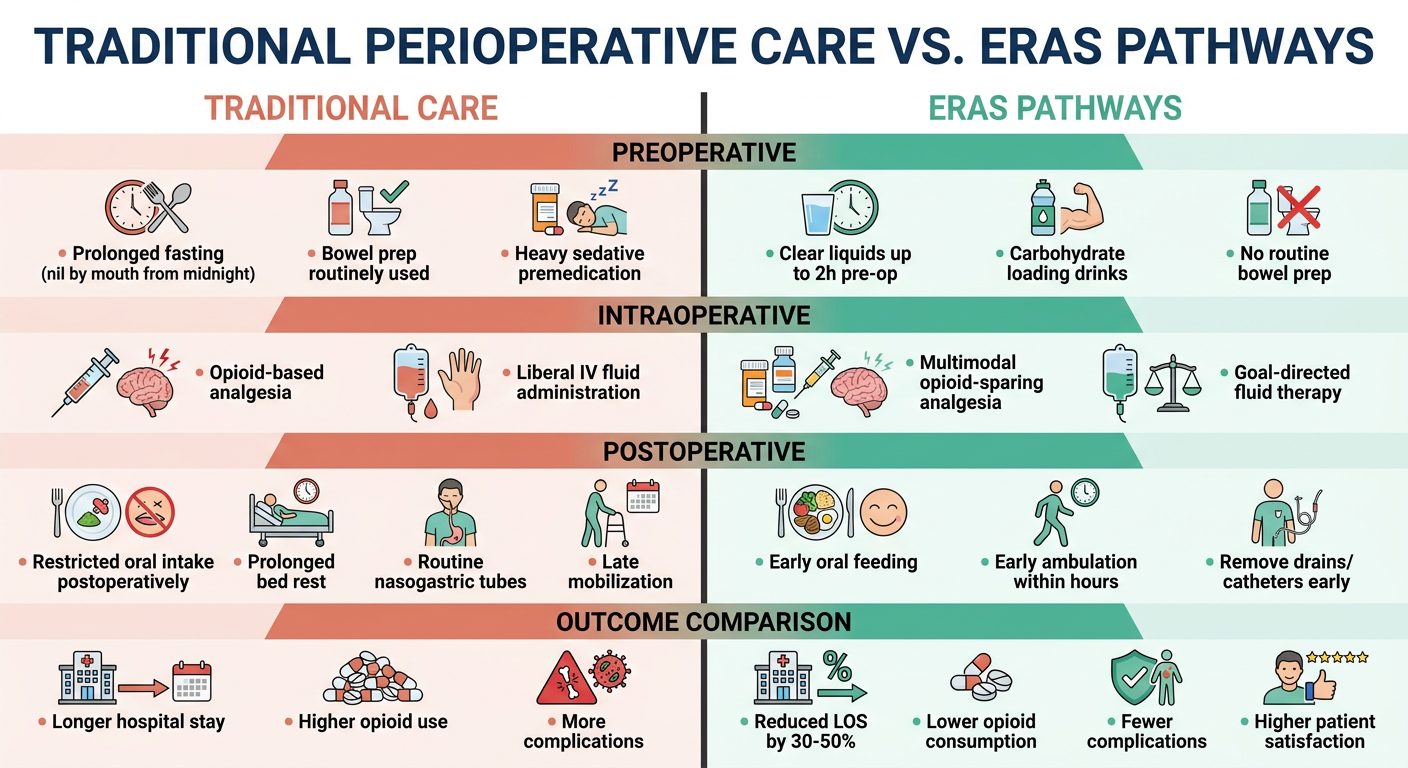
- Traditional: nil-by-mouth from midnight, routine bowel prep, heavy premedication
- ERAS: clear liquids up to 2 h pre-op, carbohydrate loading drinks, no routine bowel prep, minimal sedation
- Traditional: opioid-dominant analgesia, liberal IV fluids, general anaesthesia preferred
- ERAS: multimodal opioid-sparing analgesia, goal-directed fluid therapy, regional/local anaesthetic preference, PONV prophylaxis
- Traditional: prolonged fasting, NG tubes, restricted mobilisation, prolonged IV drips
- ERAS: early oral feeding, remove drains/catheters promptly, mobilise within hours, discontinue IV fluids early
Give ppt
Perioperative Care Seminar
Presentation · PPTX
- Preoperative Assessment - ASA classification, cardiac risk, investigations
- Medical Optimization - Diabetes, cardiac disease, frailty, nutrition
- Fluid & Electrolyte Management - Goal-directed therapy, ERAS fluid principles
- Antibiotic Prophylaxis - Timing, agents, dosing
- VTE Prophylaxis - Mechanical & pharmacological methods
- ERAS Pathways - Pre/intra/post-op components with outcomes data
- Postoperative Care & Analgesia - 'Stir up' regime, multimodal analgesia
- Postoperative Complications - SSI, anastomotic leak, POUR, pulmonary
- Special Populations - Elderly, obese, cardiac patients
- Key Takeaways + References