
Tell me everything I need to know about Frontal Bone of skull, it's all parts, features, bony landmarks, muscle attachments, nerve supply and clinicals in easy and simple wordings easier for me to understand as a 2nd year DPT student
Reading File
Now let me search the medical library for frontal bone content in parallel:
Finding Sources
Finding Sources
Now let me read the main anatomy sources in parallel:
Reading File
Reading File
Finding Sources
Reading File
Reading File
Finding Sources
Finding Sources
Finding Sources
Reading File
Reading File
Loading Image
Finding Sources
Finding Sources
I now have comprehensive information to write a thorough, student-friendly guide. Let me compile everything.
The Frontal Bone - Complete Guide for DPT Students
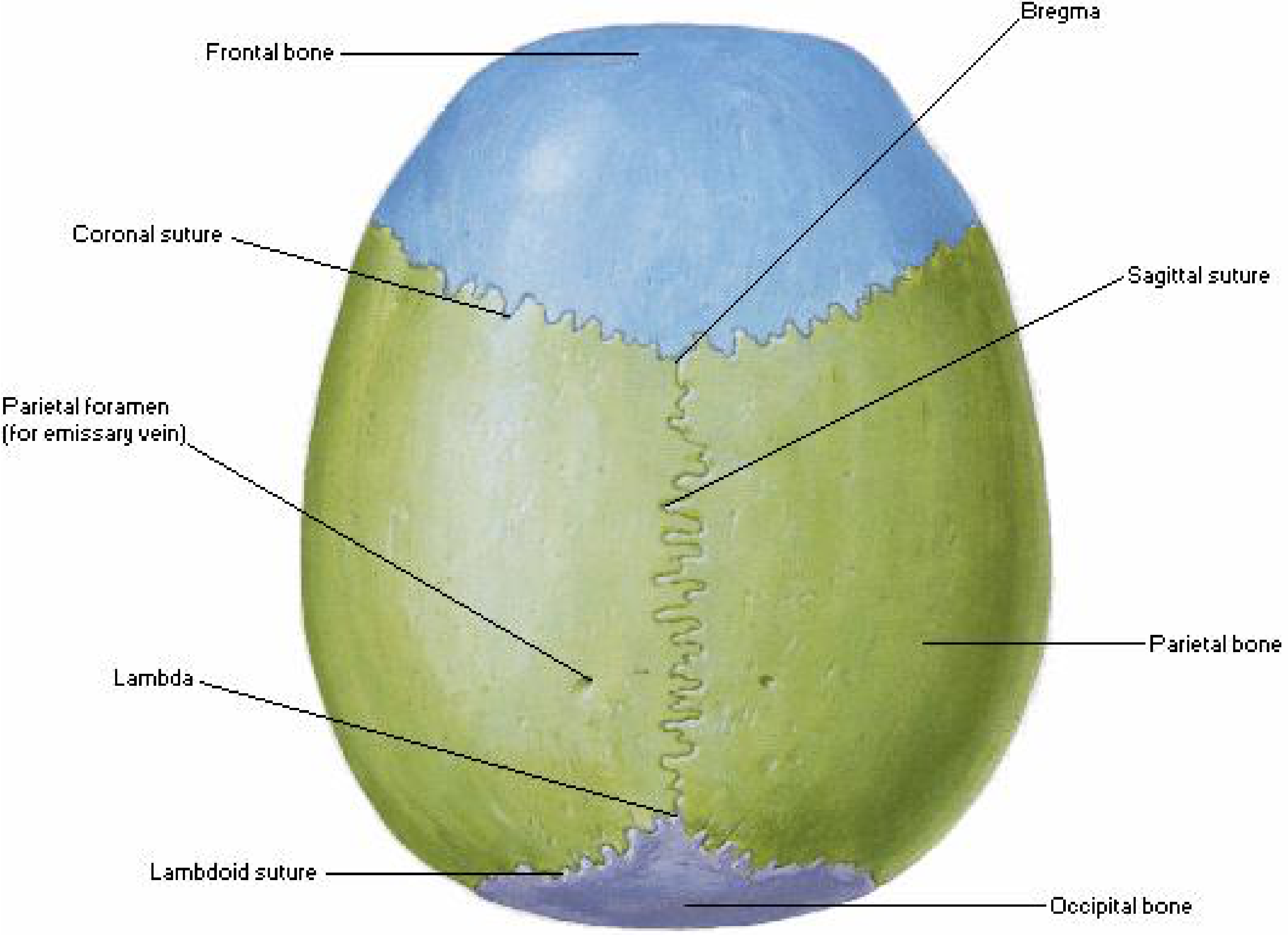
What is the Frontal Bone?
The frontal bone is a single, unpaired bone that forms:
- The forehead (the flat part of your skull above your eyes)
- The roof of both eye sockets (orbits)
- The floor of the front part of the brain cavity (anterior cranial fossa)
Think of it as a bone shaped like a shell - curved on top, flat in the middle, and dipping down over the eye sockets below.
Structure: 3 Parts of the Frontal Bone
1. Squamous Part (Vertical/Forehead Part)
- This is the large, flat, shell-shaped part - what you feel when you touch your forehead.
- It faces forward and slightly upward.
- It has both an outer surface (what you can see/touch) and an inner surface (facing the brain).
2. Orbital Part (Horizontal Part)
- Two flat, thin, horizontal plates that form the roof of the eye sockets.
- These same plates also form part of the floor of the anterior cranial fossa (where the frontal lobes of the brain sit just above them).
- Because they are thin, they can be damaged easily in trauma.
3. Nasal Part
- A small, downward-projecting notch between the two orbital plates.
- Articulates (joins) with the nasal bones and the ethmoid bone below.
Bony Landmarks (The "Features" You Need to Know)
On the Outer Surface (External):
| Landmark | What It Is | Where It Is |
|---|---|---|
| Glabella | Small smooth depression (dip) between the eyebrows | Midline, between the two superciliary arches |
| Superciliary Arches | Raised ridges above each eye socket | Above each orbit; more prominent in men than women |
| Supraorbital Margin | The curved upper rim of the eye socket | You can feel this bony edge above your eye |
| Supraorbital Foramen / Notch | A hole (or notch) in the supraorbital margin | Medial part of the supraorbital rim |
| Zygomatic Process | A downward bony projection on each side | Lower lateral edge of the frontal bone; joins the cheekbone (zygomatic bone) |
| Temporal Lines | Faint curved ridges | On the lateral surface; where temporalis muscle begins |
| Frontal Eminences / Bosses | Gentle rounded bumps on the forehead | One on each side; more noticeable in children |
| Metopic Suture (remnant) | Faint midline line | In the midline - the two halves of the frontal bone fuse here. Sometimes a visible line remains in adults. |
On the Inner Surface (Endocranial/Internal):
| Landmark | What It Is | Significance |
|---|---|---|
| Frontal Crest | A small midline ridge of bone projecting inward | Attachment point for the falx cerebri (the fold of dura mater separating the two brain halves) |
| Foramen Cecum | A small foramen between the frontal and ethmoid bones | May transmit emissary veins connecting the nasal cavity to the superior sagittal sinus |
| Groove for Superior Sagittal Sinus | A groove running up the midline | Lodges the superior sagittal sinus (a major venous drainage channel of the brain) |
Articulations (Which Bones Does the Frontal Bone Join?)
The frontal bone articulates with 8 bones total:
| Bone | Suture / Joint | Direction |
|---|---|---|
| Right & Left Parietal bones | Coronal suture | Posterior |
| Nasal bones (x2) | Frontonasal suture | Inferior |
| Maxillae (x2) | Frontomaxillary suture | Inferior |
| Ethmoid bone | Frontoethmoidal suture | Inferior |
| Lacrimal bones (x2) | Frontolacrimal suture | Inferior |
| Zygomatic bones (x2) | Zygomaticofrontal suture | Inferolateral |
| Sphenoid bone | - | Inferoposterior |
Bregma = the point where the coronal suture meets the sagittal suture (a key skull landmark)
Metopic suture = the line where the right and left halves of the frontal bone fused during childhood (usually closes by age 2, but can persist as a visible ridge in some adults - called metopism)
The Frontal Sinus
- Located inside the frontal bone, just above the root of the nose.
- Lined with mucous membrane.
- Drains into the nasal cavity via the frontonasal duct.
- It is paired but usually asymmetrical in size.
- Not present at birth - starts developing around age 2 and is fully formed by puberty.
- Clinical point: Can become infected (frontal sinusitis) and cause pain over the forehead.
Muscle Attachments
Muscles do NOT attach directly to much of the flat squamous part, but key attachments include:
| Muscle | Attachment on Frontal Bone | Action | Nerve |
|---|---|---|---|
| Frontalis (part of occipitofrontalis) | Inserts into the skin/galea aponeurotica of the forehead | Raises the eyebrows, wrinkles the forehead | Facial nerve (CN VII) - temporal branch |
| Orbicularis Oculi (orbital part) | Origin: nasal part of frontal bone + frontal process of maxilla + medial palpebral ligament | Closes eyelids forcefully | Facial nerve (CN VII) |
| Corrugator Supercilii | Origin: medial end of the superciliary arch (frontal bone) | Pulls eyebrows medially and downward (the "frowning" muscle - makes vertical wrinkle lines between brows) | Facial nerve (CN VII) - temporal branch |
| Temporalis | Origin from the temporal line on lateral surface of frontal bone | Elevates and retracts the mandible (closes mouth/chews) | Mandibular nerve (CN V3) - deep temporal nerves |
Nerve Supply to the Region
The frontal bone does not have its own nerve supply, but the region over and around it is supplied by:
Through the Supraorbital Foramen / Notch:
- Supraorbital Nerve (branch of the frontal nerve, from ophthalmic division V1 of trigeminal nerve, CN V)
- Carries sensation from: forehead skin, upper eyelid, scalp as far back as the vertex
- Exits the skull through the supraorbital foramen (or notch) at the supraorbital margin
Through the medial orbit:
- Supratrochlear Nerve (also from V1 - frontal nerve)
- Supplies the medial forehead and upper nose skin
- Exits about 1 cm lateral to the midline at the supraorbital ridge
Quick Memory Tip:
V1 (Ophthalmic division) supplies the entire forehead region. The two key branches are supraorbital and supratrochlear. Both exit near the superior orbital margin.
Key Foramina / Openings
| Foramen | Contents | Location |
|---|---|---|
| Supraorbital foramen (or notch) | Supraorbital nerve + supraorbital artery & vein | Medial part of supraorbital margin |
| Foramen cecum | Emissary veins (nasal cavity to superior sagittal sinus) | Midline, inner surface of frontal bone |
| Trochlear fovea | Attachment for the trochlea (pulley) of the superior oblique muscle of the eye | Inner surface of orbital part |
| Lacrimal fossa | Lodges the orbital part of the lacrimal gland | Lateral part of orbital roof |
Clinical Relevance (High-Yield for DPT!)
1. Frontal Bone Fractures
- The frontal bone is thick and strong - it takes high-energy trauma (car accidents, heavy blows) to fracture it.
- Because so much force is needed, frontal bone fractures are often associated with:
- Traumatic brain injury (TBI)
- Cervical spine injury (always check the neck!)
- Other facial fractures
- Ocular injuries (up to 25% of cases)
- A forehead laceration over the frontal sinus area should raise suspicion for an underlying fracture.
- CSF Rhinorrhoea (cerebrospinal fluid dripping from the nose) = fracture involving the posterior table of the frontal sinus - this is an emergency.
- Diagnosis: CT scan of the head/face.
2. Pott's Puffy Tumor
- This is NOT actually a tumor! It is a subperiosteal abscess (pus collection under the periosteum) of the frontal bone.
- Caused by osteomyelitis (bone infection) of the frontal bone, usually from frontal sinusitis spreading into the bone.
- Classic presentation: Soft, "doughy" swelling of the forehead skin - it feels squishy, not hard.
- Most common in adolescents.
- Dangerous because the infection can spread intracranially (to the brain).
3. Epidural Hematoma at the Pterion
- The pterion is the H-shaped junction where the frontal, parietal, sphenoid, and temporal bones all meet - just behind the temple.
- The bone here is very thin.
- The middle meningeal artery runs just inside this area.
- A blow to the temple = thin bone fractures = tears the artery = extradural (epidural) hematoma
- Classic presentation: "lucid interval" (patient is briefly OK after the blow, then rapidly deteriorates)
- Very important for DPT - you may see head injury patients in rehab.
4. Supraorbital Nerve Block
- The supraorbital nerve exits through the supraorbital foramen and can be blocked (injected) for pain relief in:
- Frontal headaches
- Scalp surgeries
- Trigeminal neuralgia management
- As a physiotherapist, you should know that pressure on the supraorbital notch causes forehead pain.
5. Sinusitis
- Frontal sinusitis = infection/inflammation of the frontal sinus.
- Presents with pain and tenderness when pressing over the forehead (especially the medial eyebrow area).
- Can complicate into Pott's puffy tumor or meningitis if untreated.
6. Hyperostosis Interna Frontalis
- Benign bony thickening of the inner table of the frontal bone.
- Almost exclusively in middle-aged and older women.
- Usually asymptomatic - found incidentally on X-ray or CT.
7. Hair-on-End Appearance
- In conditions like thalassemia and sickle cell disease, the diploë (spongy layer) of the frontal bone widens.
- This produces a characteristic "hair-on-end" or "sunburst" appearance on skull X-rays - most severe in the frontal bone.
Quick Summary Table
| Feature | Details |
|---|---|
| Type | Single, flat (cranial) bone |
| Parts | Squamous, orbital (x2), nasal |
| Key landmarks | Glabella, superciliary arches, supraorbital margin, frontal eminences |
| Main foramen | Supraorbital foramen - transmits supraorbital nerve + vessels |
| Inner surface | Frontal crest (falx attachment), frontal sinus, foramen cecum |
| Articulates with | Parietals (coronal suture), nasals, maxillae, ethmoid, lacrimals, zygomatics, sphenoid |
| Muscles attached | Frontalis, orbicularis oculi, corrugator supercilii, temporalis |
| Nerve supply of region | V1 (ophthalmic) - supraorbital + supratrochlear nerves |
| Key clinicals | Frontal bone fracture, Pott's puffy tumor, extradural hematoma (pterion), sinusitis |
Memory Aids
- "Forehead = Frontal" - it covers everything you see as your forehead
- "SOF carries V1" - Supraorbital Foramen carries the supraorbital nerve (V1 branch)
- "Corrugator = Corrugated iron (wavy) = the frowning wrinkle muscle"
- "Pott's puffy = pus + puffy swelling on forehead, soft and doughy"
- "Pterion = Dangerous Thin Bone = middle meningeal artery underneath"
- "Frontal crest + crista galli = two pegs holding the falx cerebri tent"
Sources: Gray's Anatomy for Students; Forensic Anthropology: A Comprehensive Introduction, 2nd Ed.; Tintinalli's Emergency Medicine; Cummings Otolaryngology Head & Neck Surgery; Harrison's Principles of Internal Medicine 22E
This is a shared conversation. Sign in to Orris to start your own chat.