
Hepatorenal syndrome management
Reading File
Now I'll search the library and PubMed in parallel for comprehensive coverage.
Finding Sources
Searching PubMed
"hepatorenal syndrome"[MeSH Terms] AND management
Excellent sources found. Now reading the most comprehensive sections in parallel.
Reading File
Reading File
Reading File
Good content from Harrison's and Sleisenger. Let me now read more of Sleisenger's detailed management section and Goldman-Cecil for additional clinical details.
Reading File
Reading File
Let me read the treatment sections from both books.
Reading File
Reading File
Excellent. Now let me also read the pathophysiology image and fetch the HRS flow diagram, plus get the TIPS and prevention sections.
Reading File
Loading Image
I now have comprehensive information. Let me compile the full management guide.
Hepatorenal Syndrome (HRS) — Management
Pathophysiology
HRS is a form of functional renal failure without renal pathology that complicates advanced cirrhosis, acute liver failure, or severe alcoholic hepatitis. The kidneys are histologically normal. The core mechanism is illustrated below:
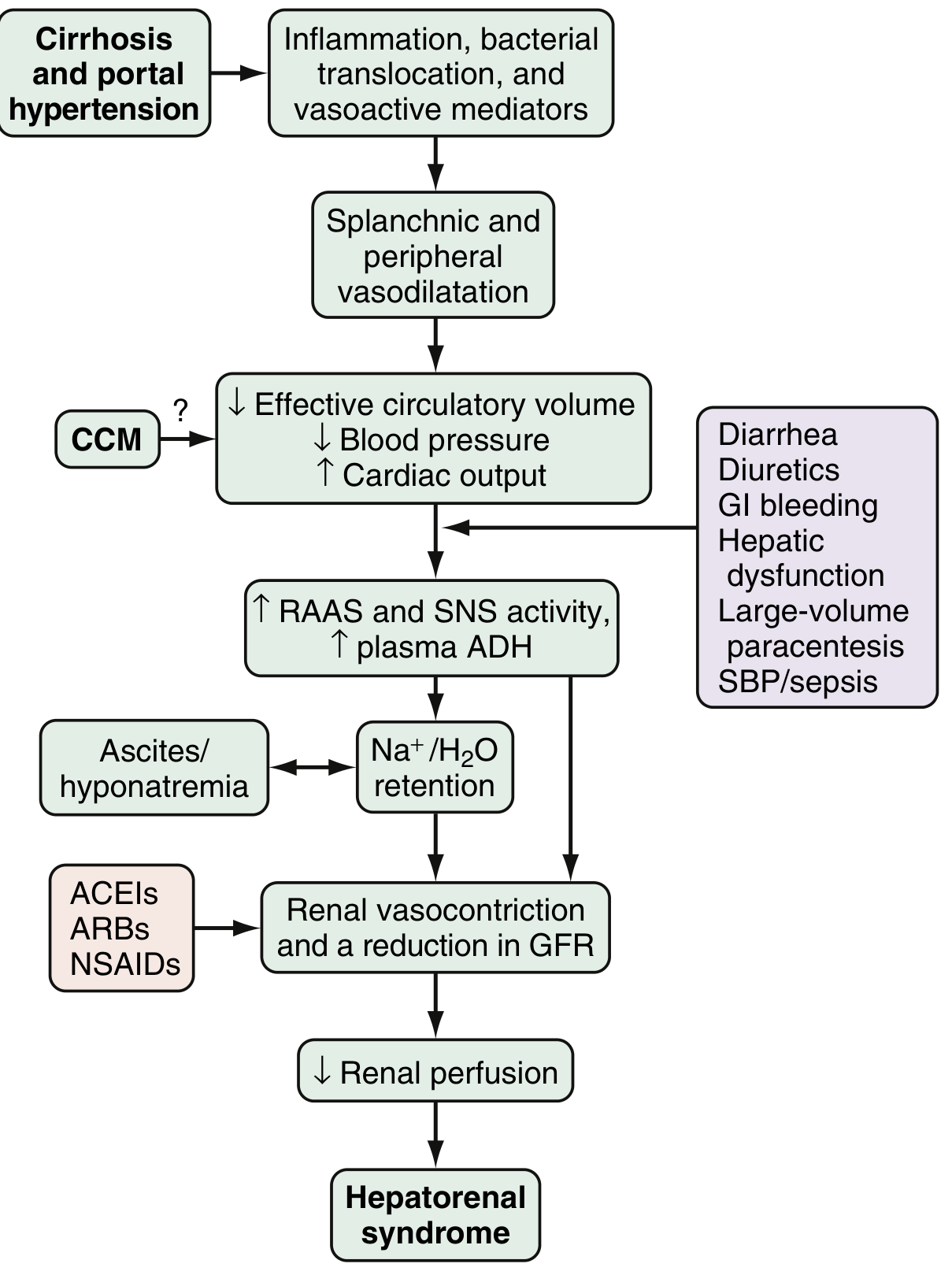
Three components drive it:
- Splanchnic arterial vasodilation (mediated by NO, CO, glucagon, prostacyclin, adrenomedullin) — the primary driver
- Compensatory renal vasoconstriction via RAAS, SNS, and ADH activation
- Cardiac dysfunction (cirrhotic cardiomyopathy further reduces effective output)
Classification (Updated Terminology)
| Old Term | New ICA Term | Characteristics |
|---|---|---|
| Type 1 HRS | HRS-AKI | Rapid, progressive AKI (≥0.3 mg/dL rise in creatinine in 48 h, or ≥50% from baseline); worse prognosis |
| Type 2 HRS | HRS-CKD | Stable, slowly progressive; GFR reduced but creatinine relatively stable; often seen with refractory ascites |
Diagnostic Criteria (ICA 2015 Revised)
All of the following must be present (Box 94.2, Sleisenger & Fordtran's):
- Cirrhosis with ascites
- AKI by ICA criteria (creatinine rise ≥0.3 mg/dL in 48 h OR ≥50% from baseline)
- No response after ≥48 hours of diuretic withdrawal + IV albumin 1 g/kg/day (max 100 g/day)
- Absence of shock
- No current/recent nephrotoxic drugs
- No parenchymal renal disease (proteinuria <500 mg/day, no microhematuria >50 RBC/hpf, normal renal ultrasound)
Key point: Urine output criteria are NOT used in cirrhotic patients because they are frequently oliguric at baseline due to sodium retention.
Management
Step 1 — Identify and Remove Precipitants
Before diagnosing HRS, actively exclude and treat:
- SBP/sepsis (present in ~30% preceding HRS; treat with antibiotics ± albumin)
- Volume depletion — overdiuresis, GI hemorrhage, diarrhea (lactulose overdose)
- Nephrotoxins — NSAIDs, aminoglycosides, contrast agents
- Vasodilators — ACEIs, ARBs
Diuretics must be stopped immediately on suspicion of HRS.
Step 2 — Volume Expansion with Albumin
- IV albumin 1 g/kg/day (max 100 g/day) for 48 hours
- Serves both as a volume expander and to bind circulating vasoactive mediators
- Lack of response after 48 h is required to confirm HRS diagnosis
Step 3 — Vasoconstrictors (First-Line Treatment)
The goal is to counteract splanchnic vasodilation and improve effective circulating volume, thereby relieving renal vasoconstriction. All regimens are combined with IV albumin.
🥇 Terlipressin + Albumin (First-Line, where available)
- Selective vasopressin V1 receptor agonist; IV bolus or continuous infusion
- Continuous infusion is better tolerated and effective at lower doses than bolus dosing
- Two pivotal RCTs (OT-0401 and REVERSE trials): terlipressin + albumin reversed HRS in 27% vs. 14% with albumin alone (P = 0.004)
- Creatinine improvement: 30–43% vs. 8–13% with albumin alone
- Response is better with lower baseline creatinine and lower bilirubin — supports early initiation
- Dosing (Box 94.3): bolus 0.5–2 mg IV q4–6h; or infusion 2–12 mg/day
- Adverse effects: cardiovascular complications (ischemia, arrhythmia) — close monitoring required; respiratory failure in ACLF patients
🥈 Norepinephrine + Albumin (Alternative, ICU setting)
- IV α1-agonist; requires ICU monitoring
- Two small RCTs: equal efficacy and safety to terlipressin
- Response rates 40–75%; relapse ~20%
- Significant cardiovascular side effects reported
- Preferred in ICU when terlipressin is unavailable
🥉 Midodrine + Octreotide + Albumin (Third-Line, USA)
- Midodrine: oral α1-agonist (titrated to ↑MAP); Octreotide: somatostatin analog (inhibits endogenous vasodilators)
- Easier to administer (oral midodrine); favorable safety profile
- Head-to-head RCT vs. terlipressin: renal recovery 28.6% vs. 70.4% (P = 0.01) — significantly inferior to terlipressin
- Used most commonly in the US where terlipressin availability has been limited, but now classified as third-line
- Dosing: Midodrine 7.5–15 mg PO TID; Octreotide 100–200 mcg SC TID; Albumin 20–40 g/day IV
Step 4 — Renal Replacement Therapy
- Initiated when pharmacologic therapy fails
- Bridge to liver transplantation, not a definitive treatment
- Does not improve underlying pathophysiology
Step 5 — TIPS (Transjugular Intrahepatic Portosystemic Shunt)
- Reduces portal hypertension, improving splanchnic hemodynamics
- Limited data in HRS specifically; more evidence in refractory ascites
- Contraindicated in advanced hepatic encephalopathy, severe hepatic insufficiency (bilirubin >5 mg/dL), MELD >18 in most protocols
Step 6 — Liver Transplantation (Definitive Therapy)
- Best and only curative treatment for HRS
- Recovery of renal function is typical post-transplant in HRS (kidneys are histologically normal)
- Pre-transplant treatment with vasoconstrictors may improve candidacy and bridge to transplant
- For HRS-CKD: simultaneous liver-kidney transplantation (SLKT) may be considered
- In both HRS-AKI and HRS-CKD, prognosis is poor without transplant
Prevention
| Trigger | Preventive Strategy |
|---|---|
| SBP | IV albumin 1.5 g/kg at diagnosis + 1 g/kg on day 3 |
| Large-volume paracentesis (>5 L) | IV albumin 6–8 g per liter removed |
| Primary prophylaxis in cirrhosis | Norfloxacin 400 mg/day (long-term) in advanced cirrhosis with low-protein ascites |
| Variceal bleeding | Antibiotics (ceftriaxone 1 g/day) + octreotide/terlipressin |
Prognosis
- HRS-AKI (Type 1): median survival without treatment is 2–4 weeks; with terlipressin bridge to transplant, outcomes improve substantially
- HRS-CKD (Type 2): median survival ~6 months
- HRS reversal with vasoconstrictors does not significantly improve overall survival unless transplantation is achieved
Recent Evidence
A 2024 systematic review and meta-analysis (PMID: 38285703) comparing terlipressin vs. norepinephrine for HRS-AKI confirmed broadly similar efficacy between the two agents, supporting norepinephrine as a reasonable terlipressin alternative. A 2026 meta-analysis (PMID: 41853888) found that continuous infusion terlipressin is preferred over bolus dosing for both variceal bleeding and HRS due to better tolerability and efficacy at lower doses.
Sources: Harrison's Principles of Internal Medicine 22E, p. HRS chapter; Sleisenger & Fordtran's Gastrointestinal and Liver Disease, Ch. 94; Goldman-Cecil Medicine, Ch. 139.
This is a shared conversation. Sign in to Orris to start your own chat.