
Insulin types and appropriate type of insulin with dose for different patients
Reading File
Now let me search the medical library for insulin types and dosing in parallel.
Finding Sources
Finding Sources
Finding Sources
Excellent sources found. Let me read from multiple authoritative textbooks in parallel.
Reading File
Reading File
Reading File
Reading File
Excellent content retrieved. Now let me get the clinical dosing per patient type and fetch the insulin action profile image.
Reading File
Reading File
Loading Image
Now let me get the special population dosing - pregnancy, pediatric, renal failure, and T2DM initiation protocols.
Finding Sources
Finding Sources
Finding Sources
Reading File
Reading File
I now have comprehensive information from multiple authoritative sources. Let me compile the full, well-organized answer.
Insulin Types and Clinical Dosing Guide
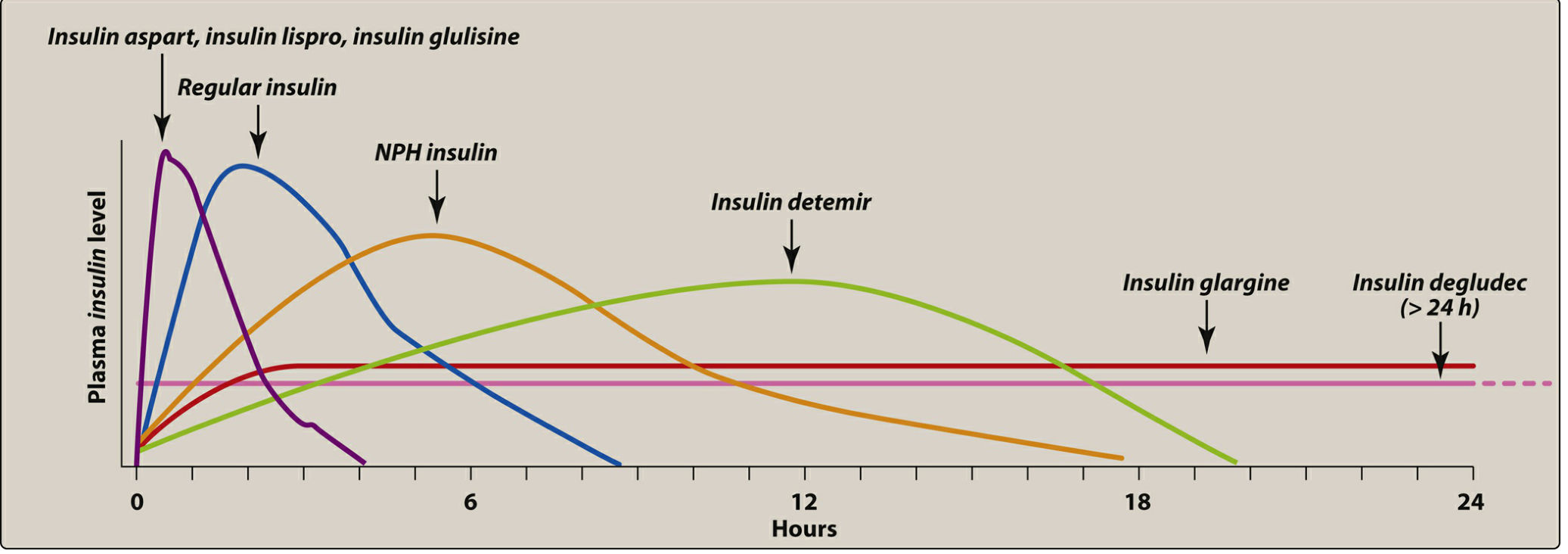
Figure: Plasma insulin levels over 24 hours for all major insulin types. (Lippincott Illustrated Reviews Pharmacology)
1. Classification of Insulin Types
Rapid-Acting Analogs (Prandial)
| Insulin | Brand Names | Onset | Peak | Duration |
|---|---|---|---|---|
| Insulin lispro | Humalog, Lyumjev | 5-15 min | 1-1.5 h | 3-4 h |
| Insulin aspart | Novolog, Fiasp | 5-15 min | 1-1.5 h | 3-4 h |
| Insulin glulisine | Apidra | 5-15 min | 1-1.5 h | 3-4 h |
| Inhaled insulin | Afrezza | 5-15 min | 1 h | ~3 h |
Administration: Inject 15 min before a meal, or within 15-20 min after starting a meal. Suitable for insulin pumps and IV when needed.
Short-Acting ("Regular") Insulin
| Insulin | Onset | Peak | Duration |
|---|---|---|---|
| Human Regular (U100) | 30-60 min | 2-4 h | 6-8 h |
| Regular U500 (concentrated) | 30-60 min | 2-4 h | 6-8 h |
Administration: Inject subcutaneously 30 min before a meal. Regular insulin is the preferred form for IV infusion (DKA, surgical protocols).
Intermediate-Acting (Basal)
| Insulin | Onset | Peak | Duration |
|---|---|---|---|
| NPH (Neutral Protamine Hagedorn) | 2-4 h | 6-10 h | 10-20 h |
Formed by adding zinc and protamine to regular insulin - less soluble, slower absorption. Never give IV. Used for basal fasting glucose control.
Long-Acting Analogs (Basal - Peakless)
| Insulin | Onset | Peak | Duration |
|---|---|---|---|
| Glargine U100 (Lantus, Basaglar) | 1.5-2 h | Flat/Peakless | 16-20 h |
| Glargine U300 (Toujeo) | 1.5-2 h | Flat/Peakless | 30-36 h |
| Detemir (Levemir) | 1.5-2 h | Flat/Peakless | 16-17 h |
| Degludec U100/U200 (Tresiba) | 1.5 h | Flat/Peakless | >42 h |
- Glargine cannot be mixed with short-acting insulins (acidic pH).
- Degludec's ultra-long duration allows flexible once-daily dosing.
- Detemir may require twice-daily dosing in some T1DM patients.
Premixed Combinations
Fixed combinations of rapid/short + intermediate insulin (e.g., 70/30 NPH/Regular, 75/25 NPH/Lispro). Onset <0.25-1 h, duration up to 10-16 h. Less flexible but useful where regimen simplicity is needed.
(Katzung's Basic and Clinical Pharmacology, 16th Ed., p. 1177-1178; Goldman-Cecil Medicine, Table 210-4)
2. Insulin Dosing by Patient Type
Type 1 Diabetes (T1DM) - Adults
- Total daily dose (TDD): 0.3-1.0 units/kg/day (typically 0.4-0.7 units/kg/day in a mixed population)
- Basal: 40-50% of TDD as long-acting insulin (glargine, detemir, or degludec) once daily
- Prandial boluses: Remaining 50-60% divided before each meal using rapid-acting analog (lispro, aspart, or glulisine)
- Correction dose: 1 unit lowers glucose ~20-50 mg/dL (individualized)
- Insulin-to-carbohydrate ratio: typically 1 unit per 10-15 g of carbohydrate
Standard Basal-Bolus Regimen:
Glargine once daily (evening) + rapid-acting analog before each meal (3 injections/day) = "Multiple Daily Injection" (MDI) regimen
(Goodman & Gilman's Pharmacological Basis of Therapeutics, p. 1053; Goldman-Cecil Medicine, p. 2474)
Type 2 Diabetes (T2DM) - Initiating Insulin
Step 1: Start with Basal Insulin
- Begin with 10 units at bedtime (9 PM) + continue oral agents (especially metformin)
- Titrate by +1 unit/day until fasting glucose ≤110 mg/dL (Canadian INSIGHT protocol)
- Or increase by +3 units every 3 days if fasting glucose >110 mg/dL (PREDICTIVE 303 protocol)
Obese/Insulin-Resistant Patients:
- Start at 0.4 units/kg at bedtime
- Titrate +5 units each Monday, up to max 60 units
- If >60 units needed, add prandial insulin ("basal-plus") or reduce basal 20% + add GLP-1 agonist
Step 2: Add Prandial Insulin when:
- A1C remains >7% despite optimized basal + fasting glucose <100 mg/dL
- Basal dose has exceeded 60 units/day
- Repeated nocturnal hypoglycemia on basal titration
- BeAM factor (bedtime minus AM glucose) >55 mg/dL
Step 3: Full Basal-Bolus Regimen
- Basal (glargine) + prandial rapid-acting analog at all 3 meals
- Approximately 60% of T2DM patients achieve A1C ≤7% with basal insulin + oral agents alone
(Textbook of Family Medicine 9e, p. 1581-1590)
Gestational Diabetes / Pregnancy (GDM)
- Start: When diet and exercise fail to achieve euglycemia
- Total dose: 0.7-1.0 units/kg/day in divided doses
- Morning dose (2/3 of TDD): 1/3 Regular + 2/3 NPH (before breakfast)
- Evening dose (1/3 of TDD): 1/2 Regular + 1/2 NPH (before dinner)
- Targets: Fasting <95 mg/dL; 1-hour post-meal <140 mg/dL; 2-hour post-meal <120 mg/dL
- Insulin requirements increase with advancing gestation - review weekly
Note: Long-acting analogs (glargine, detemir) are increasingly used in pregnancy but NPH remains the most studied. Oral agents are generally avoided in GDM due to limited safety data.
(Goldman-Cecil Medicine, p. 3595)
Diabetic Ketoacidosis (DKA) / Severe Hyperglycemia
- IV Regular insulin preferred: 0.1 units/kg/hour continuous infusion
- Blood glucose falls ~10% per hour
- Acidosis corrects more slowly than hyperglycemia
- When glucose reaches ~200-250 mg/dL, reduce drip and add dextrose to IV fluids
- Transition to subcutaneous: overlap IV + SC for 1-2 hours before stopping IV to avoid rebound hyperglycemia
(Goodman & Gilman's, p. 1053)
Perioperative/Hospitalized Patients
- Hold oral agents; use insulin for glycemic control
- Use basal-bolus regimen or sliding scale with regular/rapid insulin
- At ICU discharge or when eating resumes: restart usual subcutaneous regimen with 1-2 hour overlap before stopping IV insulin
- Target glucose: 140-180 mg/dL (non-ICU); 140-180 mg/dL (ICU) per most guidelines
Insulin Pump (CSII - Continuous Subcutaneous Insulin Infusion)
- Uses only rapid-acting analog (lispro, aspart, or glulisine)
- Delivers programmable basal rates throughout the day + manual meal boluses
- Achieves the most physiologic insulin profile (see Panel C in Goodman & Gilman's Fig. 51-8)
- Preferred in T1DM patients with hypoglycemia unawareness or variable schedules
3. Key Practical Notes
| Consideration | Guidance |
|---|---|
| Lipohypertrophy | Rotate injection sites to prevent accumulation; can impair absorption |
| Hypoglycemia | Major risk of insulin treatment; educate patients on recognition and treatment |
| Weight gain | All insulin therapy causes modest weight gain |
| Mixing insulins | Only NPH + Regular/rapid analog can be mixed; glargine/detemir/degludec cannot |
| Concentrated forms | U200, U300, U500 available for insulin-resistant/high-dose patients |
| Renal impairment | Insulin clearance is reduced in CKD - doses typically need reduction; monitor closely |
| Monitoring | SMBG (4x/day: fasting + after each meal) or CGM guides titration |
Sources:
- Katzung's Basic and Clinical Pharmacology, 16th Ed. - Tables 41-5, 41-6
- Goldman-Cecil Medicine International Edition - Table 210-4
- Goodman & Gilman's Pharmacological Basis of Therapeutics - Tables 51-3, 51-4
- Lippincott Illustrated Reviews: Pharmacology - Chapter 24
- Textbook of Family Medicine, 9th Ed. - Chapter 34
- Goldman-Cecil Medicine - Pregnancy and Diabetes, Chapter 221
This is a shared conversation. Sign in to Orris to start your own chat.